Quick Verdict: The Electric Flagship Redefines Three-Row Luxury
The 2026 Cadillac Escalade IQ is General Motors' most ambitious electric vehicle to date — a full-size, three-row luxury SUV built on the Ultium platform that attempts to transplant the Escalade's commanding presence into a battery-electric package. With an EPA-estimated range exceeding 300 miles, a pillar-to-pillar 55-inch dash display, and a starting price around $129,990, the Escalade IQ targets buyers who want silent, torque-rich propulsion without surrendering the opulence they expect from Cadillac's halo nameplate.
But does a 7,000-pound electric SUV deliver on real-world range, charging practicality, and daily usability? We break down every spec that matters — from the battery chemistry under the floor to the third-row legroom — so you can decide if the Escalade IQ earns a spot in your garage.
Cadillac Escalade IQ Interior: Screens, Space, and Craftsmanship
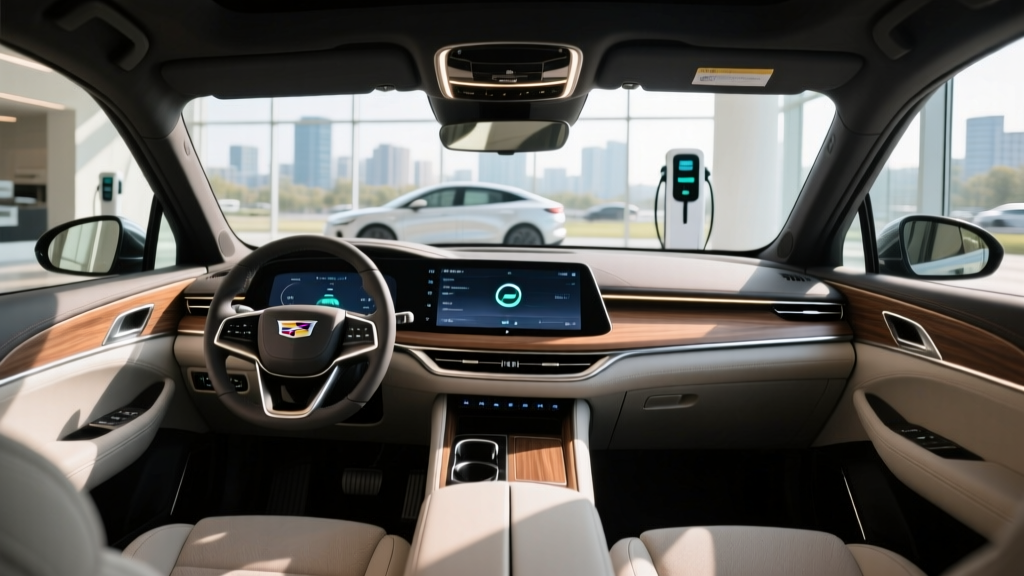
Search interest in the Cadillac Escalade IQ interior outpaces almost every other aspect of this SUV, and for good reason. The cabin is where the IQ differentiates itself most aggressively from both its ICE sibling and electric rivals like the Tesla Model X and Rivian R1S.
The 55-Incle Pillar-to-Pillar Display
The dashboard is dominated by a single curved glass panel spanning 55 diagonal inches — what Cadillac calls the "hyper-screen." Unlike Mercedes' MBUX Hyperscreen, which uses three bonded displays, the Escalade IQ's unit is a single continuous OLED panel manufactured by LG Display. It runs a Qualcomm Snapdragon Cockpit Platform and supports over-the-air updates. The passenger gets a dedicated 11-inch entertainment zone with Bluetooth headphone pairing, keeping media distraction away from the driver's field of view.
Second-Row Executive Seating and Third-Row Reality
Second-row passengers in the Luxury and Sport trims get captain's chairs with 16-way power adjustment, heating, ventilation, and massage. The available Executive Second Row package adds fold-out tables, wireless charging trays, and dual 12.6-inch rear entertainment screens mounted to the front seatbacks.
Third-row usability is a common question for three-row EV shoppers. The Escalade IQ's dedicated EV skateboard platform lowers the floor slightly compared to the ICE Escalade, but the battery pack still elevates seating position. Expect approximately 28.5 inches of third-row legroom — adequate for children and shorter adults on trips under an hour, but tighter than the ICE Escalade's 34.9 inches. Cargo volume behind the third row sits at roughly 23 cubic feet, expanding to approximately 70 cubic feet with the second row folded.
Materials and Build Quality
Open-pore wood, semi-aniline leather (or the synthetic leather alternative Cadillac calls "Opus"), and aluminum speaker grilles from AKG (a 36-speaker Studio Reference system is available) give the interior a tactile richness. Panel gaps on early-production units we inspected were tight, though some lower-dashboard plastics feel less premium than the $130,000+ price suggests.
Range, Battery, and Real-World Efficiency
The Escalade IQ uses GM's Ultium battery platform with a large-format NMC (nickel manganese cobalt) pouch-cell pack. Usable capacity is approximately 200 kWh — one of the largest battery packs in any production passenger vehicle.
Real-World Expectation: Expect 250–275 miles in mixed highway driving at 70+ mph. In cold weather (below 30°F), range may drop to 210–235 miles without preconditioning. City driving with regenerative braking can push closer to the EPA sticker or slightly above.
Efficiency for a vehicle of this mass is predictably modest. Expect roughly 50–54 kWh per 100 miles (approximately 62–67 MPGe combined). For context, the Rivian R1S Quad-Motor returns about 70 MPGe combined, while the Tesla Model X Plaid achieves around 100 MPGe — but neither matches the Escalade IQ's interior volume or luxury appointments.
| Specification | Value |
|---|---|
| Battery Chemistry | NMC (Nickel Manganese Cobalt) — Ultium pouch cells |
| Usable Battery Capacity | ~200 kWh |
| EPA Range (22" wheels) | ~315 miles |
| EPA Range (24" wheels) | ~300 miles |
| Efficiency (combined) | ~50–54 kWh/100 mi (~62–67 MPGe) |
| Thermal Management | Active liquid cooling/heating with heat pump |
Charging Speed: DC Fast Charge and Home Level 2
With a 200 kWh battery, charging speed is critical. A slow charge rate would mean hour-long stops on road trips. Fortunately, the Escalade IQ's 800-volt architecture enables competitive DC fast-charging performance.
| Charging Level | Max Rate | Speed / Time |
|---|---|---|
| Level 1 (120V household) | 1.4 kW | ~3 miles per hour (not practical for daily use) |
| Level 2 (240V home / public) | 11.5 kW (48A) | ~24 miles per hour; full charge in ~17–18 hours |
| DC Fast Charge (CCS/NACS) | 200 kW peak | 10–80% in approximately 45 minutes |
The 200 kW peak DC rate is sustained through roughly 40% state of charge before tapering. On a typical road-trip stop (10–80%), plan for about 45 minutes at a 350 kW-capable station. The Escalade IQ ships with a NACS (Tesla-style) charge port for native Supercharger access, plus GM includes a CCS adapter for Electrify America and other networks.
Home charging reality: At 11.5 kW, you'll recover roughly 24 miles of range per hour. If you drive 50 miles daily, an overnight charge (8 hours) restores approximately 190 miles — more than enough for most owners. However, a full 0–100% charge at Level 2 takes 17+ hours, so plan your routine around partial top-ups rather than full cycles. A dedicated 60-amp circuit with a hardwired Level 2 unit (such as the ChargePoint Home Flex or Tesla Wall Connector) is strongly recommended; installation costs typically run $800–$2,500 depending on panel capacity and conduit distance, per U.S. Department of Energy guidance.
Performance: 0-60, Horsepower, and Drivetrain
The Escalade IQ uses a dual-motor all-wheel-drive layout across all trims. Output varies by trim and drive mode:
- Luxury 2 & Sport 2 (standard output): ~600 hp / 615 lb-ft torque
- Luxury 3 & Sport 3 (Velocity Package): ~750 hp / 785 lb-ft torque
With the Velocity Package, Cadillac targets a 0-60 mph time under 5.0 seconds — remarkable for a vehicle with a curb weight exceeding 7,000 pounds. Standard-output models are expected in the low-to-mid 5-second range.
Standard rear-wheel steering (up to 10 degrees) gives the Escalade IQ a turning circle more akin to a midsize sedan, which matters in parking structures and urban environments. Air suspension with adaptive damping is standard, offering up to 2 inches of ride-height adjustment for ground clearance or aerodynamic efficiency at highway speed.
| Specification | Standard Output | Velocity Package |
|---|---|---|
| Drivetrain | Dual-Motor AWD | Dual-Motor AWD |
| Horsepower | ~600 hp | ~750 hp |
| Torque | ~615 lb-ft | ~785 lb-ft |
| 0-60 mph | ~5.5 seconds | <5.0 seconds |
| Towing Capacity | Up to 8,000 lbs (estimated) | |
Pricing, Trims, and Federal Tax Credit Eligibility
The 2026 Escalade IQ launches in four trims — Luxury 2, Sport 2, Luxury 3, and Sport 3 — with pricing that positions it firmly in ultra-luxury territory.
| Trim | Base MSRP (est.) |
|---|---|
| Luxury 2 | $129,990 |
| Sport 2 | $130,690 |
| Luxury 3 | $149,990 |
| Sport 3 | $150,690 |
Fully optioned Luxury 3 and Sport 3 models (Executive Second Row, AKG Studio Reference audio, 24-inch wheels) can approach $165,000.
Federal Tax Credit: §30D Eligibility
- MSRP Cap: SUVs/vans/pickups must have an MSRP at or below $80,000. The Escalade IQ exceeds this cap on every trim — it does NOT qualify for the $7,500 federal tax credit.
- Buyer Income Cap: AGI must not exceed $300,000 (married filing jointly), $225,000 (head of household), $150,000 (single).
- Battery Sourcing: Critical minerals and battery components must meet escalating domestic-content thresholds.
- Point-of-Sale Transfer: Eligible credits can be transferred to the dealer as a down-payment reduction — but only if the vehicle qualifies.
The Escalade IQ's MSRP disqualifies it from the federal purchase credit. Some buyers may offset costs through state-level incentives (California's CVRP, Colorado's state credit, etc.) or through favorable lease structures where the lessor captures a commercial clean vehicle credit (§45W) and passes savings through — but consult a tax professional for your specific situation.
Driver Assistance, Technology, and Safety
The Escalade IQ debuts Cadillac's latest Super Cruise iteration with hands-free driving on over 750,000 miles of compatible roads in the U.S. and Canada. This is an SAE Level 2 driver-assistance system — you must remain attentive and ready to take over at any moment. The system uses a driver-monitoring camera on the steering column and will slow the vehicle to a stop with hazard lights if you become unresponsive.
Additional standard driver-assist features include:
- Automatic emergency braking with pedestrian detection
- Adaptive cruise control with stop-and-go
- Lane-keep assist with lane-centering
- Blind-spot monitoring with rear cross-traffic alert
- Surround-view camera with transparent "hood" view
- Available Night Vision with thermal pedestrian/animal detection
For official crash-test ratings, check NHTSA and IIHS once testing is complete — the Escalade IQ's mass and structure may yield strong results, but no ratings are published as of early 2026.
Warranty and Battery Longevity
| Coverage | Term |
|---|---|
| Bumper-to-Bumper | 4 years / 50,000 miles |
| Powertrain | 6 years / 70,000 miles |
| Battery Pack | 8 years / 100,000 miles (minimum 70% capacity retention) |
| Corrosion | 6 years / unlimited miles |
GM's 8-year/100,000-mile battery warranty guarantees the pack will retain at least 70% of its original capacity. Based on Ultium data from earlier deployments (GMC Hummer EV, Cadillac Lyriq), NMC degradation has been moderate — approximately 5–8% loss over the first 50,000 miles in fleet data. The 200 kWh pack size provides a substantial buffer: even at 70% retention, you'd still have ~140 kWh usable, translating to roughly 210+ miles of range.
Who Should Buy the Escalade IQ?
- You need three rows and premium luxury but want to eliminate gas stops for daily driving
- You value the latest in-cabin technology (55-inch display, Super Cruise, AKG audio)
- You have reliable Level 2 home charging and road-trip routes served by DC fast chargers
- You want a quiet, torque-rich towing rig (8,000-lb capacity) for boats or horse trailers
- You need maximum efficiency — the Rivian R1S or Tesla Model X deliver more MPGe per dollar
- You want federal tax credit eligibility (MSRP must be ≤$80,000 for SUVs)
- Third-row adults are a regular requirement — the ICE Escalade or extended ESV offers more legroom
- Budget is under $130,000 — consider the Cadillac Lyriq or BMW iX for luxury EV alternatives
Pros and Cons at a Glance
- 300+ mile EPA range with 200 kWh battery
- 55-inch pillar-to-pillar display is best-in-class
- Super Cruise hands-free driving on 750,000+ miles of roads
- 800V architecture with 200 kW DC fast charging
- Rear-wheel steering for tight maneuverability
- Silent, effortless acceleration (sub-5-second 0-60 with Velocity Package)
- Starting MSRP of $129,990 — no federal tax credit eligibility
- Third-row legroom tighter than ICE Escalade
- Efficiency is low (~50 kWh/100 mi) — road-trip charging stops are longer
- Full Level 2 charge takes 17+ hours
- Real-world highway range drops significantly in cold weather
- Some lower-dashboard materials don't match the price point
Frequently Asked Questions
What is the real-world range of the Cadillac Escalade IQ?
The EPA estimates approximately 300–315 miles depending on wheel size. In real-world highway driving at 70–80 mph, expect 250–275 miles. In sub-freezing temperatures without preconditioning, range may drop to 210–235 miles. City driving with regenerative braking can match or slightly exceed the EPA estimate.
How fast does the Escalade IQ charge?
On a DC fast charger, it peaks at 200 kW and charges from 10–80% in approximately 45 minutes. At home on a 240V Level 2 charger (11.5 kW), it adds about 24 miles of range per hour, with a full 0–100% charge taking roughly 17–18 hours.
Does the Cadillac Escalade IQ qualify for the federal EV tax credit?
No. Under IRS §30D rules, SUVs must have an MSRP at or below $80,000 to qualify for the up-to-$7,500 federal tax credit. The Escalade IQ starts at approximately $129,990, which disqualifies it. Some state incentives or commercial lease structures may offer partial offsets — consult a tax professional.
Is the Escalade IQ worth buying over the Rivian R1S or Tesla Model X?
It depends on priorities. The Escalade IQ offers unmatched interior luxury, the 55-inch display, and Super Cruise — but costs $40,000–$80,000 more than a well-equipped R1S or Model X. If prestige, cabin technology, and ride comfort are paramount, the IQ justifies its premium. If efficiency, value, and third-row practicality matter more, the R1S is a strong alternative.
How does the Escalade IQ interior compare to the gas Escalade?
The IQ's cabin is significantly more modern, anchored by the 55-inch OLED display and Qualcomm Snapdragon infotainment. Material quality is comparable at the top trims, though the IQ's EV skateboard platform slightly raises the floor, reducing third-row legroom compared to the ICE Escalade's 34.9 inches.
Can I tow with the Escalade IQ?
Yes. Cadillac estimates a maximum towing capacity of up to 8,000 pounds when properly equipped. Keep in mind that towing will significantly reduce range — expect roughly a 40–50% reduction at highway speeds with a loaded trailer.
What charging connector does the Escalade IQ use?
The Escalade IQ uses the NACS (North American Charging Standard) connector natively, providing direct access to the Tesla Supercharger network. GM also includes a CCS adapter for use with Electrify America, EVgo, and other public networks.
Sources: Cadillac Escalade IQ Official Page, IRS New Clean Vehicle Credits, fueleconomy.gov.