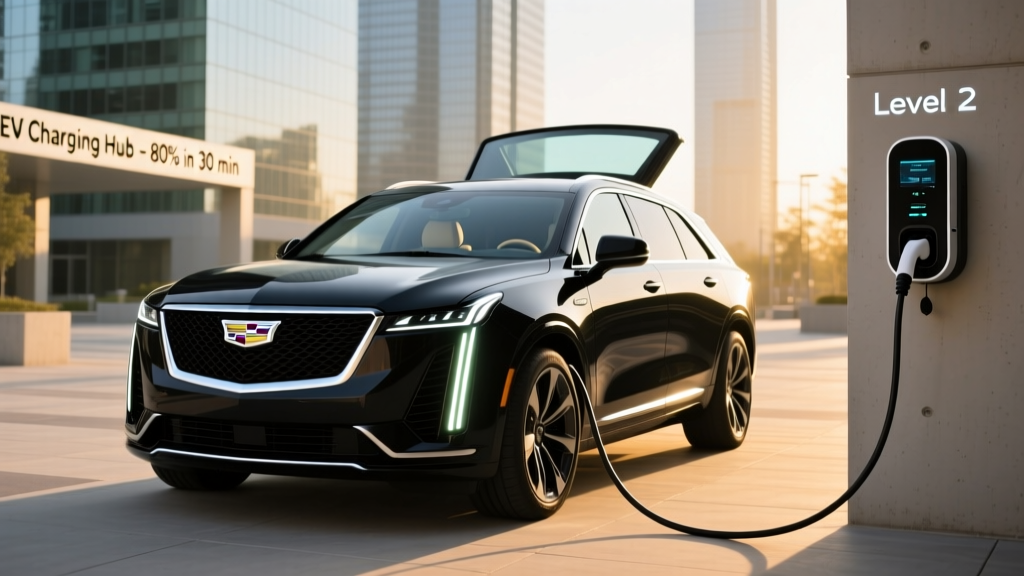
If you're researching the Cadillac Escalade electric 2026 model year — officially named the Escalade IQ — here's the direct answer: it's a luxury three-row electric SUV built on GM's Ultium platform, priced from roughly $129,990 (including destination), offering an EPA-estimated 460 miles of range on the Luxury trim with the larger battery pack, 536 horsepower standard (up to 785 hp with Velocity Max), and DC fast charging up to 350 kW capable of adding approximately 100 miles of range in 10 minutes. It qualifies for no federal §30D tax credit at purchase because its MSRP far exceeds the $80,000 SUV cap. This guide breaks down what ownership actually looks like — real-world range, charging logistics, cost versus a gas Escalade, and who should (and shouldn't) make the switch.
Quick Verdict: 2026 Cadillac Escalade IQ
Base Price: ~$129,990 (Luxury) / ~$149,990 (Sport) — no federal tax credit applies due to MSRP cap.
EPA Range: Up to 460 miles (200 kWh+ usable battery, LMR/NMC Ultium chemistry).
Best For: Luxury SUV buyers with reliable home Level 2 charging who want three-row EV space and flagship tech.
Think Twice If: You lack overnight charging access, frequently tow heavy loads in cold climates, or need federal incentive offsets.
Range, Battery, and Real-World Expectations
The Escalade IQ uses GM's Ultium battery architecture with an estimated 200+ kWh of usable capacity (exact GM-confirmed figure pending final EPA certification). The cell chemistry is a nickel-cobalt-manganese (NCM) variant with GM's low-cobalt cathode, prioritizing energy density for maximum range in a heavy vehicle.
Range Reality Check
EPA Estimate: 460 miles (Luxury trim, 22-inch wheels).
Real-World Highway (70-80 mph): Expect ~340–380 miles. Aerodynamic drag dominates at speed in a boxy 8,000+ lb SUV.
Cold Weather (below 30°F): Plan for ~280–330 miles — battery resistance and cabin heating cut usable capacity 25-35%.
Towing (5,000 lb trailer): Range can drop below 200 miles depending on terrain and speed.
GM's official Escalade IQ page highlights the 460-mile figure, but as with any full-size SUV, your actual mileage depends heavily on driving style, temperature, and wheel selection. The 23-inch wheel option on the Sport trim reduces EPA range by roughly 20–30 miles due to higher rolling resistance and added unsprung weight.
| Spec | Luxury Trim | Sport Trim |
|---|---|---|
| Base MSRP (incl. dest.) | ~$129,990 | ~$149,990 |
| EPA Range | ~460 mi | ~430–440 mi |
| Battery (usable, est.) | ~200+ kWh (NCM Ultium) | ~200+ kWh (NCM Ultium) |
| Horsepower | 536 hp (dual motor AWD) | 785 hp (Velocity Max) |
| 0–60 mph | ~4.9 sec | ~3.4 sec (est.) |
| Max DC Fast Charge | 350 kW peak | 350 kW peak |
| 10–80% DC Charge Time | ~25–30 min (350 kW station) | ~25–30 min |
| Level 2 Charge Rate | 19.2 kW (80A capable) | 19.2 kW |
| Towing Capacity | ~7,500 lb (est.) | ~7,500 lb (est.) |
| Battery Warranty | 8 yr / 100,000 mi | 8 yr / 100,000 mi |
| Federal §30D Credit | Not eligible (MSRP > $80K cap) | Not eligible |
Charging: What You Need Before You Buy
Owning a 200+ kWh battery SUV means charging logistics matter more than with a smaller EV. Here's the breakdown by level:
| Level | Power (kW) | Miles Added/Hour | Use Case |
|---|---|---|---|
| Level 1 (120V, 12A) | ~1.4 kW | ~4–5 mi/hr | Emergency/trickle only — full charge takes days |
| Level 2 (240V, 80A) | 19.2 kW | ~55–65 mi/hr | Overnight home charge — full in ~10–12 hours |
| Level 2 (240V, 48A) | 11.5 kW | ~33–38 mi/hr | Standard home charger — full in ~17–20 hours |
| DC Fast (350 kW peak) | 350 kW → tapers | ~600 mi/hr (peak) | Road trips — 10–80% in ~25–30 min |
Critical detail for home install: The Escalade IQ's onboard charger supports up to 19.2 kW (80 amps). To use this, you need a hardwired Level 2 station on a 100-amp circuit. Most homes have a 200-amp main panel that may already be near capacity — a panel upgrade to 400 amps can cost $2,000–$5,000. Budget $1,200–$2,500 for the charger unit (e.g., ChargePoint Home Flex, Emporia Vue, or GM-recommended Ultium Home Charger) plus $800–$3,000 for electrician labor and permits. Always consult a licensed electrician for final specifications.
On DC fast charging, the 350 kW peak rate is only sustained at low states of charge (roughly 5–30%). The charge curve tapers significantly above 50% SoC to protect the battery — expect sustained rates around 150–200 kW in the mid-range and below 50 kW past 80%. This is why the 10–80% time of ~25–30 minutes is a more honest metric than the peak number. GM's Ultium thermal management system preconditions the battery when you navigate to a charger, which is essential for achieving peak rates.
Escalade IQ vs. Gas Escalade: Total Cost of Ownership
Let's compare the electric Escalade IQ against the current gas-powered Escalade (6.2L V8, ~14 MPG combined) over 5 years and 75,000 miles.
| Cost Factor | Escalade IQ (Electric) | Gas Escalade (6.2L V8) |
|---|---|---|
| Purchase Price (base) | ~$129,990 | ~$83,895 |
| Federal Tax Credit | $0 (MSRP exceeds cap) | $0 |
| Fuel/Energy (75K mi) | ~$5,250 (home L2, $0.14/kWh) | ~$20,350 (14 MPG, $3.80/gal) |
| Maintenance (5 yr) | ~$1,800 (tires, cabin filter, fluid) | ~$4,500 (oil, brakes, trans, plugs) |
| Insurance (est. annual avg.) | ~$3,800/yr ($19,000 total) | ~$3,200/yr ($16,000 total) |
| Depreciation (est. 5yr) | ~$52,000 (40%) | ~$38,000 (45%) |
| 5-Year Total | ~$207,840 | ~$162,745 |
The Escalade IQ saves approximately $15,100 in fuel and $2,700 in maintenance over five years. However, the ~$46,000 higher purchase price means the gas Escalade remains substantially cheaper to own in total. The IQ is not a cost-savings play — it's a technology and refinement upgrade. Buyers who charge primarily on expensive public DC fast chargers ($0.40–$0.60/kWh) will see fuel savings shrink to roughly $8,000–$10,000 over five years.
If your state offers additional EV rebates or HOV lane access (check fueleconomy.gov for federal details and your state DMV for local incentives), those can offset a small portion of the premium.
EV vs. Gas vs. Hybrid: Who Should Choose What?
| Factor | Escalade IQ (BEV) | Gas Escalade (V8) | Competitor PHEV (e.g., BMW X7 xDrive50e) |
|---|---|---|---|
| Electric-Only Range | 460 mi (full) | 0 mi | ~30–40 mi |
| Total Range | 460 mi | ~440 mi (24-gal tank) | ~400 mi combined |
| Home Charging Needed? | Essential | No | Recommended |
| Road-Trip Convenience | Plan 25–30 min stops | 5-min fill-ups | Gas fill-ups + optional charging |
| Cold-Weather Penalty | 25–35% range loss | Minimal | Engine compensates |
| Maintenance Burden | Lowest | Highest | Moderate |
| Refinement / Quiet | Best (no engine noise) | Good (V8 rumble) | Good (EV mode quiet) |
Common Misconceptions About the Escalade IQ
| Myth | Fact |
|---|---|
| "It qualifies for the $7,500 federal tax credit." | The §30D credit caps SUV eligibility at $80,000 MSRP (IRS rules). The IQ starts at ~$130K — no credit applies. |
| "460 miles means I'll never need to stop." | Real-world highway and cold-weather driving reduces range 20–35%. Expect 300–380 miles between stops in mixed use. |
| "I can charge it on a regular outlet." | Level 1 at 1.4 kW adds ~4 miles per hour — a full charge takes over 48 hours. A Level 2 home charger is effectively mandatory. |
| "The battery will need replacing in 5 years." | GM warranties the Ultium battery for 8 years / 100,000 miles against degradation below 60% capacity. Real-world data from similar Ultium packs shows ~5–8% degradation at 100K miles. |
| "Super Cruise means it drives itself." | Super Cruise is an SAE Level 2 system. You must remain attentive, eyes on the road, hands available. It is not autonomous driving. |
Driver-Assist Clarity: Super Cruise
The Escalade IQ features GM's Super Cruise on compatible mapped highways (over 750,000 miles of roads in North America). This is SAE Level 2 automation — the vehicle handles steering and speed, but the driver must monitor the road at all times. A camera-based attention system ensures compliance. This is fundamentally different from Level 4 robotaxi services like Waymo, which operate without any driver involvement in geofenced areas.
Decision Framework: Is the Escalade IQ Right for You?
Choose the Escalade IQ If:
- You have a garage or dedicated parking with access to a 240V circuit for Level 2 charging.
- Your daily driving is under 150 miles round-trip, meaning you'll rarely need DC fast charging.
- You want the quietest, most refined three-row luxury SUV experience with instant torque.
- You live in a moderate or warm climate where range loss is manageable.
- Budget is flexible above $130K and you don't need tax-credit offsets to justify the purchase.
Stick With the Gas Escalade (or Consider a PHEV) If:
- You live in an apartment or lack reliable overnight charging access.
- You regularly tow heavy loads in cold weather (range can drop below 200 miles).
- You take frequent 500+ mile road trips through areas with sparse DC charging infrastructure.
- The $46,000+ purchase premium over the gas model doesn't align with your budget priorities.
- You live in extreme cold (consistently below 10°F) where daily range loss is significant.
First-Time EV Buyer Essentials for the Escalade IQ
If this is your first electric vehicle, the Escalade IQ's massive battery changes the ownership equation compared to a smaller EV like a Tesla Model Y or Hyundai Ioniq 5:
- Home charging is non-negotiable. Public DC fast charging a 200+ kWh battery from 10–80% at $0.50/kWh costs roughly $90–$100 per session. Home Level 2 at $0.14/kWh costs about $25–$28 for the same energy. That's a 3–4x cost difference.
- Preconditioning matters. Always use the navigation system to route to DC fast chargers — this triggers battery thermal preconditioning, which can cut your 10–80% charge time by 5–10 minutes in cold weather.
- kW vs. kWh — know the difference. kW (kilowatts) measures charge speed — how fast energy flows. kWh (kilowatt-hours) measures battery capacity — how much energy the battery stores. The IQ charges at up to 350 kW (speed) into a ~200+ kWh battery (capacity).
- Regenerative braking changes driving feel. The IQ offers adjustable regen, including one-pedal driving capability. Expect a learning curve of 1–2 weeks before it feels natural.
- Insurance will be higher. Luxury EVs with high repair costs and expensive battery packs carry premiums 15–25% above equivalent gas models. Get quotes before committing.
Frequently Asked Questions
Does the 2026 Cadillac Escalade IQ qualify for any federal tax credit?
No. The IRS §30D new clean vehicle credit has an MSRP cap of $80,000 for SUVs and pickup trucks. The Escalade IQ starts at ~$129,990, making it ineligible regardless of buyer income or battery sourcing. Some states may offer separate EV rebates — check your local DMV or energy office for current programs.
How long does it take to fully charge the Escalade IQ at home?
On a 19.2 kW (80A) Level 2 charger, a full 0–100% charge takes approximately 10–12 hours. On a more common 11.5 kW (48A) home charger, expect 17–20 hours. Most owners charge nightly from 20–80%, which takes 3–5 hours on a 19.2 kW unit — well within overnight hours.
What's the real-world range on a road trip?
At highway speeds of 70–80 mph in moderate temperatures (60–80°F), expect 340–380 miles from the 460-mile EPA-rated Luxury trim. In winter (below 30°F), plan for 280–330 miles. When towing, range drops substantially — budget a charging stop every 150–200 miles under heavy load.
Can the Escalade IQ tow, and how does that affect range?
GM rates the Escalade IQ for towing (estimated ~7,500 lb capacity). Towing a 5,000 lb camper at 65 mph will reduce range by roughly 50–60%, meaning real-world towing range of approximately 180–230 miles. Plan DC fast-charging stops accordingly and verify charger availability along your route using apps like PlugShare or A Better Routeplanner.
Is Super Cruise included, and is it self-driving?
Super Cruise is available on the Escalade IQ (standard or optional depending on trim). It is an SAE Level 2 driver-assistance system — not self-driving. The vehicle controls steering, acceleration, and braking on mapped highways, but you must remain alert, keep your eyes on the road, and be ready to take over at any moment. An infrared camera monitors driver attention and will disengage the system if you look away too long.
What happens if the battery degrades over time?
GM covers the Ultium battery with an 8-year / 100,000-mile warranty against capacity loss below 60% of original. Based on data from earlier Ultium-platform vehicles and industry-wide NCM battery studies, typical degradation is 5–10% over the first 100,000 miles — meaning you'd still have roughly 415–435 miles of range from the original 460. Full battery replacement, if ever needed outside warranty, is estimated at $20,000–$30,000+ for a pack this size.
How does the Escalade IQ compare to the Tesla Model X or Rivian R1S?
The IQ is larger, heavier, and more luxury-focused than either competitor. The Model X Plaid offers faster acceleration and access to the Supercharger network (now with NACS adapters widely available), but has a less premium interior and lower ground clearance. The Rivian R1S is more off-road capable with a quad-motor option and a lower starting price (~$80K–$100K), but has less third-row space and lower maximum range. The IQ occupies a unique niche as the first true full-size luxury electric SUV from a legacy automaker.