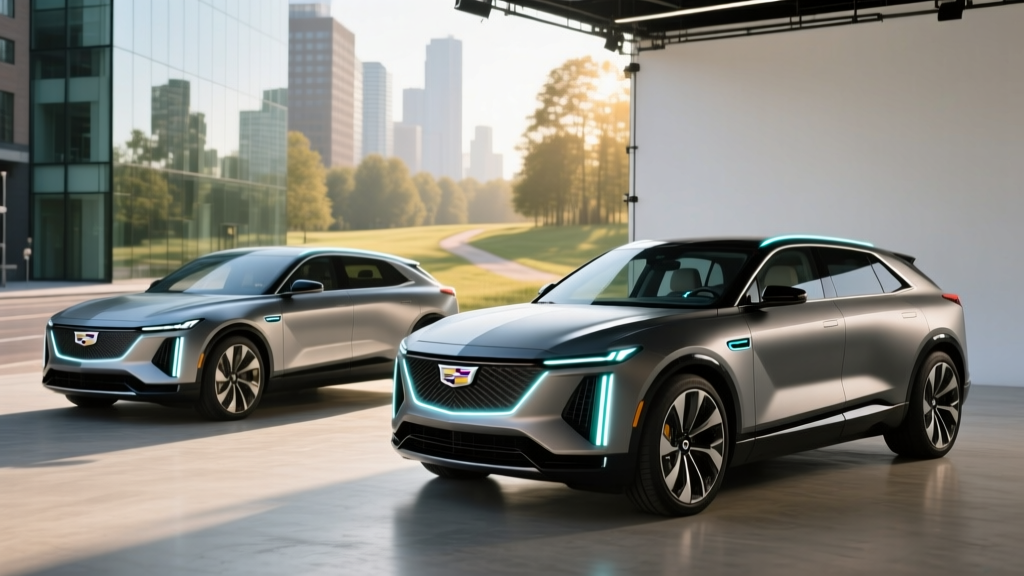
Quick Answer: Cadillac offers two electric SUVs for 2025: the midsize Lyriq (EPA range up to 314 miles, starting at ~$58,590) and the compact Optiq (EPA range up to 300 miles, starting at ~$53,990). Both use GM's Ultium battery platform with 102 kWh (Lyriq) and 85 kWh (Optiq) usable capacity. Neither currently qualifies for the full $7,500 federal §30D tax credit due to battery-sourcing requirements, though point-of-sale lease incentives may apply. Expect real-world highway range of 250–280 miles in moderate weather, dropping 15–25% in sub-freezing temperatures.
2025 Cadillac Electric SUV Specs at a Glance
Cadillac's electric transition centers on the Ultium platform shared across GM brands. For 2025, buyers choose between two SUVs targeting different segments and budgets.
| Spec | 2025 Lyriq (RWD) | 2025 Lyriq (AWD) | 2025 Optiq (AWD) |
|---|---|---|---|
| EPA Range | 314 mi | 307 mi | ~300 mi |
| Usable Battery | 102 kWh (NMC) | 102 kWh (NMC) | 85 kWh (NMC) |
| Horsepower | 340 hp | 500 hp | 415 hp |
| 0–60 mph | 6.0 sec | 4.6 sec | ~4.5 sec |
| Peak DC Charge | 190 kW | 190 kW | 150 kW |
| 10–80% DC Time | ~33 min | ~33 min | ~30 min |
| Level 2 Rate | 19.2 kW | 19.2 kW | 11.5 kW |
| MPGe (Combined) | 89 MPGe | 88 MPGe | TBD |
| Base MSRP | $58,590 | $62,090 | $53,990 |
| Battery Warranty | 8 yr / 100k mi | 8 yr / 100k mi | 8 yr / 100k mi |
Sources: EPA Fueleconomy.gov, Cadillac Lyriq official page
Real-World Range Reality: The Lyriq RWD's 314-mile EPA estimate assumes mixed driving at moderate temperatures. On sustained 75-mph highway runs in 70°F weather, expect 265–280 miles. In sub-30°F winter conditions with cabin heat running, plan for 220–250 miles. The Optiq's smaller battery yields similar proportional reductions. Both models feature a heat pump (standard on Lyriq), which reduces cold-weather losses compared to resistive heating systems.
How Cadillac's Electric SUVs Compare to Gas Equivalents
The natural cross-shops are the Cadillac XT5 (midsize gas) and XT4 (compact gas). Here's how the numbers stack up over five years of ownership at 15,000 miles annually.
| Factor | Lyriq RWD | XT5 FWD (Gas) | Optiq AWD | XT4 AWD (Gas) |
|---|---|---|---|---|
| Base MSRP | $58,590 | $44,495 | $53,990 | $38,695 |
| Fuel/Energy Cost (5 yr) | ~$4,800 | ~$11,250 | ~$5,100 | ~$11,700 |
| Maintenance (5 yr) | ~$1,500 | ~$3,800 | ~$1,500 | ~$3,600 |
| Federal Tax Credit | $0–$7,500* | $0 | $0–$7,500* | $0 |
| Est. Insurance (5 yr) | ~$12,500 | ~$9,500 | ~$11,800 | ~$9,200 |
| 5-Year Total (est.) | ~$77,390 | ~$69,045 | ~$72,390 | ~$63,195 |
* Federal §30D credit eligibility depends on battery-sourcing compliance, buyer income caps ($150k single / $300k joint), and MSRP limits ($80k for SUVs). Check current status at IRS.gov. Energy costs assume $0.14/kWh home charging and $3.50/gal premium fuel. Insurance averages vary significantly by driver profile and state.
The EVs carry a higher upfront price but recover ground through dramatically lower fueling and maintenance costs. The Lyriq saves roughly $6,450 in fuel over five years versus the XT5. However, higher insurance premiums (typically 20–35% above gas equivalents) and the purchase-price gap mean break-even often takes 6–8 years without a tax credit.
Charging Infrastructure: What You Need Before You Buy
Home charging access is the single biggest determinant of EV satisfaction. Here's what Cadillac's Ultium SUVs require.
Home Charging Setup
The Lyriq supports up to 19.2 kW Level 2 AC charging — among the fastest in its class. This requires a hardwired Wall Connector on a 100-amp circuit. Most homes have 100A or 200A electrical panels; a 19.2 kW charger may necessitate a panel upgrade ($1,500–$3,000) or a dedicated sub-panel.
| Item | Lyriq (19.2 kW capable) | Optiq (11.5 kW capable) |
|---|---|---|
| Level 2 Charger (hardware) | $500–$750 | $400–$600 |
| Electrician (240V/60A run) | $800–$2,000 | $600–$1,500 |
| Panel upgrade (if needed) | $1,500–$3,000 | $1,500–$3,000 |
| Permit & inspection | $100–$300 | $100–$300 |
| Total estimated | $1,400–$6,050 | $1,100–$5,400 |
At 19.2 kW, the Lyriq adds roughly 52 miles of range per hour — a full overnight charge in about 6 hours from 10%. The Optiq at 11.5 kW adds approximately 33 miles per hour.
DC Fast Charging on the Road
Both models use the CCS1 connector (Cadillac has announced NACS adoption for future models, but 2025 vehicles ship with CCS1). The Lyriq peaks at 190 kW, which translates to 76 miles added in 10 minutes under ideal conditions. However, the charge curve tapers significantly above 80% State of Charge — a typical 10–80% session takes about 33 minutes, while 10–100% takes over 55 minutes.
Access to DC fast chargers varies by region. The AFDC station locator shows coverage along major interstate corridors, but rural areas and some apartment-dense urban zones remain underserved.
Federal Tax Credits and Incentive Reality
This is where many Cadillac EV buyers encounter disappointment. Under current IRS §30D rules, the federal clean vehicle credit requires that a percentage of battery critical minerals and components be sourced from the US or free-trade-agreement partners. As of the 2025 model year, the Lyriq and Optiq have faced challenges meeting the full battery-sourcing thresholds.
§30D Credit Requirements (2025):
- Vehicle MSRP must not exceed $80,000 (SUVs/vans/pickups)
- Buyer AGI: ≤$150,000 (single) / ≤$225,000 (HOH) / ≤$300,000 (joint)
- Battery components: ≥60% manufactured/assembled in North America (2025)
- Critical minerals: ≥50% sourced from US or FTA partners (2025)
- Vehicle must be assembled in North America
- Credit can be transferred to dealer at point of sale as a price reduction
Source: IRS §30D Clean Vehicle Credit. Eligibility changes as sourcing requirements tighten annually. Verify current status before purchasing.
Lease workaround: Vehicles leased through a qualified lessor may qualify for the commercial clean vehicle credit (§45W), which has no MSRP, income, or sourcing caps. Many Cadillac dealers pass this $7,500 benefit to lessees as a capitalized-cost reduction. Ask specifically about lease incentives.
Common Misconceptions About Cadillac's Electric SUVs
| Myth | Fact |
|---|---|
| "314 miles means I'll always get 314 miles" | EPA range is a laboratory estimate. Real-world highway driving at 75 mph yields ~265–280 mi; cold weather (below 30°F) reduces this to 220–250 mi. |
| "The $7,500 tax credit applies to everyone" | Battery-sourcing rules, income caps, and MSRP limits disqualify many buyers. Lease structures may unlock the credit via §45W. |
| "I can charge anywhere with a regular outlet" | Level 1 (120V) charging adds only ~3–4 miles per hour — roughly 36–48 miles overnight. A Level 2 home charger is practically essential for daily use. |
| "EV batteries need replacing every few years" | GM warranties the Ultium battery for 8 years/100,000 miles against degradation below 70% capacity. Real-world data from Bolt EV owners shows ~5–8% degradation at 100k miles. |
| "Super Cruise means the car drives itself" | Super Cruise is an SAE Level 2 system requiring active driver supervision. It operates only on pre-mapped divided highways (~400,000+ miles of coverage). You must keep your eyes on the road. |
SAE Automation Level: Cadillac's Super Cruise is a Level 2 driver-assistance system — not autonomous driving. The driver must remain attentive and ready to take over at any moment. The system monitors driver gaze via an infrared camera and will issue escalating alerts (visual, audible, haptic) before disengaging if attention lapses.
Who Should Buy a 2025 Cadillac Electric SUV?
Choose the Lyriq if:
- You need 300+ miles of EPA range and a spacious midsize cabin (33.9 cu ft cargo behind rear seats)
- You value the 19.2 kW Level 2 charging capability for fast home replenishment
- Your daily commute is under 80 miles round-trip and you have home charging access
- You want the premium 33-inch LED display and available Super Cruise highway driving assist
Choose the Optiq if:
- You prefer a more compact footprint for urban driving and tighter parking
- Budget is a priority — the ~$54k starting price undercuts the Lyriq by ~$4,600
- You don't mind slightly slower Level 2 charging (11.5 kW vs 19.2 kW)
- You want AWD standard for snow-belt climates
Stick with gas (XT5/XT4) if:
- You lack reliable home or workplace charging access
- You regularly tow (Lyriq is rated for only 1,500 lbs; XT5 handles 3,500 lbs)
- You frequently drive 400+ mile trips through areas with sparse DC fast-charging infrastructure
- Upfront cost is the primary constraint and you plan to keep the vehicle under 5 years
Real-World Ownership Considerations
Climate Impact
Owners in northern-tier states (Minnesota, Michigan, Maine) should budget for 20–25% range loss in sustained sub-20°F weather. The Lyriq's heat pump mitigates this somewhat versus resistive heaters, but battery chemistry (NMC) inherently slows in cold. Preconditioning the battery while plugged in — using the Cadillac app to warm the cabin and battery before departure — recovers significant range.
Insurance Costs
EV insurance premiums run 20–35% higher than gas equivalents due to higher repair costs and specialized parts. Lyriq owners report annual premiums of $2,200–$3,200 depending on state and driving record. Always get a quote before committing to purchase.
Maintenance Differences
EVs eliminate oil changes, transmission fluid, spark plugs, and exhaust system repairs. Expect to replace cabin air filters, wiper blades, brake fluid (less frequently due to regenerative braking), and tires. EV tire wear is 15–25% faster than gas vehicles due to instant torque and higher curb weight (Lyriq: ~5,700 lbs).
Frequently Asked Questions
Does the 2025 Cadillac Lyriq qualify for the $7,500 federal tax credit?
Eligibility is uncertain under current §30D battery-sourcing rules. The Lyriq is assembled in Spring Hill, Tennessee, meeting the North American assembly requirement, but battery component and critical-mineral sourcing thresholds change annually and vary by production batch. Check the latest eligibility list at fueleconomy.gov before purchasing. Leasing may unlock a $7,500 credit via the §45W commercial vehicle provision regardless of sourcing.
How long does it take to charge the Lyriq at home?
With a 19.2 kW Level 2 charger (requires a 100A circuit), the Lyriq charges from 10% to 100% in approximately 6 hours. On a standard 48A/11.5 kW circuit, expect about 10 hours. Level 1 (120V) charging is impractical for daily use — it adds only ~3–4 miles per hour, meaning a full charge would take over 30 hours.
What happens if the Ultium battery degrades significantly?
GM warrants the battery for 8 years or 100,000 miles, whichever comes first, against capacity loss below 70% of original. If the battery falls below that threshold within the warranty period, GM will repair or replace it at no cost. Out-of-warranty replacement costs are estimated at $12,000–$18,000 based on current Ultium pricing, though costs are expected to decline as the platform matures.
Can I use Tesla Superchargers with the 2025 Lyriq or Optiq?
Not natively. The 2025 models ship with CCS1 connectors. GM has announced NACS (Tesla-style) port adoption starting with 2025-model-year vehicles produced later in the calendar year, and adapters are available for existing CCS-equipped GM EVs at many Supercharger locations. Confirm adapter availability and Supercharger compatibility via the Cadillac app before relying on the Tesla network.
Is the Lyriq or Optiq better for road trips?
The Lyriq RWD's 314-mile EPA range and 190 kW DC fast-charging capability make it the stronger road-trip choice. You can realistically drive 200–220 miles between 20-minute charging stops on the interstate. The Optiq's smaller battery means more frequent stops — plan for roughly 180-mile segments to maintain a comfortable buffer.
Pricing and incentive data reflect information available at time of publication. Always verify current MSRP, tax-credit eligibility, and dealer incentives directly with Cadillac and the IRS before purchasing.