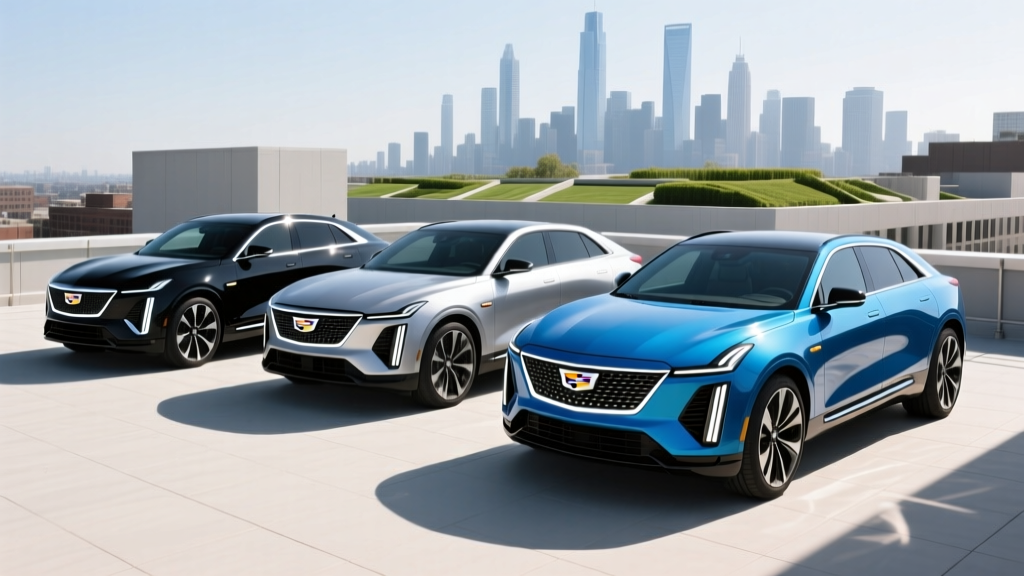
The short answer: Cadillac's 2026 electric car lineup includes three models — the Lyriq midsize SUV (EPA 314 mi, from ~$58,590), the Optiq compact SUV (EPA ~300 mi est., from ~$52,000 est.), and the Vistiq three-row SUV (EPA ~300 mi est., from ~$65,000 est.). All ride on GM's Ultium platform, support DC fast charging up to 190–200 kW, and qualify for varying levels of the federal §30D tax credit depending on battery-sourcing compliance. For most buyers, the Lyriq is the most proven and widely available choice; the Optiq and Vistiq are newer additions still ramping production. If you lack reliable home charging access or live in an extreme cold-weather climate, consider a plug-in hybrid alternative or wait until public infrastructure matures in your area.
The 2026 Cadillac Electric Car Lineup at a Glance
Cadillac has committed fully to battery-electric vehicles, and by the 2026 model year its portfolio covers three distinct SUV segments. Each model shares GM's BEV3 architecture and Ultium battery system, but they differ meaningfully in size, range, price, and intended buyer. Here is how they stack up on paper:
| Spec | 2026 Lyriq | 2026 Optiq (Est.) | 2026 Vistiq (Est.) |
|---|---|---|---|
| EPA Range | 314 mi (RWD) | ~300 mi | ~300 mi |
| Battery (usable) | 102 kWh, NMC | ~85 kWh, NMC | ~102 kWh, NMC |
| Peak DC Fast Charge | 190 kW | ~190 kW | ~200 kW |
| 10–80% DCFC Time | ~33 min | ~28 min | ~34 min |
| Level 2 (240V) Rate | 19.2 kW (77 mi/hr) | 19.2 kW | 19.2 kW |
| Horsepower | 340 hp (RWD) / 500 hp (AWD) | ~300 hp (AWD) | ~500 hp (AWD) |
| 0–60 mph | 6.0s (RWD) / 4.6s (AWD) | ~5.5s | ~4.5s |
| Starting MSRP | ~$58,590 | ~$52,000 | ~$65,000 |
| Battery Warranty | 8 yr / 100,000 mi | 8 yr / 100,000 mi | 8 yr / 100,000 mi |
Sources: EPA / fueleconomy.gov, Cadillac official specifications. Optiq and Vistiq figures are preliminary estimates for models still ramping production; verify at time of purchase.
Real-world range reality check: The Lyriq's 314-mile EPA rating applies to the RWD model in mixed driving at moderate temperatures. Expect ~260–280 miles in sustained 70+ mph highway driving and ~220–250 miles in sub-30°F winter conditions. AWD trims sacrifice roughly 20–30 miles of range. The larger Vistiq's boxier profile and heavier curb weight will likely yield lower real-world efficiency than the Lyriq despite similar battery capacity.
Charging Speed and the Ultium Charge Curve
Understanding how a Cadillac electric car charges — not just the peak number but the sustained rate — is critical for road-trip planning and daily convenience.
All three models use a NACS (North American Charging Standard) connector natively, meaning direct access to Tesla Supercharger V3 and V4 stations without an adapter. This is a significant infrastructure advantage over CCS-only vehicles, as the Supercharger network remains the most reliable DC fast-charging system in the US.
| Charging Level | Power (kW) | Miles Added per Hour | Typical Use Case |
|---|---|---|---|
| Level 1 (120V household) | ~1.4 kW | ~3–4 mi/hr | Emergency / overnight top-off |
| Level 2 (240V, 48A) | 11.5 kW | ~30 mi/hr | Standard home / workplace |
| Level 2 (240V, 80A) | 19.2 kW | ~52 mi/hr | Full-speed home / destination |
| DC Fast Charge (peak) | 190–200 kW | ~500+ mi/hr (at peak) | Road trips, 10–80% in ~30 min |
Charge-curve reality: The Lyriq's 190 kW peak rate applies only between roughly 10–40% state of charge. Above 50% SoC, the rate tapers to ~120 kW, and above 80% it drops below 50 kW to protect the NMC battery cells. This is why the 10–80% time (~33 minutes) is a more useful metric than peak kW. If you regularly charge from 80–100% at a DC fast charger, expect that last 20% to take nearly as long as the first 70%. For daily driving, home Level 2 charging to 80–90% overnight is both faster and better for long-term battery health.
Real Costs: Purchase, Fueling, Maintenance, and Insurance
The sticker price of a Cadillac electric car is only part of the ownership equation. Here is a five-year cost comparison between the Lyriq AWD (~$62,590 MSRP) and a comparably priced gas-powered luxury SUV like the Cadillac XT5 AWD (~$52,000 MSRP).
| Cost Category (5 yr / 60,000 mi) | Lyriq AWD | XT5 AWD (Gas) |
|---|---|---|
| Purchase Price (MSRP) | $62,590 | $52,000 |
| Federal Tax Credit (§30D) | Up to $7,500* | $0 |
| Effective Purchase Price | ~$55,090 | $52,000 |
| Fuel / Electricity (60k mi) | ~$3,600 (home) / ~$5,400 (public DCFC) | ~$9,000 ($3.50/gal, 22 mpg combined) |
| Maintenance (oil, filters, brakes) | ~$1,200 | ~$3,500 |
| Insurance (avg. national) | ~$12,500 | ~$10,800 |
| 5-Year Total (est.) | ~$72,390–$74,190 | ~$75,300 |
* §30D credit eligibility depends on income caps, MSRP limits, battery-sourcing requirements, and point-of-sale transfer rules. Verify at irs.gov and consult a tax professional. Electricity cost assumes $0.16/kWh home rate; gas assumes 22 mpg combined at $3.50/gal.
Key takeaway: With the full $7,500 credit and primarily home charging, the Lyriq breaks even or beats the gas XT5 over five years despite its higher sticker. Without the credit — or if you rely exclusively on public DC fast charging at $0.40–0.50/kWh — the savings narrow significantly. Insurance costs are typically 10–20% higher for EVs due to repair cost structures and parts pricing.
Federal Tax Credit Eligibility for Cadillac EVs
The §30D Clean Vehicle Credit can reduce your effective purchase price by up to $7,500, but eligibility is not guaranteed. Here is what determines whether a specific Cadillac electric car qualifies:
- MSRP cap: SUVs must be at or below $80,000 MSRP. All three Cadillac models (Lyriq, Optiq, Vistiq) fall under this threshold in most trims, but fully loaded Vistiq configurations could exceed it.
- Buyer income cap: Modified AGI must not exceed $300,000 (joint), $225,000 (head of household), or $150,000 (single).
- Battery sourcing: A percentage of critical minerals and battery components must be sourced from the US or free-trade-agreement countries. This requirement tightens annually, and GM has been working to qualify more Ultium battery configurations. Verify the specific VIN's eligibility on fueleconomy.gov before purchase.
- Point-of-sale transfer: As of 2024, you can transfer the credit to the dealer at purchase, reducing your out-of-pocket cost immediately rather than waiting for a tax refund. This requires the dealer to be registered with the IRS Energy Credits portal.
- Final assembly: Must occur in North America. All three Cadillac EVs are assembled in Spring Hill, Tennessee, or Lansing, Michigan.
Because sourcing rules change and vary by production batch, always confirm the specific VIN on fueleconomy.gov before finalizing a purchase. A Lyriq built in March 2026 may have different eligibility than one built in June 2026.
EV vs. Gas vs. Hybrid: Who Should Buy a Cadillac Electric Car?
A Cadillac electric car is not the right choice for every buyer. Here is a practical decision framework based on real ownership scenarios:
Choose a Cadillac EV (Lyriq, Optiq, or Vistiq) if:
- You have access to Level 2 home charging (garage or driveway with a 240V outlet or hardwired charger).
- Your daily driving is under 200 miles and you can charge overnight.
- You take road trips 2–4 times per year and can plan around Supercharger or Electrify America stations.
- You qualify for the §30D credit and want to reduce fuel and maintenance costs long-term.
- You value a quiet, smooth powertrain and instant torque for city and suburban driving.
Consider a plug-in hybrid (like the Cadillac XT5 PHEV, if available) or conventional hybrid if:
- You live in an apartment or condo without charging access and cannot install a home charger.
- You regularly drive 300+ miles in areas with sparse DC fast-charging infrastructure (rural routes, parts of the Mountain West).
- You live in extreme cold climates (sustained sub-10°F winters) where EV range loss of 30–40% is routine.
- You tow frequently — EVs lose 40–50% of range when towing at highway speeds, making long-distance towing impractical.
- Your budget is under $45,000 and you need a luxury-badge vehicle (the used market or CPO gas Cadillacs may fit better).
Common Misconceptions About Cadillac Electric Cars
| Myth | Fact |
|---|---|
| "The battery will need replacing in 5 years and cost $20,000." | GM's Ultium batteries are warrantied for 8 years / 100,000 miles with a minimum 70% capacity retention threshold. Real-world degradation data from earlier Ultium vehicles shows ~5–8% loss over the first 100k miles. Full replacement is rare and costs $12,000–$18,000 if out of warranty. |
| "I can't take road trips — charging takes too long." | At 190 kW, a Lyriq adds ~190 miles of range in 20 minutes. On a 600-mile trip, you will stop twice for ~25 minutes each — roughly matching typical rest-stop and meal breaks. NACS Supercharger access makes route planning straightforward. |
| "EVs are worse in winter." | Range drops 20–40% in sub-freezing temperatures due to battery chemistry and cabin heating load. However, preconditioning the battery while plugged in, using seat/steering-wheel heaters instead of cabin air, and the Lyriq's available heat pump (standard on AWD) mitigate this. You will not be stranded — but plan for reduced range. |
| "Super Cruise means the car drives itself." | Super Cruise is an SAE Level 2 driver-assistance system. It handles steering, acceleration, and braking on mapped divided highways, but you must remain attentive. The driver-monitoring camera tracks your eyes. It is not autonomous driving (Level 4) and does not work on unmapped local roads. |
| "I'll save money immediately." | Savings depend on your electricity rate, driving volume, and tax-credit eligibility. With home charging at $0.16/kWh and the $7,500 credit, break-even vs. a gas XT5 is ~3 years. Without the credit and charging primarily at public DCFC stations, break-even may extend to 5–6 years or not occur before trade-in. |
Super Cruise and Driver Assistance: What You Actually Get
SAE Automation Level: Level 2 (Partial Driving Automation). Super Cruise — available on all 2026 Cadillac EVs — provides hands-free driving on over 750,000 miles of pre-mapped divided highways in the US and Canada. The system controls steering, speed, and lane position. However, the driver must remain alert and ready to take over at any time. A camera-based driver-monitoring system ensures your eyes are on the road. This is fundamentally different from Level 4 robotaxi services (like Waymo) that operate without a driver in geofenced urban areas.
Super Cruise is included for the first 3 years on most trims, after which a subscription (~$25/month or $250/year) is required. The system excels on long interstate drives but does not handle city streets, construction zones, or unmapped roads. For those scenarios, Cadillac's standard adaptive cruise control and lane-keeping assist (Level 1 features) remain active.
What Super Cruise does NOT do:
- Navigate city streets, residential neighborhoods, or unmapped roads
- Handle construction zones, detours, or temporary lane markings reliably
- Allow you to sleep, use your phone, or look away from the road
- Operate in severe weather (heavy rain, snow, fog that obscures sensors)
- Make the vehicle autonomous — you are the driver and legally responsible at all times
Home Charging Setup: What First-Time Buyers Need to Know
Buying a Cadillac electric car without a home charging plan is like buying a gas car without knowing where the nearest station is. Here is what a typical Level 2 home installation involves:
| Item | Cost Range | Notes |
|---|---|---|
| Level 2 EVSE (charger unit) | $500–$800 | Cadillac-recommended or ChargePoint Home Flex (48A) |
| Electrical panel assessment | $0–$200 | Often free from electrician; needed to confirm 200A service |
| Electrician labor + wiring | $800–$2,500 | Varies by distance from panel to garage; conduit, drywall patching |
| Permit and inspection | $100–$400 | Required in most jurisdictions; varies by municipality |
| Panel upgrade (if needed) | $1,500–$4,000 | Only if your home has 100A service or no available breaker slots |
| Total (no panel upgrade) | $1,400–$3,900 | Most homes with 200A service fall in this range |
Critical note: The Lyriq's onboard charger supports up to 19.2 kW on Level 2, which requires an 80-amp circuit (hardwired). Most home installations use a 48-amp circuit (11.5 kW), which still adds ~30 miles per hour of charging — enough to fully replenish a depleted battery overnight in about 9 hours. A licensed electrician should make the final determination on your panel capacity and circuit sizing.
Frequently Asked Questions
Is the Cadillac Lyriq eligible for the full $7,500 federal tax credit in 2026?
Eligibility depends on the specific VIN's battery-sourcing compliance, your income, and the MSRP cap. GM has been progressively qualifying more Ultium battery configurations, but sourcing requirements tighten each year. Always check the exact VIN on fueleconomy.gov before purchasing, and consult a tax professional regarding your personal eligibility under IRS §30D rules.
How long does the Ultium battery last before needing replacement?
GM warranties the Ultium battery for 8 years or 100,000 miles, guaranteeing at least 70% of original capacity. Real-world data from early Ultium vehicles and comparable NMC packs from other manufacturers suggests 10–15% degradation over 150,000 miles under normal use. Full battery replacement is rare and typically only needed after a collision or manufacturing defect. Out-of-warranty replacement costs range from $12,000 to $18,000 depending on the model and pack size.
Can I use Tesla Superchargers with a Cadillac electric car?
Yes. All 2026 Cadillac EVs come with a native NACS charge port, giving them direct access to Tesla's Supercharger V3 and V4 network without an adapter. This is a major advantage over vehicles with CCS ports that require a NACS-to-CCS adapter (which can reduce peak charging speed). Use the Tesla app or in-car navigation to locate and pay at Supercharger stations.
What is the real-world highway range of the Lyriq?
The Lyriq RWD's EPA rating is 314 miles, but sustained highway driving at 70–80 mph typically yields 260–280 miles. In cold weather (below 30°F), expect 220–250 miles. AWD trims reduce range by approximately 20–30 miles. These numbers assume proper tire inflation, moderate climate-control use, and no heavy cargo or towing.
Does the Cadillac Vistiq have enough range for a three-row family SUV?
The Vistiq's estimated ~300-mile EPA range is competitive for a three-row electric SUV, but its larger frontal area and heavier weight mean real-world highway efficiency will likely be lower than the Lyriq's. For families who primarily drive locally and charge at home, 250+ real-world miles is ample. For frequent long-distance family road trips, plan charging stops every 200–230 miles to maintain a comfortable buffer.
Is Super Cruise standard on all Cadillac electric cars?
Super Cruise is available on most trims of the Lyriq, Optiq, and Vistiq, typically included for the first three years. After the trial period, a subscription (~$25/month) is required to continue using hands-free features. Base trims may not include Super Cruise hardware; verify at the time of purchase if this feature is important to you.