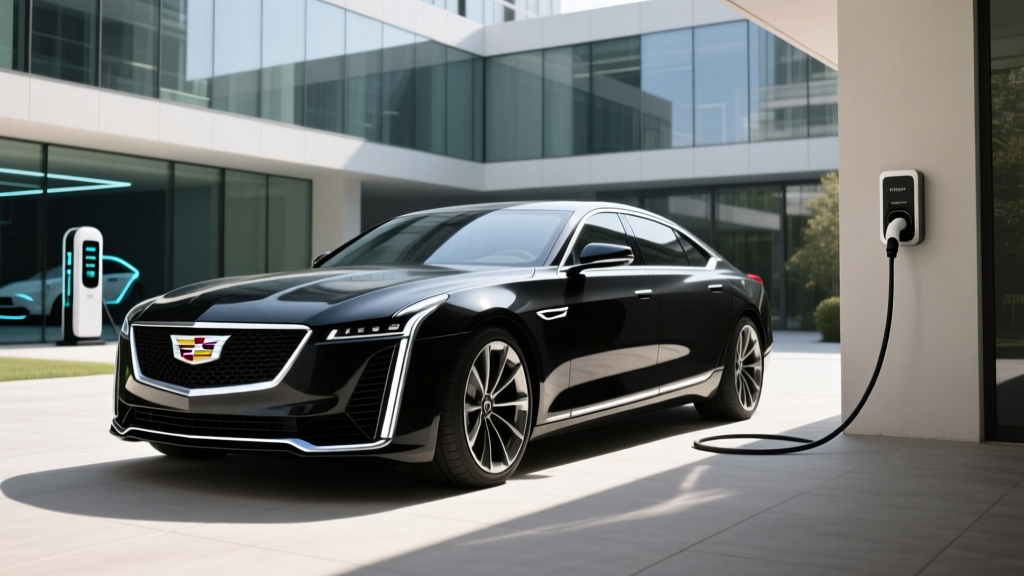
The Cadillac Celestiq sedan occupies a rarefied space in the electric vehicle market: a hand-built, ultra-luxury flagship that costs more than most homes but promises bespoke craftsmanship alongside cutting-edge EV technology. As Cadillac's halo vehicle and spiritual successor to the mid-century Eldorado Brougham, the Celestiq is less a mass-market commuter and more a rolling statement of intent for GM's luxury electric ambitions. But beneath the hand-stitched leather and 55-inch dashboard display lies a serious electric powertrain built on GM's Ultium platform. Here's everything prospective buyers and EV enthusiasts need to know about the Celestiq's real-world range, charging behavior, performance, and ownership economics.
Range, Efficiency, and Real-World Expectations
The Cadillac Celestiq sedan carries a massive 111 kWh usable lithium-ion battery pack using GM's Ultium pouch-cell architecture with NMC (nickel manganese cobalt) chemistry. This is one of the largest battery packs fitted to any production passenger car, and it delivers a GM-estimated EPA range of approximately 300 miles on a full charge. Efficiency lands around 89 MPGe combined, or roughly 38 kWh per 100 miles — a figure that reflects the Celestiq's substantial curb weight (estimated above 6,000 lbs) and its emphasis on power over efficiency.
EPA Estimated: ~300 miles
Real-World Highway (70-80 mph): Expect 240–270 miles. At sustained highway speeds, the Celestiq's aerodynamic drag and heavy mass cut into range meaningfully.
Cold-Weather (below 32°F): Plan for 210–250 miles. NMC chemistry loses roughly 15–25% capacity in freezing temperatures, and cabin heating draws heavily from the pack.
City/Mixed Driving: Closer to the 300-mile EPA sticker thanks to regenerative braking and lower average speeds.
For a vehicle in this price tier, range anxiety is largely mitigated by the reality that Celestiq owners will almost certainly charge at home overnight and use DC fast charging only on longer road trips. Still, the ~38 kWh/100mi consumption figure means the Celestiq is no efficiency champion — it trades electrons for the 600+ horsepower on tap.
Charging Speed: DC Fast, Level 2, and the Charge Curve
The Celestiq supports DC fast charging at up to 200 kW via its CCS1 connector (NACS adapter availability for Tesla Supercharger access has been confirmed for 2026 model-year vehicles). On a capable 350 kW station, the large 111 kWh pack can accept peak rates near 200 kW, though the charge curve tapers significantly above 80% state of charge to protect battery health.
| Charging Level | Power (kW) | Speed / Time | Notes |
|---|---|---|---|
| Level 1 (120V household) | ~1.4 kW | ~3–4 miles per hour | Emergency trickle only; full charge takes days |
| Level 2 (240V home, 48A) | ~11.5 kW | ~25–28 miles per hour | Full overnight charge in ~10 hours |
| Level 2 (240V home, 80A) | ~19.2 kW | ~42–45 miles per hour | Requires hardwired 100A circuit; full charge in ~6 hours |
| DC Fast Charge (peak) | 200 kW | 10–80% in ~33 minutes | Peak rate sustained to ~50% SoC, then tapers |
The 10–80% DC fast-charge time of approximately 33 minutes is respectable for a pack this large, though it trails competitors like the Lucid Air (which can achieve similar range additions faster thanks to its 900V architecture). The Celestiq's 400V Ultium platform limits peak charge rate relative to battery capacity — the C-rate at peak is roughly 1.8C, which is conservative but battery-friendly for long-term degradation.
For home charging, Cadillac includes a dual-voltage Level 2 portable cord. Most buyers will install a hardwired 48-amp or 80-amp wall connector. Budget $1,200–$3,000 for professional Level 2 installation depending on your electrical panel's capacity — and given the Celestiq's price point, a dedicated 100-amp circuit with an 80-amp charger is the logical choice for fastest overnight replenishment.
Performance: 0–60, Powertrain, and Driving Dynamics
| Specification | Value |
|---|---|
| Drivetrain | Dual-motor all-wheel drive |
| Horsepower | ~600 hp (estimated) |
| Torque | ~640 lb-ft (estimated) |
| 0–60 mph | ~3.8 seconds |
| Top Speed | Electronically limited, ~130 mph |
| Suspension | Adaptive air suspension with Magnetic Ride Control 4.0 |
| Steering | Rear-wheel steering (up to 3.5°) |
The Celestiq's dual-motor AWD powertrain delivers effortless, turbine-smooth acceleration that hits 60 mph in roughly 3.8 seconds. That's quick by any measure, though it's deliberately not a track weapon — the emphasis is on wafting, silent thrust rather than the neck-snapping brutality of a Tesla Model S Plaid or Lucid Air Sapphire. The adaptive air suspension and GM's latest Magnetic Ride Control work to isolate the cabin from road imperfections, and rear-wheel steering tightens the turning radius for a car stretching over 210 inches in length.
The driving experience is calibrated for serenity: excellent NVH (noise, vibration, harshness) isolation, a compliant ride, and one-pedal driving capability through aggressive regenerative braking settings. This is a grand tourer, not a sports sedan, and the powertrain tuning reflects that philosophy.
Interior, Technology, and the 55-Inch Dashboard
The Celestiq's cabin is where the $340,000+ price tag begins to make sense — or at least becomes explicable. Every surface is hand-finished, with materials including forged carbon fiber, aluminum, and leather from suppliers that serve haute couture fashion houses. Each Celestiq is built to order at GM's Factory ZERO facility in Detroit, with buyers involved in selecting from hundreds of material and color combinations.
The technology centerpiece is a 55-inch diagonal LED display spanning the entire dashboard width. Unlike a single monolithic screen, it's segmented to allow the front passenger to view entertainment content invisible to the driver (to minimize distraction). Rear passengers get individual 12.6-inch displays integrated into the front seatbacks, plus an available rear-seat executive console with reclining, heated, ventilated, and massaging seats.
On the driver-assistance front, the Celestiq comes equipped with GM's Super Cruise — a Level 2 hands-free driving system operational on over 750,000 miles of mapped highways in North America. Super Cruise is impressive for long-distance highway cruising but requires driver attention monitoring via an infrared camera. It is not autonomous driving: you must remain engaged and ready to take over at any time. The Celestiq is also expected to offer Ultra Cruise, GM's expanded door-to-door Level 2 system covering more road types, though availability timelines remain subject to regulatory approval.
Super Cruise and Ultra Cruise are SAE Level 2 driver-assistance systems. The driver must remain attentive and is legally responsible for vehicle operation at all times. This is not Level 4 autonomous driving.
Pricing, Trims, and Federal Tax Credit Eligibility
The Cadillac Celestiq sedan starts at an MSRP of approximately $340,000, and that's before any bespoke customization — which, given the made-to-order nature of the vehicle, means most examples will land well above that figure. Cadillac has not published traditional "trim levels" for the Celestiq; instead, each car is individually commissioned through a concierge process, with pricing scaling based on material selections, unique paint formulations, and bespoke interior treatments.
| Item | Value |
|---|---|
| Base MSRP (starting) | ~$340,000 |
| Typical As-Configured Price | $350,000–$400,000+ |
| Federal EV Tax Credit (§30D) | Not eligible — exceeds MSRP cap |
| Destination Charge | Included in bespoke pricing |
Regarding the federal EV tax credit under IRS §30D: the Celestiq does not qualify. The §30D credit imposes an MSRP cap of $55,000 for sedans (and $80,000 for SUVs, vans, and trucks). At roughly $340,000, the Celestiq exceeds this cap by an enormous margin. Additionally, buyer income caps ($150,000 single / $300,000 joint modified AGI) would exclude many but not all buyers in this price range — though the MSRP cap alone is disqualifying regardless of income.
State-level incentives vary by jurisdiction. Some states offer luxury-EV-agnostic rebates or HOV lane access, but buyers should consult their state's DMV or energy office for current programs. A tax professional can advise on any applicable state credits.
Cargo, Passenger Space, and Practicality
The Celestiq is a large sedan — approximately 213 inches long on a 122-inch wheelbase — but its fastback silhouette and Ultium battery packaging create some spatial compromises. Cadillac has not published official cargo volume figures in the traditional sense (this is a bespoke vehicle, and specs are confirmed per build), but industry estimates place trunk space at roughly 17–19 cubic feet, competitive with a full-size luxury sedan like the Mercedes-Benz S-Class. There is no front trunk (frunk), as the space is occupied by power electronics and HVAC components.
Passenger space is generous for four occupants (the Celestiq is strictly a four-seater with individual rear buckets). Rear legroom is estimated at approximately 40–42 inches, and the available reclining rear seats approach first-class airline pod comfort. Headroom is adequate despite the sloping roofline, thanks to the Ultium platform's low floor and a recessed battery pack design.
Practicality verdict: this is not a family hauler. There's no third row, limited cargo flexibility (no folding rear seats in the traditional sense due to the executive rear-seat architecture), and no towing rating. The Celestiq is designed for chauffeured or owner-driven luxury travel for two to four adults, with luggage for a long weekend.
Warranty, Battery Longevity, and Ownership Costs
| Coverage | Term |
|---|---|
| Limited Vehicle Warranty | 4 years / 50,000 miles |
| Powertrain Warranty | 6 years / 70,000 miles |
| Battery Pack Warranty | 8 years / 100,000 miles (min 70% capacity retention) |
| Corrosion Protection | 6 years / unlimited miles |
| Roadside Assistance | 6 years / 70,000 miles |
GM backs the Celestiq's Ultium battery pack with an 8-year/100,000-mile warranty guaranteeing at least 70% capacity retention — consistent with industry norms and Cadillac's published warranty terms. Given the NMC chemistry and conservative charge management (a large pack means lower per-cell stress at typical driving loads), long-term degradation should be modest. Expect roughly 8–12% capacity loss over 150,000 miles under normal use patterns, though real-world data on the Celestiq specifically is still accumulating given its low production volume.
Ownership costs extend beyond the purchase price. Insurance premiums for a $350,000+ electric vehicle are substantial — expect $8,000–$15,000+ annually depending on your profile and coverage. Maintenance is lighter than a comparable ICE luxury sedan (no oil changes, fewer brake replacements thanks to regen), but tire costs are significant given the Celestiq's weight and likely 22- or 23-inch wheel fitments with bespoke tire specifications.
Celestiq vs. the Ultra-Luxury EV Competition
The Celestiq's competitive set is small but formidable. The Lucid Air Sapphire ($250,000) offers more power (1,234 hp), faster charging (900V architecture), and better efficiency — but lacks the Celestiq's bespoke craftsmanship. The Rolls-Royce Spectre ($420,000+) is the closest analog in terms of hand-built luxury, though it's a coupe with less range (~260 miles EPA) and slower charging. The Mercedes-Benz EQS 580 ($125,000) is far more affordable and practical but doesn't approach the Celestiq's exclusivity or material quality.
Choose the Celestiq if: You want a one-of-one, hand-built American luxury EV with unmatched customization; you value exclusivity and concierge ownership over efficiency metrics; you want Super Cruise for hands-free highway travel; and budget is not a primary constraint.
Look elsewhere if: You prioritize performance-per-dollar (Lucid Air Sapphire), maximum range (Lucid Air Grand Touring), or traditional luxury brand cachet (Rolls-Royce Spectre). If you need practicality — cargo space, family seating, tax credit eligibility — the Celestiq is not the answer.
The Verdict: Pros, Cons, and Final Assessment
- ~300-mile EPA range from a 111 kWh Ultium pack — adequate for grand touring
- Bespoke, hand-built craftsmanship with hundreds of customization options
- Super Cruise hands-free driving on 750,000+ miles of mapped highways
- Stunning 55-inch dashboard display with passenger entertainment segmentation
- Adaptive air suspension and rear-wheel steering for a serene ride
- Exclusivity: extremely limited production ensures rarity
- $340,000+ starting price — no federal tax credit eligibility (MSRP cap)
- 200 kW peak DC charging is modest vs. 800V/900V competitors
- Heavy curb weight reduces efficiency (~38 kWh/100mi)
- No frunk, limited cargo flexibility, strictly a four-seater
- Real-world highway range likely 240–270 miles, less in cold weather
- Insurance and tire costs are significant ongoing expenses
The Cadillac Celestiq sedan is not a rational purchase by conventional metrics. It's slower, less efficient, and slower-charging than a Lucid Air at a fraction of the price. But rationality isn't the point. The Celestiq is a bespoke luxury object — an American answer to the Rolls-Royce Spectre with better range, more advanced driver assistance, and a distinctly modern design language. For the ultra-high-net-worth buyer who wants exclusivity, concierge service, and a flagship EV that stands apart from the Tesla-and-Lucid crowd, the Celestiq delivers on its promise. Everyone else can admire it from the outside — and appreciate that its Ultium platform technology will eventually trickle down to more accessible Cadillacs.
Frequently Asked Questions
What is the real-world range of the Cadillac Celestiq sedan?
The Celestiq carries a ~300-mile EPA estimate from its 111 kWh NMC battery. In real-world highway driving at 70–80 mph, expect 240–270 miles. In freezing temperatures, range may drop to 210–250 miles due to NMC cold-weather losses and cabin heating demands. City and mixed driving will be closest to the EPA sticker.
How fast does the Celestiq charge at home and on DC fast chargers?
On a DC fast charger, the Celestiq peaks at 200 kW and achieves 10–80% in approximately 33 minutes. At home on a 240V Level 2 charger at 48 amps (~11.5 kW), it adds roughly 25–28 miles per hour, requiring about 10 hours for a full charge. An 80-amp Level 2 circuit cuts that to roughly 6 hours.
Does the Cadillac Celestiq qualify for the federal EV tax credit?
No. The IRS §30D federal EV tax credit imposes an MSRP cap of $55,000 for sedans. At approximately $340,000, the Celestiq far exceeds this limit and is ineligible regardless of buyer income or battery sourcing. Consult a tax professional for any applicable state-level incentives.
Is the Celestiq worth buying versus a Rolls-Royce Spectre or Lucid Air?
It depends on priorities. The Celestiq offers more range and advanced driver-assist technology (Super Cruise) than the Spectre at a lower price, with distinctly American design language. Against the Lucid Air, the Celestiq sacrifices efficiency and charging speed for exclusivity and bespoke craftsmanship. If you want the most advanced EV powertrain, choose Lucid. If you want traditional European luxury, choose Rolls-Royce. If you want a hand-built, one-of-one American flagship, the Celestiq has no direct rival.
What battery chemistry does the Celestiq use, and how long will it last?
The Celestiq uses NMC (nickel manganese cobalt) lithium-ion chemistry in GM's Ultium pouch-cell format. NMC offers high energy density suited to the Celestiq's large pack. GM warranties the battery for 8 years/100,000 miles with a minimum 70% capacity retention threshold. Based on NMC degradation patterns, expect roughly 88–92% capacity after 100,000 miles under normal charging habits (avoiding frequent 100% charges and DC fast-charge-only routines).
Can the Celestiq use Tesla Superchargers?
Yes. 2026 model-year Cadillacs on the Ultium platform include NACS charge port compatibility or a CCS-to-NACS adapter, enabling access to Tesla's Supercharger network (150 kW and 250 kW stalls). Confirm adapter inclusion with your Celestiq concierge at delivery.