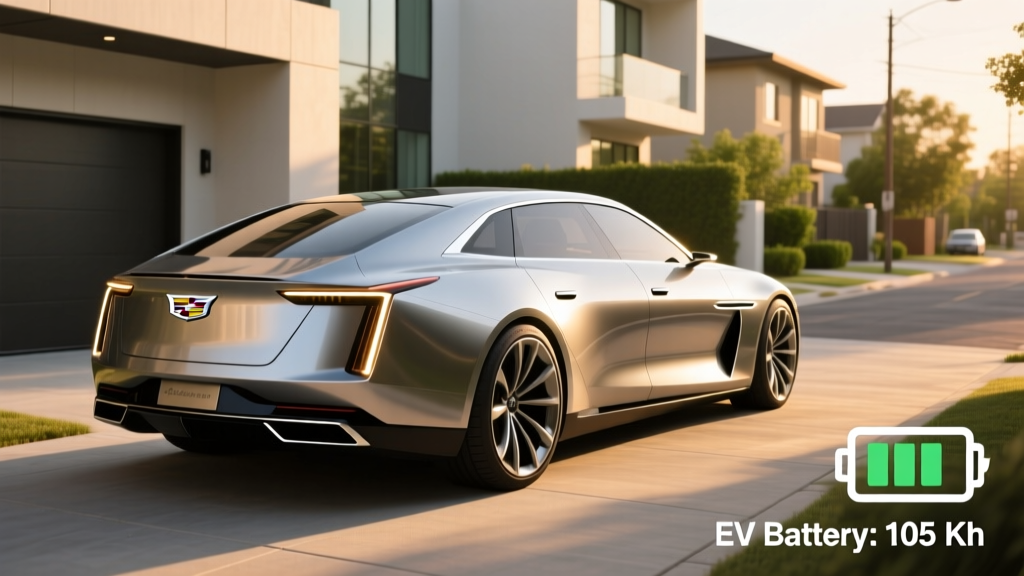
The Cadillac Celestiq is not an electric car for the masses. Priced well above $300,000 and hand-built to individual buyer specifications at GM's Factory ZERO in Michigan, it exists as a low-volume halo — a statement of what Cadillac's Ultium platform can achieve when cost constraints are largely removed. For the 2026 model year, the Celestiq continues in limited production with an estimated annual volume of fewer than 400 units.
If you are researching the Celestiq, you already know it competes with the Rolls-Royce Spectre, Bentley's electrified future, and the upper echelon of the Mercedes-Benz EQS. What you need is hard data: real range, charging behavior, ownership economics, and whether the Celestiq delivers on its ultra-luxury promise beyond the concept-car styling. This review gives you exactly that.
Range, Battery, and Real-World Efficiency
The 2026 Cadillac Celestiq carries a massive 111 kWh usable lithium-ion battery pack built on GM's Ultium platform. The cells use an NMC (nickel-manganese-cobalt) chemistry — chosen here for its high energy density, which is essential for a vehicle with a curb weight approaching 6,000 pounds. This is not an LFP application; the priority is range-per-kilogram, not cycle-life maximization at a lower price point.
Real-World Expectation: Plan for approximately 250–275 miles on highway-heavy road trips at 70–80 mph. In cold weather (below 30°F), expect a 15–25% reduction, bringing effective range to roughly 230–260 miles depending on cabin preconditioning and terrain. The Celestiq's aerodynamic profile helps at speed, but its mass and dual-motor drivetrain work against it in stop-and-go or hilly conditions.
| Specification | Value |
|---|---|
| EPA Range | 303 miles |
| Battery (usable) | 111 kWh, NMC chemistry |
| MPGe (city / hwy / combined) | 89 / 78 / 84 MPGe |
| Efficiency | ~40 kWh / 100 mi |
| Powertrain | Dual-motor AWD |
| Horsepower | ~600 hp (est.) |
| Torque | ~640 lb-ft (est.) |
| 0–60 mph | ~3.8 seconds (est.) |
| Max DC Fast Charge | 190 kW |
| Level 2 Charge Rate | 19.2 kW (est.) |
| Base MSRP | ~$340,000 |
| Battery Warranty | 8 years / 100,000 miles |
Efficiency is listed at roughly 84 MPGe combined according to fueleconomy.gov. At approximately 40 kWh per 100 miles, the Celestiq is not efficient by compact-EV standards, but it is competitive within the ultra-luxury segment where the Rolls-Royce Spectre achieves a similar figure. The practical takeaway: at a national average electricity cost of $0.16/kWh, you will spend roughly $6.40 per 100 miles — a trivial sum relative to the purchase price, but measurably higher than a Tesla Model S or Lucid Air.
Charging Speed: DC Fast Charge and Home Level 2
The Celestiq supports up to 190 kW peak DC fast charging. That is a respectable figure, though it trails the Lucid Air's 300+ kW capability and the Porsche Taycan's 270 kW. The 10–80% charge time is approximately 32 minutes under optimal conditions with a preconditioned battery.
Here is where real-world charging-curve knowledge matters: the Celestiq will not sustain 190 kW through the full session. Expect peak rates between 20–50% state of charge, with a taper beginning around 60% SoC and a significant slowdown past 80%. This is standard behavior for NMC packs managed conservatively to protect longevity, but it means your last 20% adds substantially more time than the first 60%.
| Charge Level | Power / Voltage | Rate (approx.) | Notes |
|---|---|---|---|
| Level 1 (120V) | ~1.4 kW | ~3–4 mi/hr | Emergency trickle only |
| Level 2 (240V, 80A) | ~19.2 kW | ~45–50 mi/hr | Full charge in ~6–7 hours |
| DC Fast Charge | 190 kW peak | 10–80% in ~32 min | Tapers above 60% SoC |
For home charging, the Celestiq supports Level 2 at up to 19.2 kW on a hardwired 80-amp circuit (240V). This requires a dedicated 100-amp breaker and likely a panel upgrade for many homes — a $2,000–$5,000 electrical investment before the charger itself. At this rate, a full 0–100% charge takes approximately 6–7 hours, meaning overnight replenishment is entirely practical for daily use. Most Celestiq owners will install a premium wall connector in a climate-controlled garage; GM includes access to the Ultium Charge network, which aggregates Electrify America, EVgo, and other providers.
Cold-weather charging note: without active preconditioning, DC fast-charge speeds in sub-freezing temperatures can drop by 30–50%. The Celestiq's thermal management system includes battery preconditioning — use the navigation system to route to a charger and the pack will warm itself in advance. Always precondition before a fast-charge stop.
Performance and Driving Dynamics
The dual-motor all-wheel-drive powertrain delivers an estimated 600 horsepower and 640 lb-ft of torque. Cadillac quotes a 0–60 mph time in the vicinity of 3.8 seconds. For a vehicle exceeding 5,800 pounds, that is genuinely quick — though buyers at this price point care less about launch times and more about the quality of acceleration. The Ultium platform's low center of gravity and available four-wheel steering contribute to composed highway manners and a tighter turning radius than the wheelbase suggests.
The air suspension and Magnetic Ride Control 4.0 adapt continuously, offering a ride quality that prioritizes isolation. Road noise is suppressed to near-silence, aided by acoustic laminated glass throughout. The steering is light and deliberately uncommunicative — this is a chauffeur-grade luxury car first, a driver's car second. If you want engagement, a Porsche Taycan or Lucid Air Sapphire will serve you better. If you want serenity at 85 mph, the Celestiq delivers.
Interior, Technology, and Cargo
The Celestiq's cabin is its defining feature. Each vehicle is bespoke, with buyers selecting from an extensive palette of materials including hand-stitched leather, open-pore wood, forged carbon fiber, and available precious-metal accents. The dashboard is dominated by a 55-inch diagonal pillar-to-pillar LED display — one of the largest screens ever installed in a production automobile. Rear passengers receive individual executive seating with adjustable recline, heating, ventilation, massage, and personal entertainment screens.
Cadillac's latest version of Super Cruise — GM's Level 2 hands-free driver-assistance system — is standard, with expanded coverage across mapped divided highways. To be explicit: Super Cruise is an SAE Level 2 system. The driver must remain attentive, and a camera monitors eye contact with the road at all times. This is not autonomous driving.
Cargo space is limited by the fastback sedan form factor. Expect approximately 17–18 cubic feet of trunk volume, with no front trunk (frunk) due to the forward-mounted HVAC and electronics architecture. Rear legroom is generous — over 40 inches — but the sloping roofline cuts into headroom for passengers above six feet. This is a four-passenger vehicle; there is no bench-rear option.
Pricing, Tax Credits, and Ownership Costs
The 2026 Cadillac Celestiq starts at approximately $340,000. Because each vehicle is custom-commissioned, as-tested prices routinely exceed $400,000 depending on material selections, bespoke paint, and optional equipment. There are no traditional "trim levels" — instead, buyers work with a dedicated Cadillac concierge to configure every detail.
| Item | Amount / Status |
|---|---|
| Base MSRP | ~$340,000 |
| Typical As-Configured Price | $350,000 – $420,000+ |
| IRS §30D Federal Tax Credit | Not eligible — exceeds MSRP cap |
| MSRP Cap for Sedans (§30D) | $55,000 |
| Estimated Annual Insurance | $6,000 – $10,000+ |
| Estimated Annual Electricity (12,000 mi) | ~$770 |
Regarding the federal EV tax credit under IRS §30D: the Celestiq does not qualify. The §30D credit imposes an MSRP cap of $55,000 for sedans (and $80,000 for SUVs, vans, and trucks). At $340,000, the Celestiq exceeds this cap by a factor of six. Additionally, buyer income caps ($150,000 single / $300,000 joint for modified AGI) further restrict eligibility for most buyers in this price bracket. Do not factor any federal credit into your Celestiq purchase calculation.
Ownership costs beyond the purchase price include premium insurance (specialty insurers handle vehicles above $300,000), scheduled maintenance (minimal for an EV — cabin air filters, wiper fluid, brake fluid checks, tire rotation), and tire replacement. The Celestiq's weight and torque demand premium all-season or summer tires in large diameters; budget $2,000–$3,500 for a set of four.
How It Compares: Celestiq vs. Ultra-Luxury EV Rivals
The Celestiq's most direct competitor is the Rolls-Royce Spectre, which starts around $420,000 and offers an EPA range of approximately 264 miles with a similarly serene ride. The Spectre carries even more brand prestige and a longer tradition of bespoke coachwork, but its charging speed is slower and its technology suite is less advanced.
The Mercedes-Benz EQS 580 sedan offers comparable luxury at a fraction of the cost (~$130,000), with 350+ miles of range and faster 200 kW charging. It cannot match the Celestiq's exclusivity or bespoke materials, but on pure specification, it is arguably the more rational purchase. The Lucid Air Grand Touring (~$150,000) offers 500+ miles of range and 300 kW charging in a package that is luxurious if not ultra-exclusive.
The Celestiq's value proposition is not rational. It is emotional, experiential, and status-driven. If you want the most technologically capable luxury EV, look at Lucid or Mercedes. If you want the rarest, most individually tailored electric car built in America, the Celestiq stands alone.
Who the Celestiq Is For — And Who Should Look Elsewhere
- You want a one-of-fewer-than-400 hand-built American ultra-luxury EV
- Bespoke materials and a dedicated commissioning process matter to you
- You prioritize ride comfort and cabin silence over sporty dynamics
- You have home Level 2 charging and drive mostly within a 200-mile daily radius
- You need maximum range — the Lucid Air Grand Touring offers 500+ miles
- You want the fastest possible DC charging — Porsche Taycan or Lucid Air lead here
- You prioritize practicality and cargo space — this is a four-passenger fastback
- You expect federal tax incentives — the Celestiq qualifies for none
The Celestiq suits collectors, executives, and luxury enthusiasts who view their vehicle as a personal expression rather than a transportation appliance. It is a capable daily driver — comfortable, quiet, and sufficiently ranged for most routines — but its true value lies in the ownership experience: the commissioning process, the exclusivity, and the statement it makes about American electric luxury.
- Hand-built bespoke commissioning process — no two are alike
- 55-inch pillar-to-pillar display is a technological showcase
- Super Cruise hands-free Level 2 driving on mapped highways
- 303-mile EPA range is competitive in the ultra-luxury segment
- Magnetic Ride Control 4.0 and air suspension deliver exceptional comfort
- 111 kWh battery provides meaningful daily-driving buffer
- $340,000+ price with no federal tax credit eligibility
- 190 kW peak DC charging trails Lucid and Porsche rivals
- Limited cargo volume (~17 cu ft) and no frunk
- Heavy curb weight (~5,900 lbs) reduces efficiency to ~40 kWh/100 mi
- Very few service centers qualified for bespoke components
- Depreciation on ultra-luxury low-volume EVs is historically steep
Frequently Asked Questions
What is the real-world range of the Cadillac Celestiq?
The EPA rates the Celestiq at 303 miles. In real-world highway driving at 70–80 mph, expect 250–275 miles. In cold weather below freezing, plan for 230–260 miles with preconditioning active. The 111 kWh battery provides a generous buffer, but the vehicle's weight and energy consumption (~40 kWh/100 mi) work against range at sustained high speeds.
How fast does the Celestiq charge at home and on the road?
On a DC fast charger, the Celestiq peaks at 190 kW, reaching 10–80% in approximately 32 minutes. At home on a Level 2 hardwired 80-amp circuit (19.2 kW), a full charge takes about 6–7 hours, adding roughly 45–50 miles per hour of charging. Level 1 (120V) adds only 3–4 miles per hour and is impractical for routine use.
Does the Cadillac Celestiq qualify for the federal EV tax credit?
No. Under IRS §30D, the federal clean vehicle credit imposes an MSRP cap of $55,000 for sedans. The Celestiq's $340,000+ price disqualifies it entirely. Buyer income limits ($150,000 single / $300,000 joint) would also exclude most purchasers. Consult IRS.gov or a tax professional for your specific situation.
Is the Celestiq worth buying over the Rolls-Royce Spectre or Mercedes EQS?
It depends on your priorities. The Spectre offers more brand cachet but less range and slower charging. The EQS 580 delivers comparable luxury at roughly one-third the price with more range and faster charging. The Celestiq's advantage is its bespoke American craftsmanship and extreme exclusivity — fewer than 400 built per year. If rarity and personalization are paramount, the Celestiq is unique. If value and specification-per-dollar matter, the EQS or Lucid Air are stronger choices.
What is the Celestiq's battery warranty?
GM covers the Celestiq's battery pack and electric powertrain for 8 years or 100,000 miles, whichever comes first. The warranty covers defects and capacity loss below a specified retention threshold (typically 60–70% of original capacity, per GM's Ultium warranty terms). Given the low annual production volume and bespoke nature of the vehicle, any warranty service will likely involve white-glove concierge coordination rather than a traditional dealer visit.
How much does it cost to charge a Celestiq per year?
At the national average residential electricity rate of approximately $0.16/kWh and an efficiency of 40 kWh/100 miles, driving 12,000 miles annually costs roughly $770 in electricity. This compares to approximately $2,400+ in premium gasoline for a comparable V8 luxury sedan achieving 18 MPG combined. The savings are real but largely irrelevant relative to the Celestiq's purchase price.