The Cadillac Celestiq is not a mass-market electric vehicle. Hand-built at GM's Factory ZERO in Detroit with a production run measured in the low hundreds per year, it exists to redefine what an American ultra-luxury EV can be. For buyers researching the Cadillac Celestiq interior — the cabin is the entire point of this car — the question is whether the bespoke craftsmanship, pillar-to-pillar display, and four-seat executive layout justify a starting price north of $340,000. This review examines the Celestiq's interior, range, charging, performance, and ownership economics with the exact numbers buyers need.
Cadillac Celestiq Interior: A Cabin Built Around Four People
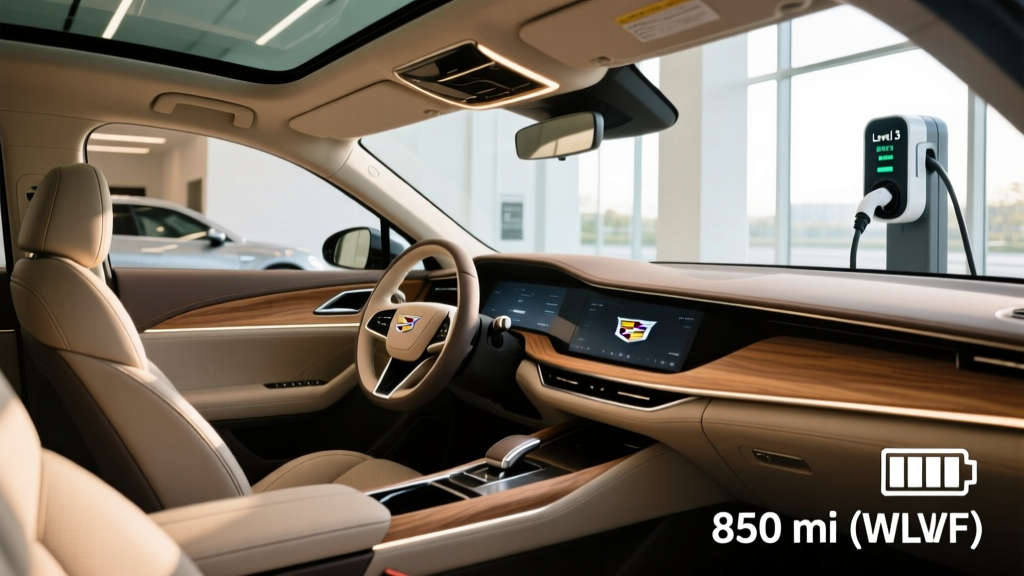
Unlike conventional luxury sedans that prioritize the driver, the Celestiq is engineered as a four-passenger executive lounge. Every surface is finished in hand-stitched leather, open-pore wood, or precision-machined aluminum. There are no plastic panels hiding in lower door pockets or seat backs — Cadillac's design team has confirmed that over 150 3D-printed metal components are used throughout the cabin, including vent vanes and seat-belt towers that would be cost-prohibitive to produce with traditional stamping.
The centerpiece is a 55-inch pillar-to-pillar diagonal HD display spanning the entire dashboard. It functions as both the instrument cluster and infotainment system, with a privacy screen allowing the front passenger to stream video content without distracting the driver. Each of the four outboard seats features its own dedicated 12.6-inch rear entertainment display mounted to the seat back ahead, plus individual climate and audio controls embedded in a rear center console.
Cadillac offers the Celestiq through its bespoke commissioning process — buyers work directly with the design team to select materials, colors, and finishes from an essentially unlimited palette. This means no two Celestiqs are exactly alike, and the interior you see in press photos is merely a starting point. Available features include:
- Executive rear seating with power-reclining outboard seats, heated/cooled/massaging functions, and deployable tray tables
- A fixed glass roof with electrochromic dimming divided into four independently controllable zones
- AKG Studio Reference 38-speaker audio system with headrest-mounted speakers
- Power rear-door open/close with gesture control
- Active noise cancellation paired with road-noise isolation engineering
- Custom luggage sets tailored to the trunk dimensions and matched to interior leather
The trade-off for this four-seat exclusivity is cargo practicality. The trunk offers approximately 14.5 cubic feet of space — adequate for a weekend's worth of luggage for two but not comparable to a crossover or hatchback. There is no frunk (front trunk), as the forward compartment houses HVAC and power electronics. Rear-seat legroom is generous at an estimated 41+ inches, befitting a vehicle with a 121.8-inch wheelbase.
Range, Battery, and Efficiency: What the EPA Says vs. Reality
The Celestiq rides on GM's BT1 platform (a bespoke ultra-luxury variant of the Ultium architecture) with a large-format NMC (nickel manganese cobalt) lithium-ion battery pack. Cadillac has confirmed a usable capacity of approximately 111 kWh.
Real-World Expectation: Expect approximately 260–280 miles during mixed highway driving at 70–75 mph. In sustained cold-weather conditions (below 30°F), range may drop to 220–250 miles due to cabin heating demands and reduced battery efficiency. City driving with regenerative braking can push range closer to or slightly above the EPA figure. The Celestiq's large frontal area and curb weight (~6,000 lbs) work against highway efficiency.
Efficiency is rated at approximately 89 MPGe combined (estimated), which translates to roughly 38 kWh per 100 miles. This is typical for a vehicle of this mass and power output — it is not designed to maximize range-per-kWh but rather to deliver effortless, silent acceleration with full climate comfort.
| Specification | Value |
|---|---|
| Battery Chemistry | NMC (Nickel Manganese Cobalt) |
| Usable Battery Capacity | ~111 kWh |
| EPA Estimated Range | ~300 miles |
| Real-World Highway Range | ~260–280 miles |
| Cold-Weather Range (below 30°F) | ~220–250 miles |
| Efficiency (Combined) | ~89 MPGe / ~38 kWh/100 mi |
| Thermal Management | Active liquid cooling + heat pump |
The heat pump is a significant inclusion for cold-climate owners — it reduces the energy penalty of cabin heating by up to 30–40% compared to resistive heating, which matters in a cabin this large. Source: fueleconomy.gov (EPA estimates; final certification figures may vary by model year).
Charging Speed: DC Fast Charging and Home Level 2
The Celestiq supports DC fast charging at up to 200 kW via a CCS1 connector (with NACS adapter compatibility for Tesla Supercharger access as GM has transitioned its fleet to NACS for the 2025+ model years). On a compatible 200+ kW station, Cadillac estimates a 10–80% charge in approximately 30 minutes.
A critical note on the charging curve: like all large NMC packs, the Celestiq will not sustain its peak 200 kW rate for the entire session. Expect peak speeds in the 10–50% state-of-charge window, with a progressive taper above 60% and a significant slowdown past 80%. This is normal battery-management behavior designed to protect long-term cell health. If you regularly fast-charge, preconditioning the battery (automatic when a charger is set in navigation) is essential to achieving advertised speeds.
| Charging Level | Power | Time / Rate |
|---|---|---|
| Level 1 (120V household) | ~1.4 kW | ~3–4 miles per hour |
| Level 2 (240V home, 48A) | ~11.5 kW | ~27–30 miles per hour / full charge in ~10–11 hours |
| Level 2 (240V, 80A) | ~19.2 kW | ~45–50 miles per hour / full charge in ~6–7 hours |
| DC Fast Charge (peak) | Up to 200 kW | 10–80% in ~30 minutes |
Home charging at 48 amps (the most common Level 2 home installation on a 60-amp circuit) will replenish the battery overnight. Given the 111 kWh usable capacity, an 80-amp hardwired circuit delivering 19.2 kW will charge significantly faster but requires a dedicated 100-amp circuit — feasible in most homes with a 200-amp panel but potentially requiring a panel upgrade in older residences. Consult a licensed electrician for site-specific requirements.
Performance: 600+ Horsepower Dual-Motor AWD
The Celestiq is powered by a dual-motor all-wheel-drive powertrain producing an estimated 600 horsepower and 640 lb-ft of torque. Cadillac quotes a 0–60 mph time of approximately 3.8 seconds — remarkable for a vehicle with a wheelbase longer than a Cadillac Escalade and a curb weight approaching three tons.
The powertrain features GM's Ultium drive units with a front and rear permanent-magnet motor. Torque vectoring at the rear axle provides cornering agility that belies the vehicle's dimensions. Air suspension with magnetic ride control is standard, offering adjustable ride height and damping that adapts in real time. An available rear-wheel steering system reduces the turning circle at low speeds and enhances stability at highway speeds.
Driving dynamics prioritize isolation and effortless acceleration over sportiness. This is a car designed to arrive silently and without drama, not to chase lap times. The regenerative braking system offers multiple levels of aggressiveness, including a one-pedal driving mode, though the pedal feel calibration leans toward traditional luxury-car smoothness rather than the aggressive regen found in performance EVs.
Pricing, Tax Credit Eligibility, and Ownership Costs
The Cadillac Celestiq starts at an MSRP of approximately $340,000 before destination and options. Because every unit is commissioned individually, final transaction prices vary significantly based on material selections and bespoke features. Fully optioned examples can approach or exceed $400,000.
| Item | Amount |
|---|---|
| Base MSRP | ~$340,000 |
| As-Tested / Commissioned Price Range | $340,000 – $400,000+ |
| Federal §30D Tax Credit | NOT ELIGIBLE (exceeds $55,000 sedan MSRP cap) |
| Estimated Annual Insurance | $5,000 – $8,000+ (varies by state/driver) |
| Estimated Annual Electricity Cost (12,000 mi/yr) | ~$600 – $900 (at $0.14–$0.20/kWh) |
Federal tax credit ineligibility: Under IRS §30D rules, the Celestiq does not qualify for the $7,500 federal EV tax credit. The credit has a hard MSRP cap of $55,000 for sedans (and $80,000 for SUVs/trucks/vans). At $340,000+, the Celestiq exceeds this cap by a wide margin. Additionally, buyer income caps ($150,000 single / $300,000 joint MAGI) and critical-mineral/battery-component sourcing requirements apply to eligible vehicles. See IRS.gov §30D guidelines for current-year rules. State-level incentives vary — check your jurisdiction's EV rebate programs.
Ownership costs beyond the purchase price are significant but not unusual for the ultra-luxury segment. Cadillac includes a concierge ownership experience with white-glove service, mobile service technicians, and a dedicated owner liaison. The battery and powertrain are covered under an 8-year/100,000-mile warranty (standard for GM EVs), with a capacity-retention threshold of 70% during the warranty period.
Standout Technology and Driver Assistance
The Celestiq debuts several firsts for Cadillac and General Motors:
- Ultra Cruise: Cadillac's next-generation hands-free driver-assistance system (SAE Level 2) covering over 2 million miles of compatible roads in the US and Canada. This is an expanded version of Super Cruise with additional urban and suburban route coverage. Important: Ultra Cruise is a Level 2 system — the driver must remain attentive and is responsible for the vehicle at all times. It is not self-driving.
- 55-inch pillar-to-pillar display with integrated privacy screen for the front passenger
- Four-zone electrochromic glass roof with individual dimming control per passenger
- AKG Studio Reference 38-speaker audio with headrest speakers and active noise cancellation
- Over-the-air (OTA) updates covering powertrain calibration, infotainment, and ADAS improvements
- Connected services with real-time traffic, remote preconditioning, and charge scheduling via the Cadillac app
Notable drawbacks at this price point include the absence of a frunk, limited trunk space relative to the vehicle's exterior footprint, and the reality that public DC fast-charging infrastructure at 200 kW is still inconsistent in many regions. Celestiq owners will rely heavily on home Level 2 charging for daily use, which is practical given overnight charging timelines but requires access to a dedicated 240V circuit.
Who Should Buy the Cadillac Celestiq?
- You want a hand-built, bespoke American luxury EV and value exclusivity over practicality
- You prioritize rear-seat comfort and executive-level cabin technology
- You have reliable access to home Level 2 charging (ideally a hardwired 48A or 80A station)
- You appreciate the Ultra Cruise hands-free system for long-distance highway commuting
- The $340,000+ price point fits your portfolio without reliance on tax incentives
- You need cargo versatility, a frunk, or seating for more than four
- You want maximum range-per-dollar (a Lucid Air Grand Touring offers 500+ miles at a fraction of the price)
- You lack home charging access and depend primarily on public DC fast chargers
- You prioritize track performance or sporty driving dynamics over isolation and comfort
Pros, Cons, and Key Competitors
- Unmatched bespoke craftsmanship — no two Celestiqs are identical
- Pillar-to-pillar 55" display is a genuine automotive first
- Ultra Cruise covers 2M+ miles of hands-free driving
- 600 HP dual-motor AWD with 3.8-second 0–60
- White-glove concierge ownership and service experience
- Heat pump reduces cold-weather range loss
- $340,000+ starting price with no federal tax credit eligibility
- Only four seats — no five-passenger option
- 14.5 cu ft trunk with no frunk — limited cargo utility
- 200 kW DC charging is adequate but not class-leading (Rivian, Hyundai Ioniq 5 charge faster)
- Production limited to hundreds per year — long wait times
- Real-world highway range ~260–280 miles, less in cold weather
Key competitors: The Celestiq competes in a rarefied segment. The Rolls-Royce Spectre (~$420,000, 260-mile EPA range) is its closest rival in ultra-luxury EV coupes. The Lucid Air Sapphire (~$250,000, 1,234 HP, 427-mile range) offers far more performance and range at a lower price but lacks the bespoke commissioning experience. The Mercedes-Maybach EQS SUV (~$200,000, 305-mile range) offers a more traditional luxury-SUV format with five seats and more cargo space. The Celestiq's value proposition is not rational — it is about owning a hand-built American artifact that happens to be electric.
Frequently Asked Questions
What is the real-world range of the Cadillac Celestiq?
The EPA estimates approximately 300 miles of range. In real-world highway driving at 70–75 mph, expect 260–280 miles. Cold weather (below 30°F) can reduce range to 220–250 miles. The heat pump helps mitigate cold-weather losses compared to vehicles using resistive heating.
How fast does the Celestiq charge?
On a 200+ kW DC fast charger, the Celestiq charges from 10–80% in approximately 30 minutes. At home on a 48-amp Level 2 station (240V), it adds roughly 27–30 miles per hour, completing a full charge overnight in about 10–11 hours. An 80-amp Level 2 station cuts that to 6–7 hours.
Does the Cadillac Celestiq qualify for the federal EV tax credit?
No. Under IRS §30D, the Celestiq is ineligible because its MSRP ($340,000+) far exceeds the $55,000 sedan cap. Buyer income limits and battery-sourcing requirements also apply to eligible vehicles. State and local incentives may be available — consult your state's energy office or a tax professional.
How many people does the Celestiq seat?
The Celestiq seats exactly four passengers — two in the front, two in the rear executive seats. There is no five-passenger configuration. This is an intentional design choice to prioritize individual comfort and bespoke cabin technology for each occupant.
What is the battery warranty?
GM covers the Celestiq's battery pack and electric powertrain for 8 years or 100,000 miles (whichever comes first), with a guaranteed minimum capacity retention of 70% during the warranty period. This is consistent with GM's standard EV warranty across the Ultium platform.
Is Ultra Cruise self-driving?
No. Ultra Cruise is an SAE Level 2 hands-free driver-assistance system. It allows hands-free driving on over 2 million miles of mapped roads, but the driver must remain attentive (monitored by a steering-column camera) and is legally responsible for the vehicle at all times. It is not an autonomous or Level 4 system.
Is the Celestiq worth buying vs. competitors?
If you value bespoke American craftsmanship, four-seat executive luxury, and exclusivity above all else, the Celestiq has no direct domestic rival. If you prioritize range (Lucid Air), performance (Lucid Sapphire), or traditional luxury SUV versatility (Maybach EQS), those competitors offer compelling alternatives at lower prices. The Celestiq is a commissioning experience as much as a vehicle purchase.
Sources: Cadillac official specifications, fueleconomy.gov (EPA estimates), IRS.gov §30D tax credit rules. Specifications reflect 2026 model-year data and may be subject to final certification. Always verify current pricing and incentive eligibility with your dealer and tax advisor.