The Short Answer on Cadillac's All-Electric Lineup
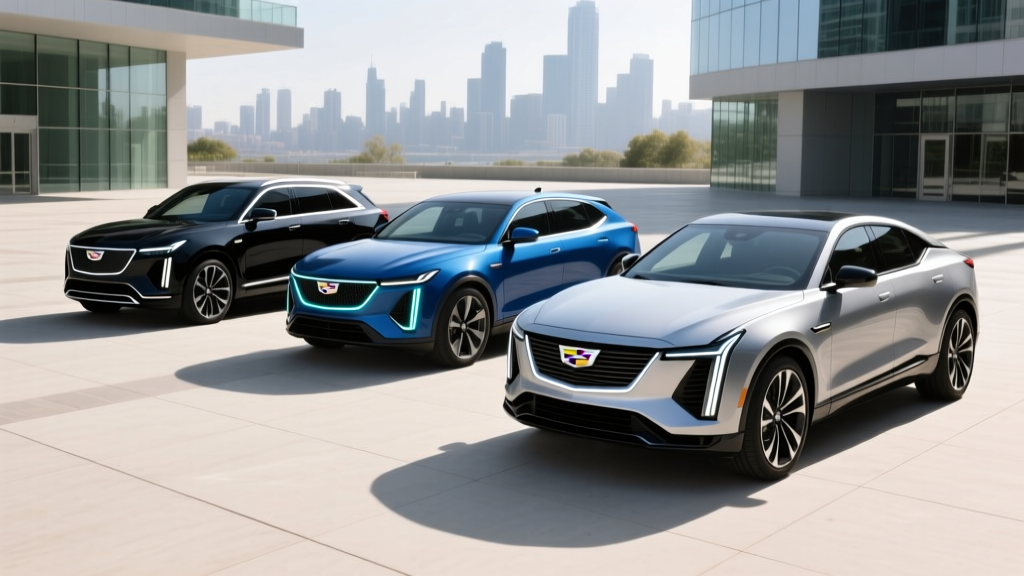
Cadillac's all-electric portfolio for 2026 spans three Ultium-based models: the Lyriq midsize SUV (314–326 mi EPA range, starting ~$59,795), the Optiq compact SUV (~300+ mi EPA range, starting ~$54,090), and the three-row Vistiq (~300 mi EPA range, starting ~$62,990). All three ride on GM's Ultium platform with 102 kWh usable battery capacity (NMC chemistry), support DC fast charging up to 190 kW (10–80% in ~30 minutes), and qualify for varying levels of the federal §30D tax credit depending on battery-sourcing compliance and buyer income. If you're cross-shopping a gas-powered Cadillac XT5 or XT6, expect $1,500–$2,200/year in fuel savings with home Level 2 charging, offset by higher insurance premiums and upfront cost.
Cadillac's 2026 Electric Vehicle Portfolio at a Glance
General Motors committed Cadillac to an electric-first future, and by the 2026 model year, the brand offers three distinct BEVs targeting different buyer segments. Each uses GM's Ultium battery architecture with a 102 kWh usable NMC (nickel-manganese-cobalt) pack, though motor configurations and tuning vary by model.
| Spec | Lyriq (Midsize SUV) | Optiq (Compact SUV) | Vistiq (3-Row SUV) |
|---|---|---|---|
| EPA Range (best trim) | 326 mi (RWD) | ~302 mi (AWD) | ~300 mi (AWD) |
| Battery (usable) | 102 kWh NMC | 102 kWh NMC | 102 kWh NMC |
| Drivetrain | RWD or AWD | AWD | AWD |
| Horsepower | 340 hp (RWD) / 500 hp (AWD) | ~400 hp | ~615 hp (V) |
| 0–60 mph | 6.0 s (RWD) / 4.6 s (AWD) | ~5.0 s | ~3.7 s (V trim) |
| DC Fast Charge (peak) | 190 kW | 190 kW | 190 kW |
| 10–80% DC Time | ~30 min | ~30 min | ~33 min |
| Level 2 (AC) | 11.5 kW / 19.2 kW option | 11.5 kW | 11.5 kW |
| MPGe (combined) | 89 MPGe (RWD) | ~85 MPGe | ~78 MPGe |
| Starting MSRP | $59,795 | $54,090 | $62,990 |
| Battery Warranty | 8 yr / 100,000 mi | 8 yr / 100,000 mi | 8 yr / 100,000 mi |
Real-World Range vs. EPA Sticker
EPA estimates assume a mix of city and highway driving at moderate temperatures. In real-world highway driving at 70+ mph, expect the Lyriq RWD to deliver ~260–280 miles before needing a charge. In cold weather (below 30°F), range can drop 20–30% due to battery resistance and cabin heating demands, putting real-world winter range around 210–250 miles for the Lyriq. The Vistiq's heavier curb weight and boxier aero profile compress its real-world highway range closer to 240–260 miles in fair conditions. All three models include a heat pump, which helps mitigate winter losses compared to resistive heating systems.
Ownership Costs: Cadillac EV vs. Gas Equivalent
The most common question from luxury SUV buyers is whether going electric actually saves money. Below is a five-year cost comparison between the Cadillac Lyriq AWD and the gas-powered Cadillac XT5 AWD — two closely matched midsize luxury SUVs.
| Category | 2026 Lyriq AWD | 2025 XT5 AWD (Gas) |
|---|---|---|
| Base MSRP | $63,795 | $50,095 |
| Est. Federal Tax Credit (§30D) | Up to $7,500* | $0 |
| Effective Purchase Price | ~$56,295 | $50,095 |
| Fuel / Electricity (5 yr) | ~$4,200 (home L2 at $0.14/kWh) | ~$10,500 ($3.50/gal, 24 MPG) |
| Maintenance (5 yr) | ~$1,200 | ~$3,500 |
| Insurance (5 yr avg) | ~$12,500 | ~$9,800 |
| Est. Depreciation (5 yr) | ~$28,000 | ~$22,000 |
| 5-Year Total Cost | ~$102,195 | ~$95,895 |
*§30D credit eligibility depends on buyer income (≤$150K single / $300K joint), MSRP caps ($80K for SUVs), and battery critical-mineral sourcing. Verify current rules at IRS.gov. Credit can be transferred to the dealer at point of sale as a purchase-price reduction.
The Lyriq's fuel and maintenance savings over five years total roughly $8,600, but higher insurance premiums (~$2,700 more) and steeper depreciation (~$6,000 more) narrow the gap. Net result: the Lyriq costs approximately $6,300 more over five years. The value proposition improves if you have access to cheap overnight electricity, drive more than 15,000 miles annually, or live in a state with additional EV rebates.
Charging the Cadillac EV Lineup: Home and Public
All three Cadillac EVs use the NACS (North American Charging Standard) connector natively, giving them direct access to Tesla Supercharger V3 and V4 stations (with 250–350 kW peak capability, though the vehicles cap at 190 kW intake) as well as GM's growing Ultium Charge network. This is a significant infrastructure advantage over CCS-only vehicles in 2026.
| Level | Power (kW) | Miles of Range per Hour | Typical Use Case |
|---|---|---|---|
| Level 1 (120V) | 1.4 kW | ~4 mi/hr | Emergency / trickle top-up |
| Level 2 (240V, 48A) | 11.5 kW | ~32 mi/hr | Home daily charging (8-hr overnight = ~250 mi) |
| Level 2 (240V, 80A) | 19.2 kW | ~52 mi/hr | Lyriq optional; faster home fills |
| DC Fast Charge | Up to 190 kW | ~190 mi in 20 min | Road trips; 10–80% in ~30 min |
Charging-Curve Reality
The 190 kW peak rate is not sustained across the entire session. The Ultium platform holds close to peak power from roughly 10–40% State of Charge (SoC), then tapers progressively. Expect the 10–80% session to average around 120–140 kW, which is why a full 10–80% charge takes ~30 minutes rather than the ~20 minutes a sustained 190 kW rate would suggest. Above 80%, charging slows dramatically to protect battery health — plan to charge to 80% on road trips and move on rather than waiting for 100%.
Home Charging Setup Costs
For a Level 2 home installation using the recommended ChargePoint Home Flex or Emporia V2 charger:
| Item | Cost Range |
|---|---|
| Level 2 EVSE (hardware) | $500 – $750 |
| Electrician (240V/60A circuit run, ~30 ft) | $800 – $2,500 |
| Permit & inspection | $100 – $300 |
| Electrical panel upgrade (if needed: 200A service) | $1,500 – $3,500 |
| Total (no panel upgrade) | $1,400 – $3,550 |
| Total (with panel upgrade) | $2,900 – $7,050 |
Not every home needs a panel upgrade. If your electrical panel has spare capacity (typically 40+ amps of headroom on a 200A service), a straightforward circuit addition keeps costs in the lower range. Have a licensed electrician perform a load calculation before committing.
Federal Tax Credit and Incentive Eligibility
The §30D Clean Vehicle Credit offers up to $7,500 for qualifying new EV purchases, but eligibility hinges on multiple requirements that change as battery supply chains evolve.
- MSRP cap: SUVs must have an MSRP ≤ $80,000. All Cadillac EV base trims qualify; fully loaded Vistiq or Lyriq trims may exceed this cap — verify the exact window sticker.
- Buyer income cap: Adjusted gross income ≤ $150,000 (single) / $225,000 (head of household) / $300,000 (joint).
- Battery sourcing: The credit splits into two halves — $3,750 for critical-mineral sourcing and $3,750 for battery-component assembly. GM has steadily increased North American sourcing for Ultium cells, but the exact credit amount (full $7,500 vs. partial $3,750) varies by model year and build date. Confirm with your dealer at purchase.
- Point-of-sale transfer: You can transfer the credit to the dealer at purchase, reducing the sale price directly rather than waiting for a tax refund. This effectively works as a down-payment reduction.
- Lease loophole: Vehicles leased (not purchased) may qualify for the commercial clean vehicle credit (§45W), which has no MSRP or income caps. Ask your dealer about lease incentives that pass this through.
For the latest eligibility details, consult the IRS Clean Vehicle Credit page and fueleconomy.gov.
Common Misconceptions About Cadillac EVs
| Myth | Fact |
|---|---|
| "The battery will need replacing in 5 years for $20K+" | GM warranties the Ultium pack for 8 years / 100,000 miles against degradation below 60% capacity. Industry data shows NMC packs losing ~10–15% capacity over 8 years with normal use. Full replacement (rarely needed) runs $12,000–$18,000. |
| "Cadillac EVs can't use Tesla Superchargers" | All 2026 Cadillac EVs have native NACS ports and can charge at Tesla Superchargers without an adapter. |
| "EVs cost more to insure — always" | Premiums are typically 15–30% higher for EVs due to repair costs and parts pricing, but the gap varies by carrier, ZIP code, and driving record. Shop multiple insurers. |
| "I need a 200A panel upgrade for home charging" | Many homes with 100A or 150A service can still install a Level 2 charger at lower amperage (32A or 40A), adding 20–28 miles of range per hour — sufficient for most daily driving. |
| "The Lyriq charges as fast as a Porsche Taycan" | The Lyriq peaks at 190 kW; the Taycan can sustain 270+ kW. The Lyriq's 10–80% time (~30 min) is adequate but not class-leading among luxury EVs. |
Decision Framework: Which Cadillac EV Fits You?
Choose the Lyriq if:
- You want maximum EPA range (326 mi RWD) and the most proven model in the lineup
- You drive 30–60 miles daily and want to charge every 3–4 days at home
- You prefer a quiet, comfort-oriented cruiser over sporty dynamics
- Two rows of seating and ~28 cu ft of cargo space meet your needs
Choose the Optiq if:
- You want the lowest entry price into Cadillac's EV lineup (~$54K)
- Compact dimensions matter for urban parking and maneuverability
- You're cross-shopping the BMW iX1, Volvo EX40, or Genesis GV60
Choose the Vistiq if:
- You need three rows and family-hauler capability without stepping to a full-size Escalade IQ
- You want the most power (615 hp in V trim) and don't mind a slight range trade-off
- You currently drive an XT6 or are considering the Lincoln Aviator
Skip Cadillac EVs (for now) if:
- You lack reliable home or workplace charging access — public-only charging adds time and cost
- You regularly tow over 3,500 lbs (towing compresses EV range by 40–50%)
- You live in a rural charging desert with minimal DC fast-charge infrastructure
What First-Time Cadillac EV Buyers Should Know
If this is your first electric vehicle, a few ownership realities differ significantly from the gas-car experience:
Preconditioning matters. Before a DC fast-charge session, the vehicle must warm (or cool) the battery to its optimal temperature window. The Lyriq, Optiq, and Vistiq will automatically precondition when you navigate to a charger in the infotainment system. Skipping preconditioning — for example, pulling into a fast charger without setting it as your destination — can reduce peak charge rates by 30–50% in cold weather.
Regenerative braking changes how you drive. All three models offer one-pedal driving mode, where lifting off the accelerator provides strong deceleration via regen, often eliminating the need for the brake pedal in stop-and-go traffic. It takes a week or two to adapt, but most EV owners prefer it once accustomed.
Maintenance is minimal but not zero. Expect tire rotations every 5,000–7,500 miles (EVs wear tires faster due to instant torque and heavier weight), cabin air filter replacement annually, and brake fluid checks every two years. Brake pads last far longer than on gas cars thanks to regen handling most deceleration — many EV owners report original pads at 80,000+ miles.
Super Cruise is Level 2, not self-driving. Cadillac's hands-free Super Cruise system is available on mapped divided highways and is among the best Level 2 driver-assist systems available. However, per SAE automation definitions, you remain the driver — eyes-on monitoring via an infrared camera is required at all times. It reduces fatigue on long trips dramatically but does not replace your attention.
SAE Automation Level: Super Cruise
Level 2 — Partial Automation. The vehicle controls steering and acceleration/braking under specific conditions (mapped highways). The driver must continuously supervise and be prepared to take over immediately. This is not autonomous driving. Only Level 4 robotaxi services (Waymo, Zoox) operate without a human driver.
Frequently Asked Questions
Does the Cadillac Lyriq qualify for the $7,500 federal tax credit?
The Lyriq is eligible for up to $7,500 under §30D, but the exact amount depends on current battery-sourcing compliance (critical minerals and component assembly requirements). Buyer income must fall below IRS caps ($150K single / $300K joint), and the vehicle MSRP must not exceed $80,000 for SUVs. Always verify the specific credit amount with your dealer and consult IRS.gov for current rules. The credit can be applied as a point-of-sale price reduction.
How long does it take to charge a Cadillac Lyriq at home?
With an 11.5 kW Level 2 home charger (48A, 240V), a full 0–100% charge takes approximately 10.5 hours. A typical overnight session from 20% to 80% takes about 5–6 hours, adding roughly 190 miles of range. The optional 19.2 kW onboard charger (available on the Lyriq) cuts this to about 6.5 hours for a full charge.
Is the Cadillac Vistiq a good EV for large families?
The Vistiq offers three rows with seating for up to seven, making it one of few luxury electric SUVs in its price range with this capability. Its ~300-mile EPA range is adequate for most family routines with home charging, but road trips with a full cabin and cargo will compress real-world range to approximately 230–260 miles. Families who regularly drive 300+ miles in a single day should plan DC fast-charge stops accordingly.
How does Cadillac's EV reliability compare to Tesla or BMW?
GM's Ultium platform is relatively new, so long-term reliability data (8+ years) is still accumulating. Early Lyriq models (2024) had some software-related issues that GM addressed via over-the-air updates. Build quality and materials generally exceed Tesla's interior standards but trail BMW's iX in fit-and-finish. For current reliability ratings, check NHTSA.gov for recalls and consumer complaints.
Can I charge a Cadillac EV at a Tesla Supercharger?
Yes. All 2026 Cadillac EVs feature the native NACS connector, which is the same connector used by Tesla Superchargers. You can pull up, plug in, and charge without any adapter. Payment is handled via the myCadillac app or the Tesla app, depending on the station.