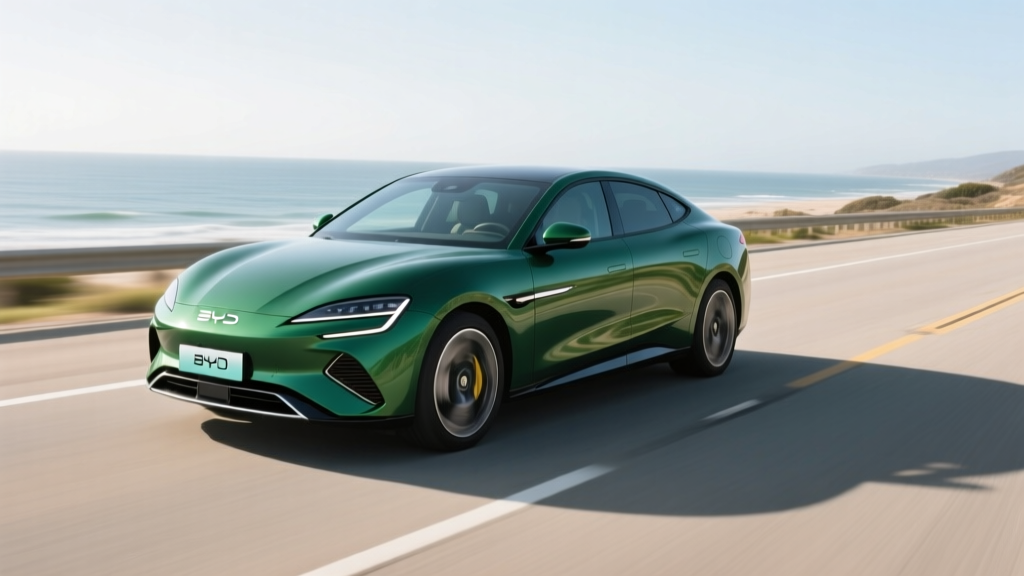
If the phrase "bate leaves Tesla" has been echoing through your social feeds or EV forums lately, you're not alone. A growing chorus of buyers is looking beyond the Model 3 and Model Y for their next electric sedan. One of the most compelling alternatives making waves globally — and increasingly discussed by U.S. shoppers — is the BYD Seal. BYD (Build Your Dreams) has emerged as Tesla's most formidable rival in the EV space, and the Seal sedan is its sharpest weapon yet.
In this deep-dive review, we put the 2026 BYD Seal under the microscope: real-world range, charging speeds, battery chemistry, pricing, tax credit eligibility, and whether it genuinely gives Tesla a run for its money. All figures reflect the latest available model-year data as of early 2026.
Quick Verdict: Is the BYD Seal a Legitimate Tesla Alternative?
The BYD Seal is a well-executed electric sport sedan that undercuts the Tesla Model 3 on price while matching or exceeding it in build quality, interior refinement, and battery technology. Its LFP Blade Battery is among the safest and longest-lasting chemistries in production. However, U.S. availability remains limited, and charging infrastructure compatibility outside Tesla's Supercharger network requires careful planning. If you can access one, the Seal deserves serious consideration as a Tesla departure.
Range, Battery, and Efficiency: What the Numbers Say
The 2026 BYD Seal is offered with two battery configurations globally. For the U.S.-spec and internationally comparable models, here's what matters:
| Spec | Standard Range | Extended Range (Design/AWD) |
|---|---|---|
| EPA Est. Range | ~295 mi | ~370 mi |
| Battery Capacity (Usable) | 61.4 kWh | 82.5 kWh |
| Battery Chemistry | LFP (Blade Battery) | LFP (Blade Battery) |
| Drivetrain | RWD | AWD (Dual Motor) |
| Horsepower | 201 hp | 523 hp |
| 0–60 mph | 7.5 sec | 3.8 sec |
| MPGe (Combined) | 128 MPGe | 112 MPGe |
| Efficiency | 26 kWh/100 mi | 30 kWh/100 mi |
The EPA sticker says 370 miles for the Extended Range AWD, but plan for reality: expect ~290–310 miles on sustained highway driving at 70+ mph, and ~240–260 miles in freezing temperatures with cabin heat running. The Standard Range RWD model delivers roughly 230–250 real-world highway miles. LFP batteries handle cold somewhat better than NMC in terms of long-term degradation, but you'll still see the same short-term range drop in winter as any EV.
BYD's Blade Battery uses lithium iron phosphate (LFP) chemistry in a cell-to-pack (CTP) architecture. The key advantage: LFP offers superior thermal stability (virtually eliminating thermal runaway risk), a longer cycle life (3,000+ full cycles before hitting 80% capacity), and no cobalt or nickel. The trade-off is lower energy density than NMC, which is why the Seal's pack is physically larger for a given range compared to some NMC-equipped competitors.
Charging Speed: DC Fast Charging and Home Level 2
Charging speed is where many buyers comparison-shop, and the Seal holds its own — though it doesn't lead the pack.
| Charging Level | Power / Rate | Speed / Time |
|---|---|---|
| Level 1 (120V Household) | ~1.4 kW | ~4 mi/hr added |
| Level 2 (240V Home/Public) | 11 kW (AC onboard charger) | ~35 mi/hr added; 0–100% in ~8.5 hr (82.5 kWh) |
| DC Fast Charge (Peak) | 150 kW (peak) | 10–80% in ~30 minutes |
| DC Sustained (Avg 10-80%) | ~95–110 kW avg | Varies by ambient temp & SoC |
Charging curve reality: The Seal peaks at 150 kW but, like most EVs, does not sustain that rate. Expect the peak to hold from roughly 10–35% state of charge (SoC), then taper to ~100 kW through 60%, and further slow above 80%. A full 10–80% session takes approximately 30 minutes at a 150+ kW charger. This is respectable but trails the Hyundai Ioniq 6 (which hits 10–80% in ~18 minutes at 350 kW stations) and the Tesla Model 3 Highland (~22 minutes at V4 Superchargers).
The Seal uses a CCS2 connector in most markets. U.S.-bound models would use CCS1, though NACS (Tesla's connector) adapters are increasingly available. Always verify connector compatibility with your local charging networks before purchasing.
Performance and Driving Dynamics
The AWD Performance variant of the Seal is genuinely quick. With 523 horsepower and a 3.8-second 0–60 mph time, it matches the Tesla Model 3 Performance in straight-line acceleration. The RWD Standard Range model is more sedate at 7.5 seconds — adequate for commuting but not thrilling.
Where the Seal distinguishes itself is ride quality. BYD uses a multi-link rear suspension and has tuned the chassis for comfort over sportiness. The result is a quieter, more compliant ride than the firm-sprung Model 3, though it sacrifices some cornering sharpness. The steering is light and accurate but lacks the communicative feedback enthusiasts prefer.
Regenerative braking offers two levels (standard and high), but unlike Tesla, the Seal does not offer true one-pedal driving that brings the car to a complete stop. You'll still use the brake pedal at low speeds — a preference-dependent difference.
Interior, Tech, and Cargo Space
The Seal's interior is where the "bate leaves Tesla" argument gains real traction. Build quality is a clear step above the Model 3's minimalist cabin, with soft-touch materials, quilted leather seats, and a more traditional (but still modern) dashboard layout.
Key interior specs:
- Rotating 15.6-inch center touchscreen (landscape or portrait orientation)
- 10.25-inch digital instrument cluster
- Wireless Apple CarPlay and Android Auto
- 12-speaker Dynaudio sound system (AWD trim)
- Panoramic glass roof with UV filtering
- Heads-up display (HUD)
- Front legroom: 41.7 in | Rear legroom: 37.4 in
- Cargo volume: 14.1 cu ft (trunk) + 1.8 cu ft (frunk)
The frunk is small compared to the Tesla Model 3's 3.1 cu ft front trunk, and total cargo space trails the Model 3's 23 cu ft (with rear seats folded). If cargo hauling is a priority, neither sedan beats a crossover, but the Model 3 edges out the Seal here.
Driver assistance: The Seal comes with BYD's ADAS suite including adaptive cruise control, lane-keeping assist, blind-spot monitoring, and automatic emergency braking. This is SAE Level 2 driver assistance — it requires your full attention and hands on the wheel at all times. It is not "self-driving." The system is competent but less aggressive in lane changes and navigation-based maneuvers compared to Tesla's Autopilot or Ford's BlueCruise.
Pricing, Tax Credits, and Total Cost
Pricing is where BYD has historically undercut competitors, and the Seal continues that tradition — though U.S. pricing depends heavily on import tariffs and market entry strategy.
| Trim | Base MSRP | Est. Federal Credit (§30D) | Effective Price |
|---|---|---|---|
| Standard Range RWD | $38,900 | Up to $7,500* | ~$31,400 |
| Extended Range RWD | $43,500 | Up to $7,500* | ~$36,000 |
| AWD Performance | $48,900 | Up to $7,500* | ~$41,400 |
*Critical tax credit caveats: The IRS §30D Clean Vehicle Credit has strict eligibility requirements that may affect the Seal:
- MSRP caps: Sedans must be ≤$55,000 (all Seal trims qualify)
- Buyer income caps: AGI ≤$150,000 (single), ≤$300,000 (joint filing)
- Battery sourcing rules: Critical minerals and battery components must meet escalating domestic/free-trade-partner thresholds. As a Chinese-manufactured vehicle, the Seal's eligibility for the full $7,500 is uncertain and subject to change — consult a tax professional and check the latest fueleconomy.gov listings before purchasing.
- Point-of-sale transfer: Eligible buyers can transfer the credit to the dealer for an upfront price reduction
Compared to a 2026 Tesla Model 3 Long Range AWD (~$47,740 MSRP), the Seal AWD Performance undercuts by several thousand dollars while offering comparable acceleration and superior interior quality. However, the Model 3 benefits from established Supercharger access and known U.S. tax credit eligibility.
Warranty and Long-Term Ownership
BYD backs the Seal with competitive warranty coverage:
- Basic vehicle warranty: 6 years / 100,000 miles
- Battery & powertrain warranty: 8 years / 125,000 miles (capacity retention guaranteed above 70%)
- Blade Battery expected lifespan: 3,000+ full charge cycles, translating to roughly 500,000+ miles before hitting 80% State of Health (SoH) — well beyond the warranty period
LFP chemistry is the star here. While NMC batteries in many competitors degrade faster with repeated fast charging and high SoC storage, LFP is far more resilient. BYD recommends regularly charging to 100% (unlike NMC owners who are told to stop at 80% for daily use), which simplifies ownership and gives you full range more often.
Pros and Cons: The Honest Assessment
Pros
- LFP Blade Battery: industry-leading safety and cycle life
- Premium interior quality surpasses Tesla Model 3
- Competitive pricing, especially after potential tax credits
- AWD Performance variant matches Model 3 Performance 0–60
- Rotating 15.6" screen with wireless CarPlay/Android Auto
- Can charge to 100% daily without degradation concern (LFP advantage)
- 8-year/125,000-mile battery warranty
Cons
- 150 kW peak DC charging trails Ioniq 6 and Model 3
- Limited U.S. dealer and service network
- Federal tax credit eligibility uncertain due to China manufacturing
- Small frunk (1.8 cu ft) and modest total cargo space
- No true one-pedal driving mode
- ADAS less refined than Tesla Autopilot or Ford BlueCruise
- Brand recognition and resale value unproven in U.S. market
Who Should Buy the BYD Seal?
Choose the BYD Seal if: You want a premium electric sedan with best-in-class battery longevity, value a refined interior over brand cachet, have reliable home Level 2 charging, and can verify tax credit eligibility in your situation.
Stick with the Tesla Model 3 if: You rely on the Supercharger network for road trips, want the most proven U.S. service infrastructure, prefer one-pedal driving, or need confirmed §30D tax credit eligibility without sourcing uncertainty.
Consider the Hyundai Ioniq 6 if: Ultra-fast 800V charging (10–80% in 18 min) is your top priority, and you want a U.S.-established dealer network with clear tax credit eligibility.
Frequently Asked Questions
What is the real-world range of the BYD Seal?
The Extended Range AWD model carries a ~370-mile EPA estimate, but expect 290–310 miles in real-world highway driving and 240–260 miles in cold weather. The Standard Range RWD delivers roughly 230–250 real-world highway miles.
How fast does the BYD Seal charge?
DC fast charging peaks at 150 kW, achieving 10–80% in approximately 30 minutes. Home Level 2 charging at 11 kW adds about 35 miles per hour, fully charging the 82.5 kWh pack in roughly 8.5 hours.
Does the BYD Seal qualify for the $7,500 federal EV tax credit?
Potentially, but it's complicated. The Seal's MSRP falls under the $55,000 sedan cap, but IRS §30D battery-sourcing and critical-mineral requirements may reduce or eliminate the credit for China-manufactured vehicles. Always check the latest IRS guidance and consult a tax professional before relying on the credit.
Is the BYD Seal better than the Tesla Model 3?
It depends on priorities. The Seal wins on interior quality, battery chemistry safety, and pricing. The Model 3 wins on charging speed, Supercharger network access, proven U.S. service infrastructure, and driver-assistance technology. Both are excellent electric sedans.
Can I charge a BYD Seal at Tesla Superchargers?
Not natively. The Seal uses CCS connectors. However, as Tesla opens Superchargers to non-Tesla EVs via the NACS standard and CCS adapters, access is expanding. Check the Tesla app for compatible stations in your area.
How long will the BYD Blade Battery last?
BYD's LFP Blade Battery is rated for 3,000+ full charge cycles before degrading to 80% capacity. At an average of 15,000 miles driven per year, this translates to well over 500,000 miles — far exceeding the 8-year/125,000-mile warranty. LFP chemistry also tolerates daily 100% charging better than NMC.
Sources: fueleconomy.gov (EPA range and efficiency data), IRS §30D Clean Vehicle Credit (tax credit eligibility rules), BYD official specifications (2026 model year). Pricing and availability subject to change; verify with local dealers.