Quick Verdict: BYD's Electric Hypercar Sets a New Top-Speed Benchmark
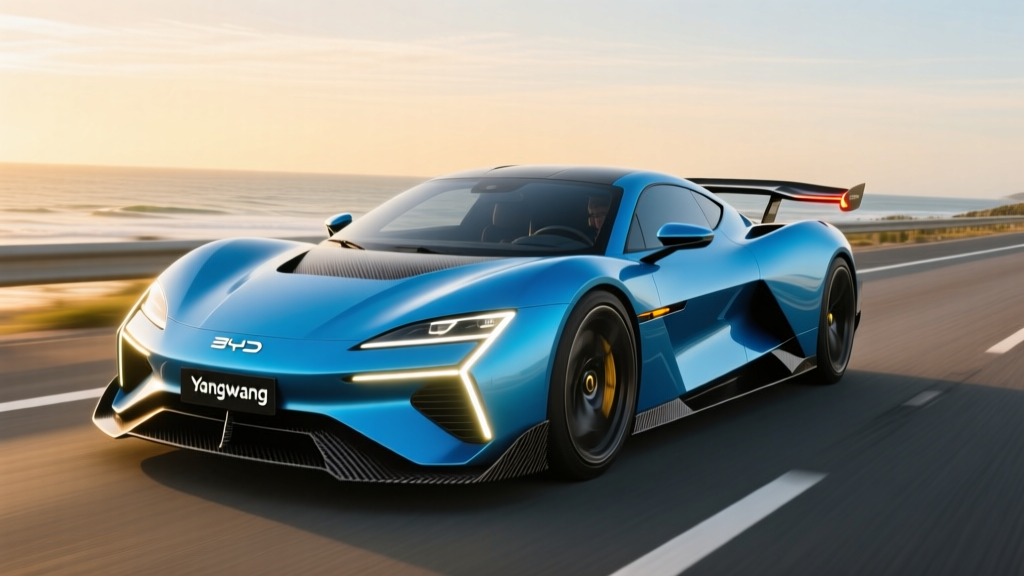
The BYD Yangwang U9 Xtreme is not a practical daily driver, and it doesn't pretend to be. With a verified top speed of 217 mph (350 km/h) and a four-motor powertrain producing over 1,300 horsepower, this electric hypercar exists to shatter perceptions of what a Chinese-built EV can achieve on the global performance stage. It's a halo product — a rolling showcase of BYD's e4 (Easy Four) torque-vectoring platform, designed to pull technological prestige down into the broader Yangwang and BYD lineups.
For the handful of buyers in markets where it's sold (primarily China, the Middle East, and select European countries — not the United States as of 2026), the U9 Xtreme offers a genuinely unique proposition: supercar-rivaling performance paired with a surprisingly compliant DiSus-X active suspension that can even launch the car into a literal jump. But make no mistake — this is a low-volume engineering statement, not a volume seller. Below, we break down every spec that matters.
| Specification | BYD Yangwang U9 Xtreme |
|---|---|
| Top Speed | 217 mph (350 km/h) |
| 0-60 mph | ~2.36 seconds (manufacturer claim) |
| Horsepower | ~1,300 HP (960 kW) |
| Drivetrain | Quad-motor AWD (e4 platform) |
| Battery Capacity | 80 kWh (usable, estimated) — BYD Blade LFP |
| CLTC Range | ~280 miles (450 km) |
| EPA Range | Not rated (not sold in US) |
| Max DC Fast Charge | ~200 kW (dual-gun capable) |
| 10-80% DC Charge | ~25-30 minutes (estimated) |
| Level 2 Home Charge | ~11 kW AC (~25 miles/hr) |
| Suspension | DiSus-X active hydraulic + air |
| Curb Weight | ~5,400 lbs (2,450 kg) |
| Base Price (China) | ¥1,680,000 (~$230,000 USD) |
| US Availability | Not available (no US sales) |
Range and Efficiency: What CLTC Means in the Real World
The Yangwang U9 Xtreme carries an estimated 80 kWh usable battery pack built on BYD's proprietary Blade cell architecture — a lithium iron phosphate (LFP) chemistry that prioritizes thermal stability and cycle life over the energy density you'd get from an NMC (nickel manganese cobalt) pack. In a hypercar application, LFP is an unusual choice: it's heavier and less energy-dense, but its resistance to thermal runaway gives BYD a safety narrative that matters when you're pushing 1,300 HP through four independent motors.
CLTC Sticker Range: ~280 miles (450 km)
Estimated Real-World Highway (70 mph): ~165-190 miles
Track / Aggressive Driving: ~60-90 miles before needing a charge
Cold-Weather Impact (below 32°F): Expect 15-25% range reduction from the already-modest baseline
Because the U9 is not sold in the United States, it has no EPA range rating. The Chinese CLTC (China Light-Duty Vehicle Test Cycle) standard is notably more generous than the EPA's testing methodology — typically inflating range figures by 20-30% compared to what American drivers experience. A CLTC-rated 280-mile hypercar with 1,300 HP, aggressive aero drag, and a heavy LFP pack will realistically deliver 165-190 miles on a highway cruise at moderate speeds, and far less under hard driving. This is a car designed for sprint performance, not cross-country touring.
Efficiency is predictably poor by mainstream EV standards. Expect consumption in the neighborhood of 55-70 MPGe equivalent under mixed driving, or roughly 55-70 kWh per 100 miles during aggressive use. For context, a Tesla Model S Plaid achieves around 120 MPGe combined. The U9 trades efficiency for raw output, and its buyers won't care.
Charging Speed: DC Fast, Dual-Gun, and Home Charging
Charging a hypercar is always a compromise between battery size, charge acceptance, and the thermal limits of the pack. The U9 Xtreme supports DC fast charging at an estimated peak of ~200 kW, and in the Chinese market it can leverage BYD's dual-gun charging protocol — plugging into two CCS or GB/T chargers simultaneously to effectively double the charge rate at compatible stations.
| Charging Level | Power / Rate | Estimated Speed |
|---|---|---|
| Level 1 (120V AC) | ~1.4 kW | ~2-3 miles per hour |
| Level 2 (240V AC) | ~11 kW | ~25 miles per hour |
| DC Fast Charge (single gun) | Up to ~200 kW peak | 10-80% in ~25-30 min |
| DC Fast (dual-gun, China) | Up to ~400 kW combined | 10-80% in ~15 min |
The LFP Blade chemistry has implications for the charge curve. Unlike NMC packs that sustain high charge rates up to around 80% state of charge before tapering sharply, LFP cells tend to have a flatter voltage curve through the mid-range but can taper earlier near the top. Expect the U9 to hold strong charge rates through roughly 70-75% SoC before slowing noticeably. For a hypercar with a modest 80 kWh pack, the 10-80% window is the one that matters — and 25-30 minutes on a single 200 kW charger is acceptable for a car you'll mostly charge at home between track sessions or weekend drives.
Home Level 2 charging at 11 kW will replenish the pack from empty to full in roughly 7-8 hours, which is standard for the segment. Hypercar owners will almost exclusively charge at home or at destination chargers, making public DC fast charging a secondary concern.
Performance: 1,300 HP, 2.36-Second 0-60, and the e4 Platform
This is the headline section, and the numbers are staggering. The Yangwang U9 Xtreme deploys BYD's e4 (Easy Four) platform — four independent electric motors, one at each wheel, each producing roughly 325 HP. Combined output reaches approximately 1,300 horsepower (960 kW) and over 1,200 lb-ft of torque, distributed with millisecond-precision torque vectoring.
The manufacturer-claimed 0-60 mph time of 2.36 seconds places the U9 Xtreme in elite hypercar territory, rivaling the Rimac Nevera and trading blows with the Lotus Evija. The verified top speed of 217 mph was achieved on BYD's test track and represents a genuine engineering milestone for a Chinese automaker — particularly one using a heavier LFP battery pack rather than the lighter NMC cells favored by European hypercar builders.
But the e4 platform's party trick isn't straight-line speed. Independent wheel motors enable 360-degree tank turns (the car can spin in place), torque-based stability control that reacts faster than any mechanical ESC system, and a unique three-wheel driving mode — if one tire blows out, the remaining three motors can compensate and bring the car to a controlled stop. These aren't gimmicks; they represent a fundamental rethink of vehicle dynamics that mechanical drivetrains simply cannot replicate.
The DiSus-X suspension is equally remarkable. This active hydraulic-pneumatic system can adjust ride height and damping at each corner independently and rapidly enough to literally jump the car off the ground — a demonstration feature that went viral and showcases the suspension's ability to manage extreme body forces. On the road, it translates to remarkably flat cornering and the ability to absorb sharp impacts without upsetting the chassis.
Pricing, Availability, and US Tax Credit Status
Let's address the elephant in the room immediately: the BYD Yangwang U9 Xtreme is not available for purchase in the United States as of 2026. BYD does not sell passenger vehicles in the US market, and ongoing trade tariffs on Chinese-built electric vehicles (currently 100% under Section 301) make any near-term US launch economically impossible. This means US-specific pricing, dealer networks, and federal tax credit eligibility under IRS §30D are entirely moot.
| Market | Base Price | USD Equivalent | Tax Credit |
|---|---|---|---|
| China (domestic) | ¥1,680,000 | ~$230,000 | China NEV subsidies apply |
| Middle East (UAE) | ~AED 950,000 | ~$258,000 | No EV credit |
| Europe (select markets) | ~€245,000 | ~$265,000 | Varies by country |
| United States | Not available | N/A | N/A — not sold in US |
For international buyers who can access the U9 Xtreme, pricing starts around the equivalent of $230,000 USD in China, rising to approximately $265,000 in European markets after import duties and homologation costs. This positions it below the Rimac Nevera (~$2.4M) and Lotus Evija (~$2.1M) but above the Tesla Model S Plaid (~$108,000) and Porsche Taycan Turbo GT (~$230,000). It competes most directly with the Porsche Taycan Turbo GT and the high-end trim of the Lucid Air Sapphire (~$250,000) on performance-per-dollar.
For US readers tracking this car out of interest: the IRS §30D federal tax credit (up to $7,500) requires vehicles to be assembled in North America, meet critical mineral and battery component sourcing thresholds, fall under MSRP caps ($55,000 for sedans, $80,000 for SUVs/trucks), and the buyer must meet income limits ($150K single / $300K joint). The U9 fails every one of these requirements — it's built in China, priced far above the cap, and isn't sold stateside.
Interior, Technology, and Cargo Practicality
The U9's cabin follows the hypercar playbook: two seats, aggressive bolstering, carbon fiber and Alcantara surfaces, and a driver-focused digital layout. The centerpiece is a large portrait-oriented infotainment screen (estimated 12.8 inches) running BYD's DiLink system, supplemented by a digital instrument cluster and a head-up display. The system supports navigation, media, vehicle dynamics controls (including suspension, torque distribution, and drive modes), and over-the-air updates.
Driver assistance is present but deliberately limited compared to mainstream BYD models. Expect SAE Level 2 features including adaptive cruise control, lane-keeping assist, and automated emergency braking — but nothing approaching autonomous driving. This is a driver's car, and BYD has calibrated the assists accordingly. There is no Autopilot-style hands-off system here; the driver remains fully responsible at all times.
Cargo space is minimal, as expected in a mid-engine-style hypercar layout. There is a small front trunk (frunk) estimated at 3-4 cubic feet — enough for a small duffel bag or a charging cable kit — and a shallow rear shelf behind the seats. There is no rear seat, no tow rating, and no pretense of practicality. Passenger space is limited to two occupants, with generous headroom and shoulder room but fixed racing-style seats that prioritize lateral support over long-distance comfort.
Battery Warranty and Long-Term Ownership
BYD's Blade LFP battery is one of the most durable chemistries in production. LFP cells typically sustain 3,000-5,000 full charge cycles before reaching 80% state of health (SoH) — far exceeding the 1,000-2,000 cycles typical of NMC chemistry. For a hypercar that will likely be driven 3,000-5,000 miles per year (if that), cycle-based degradation is essentially a non-issue. Calendar aging will be the primary degradation factor, and LFP handles that well too.
In the Chinese domestic market, BYD offers a lifetime battery warranty for the first owner on Yangwang models (with annual mileage caps, typically 30,000 km/year). For international markets, expect a more conventional 8-year / 100,000-mile equivalent battery and powertrain warranty with a capacity retention threshold of 70-80% — though exact terms vary by region and have not been published for all export markets.
Replacement cost for an 80 kWh Blade pack is estimated at $15,000-$25,000 based on BYD's internal cell pricing, though hypercar labor and calibration costs could push a full replacement higher. Given the low production volume, aftermarket options will be essentially nonexistent.
Pros, Cons, and Who Should Consider This EV
Pros
- Verified 217 mph top speed — among the fastest EVs ever produced
- 1,300 HP with four independent motors enables unprecedented torque vectoring
- DiSus-X suspension with jump capability is a genuine engineering showcase
- LFP Blade battery offers exceptional thermal safety and cycle life
- 360-degree tank turns and three-wheel driving mode add real utility
- Priced dramatically below European hypercar rivals (Rimac, Lotus)
Cons
- Not available in the United States — no path to US sales in near term
- Real-world range likely under 200 miles highway; under 100 miles under hard driving
- Heavy curb weight (~5,400 lbs) limits agility compared to lighter hypercars
- LFP pack trades energy density for safety — limits range potential
- Low production volume means limited service infrastructure outside China
- No independent crash-test ratings (NHTSA/IIHS) available
Who this EV suits: The Yangwang U9 Xtreme is built for wealthy enthusiasts in BYD's accessible markets who want a conversation-starting electric hypercar with genuine, record-setting performance. It's a weekend and track-day car, not a daily driver. If you're in the US reading this out of admiration, the closest domestic alternatives delivering similar performance thrills are the Lucid Air Sapphire (1,234 HP, 0-60 in 1.89s, EPA 427 miles, ~$250,000) and the Tesla Model S Plaid (1,020 HP, 0-60 in 1.99s, EPA 396 miles, ~$108,000).
Frequently Asked Questions
What is the BYD Yangwang U9 Xtreme top speed?
The Yangwang U9 Xtreme has a verified top speed of 217 mph (350 km/h), achieved on BYD's test track. This makes it one of the fastest production electric vehicles ever built, though it falls short of the Rimac Nevera's 258 mph record.
Can I buy the BYD Yangwang U9 in the United States?
No. BYD does not sell passenger vehicles in the US market as of 2026, and 100% Section 301 tariffs on Chinese-built EVs make any near-term US launch economically unfeasible. US buyers seeking similar performance should look at the Lucid Air Sapphire or Tesla Model S Plaid.
What battery does the U9 Xtreme use, and how long will it last?
The U9 uses an estimated 80 kWh BYD Blade LFP (lithium iron phosphate) battery. LFP chemistry typically supports 3,000-5,000 full charge cycles to 80% SoH, meaning the pack should far outlast the car's useful life under typical hypercar mileage. BYD offers a first-owner lifetime battery warranty in China.
How fast does the Yangwang U9 charge?
On a single DC fast charger, the U9 peaks at approximately 200 kW, achieving a 10-80% charge in roughly 25-30 minutes. In China, dual-gun charging at compatible stations can reduce this to around 15 minutes. Home Level 2 charging at 11 kW takes about 7-8 hours for a full charge.
Does the BYD Yangwang U9 qualify for any US tax credits?
No. The vehicle is not sold in the US, is not assembled in North America, and far exceeds the IRS §30D MSRP cap of $55,000 for sedans. It fails every eligibility criterion for the federal clean vehicle credit.
How does the U9 compare to the Rimac Nevera or Lotus Evija?
The U9 is significantly less powerful than the Nevera (1,914 HP) and Evija (~2,000 HP), and its top speed is lower. However, at roughly $230,000-$265,000 depending on market, it costs one-tenth the price of either European rival. It trades ultimate performance for accessibility and showcases unique features like DiSus-X suspension and e4 torque vectoring that neither competitor offers.
Is the DiSus-X suspension jump feature practical?
The jump demonstration is primarily a marketing showcase proving the suspension's extreme force-generation capability. In practice, DiSus-X delivers real value through millisecond-level damping adjustments that keep the car flat through corners, absorb sharp impacts without chassis upset, and enable the three-wheel driving mode. The jump is impressive but not something owners will use regularly.