The BYD Supercar Arrives: Meet the Yangwang U9
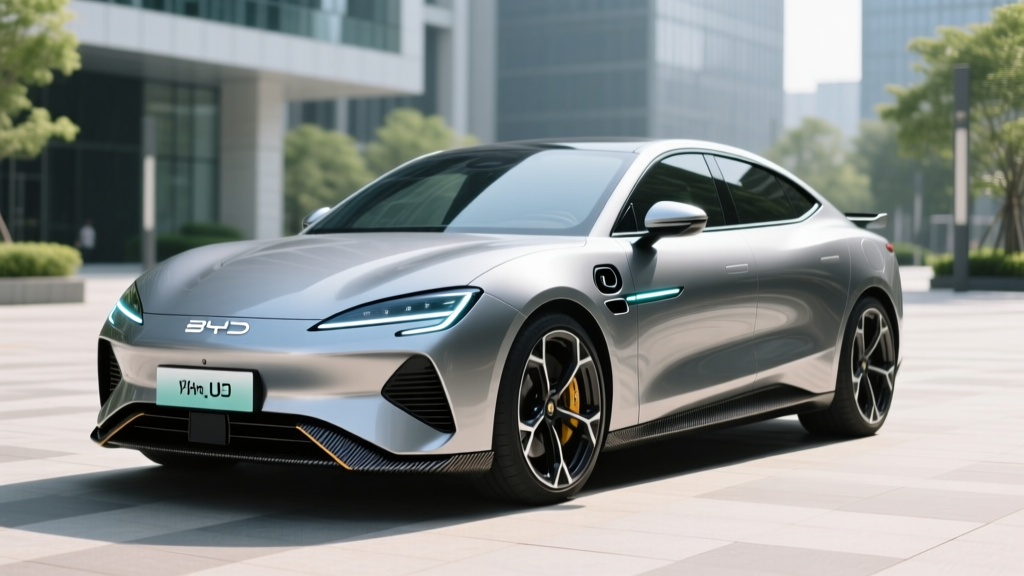
When enthusiasts search for a "BYD super car," they are almost always looking for the Yangwang U9 — the all-electric hypercar that sits at the pinnacle of BYD's luxury sub-brand. Unveiled in early 2024 and now in limited production for the Chinese market, the U9 is a technological showcase: four independent motors, over 1,300 horsepower, and BYD's latest Blade battery architecture. But can a 5,500-pound electric supercar deliver on the track, and more importantly for our readers, does it have any path to US showrooms?
This review breaks down everything we know about the Yangwang U9's range, charging, performance, pricing, and ownership proposition — with the exact numbers and real-world caveats you need to evaluate any EV purchase.
The Yangwang U9 carries a CLTC-rated range of approximately 280 miles (450 km). CLTC is China's optimistic test cycle; the equivalent EPA estimate would likely fall between 210–240 miles based on typical CLTC-to-EPA conversion factors of 20–30% reduction. Expect real-world highway driving at 75+ mph to yield closer to 180–200 miles, and cold-weather operation (below 32°F) could reduce that by another 15–25%, putting winter range in the 140–170 mile neighborhood.
Yangwang U9 Specifications at a Glance
| Spec | Yangwang U9 |
|---|---|
| Drivetrain | Quad-motor AWD (e4 platform) |
| Horsepower | ~1,300 HP (960 kW) |
| 0–60 mph | 2.36 seconds (claimed) |
| Top Speed | 190 mph (306 km/h) |
| Battery Capacity | ~80 kWh usable (BYD Blade LFP) |
| CLTC Range | ~280 mi (450 km) |
| Est. EPA Range | ~210–240 mi (unofficial) |
| Max DC Fast Charge | Dual-gun ~500 kW peak (China); single-port ~210 kW (est.) |
| 10–80% DC Charge | ~15 min (dual-gun, China); ~25 min (single-port, est.) |
| Level 2 Home Charge | ~11 kW AC (~25–30 mi/hr added) |
| Curb Weight | ~5,512 lb (2,500 kg) |
| Base Price (China) | ¥1,680,000 (~$232,000 USD) |
| US Availability | Not available — no announced US launch |
Battery Chemistry and Energy Storage
The Yangwang U9 uses BYD's proprietary Blade battery — a lithium iron phosphate (LFP) cell design arranged in long, thin prismatic modules that serve a structural role within the chassis. LFP chemistry trades some energy density for superior thermal stability and longer cycle life compared to nickel-manganese-cobalt (NMC) packs.
For a supercar application, this is an unusual choice. Most performance EVs — the Porsche Taycan, Rimac Nevera, Lotus Evija — use NMC or NCA chemistries to maximize energy density and discharge rates. BYD's decision to stick with LFP reflects both their manufacturing scale advantage in Blade cells and a safety-first philosophy. The trade-off is a heavier pack for a given capacity, which contributes to the U9's substantial 5,500-pound curb weight.
The ~80 kWh usable capacity is modest for a vehicle of this performance class. For context, the Rimac Nevera packs 120 kWh, and the Lotus Evija holds 70 kWh but weighs significantly less. The U9's efficiency will be critical — and with four motors and this mass, expect consumption around 45–55 kWh/100 mi under spirited driving, or roughly 60–75 MPGe equivalent.
Charging Speed: DC Fast and Home Level 2
Charging infrastructure compatibility is where the U9's China-market focus becomes most apparent.
| Charging Level | Power | Speed | Notes |
|---|---|---|---|
| Level 1 (120V) | ~1.4 kW | ~3 mi/hr | Emergency/trickle only |
| Level 2 (240V AC) | ~11 kW | ~25–30 mi/hr | Full charge in ~8 hours |
| DC Fast (single-port) | ~210 kW peak | 10–80% in ~25 min | CCS2/GB/T dependent on market |
| DC Fast (dual-gun, China) | ~500 kW peak | 10–80% in ~15 min | Requires dual-cable GB/T stations |
The dual-gun DC charging capability is a BYD innovation that splits the incoming current across two charge ports simultaneously. This is brilliant for China's GB/T charging ecosystem, which maxes individual connectors at ~250 kW, but it has no equivalent in North America's NACS or CCS infrastructure. If the U9 ever reaches US shores, owners would be limited to single-port speeds of approximately 210 kW — still fast, but not class-leading versus the Porsche Taycan's 320 kW capability on 800V architecture.
Charge curve reality: Like all EVs, the U9 will not sustain peak kW for the full session. Expect peak rates from 10–40% SoC, tapering to ~120 kW by 60%, and dropping below 50 kW above 85%. The 10–80% time is the meaningful metric, and ~25 minutes on a single port is competitive but not exceptional for a 2026 supercar.
Performance: Four Motors and the e4 Platform
The Yangwang U9 is built on BYD's e4 platform, which assigns one motor to each wheel. This enables torque vectoring at a resolution impossible with mechanical differentials — each wheel's torque output is independently controlled thousands of times per second.
The claimed 2.36-second 0–60 mph time places the U9 in elite company, rivaling the Rimac Nevera (1.85s) and well ahead of most production supercars. The ~1,300 HP figure comes from the combined output of four permanent-magnet synchronous motors.
Beyond straight-line speed, the e4 platform enables the U9's party trick: DiAct (Diagonal Actuator) active suspension. This system can raise the car on three wheels (demonstrated in launch events), perform a controlled jump, and actively manage body roll without traditional anti-roll bars. It is a genuine engineering milestone, though its practical benefit on a daily-driven supercar is debatable.
For comparison, the quad-motor Mercedes-AMG EQS sedan delivers similar motor independence but in a luxury sedan context. The U9 applies the concept to a two-door supercar with a carbon-fiber monocoque chassis.
Pricing, Tax Credits, and US Availability
Here is where the conversation shifts from "impressive" to "complicated."
| Pricing Factor | Details |
|---|---|
| China MSRP | ¥1,680,000 (~$232,000 USD at current exchange rates) |
| Estimated US Price (if imported) | $275,000–$320,000 (incl. tariffs, homologation, dealer markup) |
| Federal §30D Tax Credit | Not eligible — BYD is a Chinese OEM; battery sourcing and critical-mineral requirements under IRS §30D rules exclude vehicles with Chinese-manufactured battery components |
| MSRP Cap (§30D) | Even if eligible, the $80,000 sedan MSRP cap would disqualify it |
| US Market Status | Not available. BYD has not announced any US passenger-vehicle launch. 100% tariff on Chinese EVs (2024+) makes import economically prohibitive. |
The federal EV tax credit under IRS §30D requires that the vehicle's battery components be manufactured or assembled in North America, with critical minerals sourced from the US or free-trade-agreement partners. A BYD vehicle with a BYD Blade battery fails every prong of this test. Even setting sourcing aside, the §30D MSRP cap of $80,000 for sedans (and $80,000 for SUVs/pickups/trucks) would eliminate the U9 regardless.
As of 2026, the United States imposes a 100% tariff on Chinese-manufactured electric vehicles, a policy enacted in 2024. This effectively doubles the import price, pushing a U9 well past $400,000 landed — before dealership margins, state registration, or insurance.
Interior, Technology, and Daily Usability
The U9's cabin follows a minimalist supercar template: a large central touchscreen (estimated 12.8-inch rotating display, a BYD signature), a digital instrument cluster, and a flat-bottom steering wheel. Materials include Alcantara, carbon fiber trim, and sport bucket seats with multi-point harness provisions.
Standout tech features:
- DiAct active suspension — full-body articulation, jump mode, and active roll compensation
- e4 torque vectoring — independent wheel control for cornering and stability
- Tank turns — the four-motor layout enables 360-degree pivots (demonstrated on the U8 SUV; expected on U9)
- BYD ADAS suite — adaptive cruise, lane-keeping, and automated parking (SAE Level 2; driver supervision required at all times)
- OTA updates — over-the-air software improvements for powertrain and infotainment
Notable drawbacks:
- No frunk — the front trunk space is consumed by power electronics and suspension components
- Limited cargo — a small rear shelf behind the seats; total cargo estimated at ~5 cu ft
- Ground clearance — low, even by supercar standards; the active suspension helps but speed bumps remain a concern
- Infotainment ecosystem — BYD's software is optimized for Chinese apps and services; international versions may lack familiar integrations (Apple CarPlay support is inconsistent across BYD's lineup)
Who Should Consider the Yangwang U9?
Let's be direct: the Yangwang U9 is not a vehicle you can currently purchase in the United States. It is a China-market halo car that demonstrates BYD's engineering ambition. For US-based readers, the U9 matters as a technology benchmark, not a shopping option.
This EV suits best (in markets where it's sold):
- Track-day enthusiasts who want four-motor torque vectoring and active suspension in an electric package
- BYD brand loyalists in China upgrading from a Han EV or Seal to the flagship
- Supercar collectors seeking a rare, technologically novel electric entry
US buyers looking for electric performance should instead consider: the Porsche Taycan Turbo GT (up to 1,019 HP, EPA 269 mi, ~$230,000), the Tesla Model S Plaid (1,020 HP, EPA 396 mi, ~$108,000), or the upcoming Lotus Eletre R for SUV performance.
✅ Pros
- Quad-motor e4 platform with genuine torque vectoring
- 2.36-second 0–60 mph — elite acceleration
- DiAct active suspension is a genuine engineering first
- LFP Blade battery offers excellent thermal safety
- Dual-gun DC charging (in China) is extremely fast
❌ Cons
- Not available in the United States — no announced plans
- 100% US tariff on Chinese EVs makes import impractical
- Heavy at 5,500 lbs — limits handling agility vs. European rivals
- Modest ~80 kWh battery for a supercar; range is limited
- No federal tax credit eligibility under §30D
- Dual-gun charging incompatible with NACS/CCS infrastructure
Warranty and Ownership Costs
BYD has not published a formal warranty schedule for the Yangwang U9 specifically. For context, BYD's standard passenger-vehicle warranty in China covers:
- Vehicle: 6 years / 150,000 km (~93,000 miles)
- Battery (Blade LFP): 8 years / 160,000 km (~99,000 miles) with a capacity-retention threshold of 70%
- Drive motors: 8 years / 150,000 km
These figures are competitive but fall short of the US-standard 8-year/100,000-mile battery warranty mandated for emissions-related components, which most US-market EVs match or exceed. For a $230,000+ supercar, the coverage feels thin — Porsche, for comparison, offers 8 years/100,000 miles on the Taycan battery with a 70% retention guarantee, plus 4 years/50,000 miles bumper-to-bumper.
Insurance costs for a 1,300 HP Chinese-market EV with no US crash-test data (NHTSA and IIHS have not evaluated the U9) would likely be prohibitive even if the car could be imported. Expect annual premiums well above $10,000 from specialty insurers.
Frequently Asked Questions
What is the real-world range of the BYD Yangwang U9?
The CLTC-rated range is approximately 280 miles. Converted to EPA-equivalent testing, expect roughly 210–240 miles. In real-world highway driving at sustained speeds above 70 mph, plan for 180–200 miles. Cold weather (below freezing) can reduce range by 15–25%, yielding as little as 140–170 miles in winter conditions.
How fast does the Yangwang U9 charge?
On a DC fast charger, the U9 supports approximately 210 kW peak via a single port (10–80% in roughly 25 minutes). In China, dual-gun GB/T charging enables up to ~500 kW peak (10–80% in about 15 minutes). At home on Level 2 (240V, 11 kW), a full charge takes approximately 8 hours, adding about 25–30 miles of range per hour.
Does the BYD Yangwang U9 qualify for the US federal EV tax credit?
No. Under IRS §30D rules, the U9 fails multiple eligibility criteria: its battery components are manufactured in China (violating the foreign-entity-of-concern and North-American-assembly requirements), and its MSRP far exceeds the $80,000 cap for sedans. Additionally, BYD does not sell passenger vehicles in the US market.
Can I buy the Yangwang U9 in the United States?
Not currently. BYD has not announced any US passenger-vehicle sales, and the 100% tariff on Chinese EVs enacted in 2024 makes importing the U9 economically impractical. A landed cost exceeding $400,000 — before dealer markup — places it in a price bracket dominated by established European marques with US service networks.
Is the Yangwang U9 worth buying vs. competitors?
For US buyers, the question is moot — it is not purchasable. In markets where it is sold, the U9 competes on technology (quad-motor torque vectoring, active suspension) but loses on weight, range, and brand prestige versus the Porsche Taycan Turbo GT, Rimac Nevera, and Lotus Evija. It is a compelling engineering statement, not yet a practical supercar purchase outside China.
What battery chemistry does the U9 use, and does it degrade?
The U9 uses BYD's Blade battery with LFP (lithium iron phosphate) chemistry. LFP cells typically degrade more slowly than NMC — data from BYD's broader lineup suggests 10–12% capacity loss over 8 years of typical use. LFP also tolerates regular 100% charging without the degradation concerns that NMC owners face, though the U9's battery-management system likely includes a top-end buffer regardless.