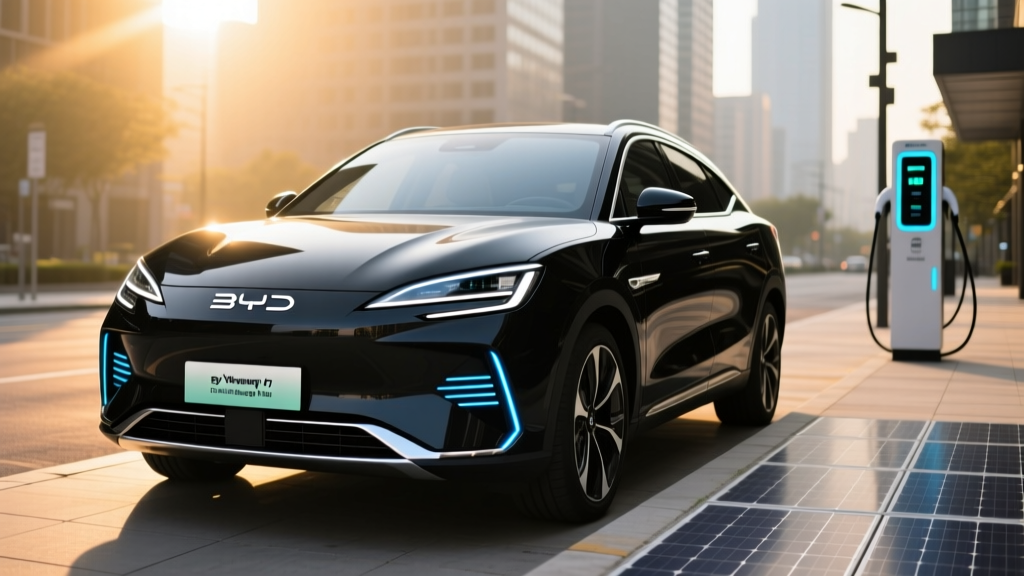
The BYD Yangwang U7 is the flagship electric sedan from China's largest automaker, positioned to challenge the Mercedes EQS, Porsche Taycan, and Tesla Model S in the ultra-luxury EV segment. With a massive 135.5 kWh Blade (LFP) battery, a four-motor e4 powertrain producing over 1,300 horsepower, and a starting price in China equivalent to roughly $140,000, the U7 is BYD's most ambitious vehicle to date. But for US-based EV shoppers researching the BYD Yangwang U7 cost, the picture is complicated: as of early 2026, the U7 is not sold in the United States, and steep tariffs on Chinese-made vehicles make a near-term US launch unlikely. This review covers everything we know from confirmed Chinese-market specs, translates the pricing for American buyers, and assesses whether the U7's technology justifies its premium positioning.
BYD Yangwang U7: Key Specifications at a Glance
| Specification | Yangwang U7 (China-Spec, 2025/2026) |
|---|---|
| Base Price (China MSRP) | ¥628,000 (~$86,500 USD) |
| Top Trim Price (China MSRP) | ¥708,000 (~$97,500 USD) |
| Estimated US Price (if imported, pre-tariff) | $140,000–$160,000+ (est.) |
| Battery Capacity | 135.5 kWh (usable est. ~130 kWh) |
| Battery Chemistry | LFP (BYD Blade Battery) |
| CLTC Range | 800 km (497 miles) |
| EPA Range (Estimated) | ~380–410 miles (not EPA-certified) |
| Powertrain | Quad-motor AWD (e4 platform) |
| Horsepower | ~1,300 hp (960 kW) |
| 0–100 km/h (0–62 mph) | 2.9 seconds |
| Max DC Fast Charge Rate | ~210 kW (est., 800V architecture) |
| 10–80% DC Charge Time | ~30 minutes (est.) |
| Length × Width × Height | 5,265 × 1,998 × 1,517 mm |
| Wheelbase | 3,160 mm (124.4 in) |
| Federal Tax Credit (§30D) | Not eligible (not US-sold; Chinese manufacture) |
Range Reality: CLTC Sticker vs. Real-World Expectations
CLTC Rating: 800 km (497 miles)
Estimated EPA Equivalent: ~380–410 miles (CLTC typically overstates range by 15–25% vs. EPA)
Real-World Highway (70 mph): ~310–350 miles
Real-World Cold Weather (below 32°F): ~270–310 miles
The Yangwang U7's 800 km CLTC range figure is impressive on paper, but US buyers should interpret it carefully. The EPA's testing cycle is significantly more demanding than China's CLTC standard. Based on conversion patterns observed in other large EVs with LFP batteries — such as the Mercedes EQS 450+ (EPA 350 mi from a 107.8 kWh NMC pack) — the U7's 135.5 kWh pack and heavy 3,000+ kg curb weight suggest an EPA-equivalent range in the high 300s to low 400s.
However, real-world highway driving at sustained 70+ mph speeds typically reduces range by 15–20% below EPA estimates in any large sedan. LFP chemistry also suffers greater cold-weather capacity loss than NMC — expect a 25–35% reduction in usable range during sub-freezing winters, even with the U7's heat pump system. The sheer size of the 135.5 kWh pack partially offsets this, since even a 30% loss still leaves roughly 270+ miles of practical range.
Charging Speed: 800V Architecture but LFP Constraints
| Charging Level | Power / Rate | Time / Miles Added |
|---|---|---|
| Level 1 (120V, 12A) | ~1.4 kW | ~3–4 miles per hour |
| Level 2 (240V, 48A) | ~11.5 kW | ~28–32 miles per hour; 0–100% in ~12 hours |
| DC Fast Charge (peak) | ~210 kW (est.) | 10–80% in ~30 min (est.) |
| DC Fast Charge (sustained, 10–80%) | ~140–160 kW avg | ~200+ miles added in 20 min |
The U7 rides on BYD's 800V e4 platform, which supports higher charge rates than the 400V architecture found in older BYD models. However, LFP batteries inherently charge slower at peak power than NMC cells due to their flatter voltage curve and lower C-rate tolerance. While the U7's peak DC rate hasn't been independently verified by third-party testers, BYD's own Blade-cell specifications and comparable vehicles suggest a peak around 210 kW that tapers significantly above 60% state of charge.
For home Level 2 charging, a 48-amp hardwired station (the most common residential setup) delivers roughly 11.5 kW, meaning a full 0–100% charge takes approximately 12 hours. This is typical for a pack this large — owners who plug in nightly and maintain a 20–80% daily window will rarely notice the charge time.
The U7 uses a GB/T charging connector in China. Should BYD ever bring it to North America, it would need to adopt the NACS (Tesla) connector per 2025+ US charging standards, or offer a CCS1 adapter.
Performance: The e4 Quad-Motor Powertrain
The Yangwang U7's e4 platform is BYD's most advanced drivetrain, featuring four independent motors — one at each wheel. This enables precise torque vectoring, a claimed 0–100 km/h time of 2.9 seconds, and system output near 1,300 horsepower. For context, that puts the U7 in the territory of the Tesla Model S Plaid (1,020 hp, 1.99s 0–60) and well ahead of the Mercedes EQS 580 (536 hp, 4.1s).
Beyond straight-line speed, the quad-motor layout enables BYD's "DiSus" active suspension system, which can adjust individual wheel damping in real time. The U7 also features rear-wheel steering (up to 20 degrees of counter-phase articulation at low speeds), reducing its turning circle despite the sedan's 5.3-meter length. In practice, this makes the U7 surprisingly maneuverable in urban environments, though the ~6,600-pound curb weight is felt during sustained cornering.
BYD Yangwang U7 Cost: China Pricing vs. US Import Reality
| Cost Factor | Amount |
|---|---|
| China Base MSRP (U7 Luxury) | ¥628,000 (~$86,500) |
| China Top MSRP (U7 Flagship) | ¥708,000 (~$97,500) |
| Estimated US Price (if imported, incl. shipping, compliance) | $140,000–$160,000 |
| Current US Tariff on Chinese EVs (2025/2026) | 100% (Section 301) |
| US Price After 100% Tariff | $280,000+ (prohibitive) |
| Federal §30D Tax Credit | $0 — not eligible (Chinese manufacture, not US-sold) |
| Effective US Cost | Not available for US purchase as of 2026 |
The most important number for US readers researching the BYD Yangwang U7 cost is one that doesn't exist yet: a legitimate American sticker price. BYD sells the U7 exclusively in China as of early 2026, and the IRS §30D federal EV tax credit requires vehicles to be assembled in North America (or a free-trade-agreement partner for battery minerals) with MSRP caps of $55,000 for sedans. The U7 clears neither threshold.
Even setting aside the tax credit, the 100% Section 301 tariff imposed by the US on Chinese-manufactured electric vehicles (effective August 2024 and maintained through 2026) effectively doubles the import cost. A U7 that might otherwise retail for $140,000–$160,000 in the US would balloon to $280,000+ after tariffs — rendering it commercially nonviable.
BYD has signaled long-term interest in the US market, potentially through a Mexico-based assembly plant, but no timeline, model commitments, or regulatory approvals have been announced as of this writing. American buyers interested in this segment should look at currently available alternatives.
Interior, Technology, and Cargo
The U7's cabin reflects its flagship ambitions: a 23.6-inch digital instrument cluster, a 12.8-inch rotating center touchscreen, and a dedicated 23.6-inch passenger display span the dashboard. The rear seats offer executive-style reclining with individual climate and entertainment controls, befitting a sedan aimed as much at chauffeured use as owner-driving.
BYD's DiLink 150 infotainment platform handles navigation, voice control, and over-the-air updates. Driver assistance is handled by BYD's DiPilot system, which includes adaptive cruise control, lane-keeping, and automated parking — all operating at SAE Level 2, meaning the driver must remain fully engaged at all times. The U7 does not offer hands-free or eyes-off driving capability.
Cargo space has not been published in cubic feet for the China-market U7, but the sedan's 5.3-meter length and 3.16-meter wheelbase suggest generous rear legroom (estimated 42+ inches) and a trunk volume in the 15–18 cu ft range, supplemented by a modest front trunk (frunk) enabled by the compact e4 motor packaging.
Battery Warranty, Longevity, and LFP Advantages
In China, BYD provides an 8-year/150,000 km (93,000-mile) warranty on the Blade Battery pack, with guaranteed capacity retention above 70% during the warranty period. BYD's LFP Blade cells are widely regarded as among the most durable in the industry — independent cycle-life testing shows LFP chemistry enduring 3,000–5,000 full charge cycles before reaching 80% state of health, compared to 1,000–2,000 cycles for typical NMC cells.
For a 135.5 kWh pack, even 3,000 cycles translates to over 400,000 miles of theoretical use before significant degradation — far exceeding the vehicle's likely service life. The trade-off is weight: LFP cells are heavier and less energy-dense than NMC, contributing to the U7's substantial curb weight.
How the Yangwang U7 Compares to US-Available Rivals
Yangwang U7 Advantages
- Massive 135.5 kWh LFP pack — largest in any production sedan
- Quad-motor AWD with individual wheel torque vectoring
- LFP cycle life far exceeds NMC competitors
- DiSus active suspension and rear-wheel steering
- Executive-grade rear-seat luxury
Yangwang U7 Disadvantages
- Not available for US purchase (2026)
- 100% tariff makes US import economically unfeasible
- No federal or state EV tax credit eligibility
- Heavy curb weight (~6,600 lbs) impacts efficiency
- DC fast charging slower than NMC rivals (Taycan, Model S)
- No US service infrastructure or parts network
- Resale value entirely speculative in Western markets
If the U7 were available in the US at a ~$150,000 price point (pre-tariff), its natural competitors would include:
- Mercedes-Benz EQS 580 4MATIC (~$127,000, 350 mi EPA, 200 kW DC charging, NMC battery)
- Porsche Taycan Turbo S (~$190,000, 280 mi EPA, 270 kW peak DC, NMC)
- Tesla Model S Plaid (~$108,000, 396 mi EPA, 250 kW DC, NMC)
- BMW i7 xDrive60 (~$125,000, 318 mi EPA, 195 kW DC, NMC)
The U7's combination of range, power, and battery durability would be competitive, but its charging speed and lack of a proven Western service network would be significant headwinds against established luxury marques.
Who Should Consider the Yangwang U7 (and Who Shouldn't)
Wait for the U7 if: You are based in China or a market where BYD has confirmed U7 distribution; you prioritize battery longevity and safety (LFP) over peak charging speed; you want a tech-forward luxury sedan with four-motor performance.
Look elsewhere if: You are a US-based buyer — tariffs, lack of sales infrastructure, and no tax credit eligibility make the U7 impractical; you need fast DC charging for frequent road trips; you want the reassurance of an established dealer and service network.
Frequently Asked Questions
What is the real-world range of the BYD Yangwang U7?
The U7 carries a CLTC rating of 800 km (497 miles). Translated to EPA-equivalent testing, expect approximately 380–410 miles. In real-world highway driving at 70+ mph, plan for 310–350 miles. In cold weather (below freezing), LFP chemistry and cabin heating demands reduce practical range to roughly 270–310 miles.
How fast does the Yangwang U7 charge?
On DC fast charging, the U7's 800V architecture supports an estimated peak of ~210 kW, with a 10–80% charge in roughly 30 minutes. On a home Level 2 charger (240V, 48A, ~11.5 kW), a full charge takes approximately 12 hours. LFP chemistry limits peak charge rate compared to NMC rivals like the Taycan (270 kW peak).
How much does the BYD Yangwang U7 cost after tax credits?
The U7 is not sold in the US and does not qualify for the federal §30D tax credit (which requires North American assembly and sedan MSRP below $55,000). In China, the U7 starts at ¥628,000 (~$86,500). If hypothetically imported to the US, tariffs and compliance costs would push the price well above $280,000.
Is the Yangwang U7 worth buying vs. competitors?
For US buyers, the U7 is not currently a purchasing option. If BYD establishes US manufacturing or tariff policy changes, the U7's massive LFP battery, quad-motor performance, and luxury appointments would compete well with the EQS, i7, and Model S on technology — but charging speed and service infrastructure remain open questions.
What battery chemistry does the U7 use, and how long will it last?
The U7 uses BYD's LFP (lithium iron phosphate) Blade Battery in a 135.5 kWh configuration. LFP cells are known for exceptional cycle life — 3,000–5,000 cycles to 80% state of health — meaning the battery should outlast the vehicle's usable life under normal conditions. BYD warranties the pack for 8 years/150,000 km in China.
Does the Yangwang U7 qualify for the US federal EV tax credit?
No. Under current IRS §30D rules, the credit requires final assembly in North America, a sedan MSRP under $55,000, buyer income within specified caps, and compliant battery-mineral sourcing. The U7 fails multiple requirements and is not sold in the US.