BYD's Uzbekistan Expansion: What EV Buyers Need to Know in 2026
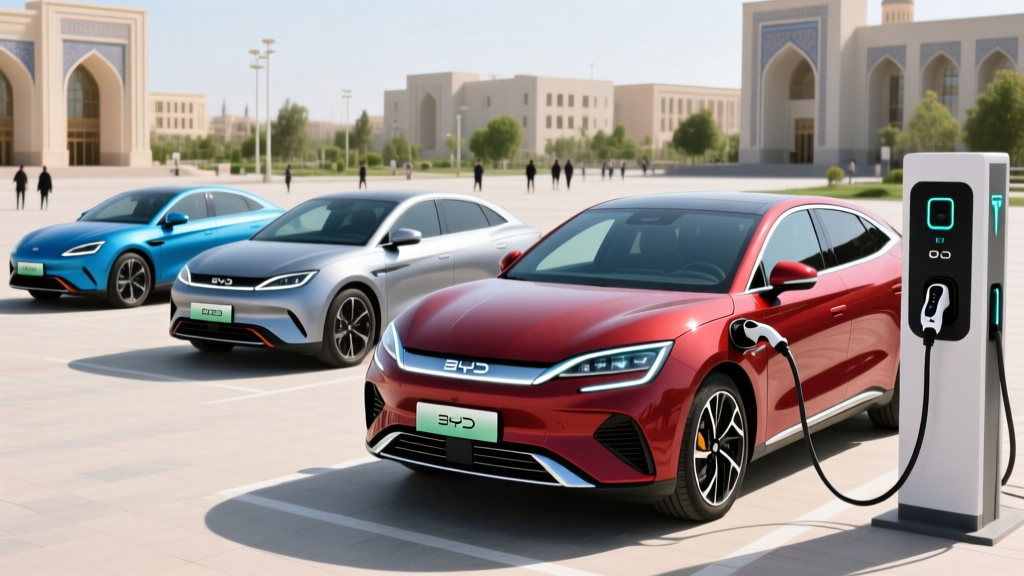
BYD's push into Central Asia has made Uzbekistan one of its fastest-growing markets outside China. With a local assembly partnership through Jizzakh-based JV operations and a growing dealer network in Tashkent, Samarkand, and Bukhara, the Chinese automaker is positioning its Blade Battery-equipped EVs as the default electrified choice for Uzbek drivers navigating extreme continental climates — from 100°F+ summers to sub-zero winters.
This review profiles the core BYD models available or officially announced for the Uzbekistan market as of early 2026, examining real-world range expectations, charging infrastructure compatibility, pricing in both UZS and USD equivalents, and how these vehicles stack up for Central Asian driving conditions.
2026 BYD Uzbekistan Lineup: Spec Overview
| Model | Battery (kWh) | Chemistry | CLTC Range | Est. Real-World Range | 0–100 km/h | Power | Drivetrain |
|---|---|---|---|---|---|---|---|
| Chizor Plus (Seagull) | 38.88 | LFP Blade | 405 km (252 mi) | ~290 km city / ~220 km hwy | 11.0 sec | 75 kW (101 hp) | FWD |
| Yuan Plus (Atto 3) | 60.48 | LFP Blade | 480 km (298 mi) | ~370 km city / ~280 km hwy | 7.3 sec | 150 kW (201 hp) | FWD |
| Song Plus EV | 71.8 | LFP Blade | 520 km (323 mi) | ~400 km city / ~310 km hwy | 7.9 sec | 150 kW (201 hp) | FWD |
| Seal | 82.5 | LFP Blade | 650 km (404 mi) | ~500 km city / ~390 km hwy | 5.9 sec (AWD: 3.8s) | 230 kW RWD / 390 kW AWD | RWD or AWD |
| Han EV | 85.4 | LFP Blade | 610 km (379 mi) | ~470 km city / ~365 km hwy | 7.9 sec | 180 kW (241 hp) | FWD |
All models listed use BYD's proprietary LFP (lithium iron phosphate) Blade Battery architecture. LFP chemistry trades some energy density for superior thermal stability and longer cycle life — a meaningful advantage in Uzbekistan's hot summers where battery thermal management is critical. LFP cells tolerate repeated 100% charging without the accelerated degradation concerns seen in NMC chemistries, though they are heavier and bulkier per kWh stored.
Charging Speeds: DC Fast Charge and Home Level 2
Uzbekistan's public charging network is still developing, with most DC fast chargers concentrated in Tashkent. Understanding charge rates is essential for trip planning between cities like Tashkent–Samarkand (300 km) or Tashkent–Bukhara (600 km).
| Model | Max DC Fast Charge (kW) | 10–80% Time | Level 2 AC Rate (kW) | Level 2 Full Charge Time | Connector |
|---|---|---|---|---|---|
| Chizor Plus | 40 kW | ~35 min | 6.6 kW | ~6 hours | GB/T (adapter available) |
| Yuan Plus | 80 kW | ~30 min | 7 kW | ~9 hours | GB/T (adapter available) |
| Song Plus EV | 90 kW | ~30 min | 7 kW | ~10.5 hours | |
| Seal | 150 kW | ~26 min | 11 kW | ~8 hours | GB/T (adapter available) |
| Han EV | 120 kW | ~30 min | 7 kW | ~12 hours | GB/T (adapter available) |
Charging curve reality check: The "max DC kW" figure represents peak rate at low state-of-charge (typically 10–30% SoC). Sustained rates taper significantly above 60% SoC. On a road trip, the 10–80% time is the metric that matters — and BYD's LFP batteries show a relatively flat charge curve compared to NMC, meaning they sustain closer to peak rate for longer. The Seal's 150 kW peak, for example, holds above 100 kW through roughly 55% SoC before tapering.
For home charging in Uzbekistan, most residential electrical systems support single-phase 220V at 32A (7 kW). The Seal's 11 kW AC capability requires three-phase power, which is available in some newer Tashkent developments but not universal. Budget-conscious buyers should factor in potential electrical panel upgrades — typically $300–$800 for a dedicated EV circuit with a licensed electrician.
Note that BYD vehicles sold in Central Asia typically use the GB/T charging standard (China's national connector). Adapters for CCS2 or Type 2 connectors used at some Uzbek public stations are available through dealers, but availability and compatibility should be confirmed before purchase.
Pricing, Tax Credits, and Ownership Costs
BYD's Uzbekistan pricing benefits from the local JV assembly agreement, which reduces import duties on CKD (completely knocked down) kits. Prices below reflect early 2026 dealer listings in Tashkent, converted from UZS at approximately 12,800 UZS = 1 USD.
| Model | Base Price (UZS) | Base Price (USD est.) | Top Trim (USD est.) | Uzbekistan EV Incentives |
|---|---|---|---|---|
| Chizor Plus | ~145M UZS | ~$11,300 | ~$13,500 | VAT exemption, reduced registration |
| Yuan Plus | ~220M UZS | ~$17,200 | ~$20,800 | VAT exemption, reduced registration |
| Song Plus EV | ~285M UZS | ~$22,300 | ~$26,000 | VAT exemption, reduced registration |
| Seal | ~395M UZS | ~$30,900 | ~$38,500 | VAT exemption, reduced registration |
| Han EV | ~420M UZS | ~$32,800 | ~$39,900 | VAT exemption, reduced registration |
Uzbekistan EV incentives: The Uzbek government has implemented VAT exemptions on imported and locally assembled electric vehicles, along with reduced registration fees and exemption from transport tax for EV owners. These incentives make BYD's already competitive pricing even more attractive compared to internal-combustion alternatives. However, these policies are subject to government review — check current regulations with your local dealer.
U.S. federal tax credit note: BYD vehicles are not eligible for the U.S. IRS §30D federal EV tax credit (up to $7,500). The credit requires final assembly in North America and compliance with battery-sourcing and critical-mineral requirements that BYD does not meet. This section is included for U.S.-based readers researching BYD globally. For Uzbekistan buyers, the local incentive structure described above applies instead.
Efficiency, Cargo Space, and Practicality
Efficiency varies significantly across the lineup. The Chizor Plus, as a compact city car, achieves roughly 12–13 kWh/100 km in mixed driving — translating to about 3.5–4.0 miles per kWh. The larger Han EV, carrying an 85.4 kWh pack and nearly 2,200 kg of curb weight, averages closer to 16–17 kWh/100 km (approximately 3.0 mi/kWh).
Cargo and passenger dimensions matter for Uzbek families who frequently carry goods between cities or drive on rural roads:
- Chizor Plus: 5-door hatchback; rear cargo ~230 L (seats up), limited rear legroom (~850 mm). Best as a solo commuter or city runabout.
- Yuan Plus: Compact SUV; 340 L cargo (seats up) / ~1,100 L (seats folded); rear legroom ~890 mm. Practical for small families.
- Song Plus EV: Mid-size SUV; 574 L cargo / ~1,400 L folded; rear legroom ~940 mm. The family-friendly workhorse.
- Seal: Sport sedan; 400 L trunk; rear legroom ~910 mm. Driver-focused, less cargo flexibility.
- Han EV: Executive sedan; 410 L trunk; rear legroom ~960 mm. Premium space, formal comfort.
Tech Features and Driver Assistance
BYD equips its Uzbekistan-bound models with the rotating 12.8-inch (or 15.6-inch on Seal/Han) infotainment touchscreen, DiLink connected-car platform, and over-the-air update capability. Higher trims include:
- 360-degree surround-view camera
- Adaptive cruise control with stop-and-go
- Lane-keeping assist and lane-departure warning
- Automatic emergency braking (front and rear)
- Wireless phone charging and NFC key card access
- Vehicle-to-Load (V2L) capability on Yuan Plus, Song Plus, Seal, and Han — allowing the EV battery to power external devices (camping, emergency backup) at up to 3.3 kW output
One notable drawback: BYD's infotainment software in export markets has drawn criticism for translation quality, occasional lag, and limited third-party app integration compared to systems from Tesla or Hyundai/Kia. The DiLink platform is improving with OTA updates, but buyers should test-drive the interface before committing.
Warranty Coverage
BYD offers the following warranty structure for Uzbekistan-market vehicles (confirm exact terms with your dealer, as regional variations apply):
- Vehicle warranty: 6 years / 150,000 km (whichever comes first)
- Blade Battery warranty: 8 years / 160,000 km, with a capacity retention guarantee of ≥70% State of Health (SoH) over the warranty period
- Electric drive unit: 8 years / 150,000 km
The 70% SoH threshold is industry-standard — matching what Tesla, Hyundai, and VW offer. In practice, BYD's LFP Blade Batteries have shown strong longevity in Chinese fleet data, with many units retaining 90%+ capacity after 200,000 km. The thermal stability of LFP chemistry is a genuine advantage in hot climates.
Who Should Buy a BYD in Uzbekistan?
✅ Pros
- Exceptional value — significantly underpriced vs. Korean/Japanese EVs
- LFP Blade Battery: thermal safety, long cycle life, 100% charge tolerant
- V2L capability for camping/emergency power
- Strong local dealer and assembly presence
- Uzbekistan VAT exemption reduces effective price
❌ Cons
- GB/T connector requires adapters for some public chargers
- Infotainment software quality lags behind global competitors
- Limited long-term resale data in Central Asian markets
- DC fast-charge speeds on Chizor/Yuan trail segment leaders
- Driver assist features less refined than Tesla/Mobileye systems
Best for: The Yuan Plus is the standout for most Uzbek buyers — it balances range, price, practicality, and charging speed for Tashkent commuting with occasional Samarkand road trips. The Song Plus EV suits families needing cargo space and rear-seat comfort. The Chizor Plus makes sense only as a budget city car with home charging access.
Skip if: You regularly drive the Tashkent–Bukhara corridor (600 km) without reliable mid-route DC charging. The current charging infrastructure outside major cities cannot yet support long-distance EV travel without careful planning and extended stops.
Frequently Asked Questions
What is the real-world range of BYD EVs in Uzbekistan?
Expect 70–80% of the CLTC sticker range in typical mixed driving, and 55–65% in winter highway conditions. The Yuan Plus, rated at 480 km CLTC, delivers roughly 370 km in city driving and about 280 km on the highway. In January cold (−10°C), plan for around 220–250 km before needing a charge.
How fast do BYD models charge on DC fast chargers?
The Seal leads the lineup at 150 kW peak, achieving 10–80% in approximately 26 minutes. The Yuan Plus and Song Plus EV charge at 80–90 kW (10–80% in ~30 minutes). The Chizor Plus is limited to 40 kW DC — adequate for city use but slow for road trips.
Does BYD qualify for the U.S. federal EV tax credit?
No. BYD vehicles do not qualify for the U.S. IRS §30D federal tax credit because they are not assembled in North America and do not meet battery-sourcing requirements. Uzbekistan buyers benefit from local VAT exemptions and transport-tax relief instead.
Is the GB/T connector a problem in Uzbekistan?
It can be. Some public DC chargers in Tashkent use CCS2 or Type 2 connectors. BYD dealers sell GB/T-to-CCS2 adapters, but availability is inconsistent. Confirm adapter compatibility with your local dealer and test at a public charger before relying on it for a road trip.
How does BYD compare to competitors available in Uzbekistan?
Against the Chevrolet Bolt EUV (if available), BYD's Yuan Plus offers more interior space and V2L at a similar price point. Against the Hyundai Ioniq 5 or Kia EV5, BYD undercuts on price but trails in charging speed (Ioniq 5 peaks at 240 kW vs. Yuan Plus at 80 kW) and infotainment polish. For pure value, BYD is difficult to beat; for charging performance and software, Korean brands still lead.
How long will the BYD Blade Battery last?
LFP Blade Batteries are rated for 3,000+ full charge cycles before reaching 80% SoH — equivalent to roughly 1.2 million km in a Yuan Plus. In real-world use, degradation is influenced by temperature extremes, charging habits, and calendar age. BYD's 8-year/160,000 km warranty with a 70% SoH floor provides reasonable protection.