BYD is the world's largest plug-in electric vehicle manufacturer by volume, selling millions of EVs and PHEVs annually across China, Europe, Southeast Asia, and Latin America. Yet American buyers still can't walk into a dealership and purchase one. The question — when is BYD coming to USA — has circulated in EV forums for years, and as of 2026, the honest answer remains: not imminently, and not without significant policy changes.
This article breaks down the concrete barriers keeping BYD out of the U.S. market, the models most likely to arrive first if those barriers shift, and what specs, pricing, and tax-credit eligibility would look like based on BYD's current global lineup. If you're researching your next EV purchase and wondering whether to wait for BYD, this is the data-driven reality check you need.
Why BYD Isn't Sold in the United States Yet
BYD's absence from the U.S. passenger vehicle market isn't a mystery — it's the result of layered trade policy that makes importing Chinese-built EVs economically unviable:
- Section 301 tariffs on Chinese EVs: In May 2024, the Biden administration raised tariffs on Chinese-made electric vehicles from 25% to 100% under Section 301 of the Trade Act. This tariff remained in effect through 2025 and persists in 2026. A $35,000 BYD Seal would effectively cost $70,000+ before any other fees upon import.
- Additional baseline auto tariffs: The standard 2.5% U.S. auto import tariff applies on top of Section 301 duties.
- Battery sourcing and critical minerals rules: Under IRS §30D guidelines, vehicles with battery components from a "foreign entity of concern" (FEOC) — which includes Chinese manufacturers — are disqualified from the federal EV tax credit. Since BYD vertically integrates its own Blade battery production, no BYD model would qualify for the $7,500 credit regardless of price.
- Dealer network and homologation: BYD has no U.S. dealer infrastructure, and its vehicles would need to undergo NHTSA crash testing, FMVSS compliance certification, and EPA range/efficiency validation before sale.
BYD's U.S. presence is currently limited to commercial electric buses and trucks (BYD Motors, based in Lancaster, California), which operate under different trade classifications. Passenger cars are an entirely separate regulatory and commercial challenge.
Which BYD Models Would Likely Come to the U.S. First?
If trade barriers were to ease — through a free-trade agreement, a U.S. or Mexico-based BYD factory, or tariff restructuring — these are the models BYD would most logically introduce to American buyers, based on their current global-market positioning and segment competitiveness:
BYD Seal (Midsize Sedan — Tesla Model 3 Competitor)
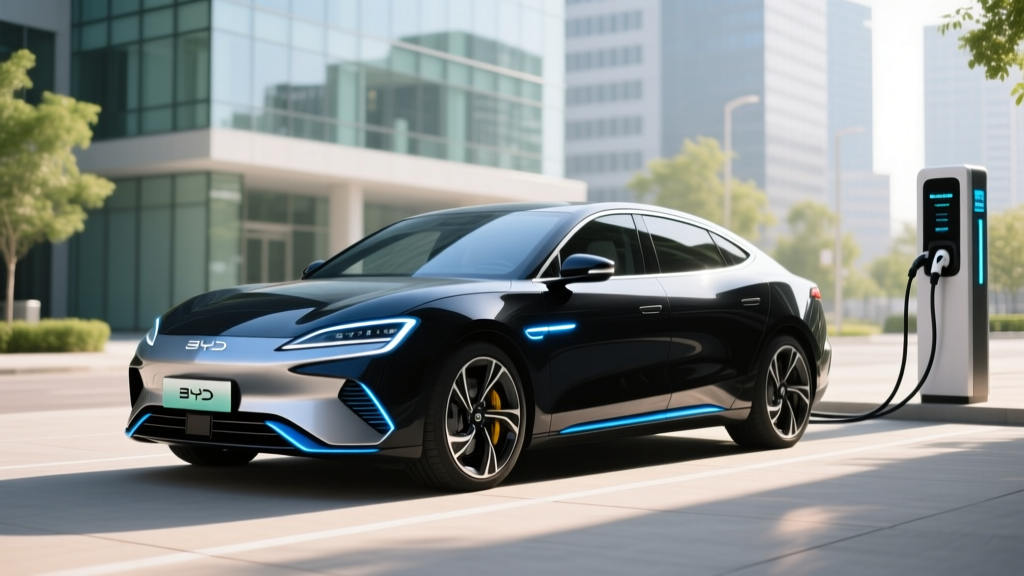
The BYD Seal is the company's most globally recognized sedan, competing directly with the Tesla Model 3 and Hyundai Ioniq 6 in international markets. It's built on BYD's e-Platform 3.0 and features the company's signature Blade Battery.
| Spec | Value |
|---|---|
| Battery Capacity | 82.5 kWh (usable) |
| Battery Chemistry | LFP (Blade Battery) |
| WLTP Range | 354 mi (570 km) |
| Estimated EPA Range | ~300-320 mi |
| Drivetrain | RWD (single motor) / AWD (dual motor) |
| Horsepower | 313 hp (RWD) / 530 hp (AWD) |
| 0-60 mph | 5.9s (RWD) / 3.8s (AWD) |
| Max DC Fast Charge | 150 kW |
| 10-80% DC Charge Time | ~26 minutes |
| Level 2 AC Charge Rate | 11 kW (~35 mi/hr) |
| Length / Wheelbase | 189.0 in / 110.2 in |
| Cargo Volume | 14.1 cu ft (trunk) + frunk |
BYD Atto 3 / Yuan Plus (Compact SUV — Most Likely First U.S. Model)
The Atto 3 (sold as the Yuan Plus in China) is BYD's best-selling global export, already available in over 40 countries. Its compact SUV form factor aligns with the highest-volume U.S. EV segment.
| Spec | Value |
|---|---|
| Battery Capacity | 60.5 kWh (usable) |
| Battery Chemistry | LFP (Blade Battery) |
| WLTP Range | 260 mi (420 km) |
| Estimated EPA Range | ~220-235 mi |
| Drivetrain | FWD (single motor) |
| Horsepower | 201 hp |
| 0-60 mph | 7.3 seconds |
| Max DC Fast Charge | 88 kW |
| 10-80% DC Charge Time | ~29 minutes |
| Level 2 AC Charge Rate | 7 kW (~22 mi/hr) |
| Cargo Volume | 15.7 cu ft (rear seats up) |
BYD Dolphin (Subcompact Hatchback — Budget Entry)
The Dolphin is BYD's most affordable EV globally, starting under $25,000 equivalent in some markets. It would compete with the Chevy Equinox EV and Nissan Leaf successor in the U.S. budget segment, though its ~200-mile estimated EPA range would be a limitation for American buyers accustomed to 250+ mile offerings.
Range, Charging, and Battery: What U.S. Buyers Would Get
BYD's Blade Battery — a lithium iron phosphate (LFP) cell in a cell-to-pack configuration — is the company's core technology differentiator. Here's what American buyers need to understand about it:
BYD publishes WLTP range figures, which run 10-15% higher than EPA estimates. For the Seal (WLTP 354 mi), expect an EPA rating closer to 300-320 miles. In real-world highway driving at 70+ mph, plan for ~260-280 miles. In cold weather (below 32°F), LFP batteries experience 15-25% range reduction, potentially dropping the Seal to ~230-250 miles in winter conditions. The Atto 3's shorter ~225-mile EPA estimate makes cold-weather range loss a more significant concern for buyers in northern states.
LFP vs. NMC — the BYD trade-off: BYD's commitment to LFP chemistry means buyers get superior thermal stability (LFP cells are far less prone to thermal runaway), longer cycle life (3,000+ cycles vs. ~1,500-2,000 for NMC), and lower raw-material cost. The trade-off is lower energy density (heavier packs for the same range) and slightly reduced cold-weather performance compared to NMC chemistries used by Tesla, Hyundai, and BMW.
| Charging Level | BYD Seal | BYD Atto 3 |
|---|---|---|
| Level 1 (120V, 12A) | ~1.4 kW / ~4 mi/hr | ~1.4 kW / ~4 mi/hr |
| Level 2 (240V, 48A) | 11 kW / ~35 mi/hr | 7 kW / ~22 mi/hr |
| DC Fast Charge (peak) | 150 kW | 88 kW |
| 10-80% DC Time | ~26 minutes | ~29 minutes |
| Charge Curve Note | Tapers significantly above 80% SoC; 80-100% adds ~20 min | Tapers above 80%; 80-100% adds ~22 min |
The Seal's 150 kW peak DC rate is competitive with the Hyundai Ioniq 6 (which peaks higher at 240 kW on 800V architecture) but trails the Tesla Model 3's ~250 kW capability on V3 Superchargers. The Atto 3's 88 kW peak is notably slow for 2026 standards — a significant drawback for road-trip-heavy American buyers who regularly use DC fast chargers on highway corridors.
Connector compatibility is an open question. BYD currently uses CCS2 in Europe and GB/T in China. For the U.S. market, BYD would need to adopt either the NACS (Tesla) connector — now the de facto North American standard with Ford, GM, Rivian, Hyundai, and others switching — or the legacy CCS1 connector. Given the industry's rapid migration to NACS, a U.S.-market BYD would almost certainly need NACS compatibility to access the Supercharger network, which remains the most reliable public charging infrastructure in the country.
Pricing, Tariffs, and Tax Credit Eligibility
This is where the BYD-in-America question hits a wall. Here's the pricing math as it stands in 2026:
| Model | Global MSRP (Equivalent) | + 100% Section 301 Tariff | + 2.5% Auto Tariff | Estimated U.S. Sticker | §30D Tax Credit |
|---|---|---|---|---|---|
| BYD Atto 3 | ~$30,000 | +$30,000 | +$750 | ~$60,750+ | $0 (FEOC disqualified) |
| BYD Seal (RWD) | ~$38,000 | +$38,000 | +$950 | ~$76,950+ | $0 (FEOC disqualified) |
| BYD Seal (AWD) | ~$45,000 | +$45,000 | +$1,125 | ~$91,125+ | $0 (FEOC disqualified) |
At these tariff-inflated prices, BYD vehicles would be priced well above their direct competitors that qualify for the federal EV tax credit. A tariff-burdened BYD Seal at ~$77,000 competes against a Tesla Model 3 Long Range at ~$42,000 (after $7,500 credit) or a Hyundai Ioniq 6 at ~$37,000 (after credit). There's simply no price advantage left.
§30D Tax Credit disqualification is the second blow. Under current IRS rules, vehicles containing battery components manufactured by a foreign entity of concern (FEOC) — a designation that includes Chinese companies — are ineligible for the $7,500 new clean vehicle credit. Since BYD manufactures its own Blade Batteries in China, every BYD model would be categorically excluded. This applies regardless of the buyer's income, the vehicle's MSRP, or where the vehicle is assembled.
The only viable path to competitive U.S. pricing would be for BYD to:
- Build a manufacturing plant in the U.S., Mexico, or a country with a U.S. free-trade agreement (eliminating or reducing the Section 301 tariff)
- Source battery components outside of China to satisfy FEOC rules for §30D eligibility
- Establish a dealer and service network from scratch
BYD has announced a factory in Mexico, but as of 2026, that facility is not yet operational for passenger vehicles, and Mexican-assembled vehicles would still face FEOC battery-sourcing scrutiny for tax credit purposes. BYD has also opened a factory in Thailand and is expanding in Brazil and Hungary, but none of these locations solve the U.S. tariff problem directly.
Warranty, Safety, and Technology
In international markets, BYD typically offers:
- Vehicle warranty: 6 years / 150,000 km (~93,000 miles) — competitive with Hyundai's 5-year/60,000-mile basic warranty
- Battery warranty: 8 years / 160,000 km (~100,000 miles) with a 70% capacity retention guarantee — in line with industry standards (Tesla offers 8 years/100,000-120,000 miles at 70%)
- Blade Battery safety: BYD's LFP Blade Battery has passed nail penetration tests without thermal runaway, a significant safety advantage over many NMC packs. However, no BYD passenger vehicle has been crash-tested by NHTSA or IIHS, so U.S. safety ratings don't yet exist.
Tech and driver assistance: BYD's global models feature a rotating 15.6-inch infotainment display, DiPilot driver-assistance suite (adaptive cruise, lane-keeping, automatic emergency braking), and over-the-air updates. However, BYD's ADAS system is a basic Level 2 driver-assist — it requires full driver engagement at all times and does not offer hands-free highway driving comparable to GM's Super Cruise or Ford's BlueCruise. The infotainment system, while feature-rich, has drawn criticism in European reviews for translation issues and a cluttered interface that would need significant localization for American users.
Pros — If BYD Could Compete at Fair Pricing
- LFP Blade Battery offers exceptional thermal safety and long cycle life
- Strong value proposition at global-market pricing ($30K-$45K range)
- Competitive range on the Seal (est. ~310 mi EPA)
- BYD's vertical integration means strong supply-chain control
- Atto 3's practical SUV form factor fits U.S. buyer preferences
Cons — The Current Reality
- 100% Section 301 tariff makes pricing completely uncompetitive
- Zero federal tax credit eligibility due to FEOC battery rules
- No U.S. dealer network, service centers, or parts infrastructure
- No NHTSA/IIHS crash-test data available
- Atto 3's 88 kW DC charging is slow for 2026 standards
- Cold-weather LFP range loss concerns in northern climates
- Infotainment system needs significant U.S. localization
How BYD Compares to EVs You Can Actually Buy Today
Since a BYD purchase isn't an option for American shoppers, here's how the closest BYD models compare to their readily available U.S. competitors — vehicles you can buy, charge, and service today:
| Spec | BYD Seal (Est.) | Tesla Model 3 LR | Hyundai Ioniq 6 SEL |
|---|---|---|---|
| Est. EPA Range | ~310 mi | 341 mi | 316 mi |
| Battery | 82.5 kWh LFP | 75 kWh NMC | 77.4 kWh NMC |
| Peak DC Charge | 150 kW | 250 kW | 240 kW (800V) |
| 10-80% Time | ~26 min | ~18 min | ~18 min |
| 0-60 mph | 5.9s (RWD) | 4.2s | 5.1s |
| MSRP (2026) | N/A (not sold) | ~$42,490 | ~$42,450 |
| After §30D Credit | N/A ($0 credit) | ~$34,990 | ~$34,950 |
| Charging Network | N/A | Supercharger (NACS) | CCS + NACS adapter |
The comparison makes the situation clear: even if the Seal could enter the U.S. at its global price, its charging speed trails both competitors, and without the $7,500 tax credit, it would be priced at a disadvantage. The Ioniq 6's 800V architecture and the Model 3's Supercharger access represent infrastructure advantages that BYD would need years to match.
Who Should Wait for BYD — And Who Shouldn't
Don't wait for BYD if:
- You're shopping for an EV in 2026 or 2027 — there is no confirmed U.S. launch timeline
- You need access to the Supercharger network or reliable public DC fast charging
- You want to claim the $7,500 federal tax credit (or the $4,000 used-EV credit)
- You live in a state with cold winters where LFP range loss is a meaningful concern
- You value established dealer service networks and readily available parts
Follow BYD's progress if:
- You're tracking long-term EV market competition and pricing pressure (BYD's global presence is already pushing legacy automakers to lower prices)
- You're interested in LFP battery technology and its safety advantages
- You're a commercial fleet buyer who might benefit from BYD's electric vans or buses through separate channels
Frequently Asked Questions
When is BYD coming to USA for passenger cars?
There is no confirmed date. As of 2026, the 100% Section 301 tariff on Chinese-made EVs, combined with FEOC battery-sourcing rules that disqualify BYD from the federal tax credit, make a U.S. passenger car launch economically unviable. BYD would need to establish non-China manufacturing and battery sourcing before a competitive U.S. entry is possible.
Does BYD sell any vehicles in the U.S. right now?
BYD sells commercial electric buses and heavy-duty trucks through its Lancaster, California facility. These are fleet/commercial products, not consumer passenger vehicles. BYD does not sell any cars, SUVs, or light trucks to U.S. consumers.
Would a BYD qualify for the $7,500 federal EV tax credit?
No. Under current IRS §30D rules, vehicles with battery components from a foreign entity of concern (FEOC) are disqualified. Since BYD manufactures its own batteries in China, all BYD models would be ineligible regardless of price, buyer income, or assembly location.
What is BYD's Blade Battery and is it safe?
The Blade Battery is BYD's proprietary LFP (lithium iron phosphate) cell design arranged in a cell-to-pack configuration. LFP chemistry is inherently more thermally stable than NMC, and BYD's nail penetration testing shows the Blade Battery does not ignite under conditions that would cause thermal runaway in NMC cells. It offers longer cycle life (3,000+ full cycles) but lower energy density and slightly worse cold-weather performance.
Could BYD build a factory in the U.S. or Mexico to avoid tariffs?
BYD has announced a passenger vehicle factory in Mexico, but as of 2026 it is not yet operational. A U.S. or Mexico factory could reduce or eliminate the Section 301 tariff. However, the FEOC battery-sourcing issue for tax credit eligibility would remain unless BYD sourced battery components from non-Chinese suppliers — a major restructuring of their vertically integrated supply chain.
What's the best alternative to a BYD vehicle I can buy today?
For a midsize sedan (Seal alternative), the Tesla Model 3 Long Range ($42,490, 341 mi EPA, ~$34,990 after credit) or Hyundai Ioniq 6 (~$42,450, 316 mi EPA, ~$34,950 after credit) are the closest competitors with superior charging speeds and full tax-credit eligibility. For a compact SUV (Atto 3 alternative), the Hyundai Ioniq 5 (~$42,600, 303 mi EPA) or Tesla Model Y (~$44,990, 320 mi EPA) offer more range, faster charging, and U.S. service infrastructure.
How does BYD's LFP battery handle cold weather?
LFP batteries experience greater capacity loss in cold temperatures compared to NMC. Expect 15-25% range reduction below 32°F, and potentially 30%+ below 10°F. BYD's global models include battery preconditioning for DC charging, but the inherent chemistry limitation means northern-climate buyers should budget for significantly reduced winter range — a key reason BYD would face headwinds in states like Minnesota, Michigan, or Colorado.
The Bottom Line: BYD's U.S. Arrival Isn't a Matter of When — It's a Matter of If
The question "when is BYD coming to USA" assumes that market entry is inevitable. In reality, the combination of a 100% import tariff, FEOC tax credit disqualification, and the absence of any U.S. manufacturing footprint means BYD faces a steeper barrier to American entry than any other major global automaker. Even BYD's much-discussed Mexico factory doesn't solve the battery-sourcing problem that would lock them out of the $7,500 federal credit.
For American EV shoppers in 2026, the practical takeaway is clear: don't delay your purchase waiting for BYD. The vehicles available now — from Tesla, Hyundai/Kia, Ford, GM, and others — offer competitive range, faster charging, established service networks, full tax-credit eligibility, and access to the rapidly expanding NACS/Supercharger infrastructure. BYD's global competition is undeniably pressuring these brands on price and features, and that indirect benefit is already reaching American buyers. But a BYD badge at your local dealership? That remains a distant prospect at best.