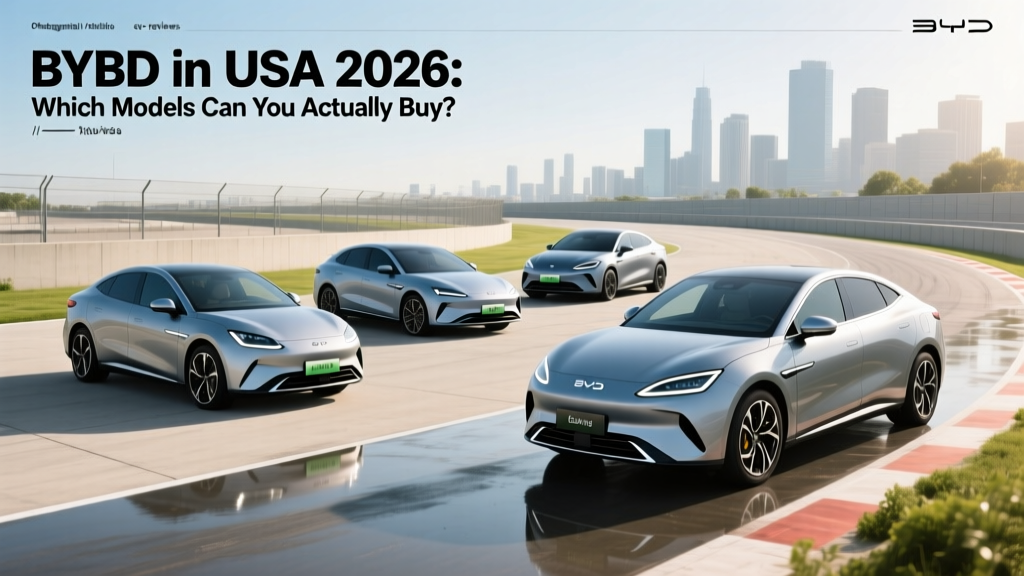
If you've been searching for BYD in USA showrooms, you've probably noticed something: the world's largest electric vehicle manufacturer doesn't actually sell passenger cars to American consumers. Despite dominating global EV sales and offering compelling models like the Seagull, Atto 3, and Seal at aggressive price points overseas, BYD's US passenger vehicle presence remains effectively zero in 2026.
That doesn't mean BYD is absent from the American market entirely — the company has a growing footprint in commercial electric buses and heavy-duty trucks. But for everyday buyers wondering whether they can walk into a dealership and drive home a BYD EV, the answer requires some nuance. Here's a comprehensive, data-driven look at where BYD stands in the US market, which models might eventually arrive, and what American EV shoppers should consider instead.
Why BYD Passenger Cars Aren't Sold in the USA (Yet)
BYD's absence from the US passenger vehicle market isn't an oversight — it's a combination of deliberate strategy and regulatory reality. Three primary barriers have kept BYD cars off American roads:
1. The 100% Tariff Wall. In May 2024, the Biden administration announced a 100% tariff on Chinese-built electric vehicles imported into the United States, up from 25%. This tariff, enacted under Section 301 of the Trade Act, effectively doubles the landed cost of any BYD vehicle built in China. A BYD Seagull that sells for roughly $10,000 in China would carry an import cost closer to $20,000 before dealer markup, logistics, and compliance modifications — erasing the price advantage that makes BYD so competitive globally.
2. No US Manufacturing Footprint for Passenger Cars. Unlike some competitors, BYD does not operate a passenger vehicle assembly plant in the United States. The company operates an electric bus factory in Lancaster, California, but this facility produces commercial transit buses — not consumer cars. Without domestic production, BYD cannot circumvent the import tariff or qualify vehicles for the IRS §30D federal tax credit, which requires final assembly in North America.
3. Geopolitical and Brand-Trust Headwinds. Chinese automakers face significant consumer skepticism and political scrutiny in the US market. Data security concerns around connected vehicles, combined with broader US-China trade tensions, make a near-term BYD passenger car launch a high-risk proposition.
BYD's US Presence: Electric Buses and Commercial Vehicles
BYD's American operations are real, just not consumer-facing. The company's Lancaster, California facility has produced electric transit buses for US municipalities and transit agencies since 2013. Models like the BYD K8M and K9M are in active service in cities including Los Angeles, Indianapolis, and Stanford University's campus shuttle fleet.
However, even this commercial presence has faced challenges. The National Defense Authorization Act (NDAA) has included provisions restricting federal funding for transit agencies that purchase buses from Chinese-owned manufacturers, limiting BYD's growth in the US transit sector.
BYD's Current US Operations — At a Glance
| Category | Details |
|---|---|
| US Facility | Lancaster, CA (electric bus assembly) |
| Consumer Passenger Cars | Not available for purchase |
| Commercial Vehicles | Electric transit buses (K8M, K9M, K11M) |
| NACS Charging Port | N/A (commercial fleet charging) |
| Federal Tax Credit Eligibility | Not eligible (no NA final assembly for consumer vehicles) |
BYD Models Americans Are Watching: Global Lineup Overview
Even though you can't buy them stateside, BYD's global lineup is worth understanding — both as a benchmark for what the competition is up against and as a potential preview of what could arrive if trade dynamics shift. Here's a look at BYD's most talked-about models and their known global specifications.
BYD Seagull (Dolphin Mini)
The compact hatchback that made headlines for its sub-$10,000 China pricing. Globally, the Seagull offers a 30.08 kWh or 38.88 kWh LFP Blade Battery pack, with CLTC range rated up to approximately 252 miles (405 km) on the larger pack. Real-world range on a US EPA cycle would likely be significantly lower — expect roughly 150–180 miles EPA-equivalent given the more demanding US testing protocol versus China's CLTC.
BYD Atto 3 (Yuan Plus)
A compact crossover that's BYD's volume leader in export markets like Australia, Southeast Asia, and Europe. The Atto 3 carries a 60.48 kWh LFP Blade Battery with a WLTP range of approximately 260 miles (420 km). EPA range, if certified, would likely land around 220–240 miles. It supports up to 88 kW DC fast charging (10–80% in approximately 44 minutes) and 7 kW Level 2 AC charging. The single-motor FWD powertrain produces 201 hp with a 0–62 mph time of 7.3 seconds.
BYD Seal
A midsize sport sedan aimed squarely at the Tesla Model 3. The Seal is available with a 82.5 kWh LFP battery (RWD, ~340 miles WLTP) or an 82.5 kWh pack with dual-motor AWD (530 hp, 0–62 mph in 3.8 seconds). It supports up to 150 kW DC fast charging. In European markets, pricing starts around €45,000.
⚡ Real-World Range Reality Check
BYD's global models are typically rated on China's CLTC or Europe's WLTP cycles, both of which produce higher range numbers than the US EPA test. As a rule of thumb, multiply a CLTC range figure by roughly 0.65–0.75 and a WLTP figure by 0.80–0.90 to estimate EPA-equivalent range. A Seagull rated at 252 miles CLTC would likely achieve approximately 160–180 EPA miles. Cold-weather highway driving could reduce that by an additional 20–30%, bringing real-world winter range to roughly 115–145 miles.
If BYD Came to the US: Expected Pricing and Tax Credit Analysis
Let's run a hypothetical exercise. If BYD were to establish US production (or if tariffs were reduced) and sell the Atto 3 stateside, what might the economics look like?
Hypothetical BYD Atto 3 US Pricing (Not Currently Available)
| Item | Estimated Cost |
|---|---|
| Estimated Base MSRP (if US-spec) | $28,000–$32,000 |
| 100% Import Tariff (China-built) | +$28,000–$32,000 |
| Landed Cost Before Dealer Markup | $56,000–$64,000 |
| IRS §30D Tax Credit Eligibility | Not eligible (no NA assembly, battery sourcing non-compliant) |
| Effective Buyer Cost | $56,000–$64,000+ |
As this table makes clear, the 100% tariff completely destroys BYD's price advantage in the US market. A $30,000 compact crossover becomes a $60,000+ vehicle — more expensive than a well-equipped Tesla Model Y, Hyundai Ioniq 5, or Ford Mustang Mach-E, all of which offer superior EPA range, DC fast charging, and dealer/service networks.
§30D Tax Credit Hurdles
Even setting aside the tariff, BYD vehicles would face steep barriers to qualifying for the federal EV tax credit under IRS §30D:
- Final Assembly Requirement: Vehicles must undergo final assembly in North America. BYD has no US, Canadian, or Mexican passenger car plant.
- Battery Component Sourcing: Battery components must be manufactured or assembled in North America (phasing thresholds increase annually through 2029). BYD's vertically integrated battery supply chain is overwhelmingly China-based.
- Critical Minerals: A percentage of critical minerals must be sourced from the US or FTA partners. BYD's LFP chemistry relies on lithium and iron phosphate supply chains centered in China.
- FEOC Exclusion: Vehicles containing battery components from a Foreign Entity of Concern (FEOC) — which includes Chinese state-linked entities — are disqualified entirely starting in 2024 for components and 2025 for critical minerals.
In short: even if you could buy a BYD in the US, it would almost certainly not qualify for the $7,500 federal tax credit, further eroding any value proposition.
What to Buy Instead: US-Market Alternatives to BYD Models
American EV buyers don't need to wait for BYD. The US market in 2026 offers compelling alternatives at competitive price points, many of which qualify for federal incentives and come with established dealer networks and charging compatibility.
If You Want a BYD Seagull (Budget EV) → Consider:
Chevrolet Equinox EV (2026): Starting around $33,000 MSRP, with an EPA range of up to 319 miles, 150 kW DC fast charging, and full §30D tax credit eligibility. After the $7,500 point-of-sale credit, effective pricing can dip below $26,000 — a realistic budget EV that you can actually buy and service.
Nissan Leaf (2026): The refreshed Leaf offers ~212 miles EPA range on the SV Plus trim, starting near $29,000. It uses CHAdeMO DC charging (a limitation), but remains one of the most affordable new EVs on the market.
If You Want a BYD Atto 3 (Compact Crossover) → Consider:
Hyundai Ioniq 5 (2026): Starting ~$42,000, with up to 310 miles EPA range, 350 kW peak DC fast charging (10–80% in ~18 minutes on a compatible charger), NACS port, and §30D eligibility. The Ioniq 5's charging speed, range, and interior space make it the segment benchmark.
Kia EV6 (2026): Shares the E-GMP platform with the Ioniq 5. Starts ~$43,000, up to 310 miles EPA, 350 kW peak DC charging. Sportier styling with similar practicality.
If You Want a BYD Seal (Sport Sedan) → Consider:
Tesla Model 3 (2026): Starting ~$38,000, up to 363 miles EPA (Long Range RWD), 250 kW peak DC charging, and access to the Supercharger network. The Model 3 remains the default sport sedan EV in the US, with the best charging infrastructure access available.
BMW i4 (2026): Starting ~$52,000, up to 307 miles EPA, 200 kW DC charging. Premium interior, excellent driving dynamics, and §30D eligibility on qualifying trims.
Could BYD Enter the US Passenger Market? What It Would Take
BYD executives have publicly stated that the US market is "under evaluation," but a realistic entry would require significant structural changes:
Option 1: Build a US Factory. BYD is reportedly evaluating sites in Mexico for a manufacturing plant. However, vehicles assembled in Mexico would still need to meet USMCA content rules and §30D battery-sourcing requirements to qualify for the tax credit. A US-based plant would face higher labor costs but could navigate tariff and credit requirements more cleanly. Timeline: 3–5 years from announcement to production, at minimum.
Option 2: License or Partner. BYD could theoretically license its Blade Battery technology or e-Platform 3.0 architecture to an established automaker with US production capacity. This is how CATL has approached the US market (licensing to Ford for its LFP battery plant in Michigan). Such a deal would put BYD technology in US-market cars without the BYD badge.
Option 3: Wait for Tariff Reduction. A change in US trade policy could lower the tariff wall, though given bipartisan support for protecting domestic auto manufacturing, this scenario appears unlikely in the near term.
The Bottom Line: Should You Wait for BYD?
No. If you're shopping for an EV in 2026, waiting for BYD to enter the US passenger market is not a practical strategy. The combination of 100% tariffs, §30D tax credit ineligibility, no US dealer network, and no confirmed timeline for market entry means BYD cars remain a fascinating "what if" rather than a viable purchase option.
The good news? The US EV market has matured to the point where BYD's value proposition — affordable EVs with LFP batteries and solid range — is already being met by domestic and allied-market competitors. A Chevrolet Equinox EV after the tax credit, a Hyundai Ioniq 5 with best-in-class charging, or a Tesla Model 3 with Supercharger access all represent excellent, purchasable-today alternatives.
Frequently Asked Questions
Can I buy a BYD car in the United States in 2026?
No. BYD does not sell passenger vehicles to US consumers. The company's US presence is limited to commercial electric buses manufactured in Lancaster, California. High import tariffs (100% on Chinese-built EVs) and the lack of a US passenger car assembly plant prevent BYD from offering its consumer models stateside.
Does BYD qualify for the $7,500 federal EV tax credit?
BYD vehicles do not currently qualify for the IRS §30D federal tax credit. Qualifying requires North American final assembly, compliant battery component sourcing, and critical minerals from approved supply chains. BYD's China-centric manufacturing and supply chain make it ineligible under current rules. Always verify current eligibility at irs.gov.
Why are BYD cars so cheap in other countries?
BYD benefits from China's massive domestic EV supply chain, government subsidies, and vertical integration — the company manufactures its own batteries (the Blade Battery), semiconductors, and electric motors. In markets without prohibitive tariffs (Australia, Thailand, Brazil, Europe), BYD can price vehicles aggressively. In the US, the 100% tariff effectively doubles the import cost, eliminating the price advantage.
Will BYD ever sell cars in the US?
There is no confirmed timeline for BYD to sell passenger vehicles in the US. The company has expressed interest but faces significant tariff, regulatory, and geopolitical barriers. A US or Mexico-based factory could theoretically enable entry, but no such facility for passenger cars has been announced as of 2026.
What's the best affordable EV I can buy instead of a BYD?
The 2026 Chevrolet Equinox EV (starting ~$33,000, up to 319 miles EPA, §30D eligible) is the closest US-market equivalent to BYD's value proposition. After the $7,500 point-of-sale tax credit, effective pricing can approach $25,500 — making it one of the most affordable long-range EVs available. The Hyundai Kona Electric and Nissan Leaf are also strong budget options.
Is BYD's Blade Battery technology available in any US-market cars?
Not directly under the BYD brand, but BYD supplies LFP Blade Battery cells to some global automakers. Toyota's bZ3 sedan (sold in China) uses BYD batteries, but this model is not available in the US. As LFP chemistry gains popularity in the US market (Tesla, Ford, and others use LFP packs from CATL and other suppliers), the technology BYD pioneered is becoming available through other supply chains.