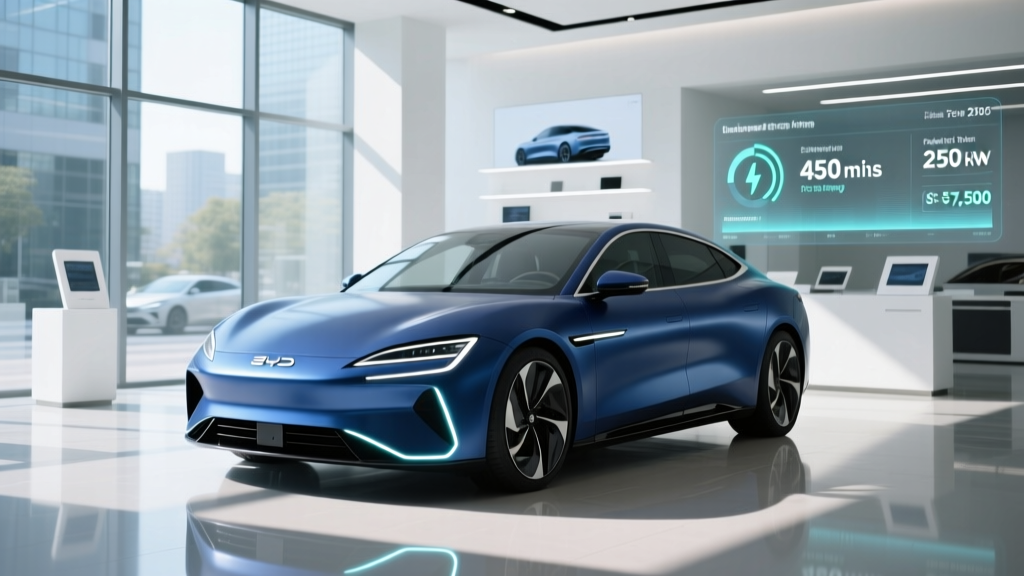
If you've been following global EV sales, you already know BYD (Build Your Dreams) has been trading the title of world's largest electric-vehicle manufacturer with Tesla. The Chinese automaker sells millions of plug-in vehicles annually across China, Europe, Southeast Asia, and Latin America. But if you're a US-based shopper asking how much does a BYD car cost, the honest answer requires unpacking a complicated situation involving tariffs, import restrictions, and a market that remains largely closed to BYD's passenger vehicles as of early 2026.
This guide breaks down what BYD's most popular global EVs would cost American buyers, how their specs stack up, whether they qualify for federal tax credits, and what realistic alternatives exist if you want BYD-level value in the US market today.
BYD's US Availability: The 2026 Reality
As of 2026, BYD does not sell passenger cars in the United States. The company has no US dealership network for consumer vehicles, and a 100% tariff on Chinese-made EVs—imposed in 2024 and maintained through 2026—effectively doubles the sticker price of any BYD imported stateside. BYD has also publicly stated it has no near-term plans to enter the US passenger-car market, citing the tariff environment and geopolitical friction.
What BYD does sell in the US are electric transit buses and heavy-duty commercial trucks through its Lancaster, California facility. But for the consumer shopping for a sedan, hatchback, or SUV, BYD remains a brand you can only admire from afar—or import at prohibitive cost.
That said, understanding BYD's global pricing and specs is valuable. It sets the benchmark for value that competitors must match, and several BYD models may eventually reach North America if BYD builds a Mexico-based factory (rumored but unconfirmed as of 2026). Below, we profile three of BYD's most popular global EVs and translate their pricing and capability for US buyers.
BYD Dolphin: The Budget Hatchback Benchmark
The BYD Dolphin is the automaker's entry-level electric hatchback and one of the best-selling EVs globally. In markets like Australia, Thailand, and Brazil, it undercuts rivals by thousands while delivering competitive range and practicality.
| Spec | Value |
|---|---|
| Global Starting Price | ~$22,000 USD equivalent (varies by market) |
| Hypothetical US Price (with 100% tariff) | ~$44,000+ |
| Battery Capacity | 60.4 kWh (LFP — Blade Battery) |
| WLTP Range | 265 miles (427 km) |
| Estimated EPA Range | ~230-245 miles (EPA typically 10-15% lower than WLTP) |
| Motor Output | 201 hp / 310 Nm torque (FWD) |
| 0-60 mph | ~7.0 seconds |
| DC Fast Charge (peak) | 88 kW |
| 10-80% DC Charge Time | ~29 minutes |
| Level 2 AC Charge Rate | 7 kW (~25 miles/hr) |
| Efficiency | ~120 MPGe combined (est.) |
| Cargo Volume | 12.1 cu ft (rear seats up) / 46.3 cu ft (folded) |
| Battery Warranty (Global) | 8 years / 100,000 miles |
BYD Dolphin: Who It Suits
The Dolphin is ideal for urban commuters who need an affordable, efficient hatchback with enough range for daily driving and occasional 150-mile trips. Its LFP Blade Battery offers excellent thermal stability and long cycle life—BYD rates it for over 3,000 charge cycles before significant degradation. However, the relatively slow DC charging speed makes it less suited for frequent long-distance road trippers.
BYD Atto 3 (Yuan Plus): The Compact SUV Sweet Spot
The Atto 3 (sold as the Yuan Plus in China) is BYD's compact electric SUV and the brand's first true global export hit. It competes directly with the Hyundai Kona Electric, Kia Niro EV, and Volkswagen ID.4 in international markets.
| Spec | Value |
|---|---|
| Global Starting Price | ~$30,000 USD equivalent |
| Hypothetical US Price (with 100% tariff) | ~$60,000+ |
| Battery Capacity | 60.48 kWh (LFP — Blade Battery) |
| WLTP Range | 260 miles (420 km) |
| Estimated EPA Range | ~225-240 miles |
| Motor Output | 201 hp / 310 Nm torque (FWD) |
| 0-60 mph | ~7.3 seconds |
| DC Fast Charge (peak) | 88 kW |
| 10-80% DC Charge Time | ~29 minutes |
| Level 2 AC Charge Rate | 7 kW (~24 miles/hr) |
| Efficiency | ~115 MPGe combined (est.) |
| Cargo Volume | 15.8 cu ft / 47.3 cu ft (rear seats folded) |
| Battery Warranty (Global) | 8 years / 100,000 miles |
The Atto 3's interior stands out with a distinctive gym-themed design (yes, the door panels feature muscle-fiber-inspired shapes and the air vents resemble dumbbells). It includes a 12.8-inch rotating touchscreen, wireless phone charging, and a full suite of ADAS features including adaptive cruise control, lane-keeping assist, and automatic emergency braking. These are SAE Level 2 driver-assist features—the driver must remain fully engaged at all times.
BYD Seal: The Tesla Model 3 Rival
The BYD Seal is the automaker's sport sedan aimed squarely at the Tesla Model 3 and BMW i4. It rides on BYD's e-Platform 3.0 with cell-to-body battery integration, lowering the center of gravity and improving structural rigidity.
| Spec | Value |
|---|---|
| Global Starting Price | ~$38,000 USD equivalent |
| Hypothetical US Price (with 100% tariff) | ~$76,000+ |
| Battery Capacity | 82.5 kWh (LFP — Blade Battery) |
| WLTP Range | 354 miles (570 km) |
| Estimated EPA Range | ~300-320 miles |
| Motor Output (RWD) | 308 hp / 360 Nm torque |
| Motor Output (AWD Performance) | 523 hp / 670 Nm torque |
| 0-60 mph (AWD) | ~3.8 seconds |
| DC Fast Charge (peak) | 150 kW |
| 10-80% DC Charge Time | ~26 minutes |
| Level 2 AC Charge Rate | 11 kW (~37 miles/hr) |
| Efficiency | ~125 MPGe combined (est.) |
| Cargo Volume | 14.1 cu ft trunk + front trunk (frunk) |
| Rear Legroom | ~37.4 inches |
| Battery Warranty (Global) | 8 years / 100,000 miles |
What Would BYD EVs Cost in the US? Pricing & Tax Credit Breakdown
Even if BYD could sell passenger cars in the US, the pricing picture would be complicated by the 100% tariff on Chinese-made vehicles and federal tax credit rules. Here's how the math would work hypothetically:
| Model | Global MSRP | US Price (100% Tariff) | §30D Federal Credit | Effective Price |
|---|---|---|---|---|
| BYD Dolphin | ~$22,000 | ~$44,000 | $0 (fails sourcing rules) | ~$44,000 |
| BYD Atto 3 | ~$30,000 | ~$60,000 | $0 (fails sourcing rules) | ~$60,000 |
| BYD Seal | ~$38,000 | ~$76,000 | $0 (fails sourcing rules) | ~$76,000 |
Federal Tax Credit (§30D) — Why BYD Qualifies for $0
Under the IRS §30D clean vehicle credit rules in effect for 2026, a new EV can qualify for up to $7,500 in federal tax credits, split into two $3,750 halves:
- $3,750 for battery components: At least 60% of battery components must be manufactured or assembled in North America (threshold rises annually).
- $3,750 for critical minerals: At least 70% of critical minerals must be sourced from the US or a free-trade-agreement partner (2026 threshold).
BYD's vehicles are manufactured in China with Chinese-sourced battery materials (BYD is vertically integrated and mines its own lithium). They fail both requirements entirely. Additionally, the §30D credit includes a foreign entity of concern (FEOC) exclusion that disqualifies any vehicle whose battery contains components from a Chinese-owned entity—making BYD ineligible regardless of where the car is assembled.
Other §30D requirements that would apply if BYD sold in the US:
- MSRP cap: $55,000 for sedans, $80,000 for SUVs/trucks
- Buyer income cap: $150,000 single / $300,000 joint AGI
- Point-of-sale transfer available at participating dealers
US Alternatives That Match BYD's Value Proposition
Since BYD isn't an option for US buyers, here are the closest domestic alternatives at each price point, all eligible for at least partial federal tax credits:
| Model | MSRP | EPA Range | DC Peak kW | §30D Credit | Best BYD Match |
|---|---|---|---|---|---|
| Chevrolet Equinox EV LT | $34,900 | 319 mi | 150 kW | Up to $7,500 | Atto 3 |
| Hyundai Kona Electric SEL | $34,000 | 261 mi | 100 kW | $0 (Korea-built) | Dolphin |
| Tesla Model 3 RWD | $39,990 | 341 mi | 250 kW | Up to $7,500 | Seal |
| Nissan Leaf S+ | $31,990 | 212 mi | 100 kW | $0 (Japan-built) | Dolphin |
The Chevrolet Equinox EV comes closest to BYD's value ethos: over 300 miles of EPA range, a sub-$35,000 starting price, and full §30D credit eligibility for qualified buyers, bringing the effective price to roughly $27,400. That's a deal BYD cannot match in the US market.
BYD's LFP Blade Battery: Chemistry Deep Dive
One area where BYD genuinely leads the industry is battery technology. Every BYD passenger EV uses the company's proprietary Blade Battery, a form-factor innovation built on LFP (lithium iron phosphate) chemistry.
| Attribute | LFP (BYD Blade) | NMC (Typical) |
|---|---|---|
| Energy Density | Lower (~160 Wh/kg cell-level) | Higher (~250 Wh/kg cell-level) |
| Thermal Stability | Excellent (resists thermal runaway) | Moderate (requires active cooling) |
| Cycle Life | 3,000-5,000 cycles | 1,000-2,000 cycles |
| Cold-Weather Performance | Weaker (15-25% range loss below freezing) | Better (10-15% range loss) |
| Recommended Charge Habit | OK to charge to 100% regularly | Best kept at 20-80% daily |
| Cost per kWh | Lower | Higher |
| Cobalt Content | None | Contains cobalt (ethical sourcing concerns) |
The Blade form factor arranges long, thin cells directly into the pack structure, eliminating module-level hardware and improving volumetric efficiency. BYD's nail-penetration test—where a steel nail is driven through a fully charged cell without fire or explosion—demonstrates LFP's superior thermal stability. For buyers prioritizing safety and longevity over maximum range, LFP is the superior chemistry.
However, LFP's lower energy density means BYD needs larger, heavier packs to match NMC-equipped rivals. And in cold climates (think Minnesota, Maine, or Colorado winters), LFP's greater range loss is a real-world disadvantage worth budgeting for.
Charging & Infrastructure: What BYD Owners Experience Abroad
| Charging Level | Dolphin | Atto 3 | Seal |
|---|---|---|---|
| Level 1 (120V / 12A) | ~1.4 kW (~5 mi/hr) | ~1.4 kW (~5 mi/hr) | ~1.4 kW (~5 mi/hr) |
| Level 2 (240V / 32A) | 7 kW (~25 mi/hr) | 7 kW (~24 mi/hr) | 11 kW (~37 mi/hr) |
| DC Fast Charge (peak) | 88 kW | 88 kW | 150 kW |
| 10-80% DC Time | ~29 min | ~29 min | ~26 min |
| Connector (Global) | CCS2 / GB/T | CCS2 / GB/T | CCS2 / GB/T |
BYD uses CCS2 in European and Australian markets and GB/T in China. If BYD ever enters the US, it would need to adopt the NACS (North American Charging Standard) connector to access Tesla's Supercharger network—the largest and most reliable DC fast-charging network in the country. Without NACS or a reliable adapter, BYD owners would be limited to Electrify America, EVgo, and ChargePoint stations, which have mixed reliability records.
The Dolphin and Atto 3's 88 kW DC peak is modest by 2026 standards. For context, the Hyundai Ioniq 5 peaks at 240 kW and the Porsche Taycan at 320 kW. On a road trip, the Dolphin's 10-80% stop takes nearly 30 minutes versus 18 minutes in an Ioniq 5—a meaningful difference when you're three stops into a 600-mile drive.
Pros and Cons: The BYD Ownership Equation
Pros
- Industry-leading LFP Blade Battery safety and cycle life
- Aggressive global pricing (20-40% below comparable rivals)
- Strong build quality and material fit for the price segment
- Comprehensive standard ADAS suite even on base trims
- Cobalt-free battery chemistry addresses ethical sourcing concerns
- 8-year/100,000-mile battery warranty across the lineup
Cons
- Not available in the US (100% tariff + no dealer network)
- Zero federal tax credit eligibility due to Chinese sourcing
- Modest DC charging speeds (88 kW on Dolphin/Atto 3)
- LFP cold-weather range loss greater than NMC competitors
- CCS2/GB/T connectors incompatible with US NACS infrastructure
- Brand has no US service/parts infrastructure for passenger vehicles
- Infotainment UI less polished than Tesla, Hyundai, or BMW systems
Frequently Asked Questions
How much does a BYD car cost if I import one to the US?
Between the 100% tariff, shipping, import compliance modifications, and registration hurdles, a BYD Dolphin that costs ~$22,000 in Australia would likely exceed $50,000 landed in the US. It's not a practical path for consumer purchase, and BYD does not support US-spec homologation for passenger vehicles.
Will BYD ever sell cars in the United States?
BYD executives have indicated they are monitoring the US market but have announced no timeline for entry. A potential factory in Mexico could theoretically bypass some tariff barriers, but US trade policy may close that loophole as well. As of 2026, there is no confirmed plan for US passenger-car sales.
Does a BYD EV qualify for the $7,500 federal tax credit?
No. BYD vehicles fail the IRS §30D battery component and critical mineral sourcing requirements. Additionally, BYD is classified as a foreign entity of concern (FEOC) under the credit's rules, which independently disqualifies its vehicles regardless of assembly location.
What US-available EV is closest to the BYD Dolphin in price and size?
The Chevrolet Bolt EV (if remaining in production) or the Nissan Leaf S+ at ~$31,990 come closest in size and price. However, the Equinox EV at $34,900 with a $7,500 credit offers far better range (319 EPA miles) and represents stronger value for US buyers.
Is BYD's Blade Battery really safer than other EV batteries?
LFP chemistry is inherently more thermally stable than NMC, and BYD's nail-penetration tests demonstrate this convincingly. In real-world crash scenarios, LFP packs are significantly less likely to experience thermal runaway. However, all EVs sold in the US must meet rigorous NHTSA safety standards, and mainstream NMC-pack EVs from Tesla, Hyundai, and GM have strong safety records.
How does BYD's warranty compare to US competitors?
BYD's global warranty of 8 years/100,000 miles on the battery is standard for the industry. For comparison, Hyundai offers 10 years/100,000 miles on the battery pack, Tesla offers 8 years/100,000-120,000 miles depending on model, and Chevrolet offers 8 years/100,000 miles. BYD is competitive but not class-leading.
Bottom Line: Great Cars, Wrong Market
So, how much does a BYD car cost? Globally, between $22,000 and $50,000 depending on model and trim—prices that have reshaped the EV industry's value expectations. But in the United States, the answer is effectively "not available at any price" thanks to 100% tariffs, zero tax credit eligibility, and no dealer or service infrastructure.
For US buyers drawn to BYD's value proposition, the smartest move in 2026 is to look at the Chevrolet Equinox EV, Tesla Model 3, or Hyundai Kona Electric—vehicles that deliver competitive range, modern charging speeds, and access to the federal tax credits that make EV ownership financially compelling. BYD sets the global benchmark, but American roads remain a market it has yet to enter.