The Short Answer: Is BYD in the US?
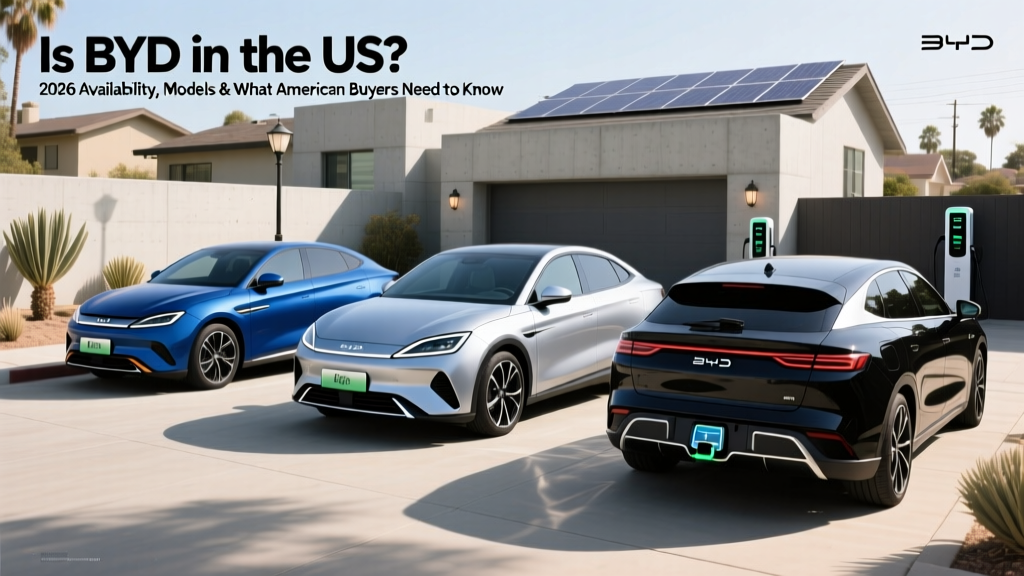
If you've been following the global EV market, you've likely seen headlines about BYD — the Chinese automaker that has surpassed Tesla in global plug-in vehicle sales and is expanding aggressively into Europe, Southeast Asia, Australia, and Latin America. So the natural question for American EV shoppers is: is BYD in the US?
As of 2026, the answer is no — BYD does not sell passenger vehicles in the United States. You cannot walk into a US dealership and purchase a BYD Seal, Dolphin, Atto 3, or any of the company's passenger EVs. The barriers are both regulatory and economic: steep US tariffs on Chinese-made automobiles, ongoing geopolitical trade tensions, and BYD's own strategic decision to focus on markets where it faces fewer import obstacles.
However, BYD's absence from the US passenger car market doesn't mean the company has no American footprint. BYD operates a commercial vehicle division in the US, primarily manufacturing electric buses at a facility in Lancaster, California. And the company's global vehicle lineup offers a revealing look at what American buyers could be driving — and what the competitive landscape might look like if trade policy ever shifts.
This guide breaks down BYD's current US status, examines its most compelling global models with hard specs, explains the tariff and tax-credit barriers, and helps you identify which currently available US-market EVs deliver similar value today.
Why BYD Passenger Cars Aren't Sold in America
Three primary factors keep BYD's passenger vehicles out of the US market in 2026:
1. The 100% Tariff on Chinese-Made EVs
In 2024, the Biden administration raised tariffs on Chinese-made electric vehicles from 25% to 100% under Section 301 of the Trade Act. This effectively doubled the landed cost of any BYD vehicle imported into the United States, making even the company's aggressively priced models uncompetitive against domestically produced or tariff-exempt alternatives. The tariff remains in effect in 2026 and there is no indication of near-term reversal.
2. Federal Tax Credit Ineligibility
Under the IRS §30D New Clean Vehicle Credit, a vehicle must meet North American final assembly requirements to qualify for up to $7,500 in federal tax credits. BYD's passenger vehicles are manufactured in China (primarily at facilities in Shenzhen, Xi'an, and Changsha), meaning they would fail the assembly requirement even if they were imported. Additionally, the battery component and critical mineral sourcing rules would present further obstacles given BYD's vertically integrated Chinese supply chain.
3. BYD's Strategic Market Prioritization
BYD has chosen to invest its expansion capital in markets with friendlier regulatory environments. The company has built or is building factories in Thailand, Brazil, Hungary, Indonesia, Uzbekistan, and Turkey — all markets where it can manufacture locally and avoid import tariffs. Entering the US market would require either absorbing the 100% tariff or building a US factory, neither of which makes near-term financial sense given the company's success elsewhere.
BYD's Global Lineup: Specs That Make Headlines
Even though you can't buy them in the US, understanding BYD's global models helps contextualize the competitive pressure they exert worldwide — and what American-market alternatives offer comparable value. Here are the models most frequently discussed by US-based EV enthusiasts:
| Model | Segment | Battery (kWh) | Chemistry | WLTP Range | 0-100 km/h | Drivetrain | Approx. Int'l Price |
|---|---|---|---|---|---|---|---|
| BYD Seal | Sedan (Tesla Model 3 rival) | 82.5 kWh | LFP (Blade) | 570 km (~354 mi) | 5.9s (RWD) / 3.8s (AWD) | RWD / AWD | ~$42,000 (EU) |
| BYD Dolphin | Subcompact hatch | 60.4 kWh | LFP (Blade) | 427 km (~265 mi) | 7.0s | FWD | ~$30,000 (EU) |
| BYD Atto 3 | Compact SUV | 60.5 kWh | LFP (Blade) | 420 km (~261 mi) | 7.3s | FWD | ~$35,000 (EU) |
| BYD Seal U | Mid-size SUV | 87 kWh | LFP (Blade) | 500 km (~311 mi) | 7.9s | FWD / AWD | ~$44,000 (EU) |
| BYD Han | Full-size sedan | 85.4 kWh | LFP (Blade) | 521 km (~324 mi) | 7.9s (EV) / 3.9s (AWD) | FWD / AWD | ~$55,000 (EU) |
Important note on range figures: BYD publishes WLTP range estimates, which tend to run 10-15% higher than US EPA estimates for the same vehicle. A BYD Seal with a 570 km WLTP rating would likely achieve an EPA-estimated 300-320 miles if sold in the US. Real-world highway driving in cold weather would further reduce that figure to roughly 240-270 miles.
BYD's Blade Battery: LFP Chemistry Done Right
Every BYD passenger model uses the company's proprietary Blade Battery, a lithium iron phosphate (LFP) cell in a unique flat-blade form factor. LFP chemistry offers several advantages over the nickel-manganese-cobalt (NMC) batteries common in many US-market EVs:
- Safety: LFP cells are significantly more resistant to thermal runaway — BYD has demonstrated nail-penetration tests without fire
- Longevity: LFP batteries typically sustain 3,000+ charge cycles before reaching 80% capacity, compared to ~1,000-2,000 for NMC
- Cost: LFP chemistry uses no cobalt or nickel, reducing material costs
- Daily charging: LFP batteries can be routinely charged to 100% without the degradation concerns that affect NMC packs
The trade-off: LFP has lower energy density than NMC, meaning heavier battery packs for a given range, and reduced performance in very cold temperatures. In sub-freezing conditions, expect 25-35% range reduction — more than the 15-25% typical of NMC-equipped vehicles.
Charging Performance: What BYD Offers Globally
BYD's charging speeds are adequate but not class-leading — a notable contrast to the company's aggressive pricing. Here's what international-market owners experience:
| Model | Max DC Fast Charge | 10-80% DC Time | Level 2 AC Rate | Level 2 Miles/Hr | Connector |
|---|---|---|---|---|---|
| BYD Seal | 150 kW | ~26 min | 11 kW | ~38 mi/hr | CCS2 (EU) / GB/T (China) |
| BYD Dolphin | 88 kW | ~29 min | 11 kW | ~38 mi/hr | CCS2 (EU) / GB/T (China) |
| BYD Atto 3 | 88 kW | ~29 min | 7.2 kW (1-phase) | ~25 mi/hr | CCS2 (EU) / GB/T (China) |
| BYD Seal U | 140 kW | ~28 min | 11 kW | ~38 mi/hr | CCS2 (EU) / GB/T (China) |
US Alternatives: What to Buy Instead in 2026
Since BYD isn't an option for American buyers, here are the closest US-market equivalents to BYD's most popular global models — with EPA-verified specs, current pricing, and tax credit status:
If You Want a BYD Seal → Consider the Tesla Model 3 or Hyundai Ioniq 6
| Spec | BYD Seal (WLTP) | Tesla Model 3 LR (EPA) | Hyundai Ioniq 6 SEL (EPA) |
|---|---|---|---|
| Range | ~354 mi (WLTP) / ~310 mi est. EPA | 341 mi (EPA) | 316 mi (EPA) |
| Battery | 82.5 kWh LFP | 75 kWh (est.) NMC | 77.4 kWh NMC |
| Max DC Charge | 150 kW | 250 kW | 240 kW |
| 10-80% Time | ~26 min | ~15 min | ~18 min |
| 0-60 mph | 5.6s (RWD) | 5.8s (LR RWD) | 6.2s (SEL RWD) |
| Base Price | N/A (not sold in US) | $42,380 | $39,250 |
| Federal Tax Credit | N/A | Partial ($3,750)* | $7,500* |
*Tax credit eligibility depends on buyer income caps ($150K single / $300K joint), MSRP caps ($55K sedans), battery sourcing requirements, and point-of-sale transfer rules under IRS §30D. Verify eligibility at purchase — rules are subject to change.
If You Want a BYD Dolphin → Consider the Chevy Bolt EV or Nissan Leaf
The Dolphin's appeal is its sub-$30,000 pricing in international markets. In the US, the closest value proposition is the Chevrolet Bolt EV (reintroduced for 2025-2026), starting around $28,000 with 259 miles of EPA range and eligibility for the full $7,500 federal credit — bringing the effective price to roughly $20,500 for qualifying buyers.
If You Want a BYD Atto 3 → Consider the Hyundai Kona Electric or Kia Niro EV
The Atto 3 compact SUV competes directly with the Hyundai Kona Electric (EPA 261 mi, ~$33,000) and Kia Niro EV (EPA 239 mi, ~$39,600). Both offer CCS/NACS charging compatibility, US dealer networks, and available federal tax credits.
The Tariff Question: Could BYD Enter the US Market?
BYD's global expansion has raised persistent questions about a potential US market entry, even under current trade barriers. Here's the realistic landscape:
Scenario 1: Direct Import (Unlikely)
Importing Chinese-built BYD vehicles into the US faces the 100% tariff, making a $30,000 Dolphin effectively a $60,000+ vehicle — destroying its value proposition entirely.
Scenario 2: Build a US Factory (Possible, Long-Term)
BYD could theoretically build a manufacturing plant in the US or Mexico to bypass import tariffs. However, this would require billions in capital investment, navigate complex US-Mexico-Canada Agreement (USMCA) rules of origin, and still face potential political backlash. BYD's current strategy favors factory builds in countries with explicit EV incentives and fewer geopolitical complications.
Scenario 3: Tariff Reduction (Unpredictable)
Trade policy can shift with administrations. A future reduction in Chinese EV tariffs would immediately make BYD competitive in the US, given the company's cost advantages. However, as of 2026, no such policy change is pending or proposed.
What BYD's Absence Means for US Buyers
The lack of BYD competition in the US has a direct effect on American EV pricing: it reduces downward pressure on cost. In markets where BYD competes — Europe, Australia, Southeast Asia — legacy automakers have been forced to cut prices and improve value. The Tesla Model 3, for instance, has seen more aggressive price cuts in China and Europe than in the US, partly in response to BYD competition.
For US shoppers, this means:
- Best value today: Look at the Chevy Bolt EV, Hyundai Kona Electric, and Tesla Model 3 RWD for the strongest price-to-range ratios
- Charging speed matters: US-market alternatives from Hyundai/Kia and Tesla significantly outpace BYD's DC fast-charging rates
- Tax credits shift the math: A $42,000 Tesla Model 3 with a $3,750 credit or a $33,000 Kona Electric with a $7,500 credit offers effective pricing that BYD couldn't match even without tariffs, given current US pricing structures
- Dealer support and service: US-market EVs come with established service networks, warranty infrastructure, and parts availability that a new entrant like BYD would take years to build
Frequently Asked Questions
Can I import a BYD vehicle to the US myself?
Technically, you could attempt to import a BYD under NHTSA's show-and-display or 25-year import rules, but for a current-production vehicle, this is effectively impossible. The vehicle would need to meet all Federal Motor Vehicle Safety Standards (FMVSS), which BYD's global models are not certified for. The 100% tariff would also apply.
Does BYD make any vehicles in the United States?
BYD manufactures electric transit buses at its Lancaster, California facility. These are commercial vehicles for transit agencies, not consumer automobiles. BYD also has a small presence in electric forklifts and commercial trucks in the US market.
Will BYD ever sell cars in the US?
There is no announced timeline for BYD passenger vehicle sales in the United States. The company has publicly stated it is focused on other markets for its expansion. A change in tariff policy or a decision to build a North American factory could alter this, but neither is expected in the near term.
What's the cheapest EV I can buy in the US that's similar to a BYD?
The Chevrolet Bolt EV (starting ~$28,000, 259 mi EPA range) is the closest US equivalent to BYD's value-oriented pricing. After the $7,500 federal tax credit (for qualifying buyers), the effective price drops to approximately $20,500 — making it one of the most affordable new EVs available anywhere.
Is BYD's Blade Battery technology available in any US-market EV?
Not directly. BYD's Blade Battery is proprietary. However, Tesla's standard-range Model 3 and Model Y vehicles use LFP cells (supplied by CATL), which share the same lithium iron phosphate chemistry and similar longevity/safety characteristics — just in a different physical form factor. The Ford Mustang Mach-E standard range also uses LFP cells.