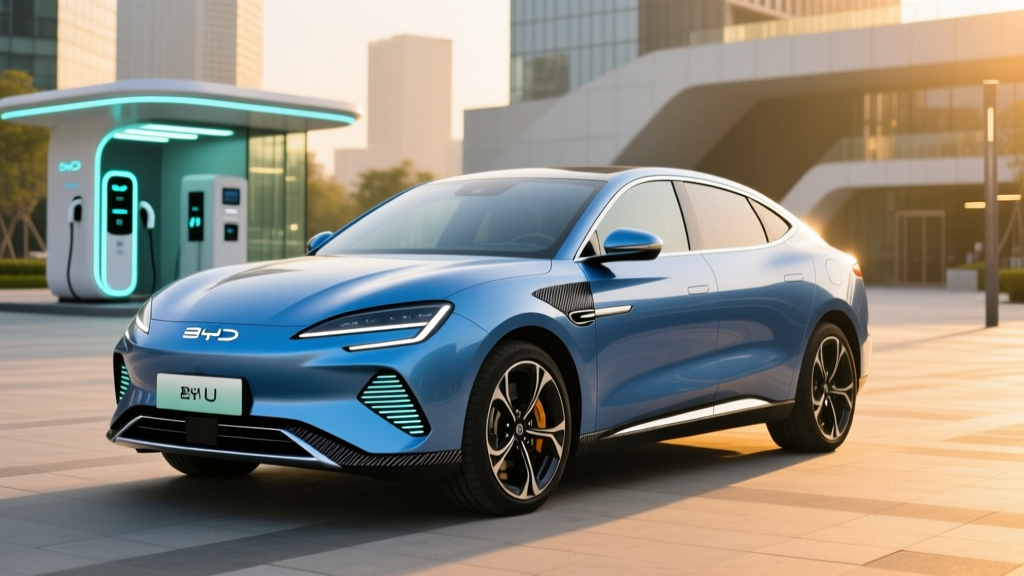
The BYD U9 is a 1,300-horsepower electric supercar that costs roughly what a used Porsche 911 Turbo fetches at auction. It exists to prove a point: that a Chinese automaker can build a halo car with active suspension that makes it hop off the ground, dance, and corner flat at absurd speeds. Whether you can actually buy one in the United States in 2026 is a different, far more complicated question.
This profile breaks down the U9's verified specifications, real-world range expectations, charging behavior, and the regulatory barriers that keep it off American roads. If you're researching the BYD U9 from the US, you're likely weighing import feasibility, track-day potential, or pure curiosity. Here's what the data shows.
Spec Sheet: BYD U9 at a Glance
| Attribute | BYD U9 (2024-2026) |
|---|---|
| Battery Capacity | ~120 kWh (BYD Blade, LFP chemistry) |
| Range (CLTC) | 450 km (~280 miles) |
| Estimated EPA Range | ~220-240 miles (unverified; no US EPA test) |
| Drivetrain | Quad-motor AWD (e4 platform) |
| Horsepower | 1,300 hp (960 kW system output) |
| 0-60 mph | 2.36 seconds (claimed) |
| Top Speed | 309 km/h (192 mph) |
| Max DC Fast Charge | ~280 kW (dual-gun capable) |
| 10-80% DC Charge Time | ~20 minutes (estimated, dual-gun) |
| Level 2 Home Charge | ~11 kW AC (estimated) |
| Suspension | DiSus-X active hydraulic (4 independent actuators) |
| Curb Weight | ~2,400 kg (5,290 lbs) |
| Base MSRP (China) | ¥1,680,000 (~$232,000 USD) |
| US Availability | Not sold; no homologation for US market |
Real-World Range: What 450 km CLTC Actually Means
Estimated EPA Equivalent: ~220-240 miles
Real-World Highway (70 mph): ~170-190 miles
Cold Weather (32°F, highway): ~140-160 miles
The U9's range figure comes from China's CLTC cycle, which is significantly more generous than the US EPA test procedure. Historically, CLTC-to-EPA conversions for performance EVs yield a 15-20% reduction. For a 120 kWh pack pushing 5,290 pounds of supercar with quad motors and active hydraulics, expect EPA-equivalent range in the low 220s at best.
In practice, supercar range is a secondary concern. At sustained highway speeds, aerodynamic drag dominates, and the U9's aggressive bodywork and wide tires create substantial resistance. Expect 170-190 miles on a full charge during a 70 mph cruise. In freezing temperatures, LFP chemistry loses roughly 20-30% of usable capacity, bringing highway range down to 140-160 miles.
This isn't a road-trip car. It's a track weapon and boulevard cruiser. If you're planning 300-mile journeys, you're shopping in the wrong category.
Charging Speed: Dual-Gun DC Fast Charging
| Charging Method | Power | Time (10-80%) | Miles Added (est.) |
|---|---|---|---|
| DC Fast (dual-gun) | ~280 kW peak | ~20 minutes | ~150 miles in 15 min |
| DC Fast (single-gun) | ~140-150 kW peak | ~35-40 minutes | ~70 miles in 15 min |
| Level 2 Home (240V) | ~11 kW | ~10-11 hours (full) | ~25 miles per hour |
| Level 1 (120V) | ~1.4 kW | ~85+ hours (full) | ~3 miles per hour |
BYD's dual-gun DC fast charging allows the U9 to accept two CCS or GB/T connectors simultaneously, effectively doubling the charge rate. At a compatible station, peak power reaches approximately 280 kW, though sustained rates taper above 60% state of charge. A 10-80% charge takes roughly 20 minutes under ideal conditions.
Single-gun charging caps at around 140-150 kW, extending the 10-80% window to 35-40 minutes. This is the more common scenario outside China, where dual-gun infrastructure is rare.
Home Level 2 charging at 11 kW refills the 120 kWh pack in 10-11 hours. For a supercar used primarily for weekend drives and track days, overnight charging is sufficient. Level 1 charging is impractical for a pack this size.
One caveat: LFP batteries prefer regular 100% charges for cell balancing, unlike NMC packs that benefit from an 80% daily limit. This means you can charge the U9 to full without degradation concerns, but the charge curve still tapers significantly above 90% SoC.
Performance: The e4 Quad-Motor Platform
The U9 uses BYD's e4 platform with four independent motors—one per wheel—producing a combined 1,300 horsepower. Each wheel can be torqued individually, enabling tank turns (360-degree spins), tank parking (crabbing sideways into a spot), and torque vectoring that makes the car corner with supernatural flatness.
The claimed 0-60 mph time is 2.36 seconds, placing the U9 in the same bracket as the Rimac Nevera and Tesla Model S Plaid. Top speed is electronically limited to 192 mph.
But raw acceleration is only part of the story. The DiSus-X active suspension uses four independent hydraulic actuators that can raise, lower, stiffen, or soften each corner in milliseconds. This allows the U9 to:
- Drive on three wheels if one tire blows out
- Jump off the ground (literally hop, as demonstrated in viral videos)
- Eliminate body roll entirely during cornering
- Adjust ride height for speed bumps or track use
This is not a gimmick. It's a fundamentally different approach to vehicle dynamics that eliminates the need for traditional anti-roll bars and passive dampers. The trade-off is weight: at 5,290 pounds, the U9 is heavier than most supercars, though the low center of gravity and instant torque mask this on a track.
Pricing, Tax Credits, and US Import Reality
| Cost Factor | Amount |
|---|---|
| Base MSRP (China) | ~$232,000 USD |
| US Import Tariff (2026) | 100% (Chinese EV tariff) |
| Estimated Landed Cost (US) | ~$464,000+ (before shipping, compliance) |
| Federal Tax Credit (§30D) | $0 (not sold by authorized US dealer) |
| Homologation Cost (if possible) | $500,000+ (estimated, crash testing, emissions) |
The BYD U9 is not sold in the United States, and bringing one in is effectively impossible for a road-legal vehicle. Here's why:
100% Tariff: As of 2024, the US imposes a 100% tariff on Chinese-made electric vehicles. This doubles the base price before shipping, duties, and compliance modifications.
No Homologation: The U9 has not been crash-tested by NHTSA or IIHS, and BYD has not pursued US Federal Motor Vehicle Safety Standards (FMVSS) certification. Without this, the car cannot be legally registered for road use.
No Dealer Network: The §30D federal tax credit requires purchase from an authorized dealer. Even if you imported a U9 under the 25-year rule (which doesn't apply to a 2024 car), you'd receive no credit.
Show or Display Import: Theoretically, you could import a U9 under the "Show or Display" exemption, which allows limited-mileage imports of historically or technologically significant vehicles. This restricts you to 2,500 miles per year and requires DOT approval. It's a path for collectors, not daily drivers.
Bottom line: If you're in the US and want a 1,300-hp electric supercar, you're looking at the Rimac Nevera (~$2.4M), Lotus Evija (~$2.1M), or a used Tesla Model S Plaid (~$80K) as realistic alternatives.
Interior, Tech, and Practicality
The U9's cabin is a two-seat supercar layout with a large central touchscreen (likely 12.8-inch rotating, BYD's signature), a digital instrument cluster, and minimal physical controls. Materials include carbon fiber, Alcantara, and leather—appropriate for the price point.
Cargo space is negligible. There is no frunk (the e4 platform and front motors occupy that space), and the rear trunk is shallow, fitting perhaps a small duffel or racing helmet. This is not a grand tourer; it's a track-focused machine with just enough room for a weekend bag.
Driver-assist features are minimal, as expected in a supercar. Expect basic stability control, traction management, and launch control, but not Level 2 ADAS like adaptive cruise or lane-keeping. The U9's focus is driver engagement, not autonomy.
The standout tech is the DiSus-X suspension, which offers programmable modes (track, comfort, dance, jump) and over-the-air updates. BYD has demonstrated the car performing choreographed suspension movements to music—a party trick that showcases the system's bandwidth.
Pros and Cons
- 1,300 hp and 2.36-second 0-60 for under $250K (in China)
- DiSus-X active suspension is genuinely revolutionary
- LFP Blade battery offers excellent thermal stability and cycle life
- Dual-gun DC charging minimizes downtime
- Quad-motor torque vectoring enables tank turns and 3-wheel driving
- Not available in the US; 100% tariff + no homologation blocks import
- Real-world highway range is ~170-190 miles (supercar-typical, but limited)
- 5,290-lb curb weight is high for a supercar
- No frunk; minimal cargo space
- No US service network or parts support
- Dual-gun charging infrastructure is rare outside China
Who Should Consider the BYD U9?
The BYD U9 is a halo car for a specific audience: Chinese-market buyers (or those with access to grey-market imports in regions like the Middle East or Southeast Asia) who want a technologically advanced electric supercar at a fraction of the cost of a Rimac or Pininfarina.
In the US, the U9 is a non-starter for road use. If you're a collector exploring Show or Display import, a track-day enthusiast with private land, or simply researching BYD's e4 platform for future products, the U9 is a fascinating case study. For everyone else, it's a reminder that the global EV landscape includes machines that may never reach American shores.
If you're in a market where the U9 is sold and you want a supercar that doubles as a tech showcase, it's worth a test drive. Just don't plan on 300-mile road trips or easy service visits.
FAQ
Can I buy the BYD U9 in the United States?
No. The U9 is not sold by BYD in the US, and importing one for road use is effectively impossible due to the 100% tariff on Chinese EVs, lack of NHTSA crash testing, and no dealer network. Show or Display import is theoretically possible but restricts you to 2,500 miles per year.
What is the real-world range of the BYD U9?
The CLTC rating is 450 km (~280 miles), but the estimated EPA equivalent is 220-240 miles. Real-world highway driving at 70 mph yields approximately 170-190 miles. In cold weather (32°F), expect 140-160 miles.
How fast does the U9 charge?
With dual-gun DC fast charging, peak power is ~280 kW, and 10-80% takes about 20 minutes. Single-gun charging caps at ~140-150 kW, extending the time to 35-40 minutes. Level 2 home charging at 11 kW refills the pack in 10-11 hours.
Does the BYD U9 qualify for the federal EV tax credit?
No. The §30D credit requires purchase from an authorized US dealer, and BYD does not sell vehicles in the US. Even if imported, the 100% tariff and lack of battery-sourcing compliance would disqualify it.
What battery chemistry does the U9 use?
The U9 uses BYD's Blade battery with LFP (lithium iron phosphate) chemistry. LFP offers excellent thermal stability, long cycle life, and lower cost than NMC, though with slightly lower energy density.
Is the U9 worth buying vs. a Tesla Model S Plaid or Rimac Nevera?
In markets where it's sold, the U9 offers Rimac-level performance at a fraction of the price. In the US, it's not an option. The Model S Plaid is far more accessible (~$80K used, EPA 396-mile range, Supercharger access), while the Nevera is a bespoke hypercar for collectors. The U9 occupies a middle ground that US buyers cannot access.