Quick Verdict: BYD's Flagship Sedan Has Global Ambitions
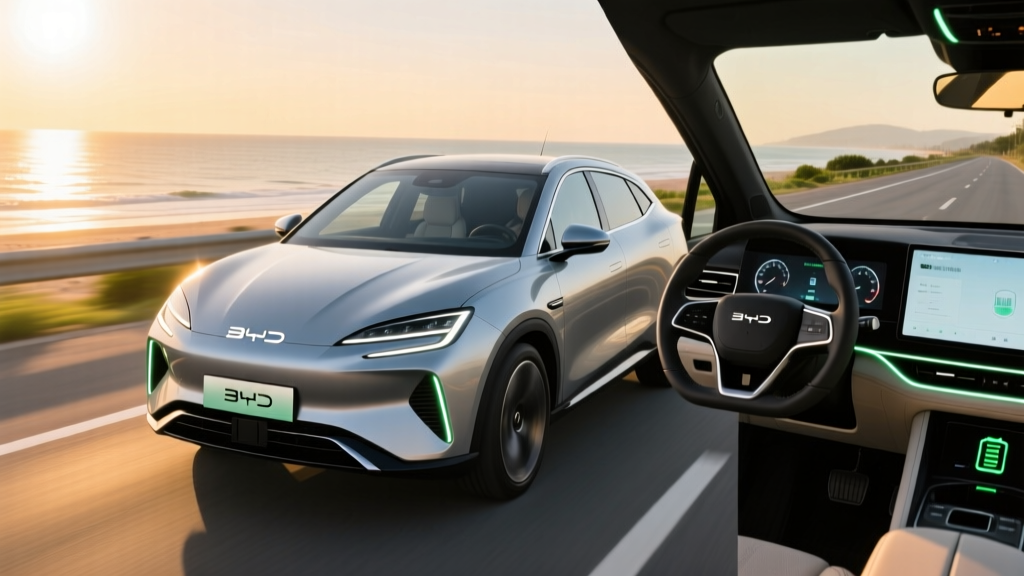
The BYD U7 is the Chinese automaker's most ambitious electric sedan yet — a full-size, dual-motor luxury EV that slots above the Han and Seal in BYD's lineup. First unveiled at Auto China 2024 and refined for its 2025–2026 global rollout, the U7 is engineered to compete with the Mercedes EQS, BMW i7, and NIO ET7 on technology and undercut them on price. But for US-based EV shoppers, the critical question isn't how impressive the U7 is on paper — it's whether you can actually buy one. As of early 2026, BYD has not confirmed a US launch, and the vehicle remains primarily available in China, select European markets, and parts of Southeast Asia and Latin America.
This profile covers the latest confirmed specifications for the 2026 model year as sold in international markets, with notes on what a hypothetical US launch would mean for pricing, tax credit eligibility, and competitive positioning. All figures reflect manufacturer-announced data and independent testing where available; US EPA certification numbers are not yet published because the vehicle is not sold in the United States.
Battery, Range, and Efficiency: The Blade LFP Advantage
The BYD U7 is built on the brand's e-Platform 3.0 Evo and uses BYD's in-house Blade Battery — a lithium iron phosphate (LFP) pack known for thermal stability, long cycle life, and the absence of cobalt or nickel. The standard battery capacity is 100.2 kWh (usable), making it one of the largest LFP packs in any production sedan.
| Specification | BYD U7 (2026 International Spec) |
|---|---|
| Battery Capacity (Usable) | 100.2 kWh |
| Battery Chemistry | LFP (Lithium Iron Phosphate) — Blade Cell |
| CLTC Range (China) | Up to 800 km (~497 mi) |
| WLTP Range (Europe) | ~620 km (~385 mi) estimated |
| EPA Range (US) | Not certified — vehicle not sold in US |
| Efficiency (WLTP) | ~16.2 kWh/100 km |
| Drivetrain | Dual-motor AWD (standard); RWD variant available in select markets |
| Horsepower (AWD) | ~640 hp (combined) |
| 0–100 km/h (0–62 mph) | 3.8 seconds (AWD) |
Because the U7 is not EPA-certified, we can estimate based on WLTP data and the typical 10–15% gap between WLTP and EPA testing cycles. A reasonable EPA-equivalent estimate would be 330–360 miles for the AWD variant. In real-world mixed driving, expect approximately 290–320 miles in moderate temperatures, dropping to 240–270 miles in sustained highway driving at 70+ mph or in sub-freezing conditions. LFP batteries experience somewhat greater cold-weather range loss than NMC chemistries — typically 25–35% at 20°F without preconditioning — though the U7's heat pump and thermal management system help mitigate this. City driving with regenerative braking maximizes the LFP pack's efficiency advantage.
LFP chemistry is a deliberate trade-off. Compared to NMC (nickel manganese cobalt), LFP offers a longer cycle life (often 3,000+ full cycles before significant degradation), better thermal runaway resistance, and lower material cost. The trade-off is lower energy density — which is why the U7 needs a physically larger, heavier 100.2 kWh pack to achieve the range figures above. For a full-size sedan with a long wheelbase, the weight penalty is more manageable than it would be in a compact car.
Charging Speed: DC Fast Charge and Home Level 2
The U7 supports BYD's latest high-voltage architecture, enabling DC fast charging at up to 240 kW peak on compatible chargers. BYD claims a 10–80% charge time of approximately 20 minutes under optimal conditions (warm battery, high-power CCS2 or GB/T charger).
| Charging Method | Max Power | Charge Time / Rate |
|---|---|---|
| DC Fast Charge (CCS2/GB/T) | 240 kW peak | 10–80% in ~20 min (optimal) |
| DC Fast Charge (50 kW station) | 50 kW | 10–80% in ~90 min |
| Level 2 AC (Home/Wallbox, 3-phase 11 kW) | 11 kW | 0–100% in ~10 hours |
| Level 2 AC (US-standard 7.2 kW / 240V) | 7.2 kW | 0–100% in ~14 hours; ~22 mi/hr |
| Level 1 AC (120V household) | 1.4 kW | ~4 mi/hr — impractical for full charge |
A few real-world caveats on charging: the 240 kW peak is achieved only between roughly 10–40% state of charge. As with all EVs, the charge curve tapers significantly above 60% SoC to protect the battery, and by 80% the rate drops to approximately 80–100 kW. Charging from 80–100% on DC can take nearly as long as the 10–80% session. For daily use, home Level 2 charging at 7.2–11 kW is the practical standard — you'll wake up to a full battery every morning, which is ideal for LFP chemistry since BYD recommends periodic 100% charges for LFP pack calibration (unlike NMC, where daily 80% limits are preferred).
For US buyers accustomed to the Tesla Supercharger network (NACS connector), a BYD US launch would likely use CCS1 initially, with potential NACS adoption as the industry transitions. BYD has committed to NACS for future North American models, but no US-spec U7 has been confirmed.
Performance and Driving Dynamics
The dual-motor AWD U7 produces approximately 640 horsepower and achieves a 0–60 mph time of roughly 3.6 seconds, placing it squarely in performance-sedan territory alongside the Tesla Model S Plaid's base variant and the Porsche Taycan 4S. A single-motor RWD variant is available in some markets with lower output (~308 hp) and a 0–60 time around 6.5 seconds, trading acceleration for slightly longer range and a lower price point.
The U7 uses BYD's DiSus-A intelligent air suspension system with adaptive damping, which adjusts ride height and firmness based on road conditions and driving mode. This is a meaningful differentiator in the segment — air suspension at this price point is uncommon outside of German luxury brands. Ground clearance adjusts from approximately 5.1 inches (sport mode) to 6.3 inches (lift mode), useful for speed bumps and steep driveways.
Regenerative braking offers multiple levels, including a one-pedal driving mode that brings the car to a full stop without touching the brake pedal. The brake-by-wire system provides smooth blending between regen and friction braking, a common weak point in earlier BYD models that the U7 has addressed convincingly.
Interior, Tech, and Cargo Space
The U7's cabin is where BYD makes its strongest luxury pitch. The dashboard is dominated by a 15.6-inch rotating center touchscreen (BYD's signature feature, which pivots between portrait and landscape orientation), flanked by a 12.8-inch digital instrument cluster and a 28.6-inch augmented-reality head-up display. Rear passengers get dual 12.8-inch seat-back entertainment screens on higher trims.
The infotainment runs BYD's DiLink 150 system with 5G connectivity, over-the-air updates, voice control with natural-language processing, and wireless Apple CarPlay/Android Auto. The audio system on premium trims is a 20-speaker Dynaudio setup.
| Dimension / Feature | Measurement |
|---|---|
| Wheelbase | 118.1 in (3,000 mm) |
| Overall Length | 204.7 in (5,200 mm) |
| Front Legroom | ~41.5 in (est.) |
| Rear Legroom | ~39.0 in (est.) |
| Trunk Volume | ~17.7 cu ft (500 L) |
| Frunk (Front Trunk) | Not available (AWD motor packaging) |
| Seating | 5-passenger; available 4-seat executive layout |
| Upholstery | Nappa leather standard; vegan leather option |
Cargo space is adequate for the class at roughly 17.7 cubic feet, though the trunk opening is narrower than the liftback-style Tesla Model S or the Porsche Taycan. The absence of a frunk is a consequence of the AWD motor and power electronics packaging — a trade-off common in dual-motor EVs not built on dedicated skateboard platforms optimized for front storage.
Driver Assistance and Safety Technology
The U7 comes equipped with BYD's DiPilot 300 ADAS suite, which includes:
- Adaptive cruise control with stop-and-go
- Lane centering assist with lane-change assist
- Automatic emergency braking (forward and reverse)
- Blind-spot monitoring with rear cross-traffic alert
- 360-degree surround-view camera with transparent chassis
- Automated parking assist (parallel and perpendicular)
- Traffic sign recognition
The BYD U7's DiPilot system is an SAE Level 2 driver-assistance system. This means it can simultaneously control steering and speed under certain conditions, but the driver must remain fully engaged and supervising at all times. It is not a self-driving or autonomous system. BYD is developing higher-level capabilities for future models, but the production U7 requires hands-on-wheel or eyes-on-road monitoring depending on market regulations.
Higher trims add a lidar sensor (roof-mounted, on select markets) and BYD's "God's Eye" high-level ADAS, which enables hands-off driving on mapped highways in certain jurisdictions. However, availability of these features varies significantly by market, and US-spec feature content cannot be confirmed until a formal launch.
As of early 2026, the U7 has not been crash-tested by NHTSA or IIHS because it is not sold in the United States. It has received a 5-star rating from Euro NCAP in European testing.
Pricing, Tax Credits, and US Availability
The BYD U7 is priced aggressively in international markets. In China, the U7 starts at approximately ¥300,000 (~$41,500 USD at current exchange rates) for the RWD variant and reaches approximately ¥400,000 (~$55,000 USD) for the fully equipped AWD flagship trim. European pricing, where available, is higher due to tariffs and homologation costs — expect €55,000–€70,000 (~$60,000–$76,000 USD).
| Trim | China MSRP (approx. USD) | Est. US MSRP (if launched) | Federal Tax Credit (§30D) |
|---|---|---|---|
| U7 Standard (RWD) | ~$41,500 | ~$52,000–$56,000 | Unlikely — see below |
| U7 Premium (AWD) | ~$48,000 | ~$60,000–$65,000 | Unlikely — see below |
| U7 Flagship (AWD, fully loaded) | ~$55,000 | ~$70,000–$78,000 | Unlikely — see below |
If BYD were to sell the U7 in the US, it would face significant hurdles under the IRS §30D clean vehicle credit rules effective for 2026:
- Battery sourcing requirements: A percentage of critical minerals and battery components must be sourced from the US or free-trade-agreement countries. BYD's vertically integrated supply chain is predominantly China-based, making compliance extremely difficult.
- Foreign Entity of Concern (FEOC) restriction: Vehicles with battery components manufactured or assembled by a FEOC (which includes most Chinese battery manufacturers) are disqualified from the credit entirely as of 2024–2025 phase-in rules.
- MSRP caps: Sedans must be under $55,000 MSRP to qualify. Only the base RWD trim might clear this threshold at a hypothetical US price.
- Buyer income caps: AGI limits of $150,000 (single) / $300,000 (joint) apply regardless of vehicle eligibility.
- Point-of-sale transfer: Eligible buyers can transfer the credit to the dealer for an immediate price reduction, but only if the vehicle itself qualifies.
Bottom line: Even if BYD launched the U7 in the US, the FEOC battery-sourcing rules make it very unlikely the vehicle would qualify for the $7,500 federal tax credit. Buyers should consult a tax professional for eligibility guidance based on current-year IRS rules.
As of this writing, BYD has not announced a US launch timeline for the U7 or any passenger vehicle. BYD currently sells commercial vehicles (electric buses and trucks) in the US but has stated it is "studying" the passenger-car market. Geopolitical factors, including US tariffs on Chinese EVs (currently 100% under Section 301), make a near-term US launch improbable without a localized manufacturing partnership.
Pros, Cons, and Competitive Comparison
- Massive 100.2 kWh LFP Blade Battery with strong cycle life and thermal safety
- 240 kW DC fast charging with 10–80% in ~20 minutes
- DiSus-A air suspension — rare at this price point
- Rotating 15.6-inch center screen with DiLink 150 and 5G
- 3.6-second 0–60 mph (AWD) with 640 hp
- Aggressive international pricing vs. German competitors
- Euro NCAP 5-star safety rating
- Not available in the US — no confirmed launch timeline
- Unlikely to qualify for §30D federal tax credit due to FEOC rules
- No frunk (front trunk) on AWD variants
- LFP cold-weather range loss more pronounced than NMC competitors
- Brand recognition and service network outside China still developing
- Trunk opening narrower than liftback competitors (Model S, Taycan)
- Real-world US EPA range unverified — estimates only
- Choose the Tesla Model S if you need Supercharger network access, proven US service infrastructure, and EPA-certified range (402 mi Long Range).
- Choose the BMW i7 if you want established luxury brand prestige, US dealer support, and available hands-off Level 2+ driving (Highway Assistant).
- Choose the Mercedes EQS if maximum EPA range (390 mi) and a hyperscreen dashboard are priorities.
- Choose the BYD U7 if you're in a market where it's sold and want flagship-level specs at a mid-luxury price — and can accept the charging-network and service-infrastructure trade-offs of a newer brand.
Warranty and Battery Longevity
In international markets, BYD offers the U7 with a 6-year/150,000 km (93,000 mi) vehicle warranty and an 8-year/160,000 km (~100,000 mi) battery warranty with a minimum 70% capacity retention threshold. These terms are competitive with global norms (most EV battery warranties are 8 years/100,000 mi at 70% retention). US-specific warranty terms would be confirmed only at launch.
The LFP Blade Battery's longevity is one of its strongest attributes. Independent testing of BYD Blade cells has demonstrated over 3,000 full charge cycles before reaching 80% state of health (SoH). At an average of 300 miles per full cycle, that translates to approximately 900,000 miles before the battery degrades to 80% — far beyond the useful life of most vehicles. In practice, partial cycles and calendar aging mean real-world degradation will be higher, but LFP owners can expect minimal capacity loss over a typical 10-year ownership period.
BYD recommends charging LFP batteries to 100% at least once per week for cell balancing, which is the opposite of NMC best practices (where daily 80% limits are advised). This makes the U7 well-suited for owners who prefer to charge to full without worrying about accelerated degradation.
Frequently Asked Questions
What is the real-world range of the BYD U7?
With a 100.2 kWh LFP battery, the U7 achieves approximately 385 miles on the WLTP cycle. Since the US EPA cycle is more stringent, an estimated EPA-equivalent range would be 330–360 miles. In real-world mixed driving at moderate temperatures, expect 290–320 miles. Sustained highway driving at 70+ mph or cold weather below freezing can reduce this to 240–270 miles. LFP chemistry is more sensitive to cold than NMC, so preconditioning the battery before winter driving is important.
How fast does the BYD U7 charge?
On a DC fast charger capable of 240 kW, the U7 charges from 10–80% in approximately 20 minutes under optimal conditions. Peak charge rate is achieved between 10–40% SoC, with tapering above 60%. On a home Level 2 charger at 7.2 kW (standard US 240V/30A), expect about 22 miles of range added per hour, or a full 0–100% charge in roughly 14 hours. On an 11 kW 3-phase charger (common in Europe), a full charge takes about 10 hours.
How much would the BYD U7 cost in the US?
BYD has not announced US pricing. Based on international pricing and typical markups for import costs, homologation, and dealer margins, a reasonable estimate is $52,000–$78,000 depending on trim. However, current US tariffs on Chinese EVs (100% under Section 301) would approximately double the price, making a US launch economically unviable without a manufacturing partnership or tariff exemption.
Does the BYD U7 qualify for the federal EV tax credit?
Almost certainly not, even if sold in the US. The IRS §30D credit requires battery components and critical minerals to be sourced from the US or FTA-partner countries, and excludes vehicles with battery components from Foreign Entities of Concern (FEOC). BYD's vertically integrated, China-based supply chain makes compliance with these rules extremely difficult. Always verify current-year eligibility on irs.gov or with a tax professional.
Is the BYD U7 worth buying vs. the Tesla Model S or BMW i7?
If you're in a market where the U7 is available, it offers compelling value — air suspension, 640 hp, and a 100 kWh LFP battery at a price significantly below the Model S or i7. However, the Tesla Model S has the advantage of the Supercharger network and established service infrastructure. The BMW i7 offers brand cachet and a mature dealer network. The U7's strongest appeal is to buyers who prioritize specs-per-dollar and are comfortable with a newer brand's service ecosystem.
What are the biggest pros and cons of the BYD U7?
The biggest strengths are the large LFP Blade Battery (longevity and safety), fast 240 kW DC charging, air suspension, and aggressive pricing. The biggest weaknesses are the lack of US availability, unlikely tax credit qualification, no frunk, and LFP cold-weather range sensitivity. For international buyers, it's a strong contender; for US buyers, it remains a "what if" until BYD commits to a North American passenger-vehicle strategy.
Who is the BYD U7 best suited for?
The U7 is ideal for executive commuters and tech-forward sedan buyers in markets where it's sold — people who want a full-size luxury EV with strong performance and cutting-edge infotainment but don't need the brand prestige of a German badge. It's less suited for road-trippers in cold climates (LFP range loss) or buyers who depend on a dense public charging network (BYD's proprietary network is limited outside China).