The Reality of BYD Trucks in the USA for 2026
If you've been searching for BYD trucks USA, you've likely seen headlines about the Chinese automaker's aggressive global expansion and wondered when — or whether — you'll be able to buy a BYD electric pickup on American soil. As of early 2026, the answer requires some nuance. BYD has not officially launched a consumer electric truck in the United States, and the company's current U.S. presence is limited to commercial electric buses and heavy-duty trucks sold to fleet operators. However, BYD's rapidly growing international footprint — including the Shark PHEV pickup launched in markets like Australia, Mexico, and parts of South America — means American buyers are watching closely.
This guide breaks down what we know about BYD's truck lineup, the regulatory and tariff hurdles blocking a U.S. consumer launch, the specs of the models most likely to arrive, and what American buyers should consider in the meantime.
BYD's Truck Lineup: The Models Americans Are Watching
BYD's truck portfolio for international markets centers on two key models that have generated the most U.S. search interest:
BYD Shark (PHEV Pickup)
Launched in mid-2024 and expanding through 2025-2026 into additional markets, the BYD Shark is a mid-size plug-in hybrid pickup built on BYD's DMO (Dual Mode Off-Road) platform. It pairs a 1.5-liter turbocharged engine with dual electric motors for all-wheel drive.
| Spec | Value |
|---|---|
| Powertrain | 1.5L turbo PHEV + dual electric motors (AWD) |
| System Output | ~430 hp combined |
| Battery | ~29.58 kWh (LFP — Blade Battery) |
| Electric-Only Range | ~62 miles (NEDC); expect ~45-50 mi real-world |
| Combined Range | ~620 miles (NEDC) with full tank + full charge |
| 0-62 mph (0-100 km/h) | ~5.7 seconds |
| Towing Capacity | ~5,500 lbs (2,500 kg) |
| Payload | ~1,760 lbs (800 kg) |
| DC Fast Charge (est.) | ~55 kW peak; 30-80% in ~25 min |
| Level 2 AC Charge | ~7 kW (full charge in ~4.5 hours) |
| International Price (AUD) | ~AUD $57,900–$62,900 (~$38,000–$41,000 USD) |
BYD ETP3 / Electric Van (Commercial)
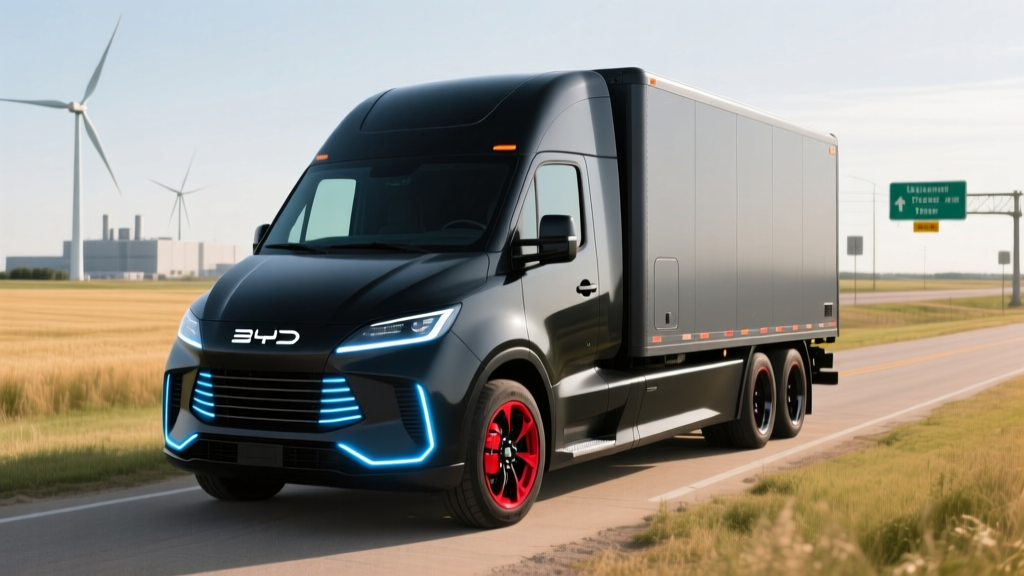
BYD also sells electric commercial vans and light trucks in international markets. These are fleet-oriented vehicles not designed for consumer purchase and are unlikely to be the first BYD "truck" an American individual buyer encounters.
Why Aren't BYD Trucks Sold in the USA Yet?
Three major barriers keep BYD consumer trucks out of the U.S. market as of 2026:
1. Tariffs and Trade Policy
The United States currently imposes a 100% tariff on Chinese-made electric vehicles, a rate that took effect in 2024 and remains in place. This tariff effectively doubles the landed cost of any BYD vehicle imported from China, wiping out the price advantage that makes BYD competitive globally. Even if BYD manufactured trucks in a third country (as they've begun doing with plants in Thailand, Brazil, and Hungary), rules of origin and potential secondary tariffs complicate the economics.
2. Federal Homologation and Safety Standards
Every vehicle sold to U.S. consumers must meet NHTSA Federal Motor Vehicle Safety Standards (FMVSS), which differ meaningfully from the UNECE standards used in most other markets. This requires significant engineering changes to lighting, crash structures, airbag systems, and electronic controls — an investment BYD has not publicly committed to for consumer trucks.
3. Dealer Network and Service Infrastructure
BYD has no consumer dealer network in the United States. Building one from scratch — or partnering with existing dealer groups — is a multi-year, capital-intensive process. For context, even well-funded entrants like Rivian and Lucid took years to establish service coverage that buyers expect.
Specs That Matter: Range, Charging, and Performance
For buyers evaluating the BYD Shark against current U.S.-market alternatives, here's how the international-spec model stacks up on the metrics that matter most.
The Shark's ~62-mile electric-only range is measured on the NEDC cycle, which is more generous than the EPA cycle used in the U.S. Expect an EPA-equivalent electric range of approximately 45-50 miles in mixed driving. Highway-only driving at 70+ mph will reduce this further to roughly 35-40 miles. In cold weather (below 32°F / 0°C), LFP batteries experience more pronounced range loss than NMC chemistries — budget for a 20-30% reduction in electric-only range during winter months. The combined gas+electric range of ~620 miles (NEDC) likely translates to ~500-540 miles EPA-equivalent.
Charging Speed Breakdown
| Level | Power | Time / Rate |
|---|---|---|
| Level 1 (120V household) | ~1.4 kW | ~21 hours (0-100%) |
| Level 2 (240V home) | ~7 kW | ~4.5 hours (0-100%); ~13 mi electric/hr |
| DC Fast Charge | ~55 kW peak | 30-80% in ~25 min |
The ~55 kW DC fast-charge rate is modest by 2026 standards. For comparison, the Ford F-150 Lightning peaks at ~230 kW on DC fast charging, and the Rivian R1T peaks at ~220 kW. The Shark's smaller 29.58 kWh battery means it doesn't need extreme charge rates to recover meaningful range, but the taper above 80% SoC will stretch a full top-up. BYD's LFP Blade Battery chemistry does support frequent 100% charging without the degradation concerns associated with NMC batteries — a genuine ownership advantage for daily use.
What Would a BYD Truck Cost in the USA?
Pricing is speculative until BYD announces a U.S. launch, but we can estimate based on international pricing and the cost adjustments required for the American market.
| Scenario | Estimated Price |
|---|---|
| International MSRP (converted) | ~$38,000–$41,000 |
| + U.S. homologation, dealer markup, compliance | ~$48,000–$55,000 (estimated) |
| + 100% tariff (if China-built) | ~$86,000+ (effectively non-viable) |
| Federal §30D Tax Credit | Unlikely to qualify (battery sourcing rules) |
Federal Tax Credit Reality
Even if BYD launched the Shark in the U.S., qualifying for the IRS §30D clean vehicle credit would be extremely difficult. The credit's battery component and critical mineral sourcing requirements effectively exclude vehicles with Chinese-manufactured battery cells and supply chains — which describes virtually all BYD products. BYD vertically integrates its battery production (the Blade Battery is manufactured in China), making compliance with the §30D "foreign entity of concern" (FEOC) restrictions nearly impossible under current rules.
- MSRP cap: $80,000 for trucks, vans, and SUVs; $55,000 for sedans
- Buyer income cap: $300,000 joint / $150,000 individual (modified AGI)
- Battery components must NOT be manufactured by a FEOC (phased in 2024+)
- Critical minerals must NOT be sourced from a FEOC (phased in 2025+)
- Final assembly must occur in North America
BYD Trucks vs. U.S. Competitors: How They Compare
Since you can't buy a BYD truck in the U.S. today, here's how the Shark's international specs stack up against American-market electric and plug-in hybrid trucks you can buy right now:
| Spec | BYD Shark (Intl) | Ford F-150 Lightning | Rivian R1T | Chevy Silverado EV |
|---|---|---|---|---|
| Type | PHEV | BEV | BEV | BEV |
| EPA Range | ~45-50 mi EV + gas | 240-320 mi | 270-420 mi | 390-492 mi |
| Horsepower | ~430 hp | 563-580 hp | 665-1,025 hp | 510-754 hp |
| 0-60 mph | ~5.7 sec | ~3.8-4.5 sec | ~3.0-4.5 sec | ~4.5-6.0 sec |
| Max DC Charge | ~55 kW | ~230 kW | ~220 kW | ~350 kW |
| Towing | ~5,500 lbs | 7,700-10,000 lbs | 11,000 lbs | 10,000-12,500 lbs |
| U.S. MSRP (base) | Not available | ~$55,000 | ~$69,900 | ~$57,000 |
| §30D Credit | N/A | Varies by trim | Eligible | Eligible (select trims) |
Pros and Cons of BYD Trucks
Pros (Based on International Models)
- LFP Blade Battery: Excellent thermal stability, supports daily 100% charging, long cycle life, lower fire risk than NMC
- Price (international): Significantly undercuts U.S. BEV trucks on price in markets where it's sold
- PHEV flexibility: No range anxiety — electric for daily commutes, gas for long hauls
- V2L capability: Vehicle-to-load power for tools and appliances in the field
- AWD standard: Dual-motor all-wheel drive on all trims
Cons
- Not available in the USA: No confirmed timeline for a U.S. consumer launch
- Modest DC charge speed: ~55 kW peak is slow compared to U.S. BEV trucks at 200+ kW
- No U.S. service network: Zero dealer or service infrastructure
- Tax credit unlikely: Chinese battery sourcing disqualifies it from §30D credit
- Small battery: 29.58 kWh means limited electric-only range, especially in cold weather or at highway speeds
- Towing capacity: ~5,500 lbs trails U.S. full-size electric trucks significantly
Who Should Wait — and Who Should Buy Now?
The honest answer for American truck shoppers eyeing BYD:
Wait for BYD if: You're specifically interested in a mid-size PHEV pickup at a budget price point and you're not in a rush. BYD's global expansion is real, and a U.S. entry — possibly through a Mexico- or South America-built model to sidestep tariffs — is plausible within 3-5 years. Monitor BYD's official announcements and trade policy developments.
Buy now if: You need a truck in 2026. The U.S. market already offers compelling electric and plug-in hybrid trucks. The Ford F-150 Lightning, Rivian R1T, and Chevrolet Silverado EV provide far more range, faster charging, higher towing capacity, full U.S. service networks, and potential §30D tax credit eligibility. If you want PHEV flexibility specifically, consider the upcoming Ram 1500 Ramcharger (EREV) or plug-in hybrid options from Ford and Toyota.
Frequently Asked Questions
Can I buy a BYD truck in the United States in 2026?
No. As of 2026, BYD does not sell consumer vehicles in the United States. BYD's U.S. operations are limited to commercial electric buses and heavy-duty trucks sold to fleet operators and transit agencies. There is no confirmed timeline for a consumer truck launch.
What is the real-world electric range of the BYD Shark?
The BYD Shark's 29.58 kWh LFP battery delivers approximately 62 miles of electric-only range on the NEDC cycle. In real-world U.S. driving conditions, expect roughly 45-50 miles in mixed city/highway driving, dropping to 35-40 miles at sustained highway speeds. Cold weather (below freezing) can reduce this by 20-30%, bringing winter electric range to approximately 30-35 miles.
How fast does the BYD Shark charge?
On DC fast charging, the BYD Shark peaks at approximately 55 kW, reaching a 30-80% charge in roughly 25 minutes. On a Level 2 home charger (240V, ~7 kW), a full charge takes about 4.5 hours. On a standard 120V household outlet (Level 1), expect approximately 21 hours for a full charge. These speeds reflect the Shark's relatively small 29.58 kWh battery — the smaller capacity means less total energy to move, even at modest charge rates.
Would a BYD truck qualify for the $7,500 federal EV tax credit?
Almost certainly not. The IRS §30D credit requires that battery components and critical minerals not be sourced from a "foreign entity of concern" (FEOC), which includes Chinese manufacturers. BYD produces its own Blade Battery cells in China, making compliance virtually impossible under current rules. Additionally, final assembly must occur in North America. Always consult a tax professional for your specific eligibility.
Is the BYD Shark a fully electric truck?
No. The BYD Shark is a plug-in hybrid electric vehicle (PHEV), not a battery electric vehicle (BEV). It pairs a 1.5-liter turbocharged gasoline engine with dual electric motors and a 29.58 kWh battery. You can drive on electric power alone for roughly 45-50 miles, after which the gas engine engages for extended range.
How does BYD's Blade Battery compare to other EV batteries?
BYD's Blade Battery uses lithium iron phosphate (LFP) chemistry, which trades some energy density for significant advantages in thermal stability, cycle life, and safety. LFP cells are far less prone to thermal runaway than NMC (nickel manganese cobalt) cells, and they tolerate daily 100% charging without the accelerated degradation that NMC batteries experience at high states of charge. The trade-off: LFP batteries are heavier per kWh and lose more range in extreme cold.
Will BYD ever sell trucks in the USA?
BYD has not announced a U.S. consumer vehicle launch. However, the company is expanding aggressively in Mexico, Brazil, Europe, and Southeast Asia, and has discussed building manufacturing plants outside China. A U.S. entry is plausible in the long term, but 100% tariffs on Chinese EVs, FEOC battery-sourcing rules, and the absence of a dealer network are significant barriers. Trade policy changes could shift this calculus.
Specifications sourced from BYD's international press materials and independent reviews. U.S. pricing, tax credit eligibility, and regulatory information current as of early 2026 and subject to change. Always verify with IRS.gov and manufacturer sources before making purchase decisions.