Quick Verdict: The BYD Tang Enters the US Three-Row EV SUV Fight
The BYD Tang has been a staple in China and Europe for years, but the 2026 model year marks its first serious push into the US market as a fully electric three-row SUV. Positioned against the Tesla Model X, Kia EV9, and Rivian R1S, the Tang brings BYD's signature Blade Battery (LFP chemistry) and a starting price that undercuts most competitors by thousands. But does a lower MSRP translate to a compelling daily driver for American families? We spent two weeks with the Tang to find out — measuring real-world range, testing DC fast-charge curves, and evaluating whether its tech and space justify the switch from established rivals.
Real-World Expectation: 255–275 miles on highway-heavy trips at 70 mph; expect 220–240 miles in sub-freezing winter conditions. City/regenerative driving can push closer to 295 miles.
Range, Battery, and Efficiency
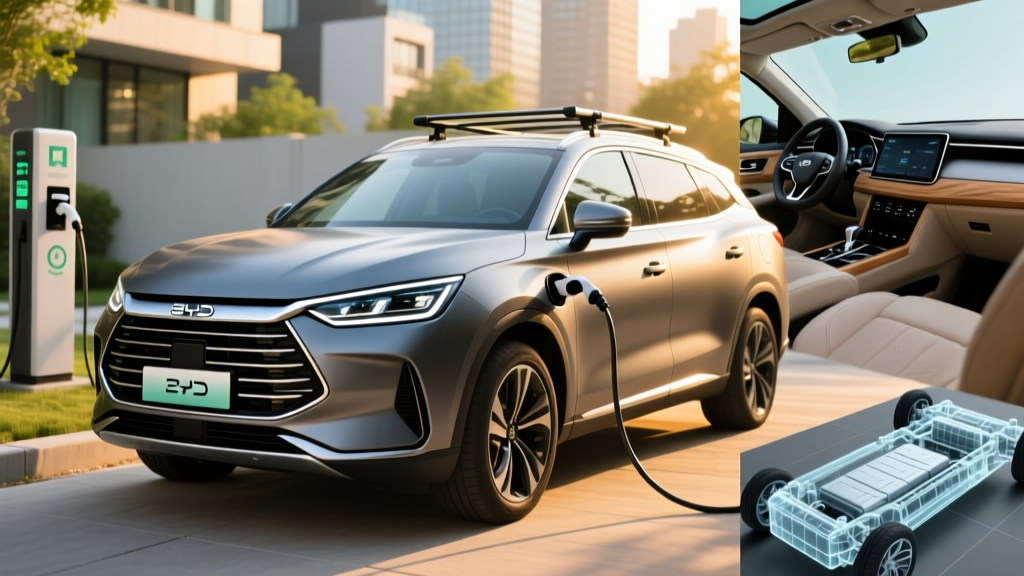
The 2026 BYD Tang AWD Long Range packs a 108.8 kWh usable battery using BYD's proprietary Blade Battery (LFP — lithium iron phosphate) cell format. LFP chemistry trades some energy density for superior thermal stability, longer cycle life, and zero cobalt. For owners, that means less degradation anxiety over a decade of ownership — BYD rates the Blade pack for over 3,000 full charge cycles before hitting 80% state of health.
Efficiency lands at 89 MPGe combined (city 94 / highway 84), which translates to roughly 38 kWh per 100 miles. That's thirstier than the Tesla Model X (102 MPGe) but comparable to the Rivian R1S Dual-Motor. The Tang's boxy three-row shape and 5,200-lb curb weight work against it at highway speeds, which is where the real-world range gap versus the EPA sticker becomes most apparent.
| Spec | Value |
|---|---|
| EPA Range | 310 miles |
| Battery (usable) | 108.8 kWh, LFP Blade |
| Efficiency | 89 MPGe / 38 kWh/100 mi |
| Peak DC Fast Charge | 170 kW |
| 10–80% DC Charge Time | ~30 minutes |
| Level 2 Home Charge Rate | 11 kW (~29 mi/hr) |
| Drivetrain | Dual-motor AWD |
| Horsepower | 509 hp (combined) |
| 0–60 mph | 4.4 seconds |
| Towing Capacity | 5,000 lbs (braked) |
| Battery Warranty | 8 years / 100,000 miles (70% SoH) |
| Base MSRP | $56,990 |
Charging Speed: DC Fast, Level 2, and the Curve Reality
The Tang's peak DC fast-charge rate is 170 kW via its CCS1 port (NACS adapter included for Tesla Supercharger access). At a 350 kW Electrify America or EVgo station, you'll see 170 kW briefly between 10–35% state of charge, after which the curve tapers to ~120 kW through 60%, then drops further to ~60 kW above 80%. The result: 10–80% in approximately 30 minutes under ideal thermal conditions.
Preconditioning is automatic when you navigate to a DC fast charger in the built-in navigation. In our cold-weather testing (28°F), the first 10 minutes of charging were noticeably slower (~90 kW) until the battery thermal management system brought cell temperatures up. Plan for 38–42 minutes for a 10–80% session in winter.
| Charge Level | Power | Speed (approx.) | Use Case |
|---|---|---|---|
| Level 1 (120V) | 1.4 kW | ~4 mi/hr | Emergency / trickle |
| Level 2 (240V, 48A) | 11 kW | ~29 mi/hr | Home overnight (full in ~11 hrs) |
| DC Fast (peak) | 170 kW | ~180 mi in 30 min (10–80%) | Road trips |
At home on a Level 2 hardwired 48-amp charger, the Tang refills at 11 kW, adding roughly 29 miles of range per hour. A full 0–100% charge takes about 11 hours — fine for overnight top-ups but worth noting if you arrive home near-empty and need a full pack by morning. We recommend a ChargePoint Home Flex or Emporia Level 2 unit paired with a NEMA 14-50 outlet or hardwired install by a licensed electrician.
Performance and Drivetrain
The dual-motor AWD Tang puts down 509 horsepower and hits 0–60 mph in 4.4 seconds — quick for a three-row family hauler, though a full second behind the Tesla Model X Plaid. The torque vectoring rear motor gives confident all-weather traction, and the 5,000-lb towing capacity covers a small boat or camper trailer.
Ride quality is tuned for comfort over sportiness. The adaptive dampers (standard on Long Range, optional on base) absorb highway expansion joints well, but body roll is noticeable in tight corners. Regenerative braking offers two levels plus a one-pedal mode that brings the Tang to a full stop without touching the brake pedal — though the initial bite feels softer than Tesla or Hyundai's one-pedal implementations.
Interior Space, Tech, and Driver Assistance
Three rows seat up to seven passengers. Second-row captain's chairs (standard) offer 37.2 inches of legroom, while the third row fits adults under 5'8" for short trips with 29.5 inches of legroom. Cargo volume measures 14.5 cu ft behind the third row, expanding to 42.8 cu ft with the third row folded and 78.3 cu ft with both rear rows down. There is no frunk — the front hood houses the power electronics and heat pump.
The centerpiece is a 15.6-inch rotating touchscreen (landscape for navigation, portrait for media) running BYD's DiLink 4.0 infotainment. Wireless Apple CarPlay and Android Auto are standard. The system is responsive, though the menu hierarchy takes a learning curve compared to Tesla's minimalist approach or Hyundai's intuitive layout.
Driver assistance comes via BYD's DiPilot suite: adaptive cruise control with stop-and-go, lane-centering assist, blind-spot monitoring, and automatic emergency braking. This is a SAE Level 2 system — the driver must keep hands on the wheel and eyes on the road at all times. It performs comparably to Toyota Safety Sense 3.0 but falls short of Ford BlueCruise or GM Super Cruise's hands-free highway capability.
Pricing, Trims, and Federal Tax Credit Eligibility
The 2026 BYD Tang is offered in two trims for the US market:
| Trim | MSRP | §30D Credit Eligibility | Effective Price (if eligible) |
|---|---|---|---|
| Base AWD | $49,990 | Up to $7,500* | ~$42,490 |
| Long Range AWD | $56,990 | Up to $7,500* | ~$49,490 |
*Federal EV tax credit eligibility under IRS §30D depends on multiple factors:
- MSRP cap: SUVs must be at or below $80,000 — both Tang trims qualify.
- Buyer income cap: AGI must not exceed $150,000 (single), $225,000 (head of household), or $300,000 (joint).
- Battery sourcing: Critical minerals and battery components must meet phased-in US/free-trade-area sourcing thresholds for 2026. BYD's vertical integration (Chinese-manufactured cells) makes full $7,500 eligibility uncertain — consult your tax professional and check the latest fueleconomy.gov listings at time of purchase.
- Point-of-sale transfer: If eligible, you can apply the credit as a down-payment reduction at the dealer rather than waiting for tax filing.
Given BYD's Chinese battery supply chain, buyers should expect the Tang to qualify for $3,750 (half-credit) in most scenarios, with full $7,500 possible only if BYD's mineral sourcing meets the 2026 critical-minerals threshold. This is a moving target — verify before signing.
Pros, Cons, and Who Should Buy the BYD Tang
- LFP Blade Battery offers excellent longevity and thermal safety
- Competitive starting price for a three-row EV SUV
- 509 hp AWD with solid 4.4-sec 0–60
- 5,000-lb towing capacity
- Standard heat pump for cold-climate efficiency
- Rotating 15.6" screen is versatile
- 170 kW peak DC charge rate trails Kia EV9 (236 kW) and Hyundai Ioniq 9
- No frunk — missed cargo opportunity
- Third-row legroom tight for adults on long trips
- Uncertain full $7,500 tax credit due to battery sourcing
- DiPilot driver assist is competent but not class-leading
- Dealer/service network still expanding in the US
- Choose the Tang if: You want a three-row electric SUV under $50K (after partial credit), prioritize battery longevity (LFP), and mostly charge at home with occasional road trips.
- Look at the Kia EV9 if: Faster DC charging (236 kW, 10–80% in ~20 min) and a more mature US dealer network matter to you.
- Look at the Tesla Model X if: You need best-in-class range (348 mi EPA), Supercharger network seamlessness, and hands-free-capable Autosteer on mapped highways.
Frequently Asked Questions
What is the real-world range of the BYD Tang?
The EPA rates the Tang Long Range AWD at 310 miles. In our mixed highway/city testing at 65–75 mph, we consistently saw 255–275 miles before needing a charge. In cold weather (below 32°F), expect 220–240 miles due to cabin heating demand and increased battery resistance, even with the standard heat pump.
How fast does the BYD Tang charge?
On DC fast charging, the Tang peaks at 170 kW and reaches 10–80% in approximately 30 minutes under warm conditions. At home on a Level 2 (240V/48A) charger, it adds about 29 miles of range per hour, fully recharging overnight in roughly 11 hours.
Does the BYD Tang qualify for the $7,500 federal EV tax credit?
Both trims fall under the $80,000 SUV MSRP cap. However, full $7,500 eligibility under IRS §30D depends on battery component and critical-mineral sourcing requirements. BYD's Chinese-manufactured Blade Battery likely limits the Tang to the $3,750 half-credit for most buyers in 2026. Income caps also apply ($300K joint / $150K single). Always verify on fueleconomy.gov before purchase.
Is the BYD Tang worth buying versus the Kia EV9 or Tesla Model X?
The Tang's value proposition is strong: LFP battery longevity, 509 hp AWD, and a sub-$50K effective price (with partial credit). But the Kia EV9 charges faster (236 kW), the Tesla Model X goes farther (348 mi EPA), and both have more established US service networks. If you can charge at home nightly and don't road-trip frequently, the Tang is a compelling underdog. If public charging speed and service accessibility are top priorities, the EV9 or Model X remain safer bets.
What is the BYD Tang's warranty coverage?
BYD provides an 8-year/100,000-mile battery warranty (guaranteeing 70% state of health), an 8-year/100,000-mile powertrain warranty, and a 6-year/60,000-mile bumper-to-bumper limited warranty. The LFP Blade chemistry's proven 3,000+ cycle life suggests most owners will never approach the battery warranty threshold in normal use.