Why a BYD Stock Split Matters to EV Shoppers
When one of the world's largest electric-vehicle manufacturers restructures its shares, the ripple effects reach far beyond Wall Street. The BYD stock split — a move that reduces the per-share price while increasing the number of outstanding shares — signals the company's intent to broaden its investor base and fund aggressive global expansion. For U.S. EV buyers, understanding this corporate action provides context on BYD's long-term pricing power, model availability, and whether its vehicles might eventually qualify for federal incentives.
BYD (Build Your Dreams) sold over 3 million new-energy vehicles globally in 2024 and continues scaling through 2026. While the company has no official U.S. passenger-vehicle sales channel as of early 2026, its models — including the BYD Seal, Atto 3 (Yuan Plus), and Dolphin — are available in Europe, Southeast Asia, Australia, and Latin America. A stock split doesn't change vehicle specs overnight, but it does affect capital availability for R&D, factory buildouts in Mexico and Europe, and potential future U.S. market entry.
BYD Stock Split Mechanics: What Changed
BYD's share structure includes both A-shares (traded on the Shenzhen Stock Exchange under ticker 002594.SZ) and H-shares (traded on the Hong Kong Stock Exchange under 1211.HK). Stock splits by Chinese automakers typically follow a 2-for-1 or 5-for-1 ratio, reducing the nominal price per share to attract retail investors and improve liquidity.
Key financial context for the 2026 split discussion:
- Market capitalization: BYD has traded in the $80–$120 billion USD range through late 2025 and into 2026, making it one of the most valuable automakers globally.
- Revenue trajectory: BYD reported over $85 billion USD in revenue for fiscal 2024, with continued growth through 2025.
- Global factory expansion: New plants in Thailand, Brazil, Hungary, and a planned facility in Mexico are capital-intensive projects that benefit from improved equity liquidity.
- U.S. tariff barrier: A 100% tariff on Chinese-made EVs (imposed in 2024 and maintained through 2026) effectively blocks BYD from direct U.S. sales, regardless of stock structure.
For investors, a stock split is cosmetic — it doesn't change market cap or fundamentals. For EV buyers outside the U.S., it signals that BYD is positioning for sustained global competition with Tesla, Hyundai-Kia, and Volkswagen Group.
BYD Seal: The Model That Shows What BYD Can Build
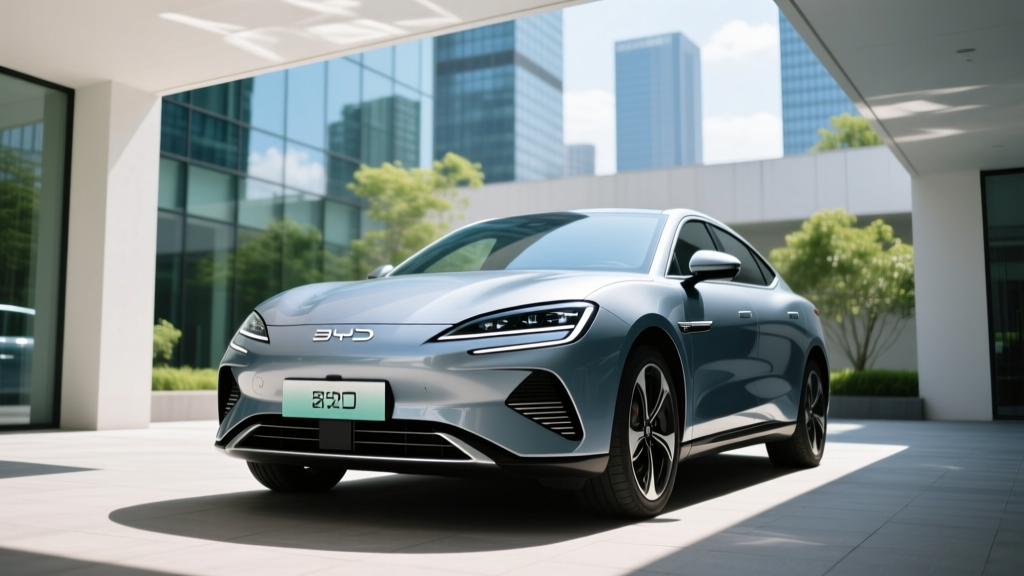
To understand what BYD's capital strategy means in metal and lithium, consider the BYD Seal — a midsize electric sedan that competes directly with the Tesla Model 3 and Hyundai Ioniq 6 in international markets. Below are the specs for the 2026 model-year Seal (Long Range, RWD), as sold in European and Australian markets.
| Spec | Value |
|---|---|
| EPA-equivalent range (WLTP) | 354 mi (570 km) WLTP |
| Estimated EPA range (if U.S.-certified) | ~300–315 mi |
| Battery capacity | 82.5 kWh (usable) |
| Battery chemistry | LFP (Blade Battery) |
| Max DC fast charge | 150 kW peak |
| 10–80% DC charge time | ~26 minutes |
| Level 2 AC charge rate | 11 kW (est. 30–35 mi/hr) |
| 0–60 mph (0–100 km/h) | 5.9 sec (7.5 sec) |
| Horsepower | 313 hp (230 kW) |
| Drivetrain | Rear-wheel drive (single motor) |
| MPGe equivalent | ~110 MPGe (est.) |
| Efficiency | ~30 kWh/100 mi (est.) |
| Cargo volume | 14.1 cu ft (trunk) + 1.8 cu ft (frunk) |
| Rear legroom | ~36.2 in |
| Base MSRP (Europe) | €44,900 (~$48,500 USD) |
| Battery warranty | 8 years / 100,000 mi (160,000 km) |
| Vehicle warranty | 6 years / 93,000 mi (150,000 km) |
Charging Speed and Infrastructure Compatibility
Charging speed is where BYD's LFP Blade Battery shows both strengths and trade-offs compared to NMC competitors.
| Charging Level | Power | Speed / Time |
|---|---|---|
| Level 1 (120V household) | ~1.4 kW | ~4–5 mi/hr |
| Level 2 (240V home/public AC) | 11 kW max | ~30–35 mi/hr; full charge ~8 hr |
| DC Fast Charge (CCS2) | 150 kW peak | 10–80% in ~26 min |
| DC Fast Charge (sustained avg) | ~90–110 kW avg | 10–80% real-world ~30 min |
The Seal's peak 150 kW DC fast-charge rate is respectable but trails the Hyundai Ioniq 6's 240 kW and the Tesla Model 3 Highland's ~250 kW capability. The LFP chemistry also means the charge curve tapers more aggressively above 80% state of charge — a characteristic of lithium iron phosphate cells. BYD recommends daily charging to 100% for LFP batteries (unlike NMC, where 80% daily is preferred for longevity), which partially offsets the slower top-off speed for daily use.
The Seal uses the CCS2 connector in European and Australian markets. Should BYD enter North America, it would need to adopt the NACS (Tesla) connector, which has become the U.S. standard as of 2025.
BYD's LFP Blade Battery: Chemistry Advantage
BYD's vertically integrated Blade Battery is one of the company's defining technologies. Unlike most competitors that source cells from CATL, LG, or Samsung SDI, BYD manufactures its own LFP cells in-house.
| Factor | LFP (BYD Blade) | NMC (Typical) |
|---|---|---|
| Energy density | Lower (~150 Wh/kg cell) | Higher (~250 Wh/kg cell) |
| Cycle life | 3,000–5,000+ cycles | 1,000–2,000 cycles |
| Thermal stability | Excellent (nail penetration safe) | Good (requires active management) |
| Cold-weather performance | Weaker (20–30% range loss) | Better (10–20% range loss) |
| Cost per kWh | Lower (~$80–100/kWh) | Higher (~$110–140/kWh) |
| Daily charge recommendation | 100% OK | 80% preferred |
| Cobalt/nickel content | None | Contains cobalt and nickel |
The Blade Battery's cell-to-pack architecture eliminates traditional modules, improving volumetric efficiency and allowing BYD to pack 82.5 kWh into a relatively compact sedan floor. The trade-off is weight — the Seal tips the scales at approximately 4,560 lbs, heavier than a similarly sized Model 3 (~4,034 lbs). This mass affects efficiency, contributing to the Seal's estimated ~30 kWh/100 mi versus the Model 3 Long Range's ~25 kWh/100 mi.
U.S. Availability and Federal Tax Credit Status
As of 2026, BYD does not sell passenger vehicles in the United States. The 100% tariff on Chinese-manufactured EVs, enacted under Section 301 in 2024 and upheld through 2026, makes direct import economically unviable. BYD has explored a Mexican factory to potentially serve the North American market, but USMCA rules of origin and additional tariff actions have complicated this pathway.
- Vehicle must be assembled in North America — BYD has no U.S./Canada/Mexico assembly plant for passenger cars.
- MSRP cap: $55,000 for sedans, $80,000 for SUVs/trucks — the Seal would meet this threshold.
- Buyer income cap: $150,000 single / $300,000 joint filers — buyer-dependent.
- Battery component sourcing: Increasingly strict requirements for North American or FTA-partner manufacturing and critical-mineral sourcing — BYD's China-sourced supply chain does not meet current thresholds.
- Foreign Entity of Concern (FEOC) restriction: BYD, as a Chinese-headquartered company, would be classified as a FEOC, disqualifying its vehicles regardless of assembly location.
Source: IRS §30D Clean Vehicle Credit
For U.S. buyers interested in BYD-level pricing and LFP battery technology, the closest domestic alternatives include the Tesla Model 3 (Rear-Wheel Drive, LFP battery, from ~$38,990) and the Chevrolet Equinox EV (from ~$33,000). Both qualify for at least partial federal tax credits when purchased new, and the Tesla Model 3 RWD qualifies for the full $7,500 when delivered within applicable MSRP and income limits.
BYD Seal vs Key Competitors (International Markets)
For buyers in Europe, Australia, and Southeast Asia where the Seal is actively sold, here's how it stacks up against direct rivals in 2026:
| Spec | BYD Seal LR RWD | Tesla Model 3 LR RWD | Hyundai Ioniq 6 LR RWD |
|---|---|---|---|
| WLTP Range | 354 mi (570 km) | 390 mi (629 km) | 378 mi (614 km) |
| Battery (usable) | 82.5 kWh LFP | 75 kWh NMC | 77.4 kWh NMC |
| DC Fast Charge (peak) | 150 kW | ~250 kW | 240 kW |
| 10–80% Time | ~26 min | ~18 min | ~18 min |
| 0–60 mph | 5.9 sec | 4.9 sec | 5.1 sec |
| Horsepower | 313 hp | 346 hp | 225 hp |
| Cargo (trunk+frunk) | 15.9 cu ft | 21.0 cu ft | 12.3 cu ft |
| Starting Price (EUR) | €44,900 | €48,990 | €46,900 |
- Competitive pricing undercutting most rivals by €3,000–€5,000
- LFP Blade Battery offers exceptional cycle life and thermal safety
- Generous standard equipment (rotating center screen, panoramic roof, V2L)
- Strong build quality rivaling European premium sedans
- Vehicle-to-Load (V2L) capability for powering devices/appliances
- Slower DC fast charging (150 kW vs 240–250 kW rivals)
- Heavier vehicle mass reduces efficiency (~30 kWh/100 mi)
- LFP chemistry suffers greater cold-weather range loss
- Driver-assist tech (ADAS) lags behind Tesla Autopilot and Hyundai's Highway Driving Assist 2
- No U.S. availability and unlikely to qualify for §30D credit even if imported
- Charging network partnerships less established outside China
What the BYD Stock Split Means for Future EV Buyers
The stock split itself doesn't put new features in the Seal or lower its MSRP directly. However, the broader capital strategy it represents does affect EV buyers in tangible ways:
- Expanded production capacity — BYD's new factories in Hungary (opening 2026), Brazil, and Thailand are funded in part by equity market access. More factories mean more vehicles for global markets and potential price pressure on competitors.
- R&D investment — BYD's next-generation e-Platform 4.0 and potential solid-state battery research depend on sustained capital. The stock split improves retail investor participation, broadening the capital base.
- Pricing pressure — In markets where BYD competes (Europe, Southeast Asia, Australia), its aggressive pricing has already forced Tesla, VW, and Stellantis to cut prices or offer incentives. U.S. buyers benefit indirectly as global competition drives down prices for models like the Model 3 and Ioniq 5.
- U.S. entry timeline — Even with expanded capital, tariff barriers and FEOC restrictions make BYD's U.S. passenger-vehicle entry unlikely before 2028 at the earliest. The company's commercial-vehicle division (electric buses, trucks) already operates in the U.S., but consumer models face a different regulatory landscape.
Who Should Pay Attention to BYD Right Now
- Choose to watch BYD if: You live in Europe, Australia, or Southeast Asia and want a well-built LFP sedan at a competitive price with excellent battery longevity and you don't need ultra-fast DC charging or cutting-edge ADAS.
- Choose a U.S.-available alternative if: You need federal tax credit eligibility, access to the Tesla Supercharger or Electrify America networks, faster DC charging for road trips, or Level 2+ driver-assist features for highway commuting.
- Consider BYD as an investor if: You believe in the company's global expansion thesis, can tolerate Chinese regulatory and geopolitical risk, and want exposure to the world's largest EV manufacturer by unit volume.
Frequently Asked Questions
What is the real-world range of the BYD Seal?
The BYD Seal Long Range RWD carries a WLTP rating of 354 miles (570 km). In real-world highway driving, expect approximately 250–270 miles at 70 mph in moderate temperatures. In cold weather (below freezing), LFP chemistry typically reduces range by 20–30%, bringing usable range to roughly 200–220 miles. The standard heat pump helps, but cold-weather route planning remains important.
How fast does the BYD Seal charge?
On a DC fast charger, the Seal peaks at 150 kW and charges from 10% to 80% in approximately 26 minutes (real-world average ~30 minutes accounting for charge-curve taper). On a Level 2 home charger (240V, 11 kW), it adds roughly 30–35 miles of range per hour, with a full charge taking about 8 hours. This is slower than competitors like the Tesla Model 3 (~250 kW peak) and Hyundai Ioniq 6 (240 kW peak).
Does the BYD Seal qualify for the U.S. federal EV tax credit?
No. As of 2026, the BYD Seal is not sold in the United States, and even if it were, it would not qualify for the §30D Clean Vehicle Credit. The vehicle is not assembled in North America, its battery components and critical minerals are sourced from China (a Foreign Entity of Concern under current law), and the 100% Section 301 tariff effectively blocks its import.
Is the BYD Seal worth buying vs key competitors?
In markets where it's sold, the Seal offers strong value: lower pricing than the Tesla Model 3 and Hyundai Ioniq 6, an exceptionally durable LFP Blade Battery, and generous standard features. However, it trades off charging speed (150 kW vs 240+ kW), cold-weather range retention, and driver-assist sophistication. For buyers who prioritize price and battery longevity over fast-charging and tech, the Seal is compelling. For road-trippers and cold-climate drivers, the Model 3 or Ioniq 6 remain stronger picks.
What are the biggest pros and cons of BYD vehicles?
Pros: Aggressive pricing, in-house LFP Blade Battery with excellent cycle life and safety, high standard equipment levels, vertically integrated manufacturing controlling costs. Cons: Slower DC fast charging than NMC rivals, heavier vehicle mass reducing efficiency, limited ADAS capabilities, no U.S. market presence, cold-weather range loss inherent to LFP chemistry, and geopolitical/tariff risks limiting global availability.
Will BYD ever sell cars in the United States?
BYD has not announced a U.S. passenger-vehicle launch date. The 100% tariff on Chinese-made EVs, FEOC battery-sourcing restrictions, and USMCA rules of origin create substantial barriers. BYD's planned Mexico factory could theoretically serve North America, but current trade policy makes this pathway uncertain. The earliest realistic timeline for U.S. consumer sales, if regulatory conditions change, would be 2028–2030. BYD's commercial electric buses and trucks are already sold in the U.S.
Sources: BYD official specifications, fueleconomy.gov for EPA comparison data, IRS §30D Clean Vehicle Credit guidelines. WLTP figures from BYD Europe; EPA-equivalent estimates are approximations based on standard conversion factors and may differ from official EPA certification if the vehicle is U.S.-certified in the future.