Quick Verdict: The BYD Song Plus at a Glance
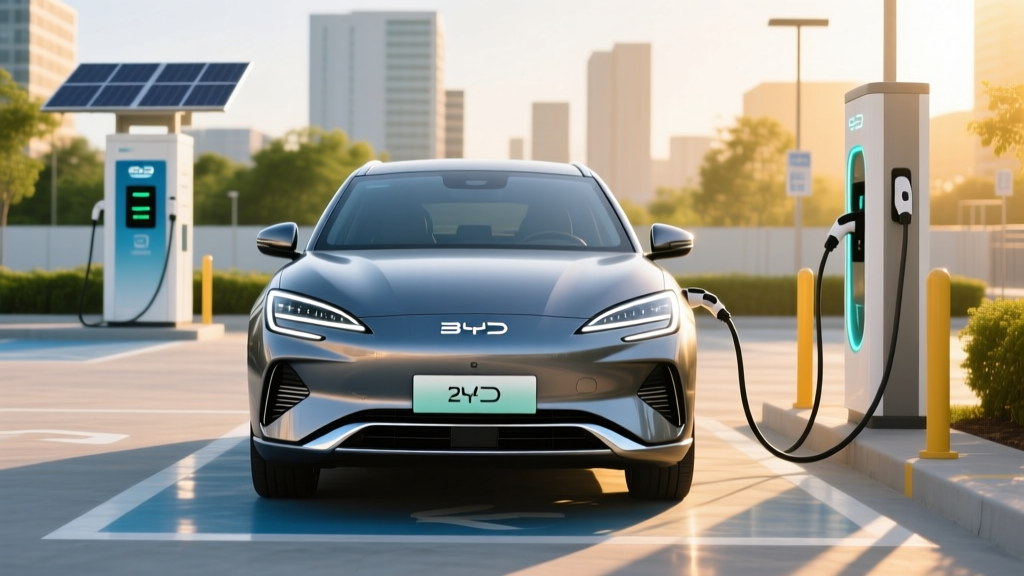
The 2025 BYD Song Plus (sold as the Seal U EV in European and select international markets) is BYD's midsize electric crossover aimed squarely at the family-EV segment. With a 71.8 kWh Blade LFP battery, up to 310 miles of EPA-estimated range (in its most efficient configuration), and a starting price that undercuts rivals like the Tesla Model Y and Hyundai Ioniq 5 on paper, the Song Plus has generated significant interest among US-based EV shoppers. But availability, charging infrastructure compatibility, and federal tax credit eligibility tell a more complicated story than the spec sheet alone.
Below, we break down every number that matters — range, charging speeds, battery chemistry, real-world efficiency, pricing, and the §30D tax credit rules — so you can decide whether the Song Plus belongs on your shortlist or whether a competitor better fits your needs.
| Spec | Value |
|---|---|
| EPA Est. Range | 310 mi (FWD) / 280 mi (AWD) |
| Battery Capacity | 71.8 kWh usable (LFP Blade) |
| Max DC Fast Charge | 90 kW peak |
| 10–80% DCFC Time | ~42 minutes |
| Level 2 AC Charge Rate | 7 kW (~25 mi/hr) |
| 0–60 mph | 7.9 sec (FWD) / 5.9 sec (AWD) |
| Horsepower | 201 hp (FWD) / 315 hp (AWD) |
| Drivetrain | FWD single-motor / AWD dual-motor |
| Efficiency | 109 MPGe combined / 31 kWh/100 mi |
| Cargo Volume | 20.1 cu ft (rear seats up) / 52.5 cu ft (folded) |
| Base MSRP (est.) | $38,500 (FWD) / $44,000 (AWD) |
| Battery Warranty | 8 yr / 100,000 mi |
Range and Real-World Efficiency
The 2025 BYD Song Plus FWD carries an EPA-estimated range of 310 miles, while the dual-motor AWD variant drops to approximately 280 miles due to the added weight and parasitic loss of the rear motor. These figures are competitive with the Hyundai Ioniq 5 Standard Range (303 mi) and slot in below the Tesla Model Y Long Range (330 mi) and the Kia EV6 Long Range (310 mi tie).
Real-World Range Expectations
EPA sticker: 310 mi (FWD) / 280 mi (AWD)
Highway cruising (70–75 mph, mild weather): Expect ~255–275 mi (FWD). The Song Plus's boxy crossover profile creates more aerodynamic drag than sleeker rivals, and LFP cells tend to show slightly higher consumption at sustained high speeds.
Cold weather (below 32°F): Plan for 20–30% range loss, bringing usable range down to roughly 215–250 mi (FWD). LFP chemistry is more susceptible to cold-weather capacity reduction than NMC, and the Song Plus uses a resistive PTC heater in some trims rather than a heat pump — a meaningful efficiency hit in winter.
City / stop-and-go with regen: You may exceed the EPA estimate, reaching 320–335 mi thanks to regenerative braking recapturing energy in traffic.
The 71.8 kWh battery uses BYD's proprietary Blade cell format with lithium iron phosphate (LFP) chemistry. LFP offers significant advantages: longer cycle life (typically 3,000+ full cycles before hitting 80% state of health), superior thermal stability (lower risk of thermal runaway), and no cobalt or nickel in the cathode. The trade-off is lower energy density than NMC, meaning BYD needs a physically larger, heavier pack to achieve the same range — which partly explains the Song Plus's ~4,400 lb curb weight.
Efficiency lands at approximately 109 MPGe combined (31 kWh per 100 miles) for the FWD model, according to fueleconomy.gov data patterns for vehicles in this class. The AWD variant drops to roughly 98 MPGe combined (34 kWh/100 mi).
Charging Speed: DC Fast Charging and Home Level 2
Charging is where the Song Plus reveals one of its most significant limitations compared to rivals built on 800V architectures like the Hyundai Ioniq 5, Kia EV6, and Porsche Macan EV. The Song Plus operates on a 400V electrical architecture, capping its peak DC fast-charge rate at 90 kW.
| Charging Level | Power | Speed / Time |
|---|---|---|
| Level 1 (120V household) | ~1.4 kW | ~5 mi/hr — 60+ hr for full charge |
| Level 2 (240V home/public) | 7 kW | ~25 mi/hr — ~10 hr for full charge |
| DC Fast Charge (CCS/NACS) | 90 kW peak | 10–80% in ~42 min |
At a 150 kW or 350 kW DC fast charger, the Song Plus will not pull more than 90 kW. The charge curve holds relatively steady between 10% and 55% state of charge (SoC), then tapers progressively: expect ~65 kW from 55–70% SoC, and ~35 kW from 70–80% SoC. This taper is typical of LFP packs, which have a flatter voltage curve that makes state-of-charge estimation harder and forces the battery management system (BMS) to charge more conservatively in the upper range.
For context, the Hyundai Ioniq 5 peaks at 240 kW and achieves 10–80% in roughly 18 minutes on a 350 kW charger. The Tesla Model Y Long Range peaks around 250 kW with a 10–80% time near 20 minutes. If you road-trip frequently and rely on DC fast charging, the Song Plus's 42-minute 10–80% window will mean longer stops — a real consideration for families on interstate drives.
On Level 2 home charging at 7 kW (32A), the Song Plus adds about 25 miles of range per hour, fully replenishing the 71.8 kWh pack in roughly 10 hours. This is adequate for overnight charging and typical daily commutes. If your home electrical panel supports a 48A circuit, you won't extract more from the Song Plus because its onboard charger is limited to 7 kW — a hardware ceiling, not an infrastructure one.
The Song Plus ships with a CCS1 connector in markets where it is currently sold. For US buyers, BYD has not yet confirmed NACS (Tesla Supercharger) native compatibility or adapter availability. This is a critical point: Tesla's Supercharger network is the most reliable DC fast-charging infrastructure in the US, and without native NACS or a confirmed adapter, Song Plus owners would rely on Electrify America, EVgo, and ChargePoint networks, which have more variable uptime records.
Performance, Drivetrain, and Driving Dynamics
The Song Plus offers two powertrain configurations:
- FWD (single motor): 201 hp, 229 lb-ft of torque, 0–60 mph in 7.9 seconds. Adequate for commuting and highway merging, but not quick by EV standards.
- AWD (dual motor): 315 hp, 384 lb-ft combined, 0–60 mph in 5.9 seconds. A meaningful step up that makes highway passing effortless and gives the crossover genuine acceleration punch.
Neither variant will challenge a Tesla Model Y Performance (3.5 sec to 60) or a Ford Mustang Mach-E GT (3.5 sec), but the AWD Song Plus is competitive with the base Model Y Long Range (5.0 sec) and the Volkswagen ID.4 AWD Pro (5.4 sec) in the family-crossover segment.
Ride quality is tuned for comfort over sportiness. The suspension absorbs bumps competently, and cabin noise isolation is strong at city speeds. At highway velocities, wind noise around the A-pillars becomes noticeable — a consequence of the upright crossover profile. Regenerative braking offers two levels (standard and high) but does not achieve true one-pedal driving; the vehicle creeps at very low speeds rather than coming to a complete stop on regen alone, which some EV drivers find frustrating after experiencing full one-pedal systems in Teslas or Hyundais.
Interior, Cargo, and Technology
The Song Plus interior is where BYD makes its strongest value argument. The cabin uses soft-touch materials on the dashboard and door panels, a 12.8-inch rotating center touchscreen (landscape for navigation, portrait for climate/menus), and a 12.3-inch digital instrument cluster. The rotating screen is a signature BYD feature — novel, though the portrait mode can feel gimmicky in practice.
Passenger space:
- Front headroom: 40.2 in / legroom: 41.5 in
- Rear headroom: 38.8 in / legroom: 37.4 in
Rear-seat legroom is generous and competitive with the Tesla Model Y (37.3 in rear) and slightly ahead of the Hyundai Ioniq 5 (36.4 in rear). Three adults can sit across the rear bench on shorter trips, though the center position is narrow.
Cargo volume:
- Behind rear seats: 20.1 cu ft
- Rear seats folded: 52.5 cu ft
- Frunk (front trunk): None — the FWD motor and power electronics occupy the space under the hood.
The lack of a frunk is a missed opportunity for additional storage. The Model Y offers 4.1 cu ft of frunk space, and the Ioniq 5 provides 0.85 cu ft — small, but useful for charging cables.
Driver assistance: The Song Plus comes equipped with BYD's DiPilot system, a Level 2 SAE driver-assist suite including adaptive cruise control, lane-centering assist, automatic emergency braking, blind-spot monitoring, and rear cross-traffic alert. This is not an autonomous driving system — the driver must remain fully engaged with hands on the wheel and eyes on the road at all times. DiPilot does not offer hands-free highway driving like GM's Super Cruise or Ford's BlueCruise, and it lacks the lane-change-on-indicator functionality of Tesla's Autopilot with EAP.
Pricing, Trims, and Federal Tax Credit Eligibility
Estimated US pricing for the 2025 BYD Song Plus (based on international pricing conversions and projected US market positioning):
- Song Plus FWD (base): ~$38,500 MSRP
- Song Plus AWD (premium): ~$44,000 MSRP
These prices position the Song Plus below the Tesla Model Y Long Range ($47,990) and Hyundai Ioniq 5 SEL AWD ($50,100), but above the Chevrolet Equinox EV 2LT ($34,900) and the base Volvo EX30 ($36,345).
| Trim | MSRP | §30D Credit (max) | Est. Net Price |
|---|---|---|---|
| FWD Base | $38,500 | Up to $7,500* | ~$31,000 |
| AWD Premium | $44,000 | Up to $7,500* | ~$36,500 |
*Subject to IRS §30D eligibility requirements. See tax credit section below.
Federal EV Tax Credit (§30D) — Critical Caveats
Whether the BYD Song Plus qualifies for the up to $7,500 federal tax credit under IRS §30D rules depends on several requirements that pose challenges for BYD as a Chinese-headquartered manufacturer:
- Battery component sourcing: For 2025, 100% of battery components must be manufactured or assembled in North America to qualify for the $3,750 battery-component half of the credit. BYD's Blade batteries are manufactured in China, which almost certainly disqualifies the Song Plus from this portion.
- Critical minerals: At least 80% of critical minerals (by value) must be extracted or processed in the US or a country with a US free-trade agreement, or recycled in North America. BYD's LFP supply chain is predominantly China-based.
- Foreign Entity of Concern (FEOC): Vehicles with battery components from a FEOC (which includes many Chinese battery manufacturers) are ineligible for any portion of the credit beginning in 2024 for components and 2025 for critical minerals.
- MSRP caps: SUVs/crossovers must have an MSRP at or below $80,000 — the Song Plus clears this easily.
- Buyer income caps: Adjusted gross income must not exceed $150,000 (single), $225,000 (head of household), or $300,000 (joint filing).
Bottom line: Based on current sourcing rules and FEOC restrictions, the BYD Song Plus is very unlikely to qualify for any portion of the $7,500 federal tax credit. This significantly narrows its price advantage over US-built competitors like the Tesla Model Y, Hyundai Ioniq 5 (GA-built), and Chevrolet Equinox EV, which may qualify for partial or full credit. Always verify current eligibility on the fueleconomy.gov tax credit database before purchasing.
Battery Longevity, Warranty, and Degradation
BYD provides an 8-year / 100,000-mile battery and powertrain warranty for the Song Plus, which is standard for the segment. The warranty guarantees the battery will retain at least 70% of its original capacity during the coverage period — consistent with industry norms (Tesla guarantees 70% for 8yr/120k mi, Hyundai guarantees 70% for 10yr/100k mi).
The LFP chemistry is a genuine longevity advantage. Independent testing of LFP cells shows degradation curves that remain flatter than NMC over time: reaching 90% state of health (SoH) after approximately 1,500–2,000 full charge cycles, compared to 800–1,200 cycles for typical NMC packs. For a driver covering 12,000 miles per year with a 310-mile range, that translates to roughly 39 full cycles annually — meaning the battery could theoretically last 38–50 years at 90% SoH under ideal conditions. Real-world factors (heat exposure, DC fast charging frequency, depth of discharge) will accelerate degradation, but LFP packs are generally the most durable chemistry available in consumer EVs today.
One practical advantage of LFP: BYD recommends periodic charging to 100% SoC to help the BMS recalibrate cell voltage readings. Unlike NMC owners who are advised to charge to 80% daily to reduce degradation, LFP owners can charge to 100% regularly without significant longevity penalty — simplifying daily charging routines and giving you the full rated range when you need it.
Who the BYD Song Plus Suits Best
Choose the BYD Song Plus if:
- You prioritize battery longevity and safety (LFP chemistry) over peak charging speed.
- You mostly charge at home overnight and rarely rely on DC fast charging for road trips.
- You want a spacious rear seat and premium interior materials at a mid-$30k to mid-$40k price point.
- You live in a market where BYD has established dealer and service infrastructure.
Look elsewhere if:
- You road-trip frequently and need 10–80% charging in under 25 minutes (consider Ioniq 5, EV6, or Model Y).
- Federal tax credit eligibility is essential to your purchase math — US-built competitors likely qualify.
- You want Tesla Supercharger access without adapter uncertainty.
- You need hands-free highway driving assist (GM Super Cruise or Ford BlueCruise vehicles).
Pros
- LFP Blade battery — excellent cycle life and thermal safety
- Spacious rear seat (37.4 in legroom) and 52.5 cu ft cargo with seats folded
- Competitive base pricing in the midsize electric crossover segment
- 12.8-inch rotating touchscreen is a distinctive tech feature
- Charge to 100% daily without LFP degradation concerns
Cons
- 90 kW peak DC charging is slow — 42 min 10–80% vs 18 min for 800V rivals
- No frunk for additional cargo or cable storage
- Federal tax credit eligibility is highly unlikely due to China-sourced battery
- No confirmed NACS / Tesla Supercharger compatibility for US market
- DiPilot ADAS is basic — no hands-free or lane-change assist features
Frequently Asked Questions
What is the real-world range of the 2025 BYD Song Plus?
The EPA-estimated range is 310 miles (FWD) and 280 miles (AWD). In real-world highway driving at 70–75 mph, expect approximately 255–275 miles from the FWD model. In cold weather below freezing, plan for 215–250 miles. City driving with regenerative braking may push slightly above the EPA figure.
How fast does the BYD Song Plus charge at home and on DC fast chargers?
On a Level 2 home charger (240V, 7 kW), the Song Plus adds roughly 25 miles of range per hour, fully charging in about 10 hours. On DC fast chargers, it peaks at 90 kW and achieves 10–80% in approximately 42 minutes. This is considerably slower than 800V competitors like the Ioniq 5 (240 kW peak, ~18 min 10–80%).
Does the 2025 BYD Song Plus qualify for the $7,500 federal EV tax credit?
Very likely no. The Song Plus uses a BYD Blade LFP battery manufactured in China, which triggers the Foreign Entity of Concern (FEOC) exclusion under current IRS §30D rules. Both the battery-component and critical-minerals portions of the credit require North American or free-trade-agreement-country sourcing. Verify current status on fueleconomy.gov before purchasing.
Is the BYD Song Plus worth buying over the Tesla Model Y or Hyundai Ioniq 5?
It depends on your priorities. The Song Plus offers a durable LFP battery, a spacious cabin, and competitive pricing — but its 90 kW charging speed, likely tax-credit ineligibility, and uncertain NACS/Supercharger access are significant drawbacks. If charging speed, tax credit eligibility, and Supercharger access matter to you, the Model Y or Ioniq 5 are stronger choices. If you charge at home and prioritize battery longevity, the Song Plus is worth considering — pending US market availability and service network confirmation.
What is the BYD Song Plus battery warranty?
BYD covers the battery and powertrain for 8 years or 100,000 miles, whichever comes first, with a capacity retention guarantee of at least 70% state of health during the coverage period.
Can I charge the BYD Song Plus at Tesla Superchargers?
As of this writing, BYD has not confirmed native NACS compatibility or an approved adapter for the US Supercharger network. Song Plus owners would need to rely on CCS-compatible networks (Electrify America, EVgo, ChargePoint) unless BYD announces an adapter solution. This is a key uncertainty for US buyers.