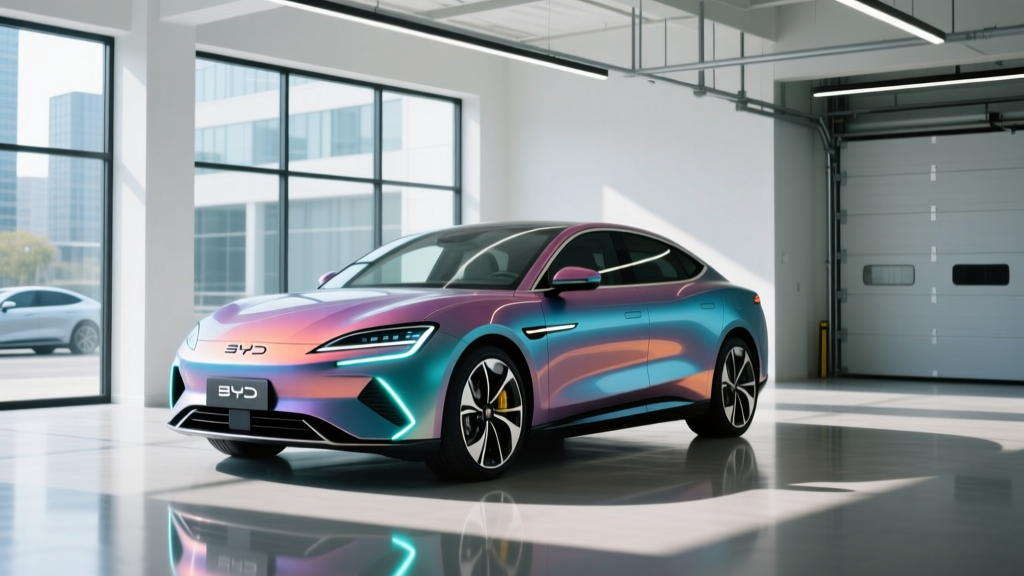
BYD — the Chinese automaker that has surpassed Tesla in global battery-electric vehicle sales — is the biggest name in EVs that American buyers still cannot purchase. Search interest in BYD shipping to the United States has surged as the company expands into Europe, Southeast Asia, and Latin America. Yet as of early 2026, no BYD passenger vehicle is sold, shipped, or homologated for the US market. Here is exactly where things stand, which models could theoretically cross the Pacific, and what their specs mean for American buyers if trade policy ever shifts.
Why BYD Shipping to the US Remains Blocked in 2026
BYD's absence from the United States is not a product decision — it is a trade-policy wall. In May 2024, the Biden administration raised the tariff on Chinese-made EVs from 25% to 100% under Section 301 of the Trade Act, effectively doubling the sticker price of any BYD vehicle imported into the US. The Trump administration maintained and reinforced this posture through 2025, layering additional reciprocal tariffs on Chinese goods.
The practical result: even BYD's most affordable models, like the Seagull (which starts around $10,000 in China), would carry a landed cost well above $20,000 before dealer margins — eliminating the price advantage that makes BYD disruptive globally. BYD has publicly stated it has no near-term plans to sell passenger cars in the US, focusing instead on markets where it faces no punitive tariff regime.
What BYD does ship to the US are electric buses and commercial trucks through its Lancaster, California facility — but consumer passenger vehicles remain off-limits barring a major trade agreement.
The BYD Models American Buyers Are Watching
If trade barriers were lifted, several BYD models would immediately compete in popular US segments. Below are the specifications based on BYD's current global-market configurations. Note that US-spec models would require modifications to meet NHTSA crash standards, EPA certification, and FMVSS lighting rules — meaning final specs could differ.
| Spec | BYD Seagull | BYD Dolphin | BYD Atto 3 (Yuan Plus) | BYD Seal |
|---|---|---|---|---|
| Segment | Subcompact hatch | Compact hatch | Compact SUV | Midsize sedan |
| Battery (usable) | 38.9 kWh | 60.4 kWh | 60.5 kWh | 82.5 kWh |
| Chemistry | LFP (Blade) | LFP (Blade) | LFP (Blade) | LFP (Blade) |
| WLTP Range | ~252 mi | ~265 mi | ~260 mi | ~354 mi |
| Est. EPA Range | ~200-215 mi | ~220-235 mi | ~215-230 mi | ~295-315 mi |
| Horsepower | 74 hp | 201 hp | 201 hp | 308 hp (RWD) / 523 hp (AWD) |
| 0-60 mph (est.) | ~11.0 sec | ~7.0 sec | ~7.3 sec | ~5.9 sec (RWD) / 3.8 sec (AWD) |
| Max DC Charge | 40 kW | 88 kW | 88 kW | 150 kW |
| 10-80% DC Time | ~30 min | ~29 min | ~29 min | ~26 min |
| Drivetrain | FWD | FWD | FWD | RWD / AWD |
| China MSRP (approx.) | ~$10,000 | ~$17,000 | ~$19,000 | ~$25,000 |
Important EPA range note: WLTP testing (used in Europe and China) produces range figures 15-20% higher than the US EPA cycle. The estimated EPA ranges above reflect this adjustment. Real-world highway driving at 70+ mph typically reduces range an additional 10-15% below EPA estimates, and cold-weather operation (below freezing) can cut range by 20-30% due to battery resistance and cabin heating loads — particularly in the LFP chemistry BYD exclusively uses, which is more cold-sensitive than NMC.
WLTP sticker: 323 mi → Estimated EPA: ~275-290 mi → Real-world highway (70 mph, 65°F): ~240-260 mi → Cold-weather highway (30°F): ~195-220 mi. Plan charging stops accordingly.
BYD's Blade Battery: LFP Chemistry Explained
Every BYD passenger vehicle uses the company's proprietary Blade Battery, which employs lithium iron phosphate (LFP) chemistry arranged in a cell-to-pack structural design. This matters for American buyers accustomed to NMC (nickel manganese cobalt) batteries from suppliers like LG and Panasonic.
| Attribute | LFP (BYD Blade) | NMC (typical US EVs) |
|---|---|---|
| Energy Density | Lower (~150-170 Wh/kg cell) | Higher (~200-260 Wh/kg cell) |
| Cycle Life | 3,000-5,000+ cycles | 1,000-2,000 cycles |
| Thermal Stability | Excellent (nail penetration safe) | Good (requires BMS management) |
| Cold Performance | Weaker (more range loss below 32°F) | Better cold-weather retention |
| Charging to 100% | Recommended regularly for calibration | Best kept at 80% daily |
| Cobalt/Nickel | None (lower supply-chain risk) | Contains both |
| Cost | Lower per kWh | Higher per kWh |
BYD's Blade Battery has demonstrated strong longevity in Chinese fleet data, with taxis reporting less than 10% degradation after 300,000+ miles. The cell-to-pack architecture eliminates module-level hardware, improving volumetric efficiency and reducing weight — though the lower energy density of LFP means BYD vehicles generally carry heavier battery packs for a given range compared to NMC competitors.
Charging Speed: BYD's Weakness for US Road Trips
Charging speed is where BYD's global lineup reveals a gap against vehicles American buyers can already purchase. Most BYD models peak between 88-150 kW on DC fast chargers — adequate but unremarkable compared to the Hyundai Ioniq 5 (peak 240 kW, 10-80% in ~18 minutes) or the Tesla Model 3 Highland (peak 250 kW on V3 Superchargers).
| Vehicle | Peak DC kW | 10-80% Time | L2 Home Rate | Miles/Hr (L2) |
|---|---|---|---|---|
| BYD Atto 3 | 88 kW | ~29 min | 7.2 kW | ~25 mi/hr |
| BYD Seal | 150 kW | ~26 min | 11 kW | ~35 mi/hr |
| Hyundai Ioniq 5 | 240 kW | ~18 min | 10.9 kW | ~38 mi/hr |
| Tesla Model 3 | 250 kW | ~15 min | 11.5 kW | ~44 mi/hr |
| Chevrolet Equinox EV | 150 kW | ~28 min | 11.5 kW | ~34 mi/hr |
On a US road trip using Electrify America or Tesla Supercharger (via NACS adapter, which BYD would need to adopt for the US market), a BYD Seal owner would spend roughly 26 minutes at each charging stop for a 10-80% fill. That is 8-10 minutes longer per stop than an Ioniq 5 or Model 3. Over a 600-mile drive requiring two charging stops, that translates to roughly 20 extra minutes of downtime — noticeable but not prohibitive.
One practical note: BYD currently uses CCS2 in Europe and GB/T in China. For the US market, BYD would need to adopt either the CCS1 connector or, more likely given the industry's direction, the North American Charging Standard (NACS). Without NACS, BYD owners would lack access to the 17,000+ Tesla Supercharger stalls that now dominate the US DC fast-charging landscape.
Pricing, Tariffs, and the Federal Tax Credit Question
The theoretical pricing of BYD vehicles in the US is where the conversation gets complicated — and where trade policy entirely reshapes the math.
| Model | China MSRP | Est. US Price (no tariff) | US Price (100% tariff) | US Price (after $7,500 credit) |
|---|---|---|---|---|
| BYD Seagull | ~$10,000 | ~$18,000-20,000 | ~$36,000-40,000 | ~$28,500-32,500 |
| BYD Dolphin | ~$17,000 | ~$25,000-28,000 | ~$50,000-56,000 | ~$42,500-48,500 |
| BYD Atto 3 | ~$19,000 | ~$28,000-32,000 | ~$56,000-64,000 | ~$48,500-56,500 |
| BYD Seal | ~$25,000 | ~$35,000-40,000 | ~$70,000-80,000 | ~$62,500-72,500 |
Under the IRS §30D Clean Vehicle Credit, a BYD EV would face an uphill battle for the $7,500 federal tax credit. The credit requires:
- MSRP cap: Sedans under $55,000; SUVs/trucks under $80,000
- Buyer income cap: AGI below $150,000 (single) / $300,000 (joint)
- Battery sourcing: Critical minerals and battery components must meet escalating domestic/free-trade-agreement percentages — which Chinese-sourced LFP cells currently fail entirely
- Foreign Entity of Concern (FEOC): Vehicles with battery components from a Chinese FEOC are disqualified from the credit entirely as of 2024 (components) and 2025 (critical minerals)
Even without the 100% tariff, a BYD vehicle with a Chinese-manufactured Blade Battery would not qualify for the $7,500 credit under current FEOC rules. This eliminates BYD's primary competitive advantage — price — in the US market. BYD would need to source batteries from a non-FEOC supplier or build a battery plant in a free-trade-agreement country to regain credit eligibility, a multi-year and multi-billion-dollar undertaking.
Tech, Interior, and Driver Assistance
BYD vehicles sold globally feature a rotating 12.8-inch or 15.6-inch center touchscreen (portrait or landscape orientation), a distinctive design choice that sets them apart from the fixed-screen layouts of most competitors. The infotainment system runs BYD's DiLink platform, which supports over-the-air updates but has received mixed reviews from European journalists for translation quality and interface responsiveness.
Driver assistance on global BYD models includes:
- Adaptive cruise control with stop-and-go
- Lane-keeping assist and lane-centering
- Automatic emergency braking with pedestrian detection
- Blind-spot monitoring and rear cross-traffic alert
- 360-degree surround-view camera
These features represent SAE Level 2 driver assistance — meaning the driver must remain fully engaged with hands on the wheel and eyes on the road at all times. BYD's system is not comparable to Tesla's FSD Supervised, GM's Super Cruise, or Ford's BlueCruise in terms of hands-free capability or mapping coverage. For US-market vehicles, BYD would need to significantly upgrade its ADAS to meet American buyer expectations in the $30,000+ segments where it would land post-tariff.
Cargo Space and Practicality
For buyers evaluating BYD models against US alternatives, interior dimensions matter:
- BYD Atto 3: 15.7 cu ft cargo (rear seats up), ~40 cu ft (seats folded). Rear legroom approximately 37 inches. Comparable to a Hyundai Kona Electric (19.3 cu ft) but with slightly less cargo space.
- BYD Seal: 14.1 cu ft trunk. Rear legroom approximately 36 inches. Comparable to a Tesla Model 3 (23 cu ft including frunk), though the Seal lacks a front trunk.
- BYD Dolphin: 12.2 cu ft cargo. Subcompact — smaller than a Chevrolet Bolt EV (16.3 cu ft).
None of BYD's current global models offer a frunk (front trunk), which is a notable omission against competitors like the Tesla Model 3, Ford Mustang Mach-E, and Hyundai Ioniq 5 that use their empty engine bays for additional storage.
Warranty: What BYD Offers Globally
BYD's warranty terms vary by market, but the company's standard global coverage includes:
- Battery: 8 years / 100,000 miles (or 160,000 km), with a capacity retention threshold of 70%
- Powertrain (motor, inverter): 8 years / 100,000 miles
- Vehicle (bumper-to-bumper): 6 years / 93,000 miles (150,000 km)
These terms are competitive with US-market norms. For comparison, Hyundai offers 10 years/100,000 miles on the battery, and Tesla offers 8 years/100,000-120,000 miles depending on the model. BYD's 70% capacity retention threshold is industry-standard — meaning the warranty triggers if your battery degrades below 70% of original capacity within the warranty period.
The LFP Blade Battery's demonstrated longevity in Chinese fleet use suggests that most owners would not approach this threshold within the warranty period, though US buyers would want to see third-party validation from organizations like IIHS and NHTSA before committing.
Who Would a BYD EV Suit — If You Could Buy One?
✅ BYD Seagull / Dolphin
Best for: Urban commuters, second-car households, budget-focused buyers who want the lowest possible EV entry price.
Reality: At $18,000-28,000 (pre-tariff), these would undercut every US EV. Post-tariff, they lose all price advantage.
✅ BYD Seal
Best for: Tesla Model 3 intenders who want a premium sedan with strong range and LFP longevity.
Reality: The AWD Performance variant is genuinely quick (3.8 sec 0-60) but charging speeds lag the competition.
⚠️ BYD Atto 3
Best for: Compact SUV buyers prioritizing battery longevity over fast charging.
Reality: Faces fierce US competition from the Hyundai Kona Electric, Chevrolet Equinox EV, and Tesla Model Y — all with faster charging and established service networks.
❌ Not Ideal For
Frequent road-trippers: 88-150 kW peak charging adds time on long drives.
Cold-climate buyers: LFP chemistry suffers more range loss below freezing than NMC alternatives.
Towing: None of BYD's global passenger models are rated for significant towing.
The Bottom Line: Should You Wait for BYD?
The short answer is no — not in any foreseeable timeframe. BYD shipping passenger EVs to the US requires a convergence of events that is unlikely before 2028 at the earliest: tariff reduction or elimination, FEOC rule changes or BYD battery re-sourcing, NHTSA crash-test certification, and the establishment of a US dealer and service network.
For American buyers drawn to BYD's value proposition, the practical alternatives are already on showroom floors:
- Budget EV: Chevrolet Equinox EV (~$33,000, 315 mi EPA, eligible for $7,500 credit → ~$25,500 net)
- Compact SUV: Hyundai Kona Electric (~$33,000, 261 mi EPA) or Tesla Model Y (~$44,000, 310 mi EPA)
- Sedan: Tesla Model 3 (~$39,000, 341 mi EPA) or Hyundai Ioniq 6 (~$38,000, 361 mi EPA)
- Ultra-budget: Used EV market — a pre-owned Chevrolet Bolt EV can be found under $20,000 with the $4,000 used-EV credit
BYD makes genuinely competitive electric vehicles. The Blade Battery is a legitimate engineering achievement, and the company's vertical integration (it manufactures its own cells, semiconductors, and motors) gives it a cost structure no Western automaker can match today. But trade policy, not product quality, determines what reaches American driveways — and that policy shows no signs of changing.
Frequently Asked Questions
Can I import a BYD from another country to the US?
Practically, no. The vehicle would need to comply with all FMVSS (Federal Motor Vehicle Safety Standards) and EPA emissions certification. BYD's global models are not built to US specifications, and the 25-year import exemption only applies to vehicles manufactured before 2001. Grey-market importation would also void any warranty and create insurance difficulties.
Will BYD build a factory in the US or Mexico?
As of 2026, BYD has announced factories in Thailand, Brazil, Hungary, Indonesia, and Turkey — but none in the US, Mexico, or Canada. A North American factory would partially circumvent tariffs but would still face FEOC battery-sourcing restrictions for tax-credit eligibility. BYD executives have indicated the US is not a near-term priority.
Does BYD use NACS or CCS connectors?
Neither, currently. BYD uses CCS2 in Europe and GB/T in China. For the US market, BYD would almost certainly need to adopt NACS (the Tesla connector standard now endorsed by Ford, GM, Rivian, Hyundai, and most major automakers) to access the Supercharger network. This would require hardware redesign.
How does BYD's Blade Battery compare to Tesla's 4680 cells?
They serve different design philosophies. The Blade Battery is LFP — lower energy density but longer cycle life, better thermal stability, and lower cost. Tesla's 4680 cells are NMC — higher energy density for longer range in a lighter package, but shorter cycle life and higher cost. Tesla also uses LFP (from CATL) in its standard-range Model 3, making that variant a closer comparison to BYD's chemistry.
What is the real-world range of the BYD Seal?
The BYD Seal (82.5 kWh, RWD) carries a WLTP rating of approximately 354 miles. The estimated EPA equivalent is 295-315 miles. In real-world highway driving at 70 mph in moderate temperatures, expect 250-275 miles. In cold weather (below 32°F), that drops to approximately 200-230 miles due to LFP chemistry's cold sensitivity and cabin heating demands.