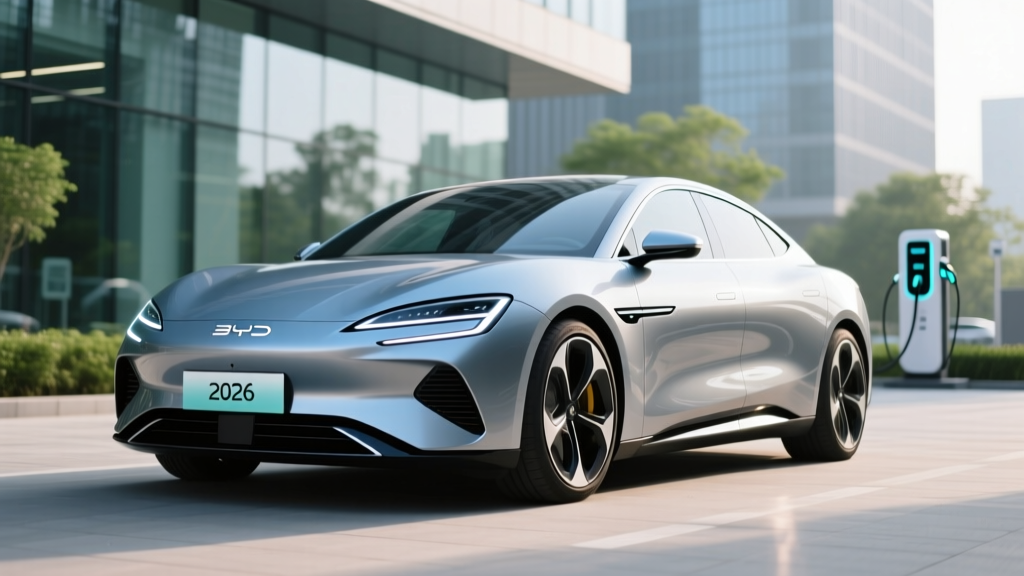
For years, BYD (Build Your Dreams) has dominated global EV sales, routinely trading the title of world's largest plug-in vehicle manufacturer with Tesla. Yet for US buyers, the Chinese automaker has remained largely a spectator — kept at bay by steep tariffs and a complex regulatory landscape. That narrative is shifting. Recent BYD shipment manifests and port filings suggest the company is positioning specific models for North American entry, with the compact crossover segment as the likely beachhead.
This profile breaks down the BYD models most frequently tied to recent export shipments, their real-world specs, and what US buyers should actually expect regarding availability, pricing, and federal incentives in 2026.
Which BYD Models Are in the Latest Shipments?
BYD's export strategy focuses on a handful of globally-oriented models rather than its full domestic lineup. Based on shipping records and BYD's international press releases, three models appear most frequently in BYD shipment data bound for markets outside China:
- BYD Atto 3 (Yuan Plus) — A compact crossover competing with the Hyundai Kona Electric and Chevrolet Equinox EV.
- BYD Dolphin — A subcompact hatchback positioned below the Bolt EV in price.
- BYD Seal — A midsize sedan rivaling the Tesla Model 3 and Hyundai Ioniq 6.
As of early 2026, none of these models are officially on sale at US dealerships. BYD has not announced a US retail launch date, and the 100% tariff on Chinese-manufactured EVs (raised from 25% in 2024) remains a formidable barrier. However, BYD's expanding factory footprint — including facilities in Thailand, Brazil, and Hungary — creates potential pathways for models built outside China to enter the US market at reduced tariff exposure.
BYD Atto 3 (Yuan Plus): Specs & Real-World Range
The Atto 3 is BYD's volume export leader and the model most commonly identified in BYD shipment tracking data. It rides on BYD's e-Platform 3.0 and uses the company's proprietary Blade Battery — a lithium iron phosphate (LFP) cell in a cell-to-pack configuration that prioritizes safety and cycle life over maximum energy density.
| Spec | Value |
|---|---|
| Battery Capacity | 58.56 kWh usable (LFP Blade) |
| WLTP Range | 261 miles (420 km) |
| Estimated EPA Range | ~230-240 miles (EPA testing is more conservative than WLTP) |
| Motor Output | 201 hp / 310 Nm torque |
| Drivetrain | FWD (single motor) |
| 0-62 mph (0-100 km/h) | 7.3 seconds |
| DC Fast Charge (Peak) | 88 kW |
| 10-80% DC Charge Time | ~29 minutes |
| Level 2 AC Charge | 7 kW (onboard charger) |
| Length / Width / Height | 176.8" / 72.0" / 65.7" |
| Cargo Volume | 15.5 cu ft (rear seats up) / 47.0 cu ft (folded) |
| Curb Weight | ~3,748 lbs |
BYD Seal: The Model 3 Challenger
The BYD Seal is the model that has drawn the most attention from Western automotive press, and for good reason. It's a low-slung, aerodynamically efficient sedan with available all-wheel drive and a larger battery pack. In BYD shipment data, the Seal appears frequently in European and Southeast Asian export records.
| Spec | RWD (Design) | AWD (Excellence) |
|---|---|---|
| Battery | 82.5 kWh (LFP Blade) | 82.5 kWh (LFP Blade) |
| WLTP Range | 354 miles (570 km) | 323 miles (520 km) |
| Est. EPA Range | ~300-310 miles | ~275-285 miles |
| Power | 308 hp | 523 hp |
| 0-62 mph | 5.9 sec | 3.8 sec |
| Peak DC Charge | 150 kW | 150 kW |
| 10-80% Time | ~26 minutes | ~26 minutes |
| AC Level 2 | 7 kW | 7 kW |
| Cargo (Trunk + Frunk) | 14.1 cu ft + 1.8 cu ft | 14.1 cu ft + 1.8 cu ft |
The Seal's 150 kW peak DC charging rate is competitive but trails the Hyundai Ioniq 6's 350 kW capability and the Tesla Model 3's sustained ~250 kW on V3/V4 Superchargers. The charge curve tapers noticeably above 80% State of Charge, typical of LFP chemistry — a full charge from 10-100% will take closer to 45-50 minutes at a DC fast charger.
BYD Dolphin: The Budget Hatchback
The Dolphin rounds out BYD's core export trio and represents the most affordable entry in the lineup. It's aimed squarely at urban commuters and price-sensitive buyers.
| Spec | Value |
|---|---|
| Battery | 60.4 kWh (LFP Blade) |
| WLTP Range | 265 miles (427 km) |
| Est. EPA Range | ~230-240 miles |
| Power | 201 hp |
| 0-62 mph | 7.0 seconds |
| Peak DC Charge | 88 kW |
| 10-80% Time | ~29 minutes |
| Cargo Volume | 12.2 cu ft / 37.4 cu ft (folded) |
Charging Infrastructure & Connector Compatibility
One of the most critical questions for any potential BYD US launch is charging connector compatibility. In Europe and most export markets, BYD vehicles use the CCS2 connector (the European standard). The US market uses either CCS1 or, increasingly, the Tesla NACS (North American Charging Standard) connector, which has been adopted by Ford, GM, Rivian, Hyundai, and most major automakers for 2025+ models.
| Charging Level | Power | Atto 3 (Miles/Hr) | Seal (Miles/Hr) | Dolphin (Miles/Hr) |
|---|---|---|---|---|
| Level 1 (120V) | 1.4 kW | ~4 mi/hr | ~5 mi/hr | ~4 mi/hr |
| Level 2 (240V) | 7 kW | ~22 mi/hr | ~25 mi/hr | ~22 mi/hr |
| DC Fast (Peak) | 88-150 kW | ~170 mi/hr* | ~340 mi/hr* | ~170 mi/hr* |
*Peak rate; sustained rate is lower as the charge curve tapers above 50-60% SoC.
For a US launch, BYD would need to either adopt NACS natively (the smartest long-term move given Supercharger network access) or provide CCS1 with a NACS adapter. Home Level 2 charging at 7 kW is adequate for overnight replenishment but slower than competitors like the Hyundai Ioniq 5 (10.9 kW onboard charger) or Tesla Model 3 (11.5 kW).
Pricing, Tariffs & Federal Tax Credit Eligibility
This is where the BYD shipment story gets complicated for US buyers.
International Pricing (for reference):
- BYD Atto 3: ~€38,000 in Europe (~$41,000 USD)
- BYD Seal: ~€45,000-€48,000 in Europe (~$48,500-$52,000 USD)
- BYD Dolphin: ~€35,000 in Europe (~$37,800 USD)
The Tariff Problem: Under current US trade policy, Chinese-manufactured EVs face a 100% import tariff (effective 2024, raised from the prior 25%). This would roughly double the landed cost of any BYD vehicle shipped directly from China, making them uncompetitive against domestically produced alternatives like the Chevrolet Equinox EV, Tesla Model 3, and Hyundai Ioniq 5.
BYD's potential workaround involves manufacturing in third-party countries (Thailand, Brazil, Hungary) that have more favorable trade terms with the US. However, vehicles must still meet US safety (NHTSA/FMVSS) and emissions certification requirements, a process that typically takes 12-18 months.
Battery Technology: The Blade Advantage
BYD's Blade Battery is the company's signature technology and a genuine differentiator. It uses LFP (lithium iron phosphate) chemistry arranged in long, thin prismatic cells that slot directly into the pack structure, eliminating module-level hardware and improving volumetric efficiency.
| Attribute | BYD LFP Blade | Typical NMC Pack |
|---|---|---|
| Energy Density | Lower (~140 Wh/kg cell-level) | Higher (~250 Wh/kg cell-level) |
| Cycle Life | 3,000+ cycles to 80% SoH | 1,000-2,000 cycles to 80% SoH |
| Thermal Stability | Excellent (passes nail penetration test) | Good (requires more thermal management) |
| Cold Performance | Moderate (less range loss than older LFP) | Better at very low temps |
| Cost | Lower (no cobalt, no nickel) | Higher |
| Charging to 100% | Recommended periodically for SoC calibration | Typically limited to 80-90% for longevity |
The Blade Battery's standout trait is safety. BYD has demonstrated that a nail can penetrate a fully charged Blade cell without triggering thermal runaway — a test that typically causes conventional NMC cells to ignite. For buyers prioritizing long-term durability and safety over maximum range, LFP is a compelling choice.
Warranty: In export markets, BYD typically offers an 8-year/100,000-mile battery warranty (whichever comes first) with a capacity retention threshold of 70%. This aligns with the US industry standard. US-specific warranty terms would be confirmed at launch.
Technology, ADAS & Interior
BYD's export vehicles feature a rotating 12.8-inch (or 15.6-inch in the Seal) central touchscreen running BYD's proprietary infotainment OS. The system supports wireless Apple CarPlay and Android Auto, over-the-air updates, and NFC phone-as-key functionality.
Driver Assistance (ADAS): BYD equips export models with its "DiPilot" suite, which includes:
- Adaptive cruise control with stop-and-go
- Lane-keeping assist and lane-centering
- Automatic emergency braking with pedestrian detection
- Blind-spot monitoring and rear cross-traffic alert
- 360-degree surround-view camera
This is firmly SAE Level 2 driver assistance — the driver must remain fully engaged with hands on the wheel and eyes on the road at all times. It does not approach the hands-free capability of GM's Super Cruise or Ford's BlueCruise on mapped highways.
Notable Drawbacks:
- Infotainment UI can feel cluttered compared to Tesla or Hyundai's systems
- No native integration with major US charging networks (would need to be developed)
- Dealer and service network: nonexistent in the US — a major ownership risk
- Resale value: completely unknown for a new Chinese brand in the US market
BYD vs. Key US Competitors
| Spec | BYD Atto 3 | Hyundai Kona Electric | Chevrolet Equinox EV | Tesla Model Y (RWD) |
|---|---|---|---|---|
| Est. EPA Range | ~230-240 mi | 261 mi | 319 mi | 320 mi |
| Battery | 58.6 kWh LFP | 65.4 kWh NMC | 85 kWh NMC | ~60 kWh LFP |
| Peak DC Charge | 88 kW | 100 kW | 150 kW | ~170 kW |
| 0-60 mph | ~7.0 sec | ~6.5 sec | ~7.9 sec | ~6.6 sec |
| Base MSRP (US) | N/A (not sold) | $32,675 | $33,600 | $44,990 |
| Tax Credit | Not eligible | Up to $7,500 | Up to $7,500 | Up to $7,500 |
| US Service Network | None | Nationwide | Nationwide | Nationwide |
- Choose the Hyundai Kona Electric if you want a proven compact EV with full US dealer support, competitive range, and tax credit eligibility.
- Choose the Chevrolet Equinox EV if maximum range per dollar and US manufacturing are priorities.
- Choose the Tesla Model Y if Supercharger network access and software integration matter most.
- Watch BYD if you're interested in LFP battery longevity and can wait for a potential US launch with local manufacturing.
Frequently Asked Questions
Is BYD selling cars in the US in 2026?
No. As of 2026, BYD does not sell passenger vehicles through US dealerships. The 100% tariff on Chinese-made EVs and the lack of a US-certified model lineup keep BYD out of the market. BYD's US presence is limited to commercial vehicles (electric buses and trucks) manufactured at its Lancaster, California facility.
Could BYD avoid US tariffs by building cars elsewhere?
Potentially. BYD's factories in Thailand, Brazil, and (upcoming) Hungary could theoretically export to the US at lower tariff rates, depending on trade agreements. However, any vehicle still requires NHTSA safety certification, EPA compliance, and a dealer/service network — a multi-year undertaking.
Would a BYD vehicle qualify for the $7,500 federal tax credit?
Almost certainly not under current IRS §30D rules. The credit requires North American final assembly and battery component/critical mineral sourcing from the US or FTA partners. BYD's vertically integrated Chinese supply chain does not meet these requirements.
How does BYD's Blade Battery compare to Tesla's LFP packs?
Both use LFP chemistry, but BYD's Blade format is structurally integrated into the pack (cell-to-pack), offering better volumetric efficiency and demonstrated nail-penetration safety. Tesla sources LFP cells primarily from CATL. Both recommend periodic 100% charges for accurate state-of-charge calibration.
What's the real-world range of the BYD Atto 3?
Based on WLTP-to-EPA conversion and independent European testing, expect approximately 230-240 miles in mixed driving, 195-215 miles at sustained highway speeds, and 160-185 miles in cold weather (below 32°F). These are estimates — official EPA figures would only be available if BYD certifies the vehicle for US sale.
Does BYD offer any Level 3 or Level 4 autonomous driving?
No. BYD's DiPilot system is an SAE Level 2 driver-assistance suite requiring full driver engagement. BYD has no announced Level 4 robotaxi or driverless program comparable to Waymo or Zoox.