What Is the BYD Shenzhen, and Why Does It Matter for EV Buyers?
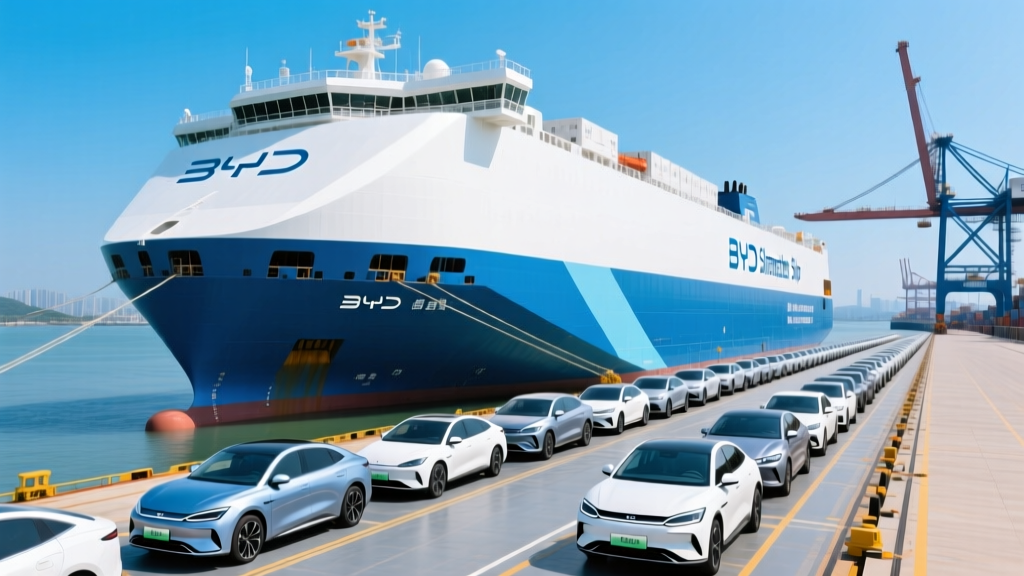
When you search for "BYD Shenzhen ship," you're not looking for a car — you're looking at the vessel that delivers them. The BYD Shenzhen is a 7,000-CEU (car equivalent unit) pure car and truck carrier (PCTC) — a roll-on/roll-off (ro-ro) cargo ship purpose-built by BYD to export its electric vehicles from China to global markets. Launched in early 2025 and named after BYD's home city, it is the first of a planned fleet of eight company-owned car carriers designed to reduce shipping costs and secure export capacity at a time when global ro-ro space is tight.
For U.S. EV shoppers, the BYD Shenzhen is mostly a logistics curiosity. BYD does not currently sell passenger EVs in the United States (its U.S. presence is limited to electric buses and commercial trucks built in Lancaster, California). But for buyers in Europe, Southeast Asia, Australia, and Latin America, the ships directly affect vehicle availability, delivery times, and ultimately pricing.
This profile breaks down what the BYD Shenzhen actually is, its specs and routes, and what BYD's vertical integration into ocean shipping signals for the global EV market.
Ship Specifications: Tonnage, Capacity, and Propulsion
The BYD Shenzhen was built by China Merchants Jinling Shipyard (Weihai) and classed by DNV. It is a dual-fuel LNG/marine-gas-oil vessel, meaning it can run on liquefied natural gas to reduce sulfur and particulate emissions relative to conventional heavy fuel oil. It is not battery-electric or hybrid — a 7,000-CEU ocean crossing still requires energy density that only liquid or cryogenic fuels provide.
| Attribute | Value |
|---|---|
| Vessel type | Pure Car and Truck Carrier (PCTC) / Ro-Ro |
| Capacity | ~7,000 CEU (car equivalent units) |
| Length overall | ~199.9 m (656 ft) |
| Beam (width) | ~38 m (125 ft) |
| Design draft | ~9.5 m |
| Gross tonnage | ~75,000 GT |
| Propulsion | Dual-fuel LNG / MGO (marine gas oil) |
| Service speed | ~19 knots |
| Decks | 13 (several hoistable for tall cargo) |
| Builder | China Merchants Jinling Shipyard (Weihai) |
| Classification | DNV |
| Maiden voyage | Early 2025 |
For context, the world's largest PCTCs — such as Wallenius Wilhelmsen's Odin-class — carry around 8,800 CEU. The BYD Shenzhen sits in the upper-middle tier of global car carriers, but what makes it notable is ownership: BYD is one of the only automakers in history to commission and operate its own ocean-going export fleet.
Routes and Markets: Where the BYD Shenzhen Delivers
BYD's shipping arm (a subsidiary operation) has deployed its vessels on routes connecting Chinese export ports — primarily Shenzhen, Shanghai, and Guangzhou — to:
- Europe: Bremerhaven (Germany), Zeebrugge (Belgium), Portbury/Bristol (UK), Rotterdam (Netherlands)
- Southeast Asia: Singapore, Laem Chabang (Thailand), Port Klang (Malaysia)
- Middle East: Jebel Ali (UAE)
- Latin America: Brazil, Mexico
- Australia/New Zealand: Port Kembla, Melbourne, Auckland
A typical China-to-Europe transit takes roughly 28–35 days depending on routing (Suez Canal vs. Cape of Good Hope diversions). China-to-Southeast-Asia runs are shorter, on the order of 7–14 days. BYD has stated the fleet will prioritize its highest-volume export markets; in 2025, BYD exported more than 400,000 NEVs (new energy vehicles, including BEVs and PHEVs), and company-owned tonnage is intended to handle an increasing share of that volume.
The United States is conspicuously absent from the route map. High U.S. tariffs on Chinese-built EVs (100% as of late 2024 under Section 301 actions) make direct BYD passenger-car imports commercially unviable, so the BYD Shenzhen does not call at U.S. ports with consumer vehicles.
Why BYD Built Its Own Fleet (and Why It Matters)
Global ro-ro capacity has been constrained since the early 2020s. Chinese EV exports surged — China became the world's largest auto exporter in 2023, surpassing Japan — and legacy car carriers operated by Wallenius Wilhelmsen, NYK, MOL, and K-Line were largely booked under long-term contracts with Toyota, VW, Hyundai, and other incumbents. Chinese OEMs faced spot-market rates that sometimes exceeded $100,000 per day for a mid-size PCTC.
BYD's response was vertical integration on an unusual scale: order eight 7,000-CEU vessels, take ownership, and run its own logistics pipeline. The strategy mirrors BYD's broader integration — the company builds its own Blade LFP battery cells, its own semiconductors, and even its own semiconductor fabrication equipment. Controlling shipping:
- Locks in capacity during peak export seasons
- Reduces per-unit logistics cost at scale
- Shortens the feedback loop between factory output and dealer-lot availability overseas
- Insulates BYD from rate spikes that hurt smaller Chinese EV exporters
For buyers in BYD's export markets, the practical effect is more predictable delivery windows and, over time, a cost advantage that supports BYD's aggressive pricing (the Dolphin hatchback, for example, undercuts most European BEVs by a wide margin).
Environmental Profile: LNG, Not Zero-Emission
It's worth being direct: the BYD Shenzhen is not a zero-emission vessel. Dual-fuel LNG propulsion reduces CO₂ emissions by roughly 20–25% compared with heavy fuel oil, and it virtually eliminates sulfur oxides (SOx) and sharply cuts particulate matter. But methane slip — unburned methane escaping the engine — remains a contested issue for LNG-fueled shipping, and the lifecycle greenhouse benefit depends heavily on how the LNG is sourced and transported.
True zero-emission ocean shipping (ammonia, hydrogen, or battery-electric) is not yet viable at the 7,000-CEU scale. The BYD Shenzhen represents a transitional technology: cleaner than the legacy fleet, but far from carbon-neutral. BYD has not announced plans for a zero-emission successor.
What This Means for Non-U.S. EV Buyers
If you're shopping for a BYD Atto 3, Dolphin, Seal, or Seagull in Europe, Australia, Thailand, or Brazil, the BYD Shenzhen fleet affects you in three concrete ways:
- Delivery predictability. Company-owned tonnage means BYD is less likely to delay shipments due to third-party carrier shortages. Order-to-delivery windows should be more stable than for Chinese brands relying on spot-market ro-ro space.
- Pricing pressure. Lower logistics costs, amortized over hundreds of thousands of vehicles per year, contribute to BYD's ability to price aggressively. In markets like Thailand and Brazil, this has already driven BEV prices below equivalent ICE models in some segments.
- Service and parts supply. The same vessels carry spare parts and service equipment. A dedicated fleet reduces the risk of parts shortages that have plagued other new-market entrants.
For U.S. readers, the BYD Shenzhen is a reminder of a parallel EV market that American buyers largely cannot access due to trade policy. The vehicles on board are real, shipping in volume, and reshaping competition in every market they reach — just not here.
Frequently Asked Questions
Can I buy a vehicle that was shipped on the BYD Shenzhen?
If you live in Europe, Australia, Southeast Asia, Latin America, or the Middle East — yes, many BYD vehicles delivered in 2025 and 2026 arrived on the BYD Shenzhen or its sister ships. In the United States, no — BYD does not sell passenger EVs there, and the ships do not call at U.S. ports with consumer vehicles.
Is the BYD Shenzhen electric-powered?
No. It is a dual-fuel LNG/MGO vessel. Battery-electric propulsion is not feasible for a 7,000-CEU ocean-going carrier with current technology; the energy density required for transoceanic voyages still demands liquid or cryogenic fuel.
How many ships does BYD operate?
BYD has ordered a fleet of eight 7,000-CEU PCTCs. The BYD Shenzhen was the first delivered, with the remainder scheduled through 2026. Exact commissioning dates vary by shipyard schedule.
Does BYD's shipping fleet affect U.S. EV prices?
Indirectly, yes — by enabling BYD to scale aggressively in every other major market, the fleet increases global BEV supply and intensifies price competition that eventually pressures legacy automakers' global pricing strategies. Directly, no — U.S. tariffs block BYD passenger vehicles from the American market.
Where can I track the BYD Shenzhen's current position?
Marine tracking services such as MarineTraffic and VesselFinder track the BYD Shenzhen by its IMO number. Search "BYD Shenzhen" on either platform for live AIS position, current voyage, and port-call history.