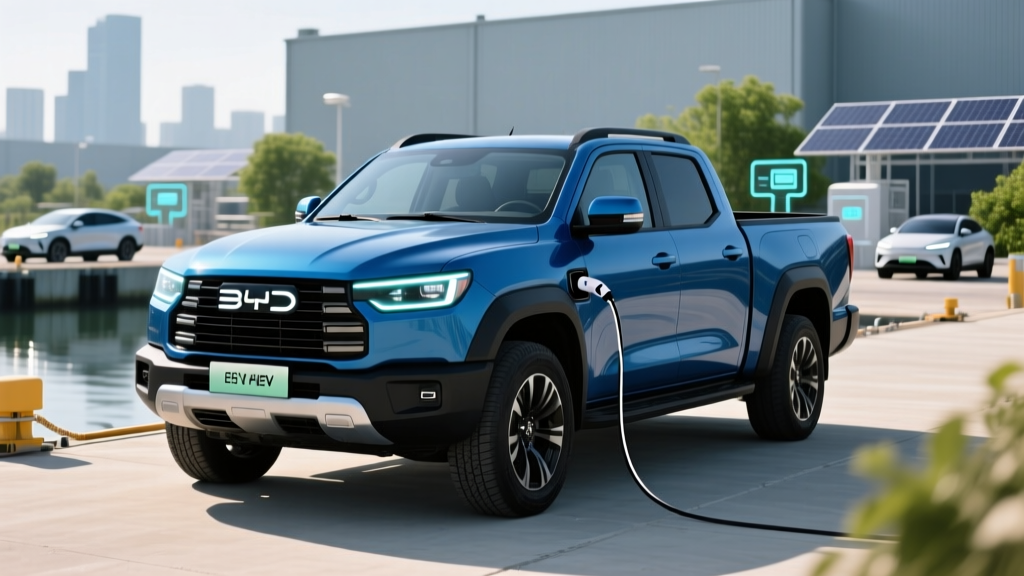
BYD has become the world's largest plug-in electric vehicle manufacturer, but for US truck shoppers, the question remains: when will BYD trucks actually arrive on American soil? The answer in 2026 is complicated. While the BYD Shark — the company's first unibody plug-in hybrid pickup — is now on sale in Australia, Mexico, Brazil, and parts of Europe, a 100% tariff on Chinese-built vehicles effectively locks it out of the US market. Still, understanding what BYD's truck platform offers is essential for anyone tracking the global electrified-truck landscape or considering cross-border purchase options.
This review covers the 2026 BYD Shark 6 PHEV pickup in detail: its dual-motor powertrain, electric-only range, charging behavior, real-world efficiency, and where it stacks up against the Ford Maverick Hybrid, Toyota Tacoma i-FORCE MAX, and Chevrolet Colorado. If you're researching BYD trucks to understand the competitive threat — or hoping for a US launch — here's the data you need.
BYD Shark 6: Core Specifications at a Glance
| Attribute | Specification |
|---|---|
| Powertrain | 1.5L turbo PHEV + dual electric motors (AWD) |
| System Output | 430 kW (577 hp) combined |
| 0–100 km/h (0–62 mph) | 5.7 seconds |
| Battery Capacity | 29.58 kWh usable (LFP — Blade Battery) |
| EV-Only Range (WLTP) | 100 km (~62 miles) |
| EV-Only Range (EPA est.) | ~50–55 miles (estimated, not EPA-certified) |
| Combined Range (fuel + electric) | ~840 km / ~522 miles (WLTP) |
| DC Fast Charge (peak) | 55 kW (CCS2 in global markets) |
| DC 30–80% Time | ~18 minutes |
| AC Level 2 Charge | 7 kW onboard (~4.5 hours 0–100%) |
| Towing Capacity | 2,500 kg / 5,511 lbs (braked) |
| Payload | 735 kg / 1,620 lbs |
| Cargo Bed Length | 1,520 mm × 1,480 mm (~59.8" × 58.3") |
| Drivetrain | AWD (rear motor primary, front motor assist) |
| Base MSRP (Australia) | AUD $59,990 (~USD $38,500) |
| US Availability | Not available — 100% tariff on Chinese-built vehicles |
| Battery Warranty (global) | 8 years / 160,000 km (~100,000 mi) |
Electric Range, Efficiency, and Real-World Expectations
The BYD Shark 6 uses a 29.58 kWh LFP (lithium iron phosphate) Blade Battery pack — the same cell chemistry BYD has standardized across most of its passenger lineup. LFP offers superior thermal stability and longer cycle life compared to NMC, though at the cost of lower energy density and slightly reduced cold-weather performance.
- City/commute (mild weather): 50–58 miles EV-only
- Highway (70 mph sustained): 38–44 miles EV-only
- Cold weather (below 32°F / 0°C): 30–38 miles EV-only (LFP chemistry loses ~30–40% in deep cold)
For comparison, the Ford Maverick Hybrid achieves an EPA-estimated 42 MPG combined but offers zero electric-only miles. The Toyota Tacoma i-FORCE MAX hybrid delivers strong torque but similarly lacks a plug. The BYD Shark's advantage is genuine EV commuting capability in a truck form factor — a niche the US market hasn't yet filled with a unibody PHEV pickup.
Charging Speed and Infrastructure Compatibility
Charging is where BYD trucks reveal their PHEV compromise. The Shark 6's 55 kW peak DC charge rate is modest compared to full BEVs, but it's respectable for a plug-in hybrid with a sub-30 kWh pack.
| Charge Level | Power | Connector | Charge Time | Miles of EV Range Added/Hour |
|---|---|---|---|---|
| Level 1 (120V household) | ~1.4 kW | Standard outlet | ~22 hours (0–100%) | ~2.5 mi/hr |
| Level 2 (240V home/public) | 7 kW (onboard limit) | Type 2 / CCS (market dependent) | ~4.5 hours (0–100%) | ~12 mi/hr |
| DC Fast Charge | 55 kW peak | CCS2 (global) / NACS (if US) | ~18 min (30–80%) | ~65 mi/hr (at peak) |
The 30–80% DC fast charge time of approximately 18 minutes is practical for quick top-ups on longer trips, though the small battery means you're adding roughly 30 miles of EV range in that window. The charge curve tapers significantly above 80%, as is typical with LFP chemistry — BYD recommends regular 100% charges for LFP packs to maintain cell balancing, unlike NMC batteries where daily 80% limits are preferred.
One critical note: the Shark currently ships with CCS2 connectors in global markets. Were BYD to enter the US, the vehicle would need to adopt the NACS (Tesla) connector to access the Supercharger network — now the de facto North American standard.
Performance, Drivetrain, and Driving Dynamics
The Shark 6's dual-motor AWD system is where BYD's electric powertrain expertise shows. The rear axle is driven by a 150 kW (201 hp) permanent-magnet motor as the primary drive unit, while the front axle adds a 110 kW (147 hp) motor. Combined with the 1.5L turbo engine (which can drive the wheels directly at highway speeds or act as a generator in series-hybrid mode), total system output reaches 430 kW — approximately 577 horsepower.
The 0–100 km/h time of 5.7 seconds (roughly 5.5 seconds to 60 mph) places the Shark in sports-truck territory, comparable to a Ford F-150 Lightning in base dual-motor form. Electric torque delivery is immediate, making the Shark feel quicker in urban driving than the 0–60 number alone suggests.
However, the unibody platform — while offering car-like ride quality and a lower step-in height — limits off-road articulation compared to body-on-frame competitors like the Tacoma or Colorado. The Shark is best understood as a performance-oriented lifestyle truck, not a rock crawler. Ground clearance sits at approximately 200 mm (7.9 inches), adequate for fire roads and light trail use but not extreme terrain.
Interior, Cargo, and Technology
Inside, the Shark 6 borrows heavily from BYD's passenger-car playbook. A 12.8-inch rotating center touchscreen (landscape for navigation, portrait for climate and media) dominates the dash, running BYD's DiLink infotainment system. Wireless Apple CarPlay and Android Auto are standard. A 10.25-inch digital instrument cluster sits behind a flat-bottom steering wheel.
Cabin space is competitive with midsize trucks:
- Front legroom: ~1,050 mm (41.3 inches)
- Rear legroom: ~910 mm (35.8 inches) — adequate for adults on shorter trips
- Cargo bed: 1,520 mm L × 1,480 mm W (~59.8" × 58.3") — shorter than a Tacoma 5-foot bed, limiting full 4×8 sheet goods transport
- Bed payload: 735 kg (1,620 lbs)
- Towing: 2,500 kg braked (5,511 lbs) — competitive with V6 midsize trucks
Driver-assistance features include adaptive cruise control, lane-keep assist, automatic emergency braking, blind-spot monitoring, and a 360-degree camera system. These constitute SAE Level 2 driver assistance — the driver must remain fully engaged at all times. BYD does not currently offer a hands-free highway driving system comparable to GM's Super Cruise or Ford's BlueCruise.
A notable tech feature is V2L (vehicle-to-load) capability: the Shark can output up to 3.3 kW of AC power from its battery to run tools, camping equipment, or appliances — a practical differentiator for work-site and outdoor use.
Pricing, Tax Credits, and the US Availability Problem
Here's where the story of BYD trucks in America hits a wall. The Shark 6 launched in Australia at AUD $59,990 (approximately USD $38,500 at early-2026 exchange rates), with a higher-spec Shark 8 variant at AUD $65,990. In Mexico — BYD's closest market to the US — pricing starts around MXN $899,900 (~USD $47,000).
| Market / Scenario | Base Price (Local) | Base Price (USD equiv.) | US Federal Tax Credit | Effective Price |
|---|---|---|---|---|
| Australia (on sale) | AUD $59,990 | ~$38,500 | N/A | $38,500 |
| Mexico (on sale) | MXN $899,900 | ~$47,000 | N/A for US buyers | $47,000 |
| US (hypothetical, no tariff) | ~$40,000 est. | $40,000 | Up to $7,500 (§30D)* | ~$32,500 |
| US (with 100% tariff reality) | ~$80,000+ est. | $80,000+ | Unlikely eligible** | $80,000+ |
*IRS §30D tax credit eligibility requires meeting multiple criteria under current 2026 rules: buyer income caps ($150K single / $300K joint modified AGI), MSRP caps ($80,000 for trucks/vans/SUVs), battery critical-mineral sourcing thresholds, and final assembly in North America. A China-assembled BYD would fail the final-assembly requirement outright, regardless of other qualifications. See IRS.gov §30D guidelines for complete current-year rules.
**Even if BYD established North American assembly, the battery-sourcing and critical-mineral requirements — which phase in stricter thresholds each year through 2032 — would present additional hurdles given BYD's vertically integrated Chinese supply chain.
The bottom line: BYD trucks are not purchasable in the United States in 2026, and the current tariff and regulatory environment makes near-term entry extremely unlikely. US buyers researching the Shark should treat it as a benchmark for what global competitors offer, not a purchase option.
How the BYD Shark Compares to US-Market Trucks
| Spec | BYD Shark 6 (PHEV) | Ford Maverick Hybrid | Toyota Tacoma i-FORCE MAX | Chevy Colorado ZR2 |
|---|---|---|---|---|
| Powertrain | 1.5T PHEV AWD | 2.5L HEV FWD/AWD | 2.4T Hybrid AWD | 2.7T Turbo AWD |
| Horsepower | 577 hp | 191 hp | 326 hp | 310 hp |
| EV-Only Range | ~50–55 mi (est. EPA) | 0 mi (no plug) | 0 mi (no plug) | 0 mi (no plug) |
| Fuel Economy (combined) | ~24–27 MPG (hybrid mode) | 42 MPG (EPA) | ~23 MPG (EPA est.) | ~19 MPG (EPA est.) |
| 0–60 mph | ~5.5 sec | ~8.0 sec | ~6.5 sec | ~7.0 sec |
| Towing | 5,511 lbs | 2,000 lbs (HEV) | 6,000 lbs | 5,500 lbs |
| US MSRP (base) | Not available | ~$28,000 | ~$40,000 | ~$47,000 |
| US Tax Credit | N/A | N/A (HEV) | N/A (HEV) | N/A (ICE) |
The Shark's combination of EV-only commuting range and serious power output has no direct US-market rival. The Maverick Hybrid wins on fuel economy and price but lacks plug-in capability. The Tacoma i-FORCE MAX offers genuine off-road hardware and towing but no electric range. If BYD could sell the Shark in the US at its global price point — a significant "if" — it would occupy a unique niche between compact lifestyle trucks and full-size workhorses.
Pros
- Genuine 50+ mile EV-only range for daily commuting
- 577 hp system output — fastest truck in its class
- LFP Blade Battery offers excellent thermal safety and cycle life
- V2L capability (3.3 kW) for work-site and camping power
- Competitive pricing in global markets (~$38,500 USD equivalent)
- 8-year / 100,000-mile battery warranty
Cons
- Not available in the United States (100% tariff barrier)
- LFP battery loses 30–40% range in freezing temperatures
- 55 kW DC fast charge is slow compared to BEV trucks
- Short cargo bed (~59.8") limits utility vs. full-size trucks
- No hands-free highway driving assist (Level 2 only)
- Unproven long-term reliability outside BYD's home market
Who Should Pay Attention to BYD Trucks?
Even though you can't buy a BYD Shark in the US today, the truck matters for several audiences:
- US truck shoppers frustrated by the lack of PHEV pickups: The Shark demonstrates that a plug-in hybrid truck with genuine EV commuting range is technically and commercially viable. Its existence increases pressure on Ford, Toyota, and GM to offer PHEV variants in the US.
- Expats and dual-citizens: If you live or work in Australia, Mexico, or Latin America, the Shark is a legitimate purchase option worth cross-shopping against the Ranger and Hilux.
- Industry watchers: BYD's vertical integration — they build their own batteries, motors, and semiconductors — gives them a cost structure that legacy automakers cannot match. Understanding BYD trucks means understanding the competitive future of the global truck market.
- Investors and fleet operators: BYD's commercial truck division (separate from the Shark passenger pickup) already operates electric buses and medium-duty trucks in limited US applications through partnerships, though these face the same tariff headwinds.
Frequently Asked Questions
Can I buy a BYD truck in the United States in 2026?
No. BYD trucks, including the Shark 6 PHEV pickup, are not sold in the US. A 100% tariff on Chinese-built automobiles imposed in 2024–2025 makes importing them economically unviable. BYD has not announced any plans for US-market assembly or a tariff-compliant supply chain.
What is the real-world electric range of the BYD Shark?
BYD quotes 100 km (62 miles) under the WLTP cycle. Real-world EPA-equivalent range is estimated at 50–55 miles in mild conditions, dropping to 38–44 miles at sustained highway speeds and 30–38 miles in freezing weather due to LFP chemistry characteristics.
How fast does the BYD Shark charge?
The Shark accepts up to 55 kW on DC fast charging, achieving a 30–80% charge in approximately 18 minutes. On Level 2 AC (7 kW), a full charge takes about 4.5 hours. Level 1 (120V) charging adds roughly 2.5 miles of EV range per hour.
Would the BYD Shark qualify for the US federal EV tax credit?
Under current IRS §30D rules, no. The credit requires final assembly in North America, which the China-built Shark does not meet. Even with North American assembly, battery critical-mineral and component sourcing requirements would present additional barriers. Tax credit rules are subject to change — consult a tax professional for personalized guidance.
Is the BYD Shark a good truck compared to American alternatives?
On paper, the Shark's combination of 577 hp, 50+ mile EV range, and sub-$40,000 pricing (in global markets) is highly competitive. However, US buyers cannot purchase it, and its long-term reliability, parts availability, and resale value outside BYD's established markets remain unproven. For US shoppers, the Ford Maverick Hybrid remains the closest accessible alternative for efficiency-focused truck buyers.
What battery chemistry does the BYD Shark use?
The Shark uses BYD's proprietary LFP (lithium iron phosphate) Blade Battery at 29.58 kWh usable capacity. LFP offers excellent thermal stability (lower fire risk), long cycle life (3,000+ cycles), and lower cost, but trades off energy density and cold-weather performance compared to NMC chemistry.
Does BYD make a fully electric truck?
BYD's commercial vehicle division produces fully electric medium- and heavy-duty trucks for fleet and industrial use globally. However, the Shark — their only passenger pickup — is a plug-in hybrid, not a full BEV. BYD has not announced a fully electric consumer pickup as of early 2026.
What is the BYD Shark's towing capacity?
The Shark 6 is rated to tow 2,500 kg (5,511 lbs) with a braked trailer. This is competitive with midsize trucks like the Colorado and Tacoma but significantly less than full-size trucks like the F-150 or Silverado. Payload is rated at 735 kg (1,620 lbs).
Sources: fueleconomy.gov (EPA testing methodology and comparison data), IRS.gov (§30D clean vehicle credit rules), BYD global press specifications. Pricing reflects early-2026 exchange rates and is subject to fluctuation. US availability status current as of publication date.