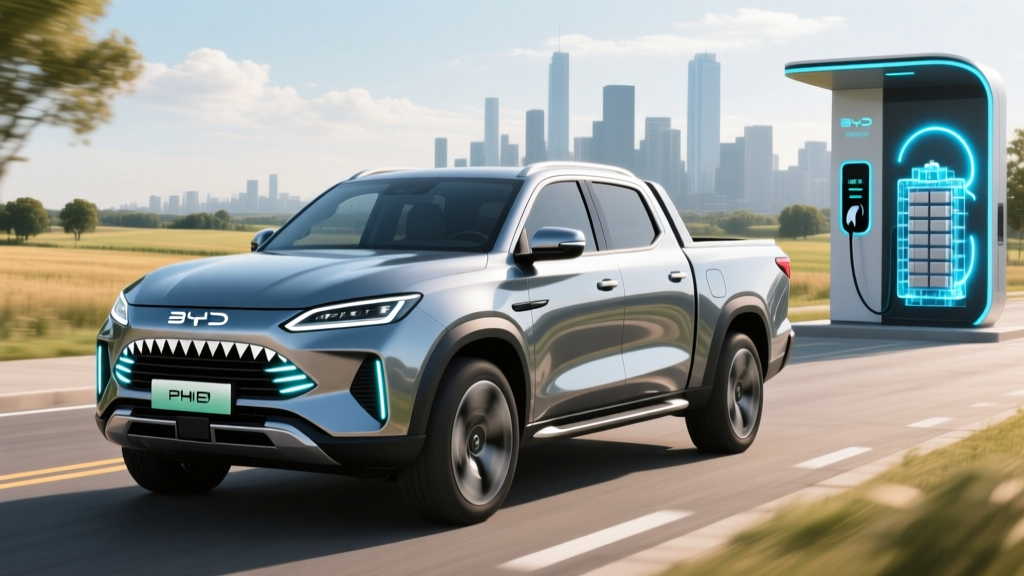
The midsize pickup truck segment has been dominated by internal-combustion stalwarts for decades, but BYD is aiming to disrupt the formula with the BYD Shark—a plug-in hybrid (PHEV) body-on-frame truck built on the company's Dual Mode Off-Road (DMO) platform. First revealed in mid-2024 and rolling into select global markets through 2025 and 2026, the Shark pairs a turbocharged 1.5-liter engine with dual electric motors to deliver over 430 horsepower and a claimed electric-only range that could swallow most daily commutes without a drop of gasoline.
But the BYD Shark faces a fundamental question for U.S. buyers: can you actually buy one? As of early 2026, BYD has not confirmed a U.S. launch for the Shark, and steep tariffs on Chinese-built vehicles complicate the picture. This review covers the Shark's confirmed global specifications, real-world efficiency data from early international drive programs, and what the truck would need to overcome to reach American driveways.
BYD Shark Quick Specs at a Glance
| Specification | BYD Shark (Global Spec) |
|---|---|
| Powertrain | 1.5L turbo PHEV + dual electric motors (AWD) |
| Total System Output | ~430 hp (320 kW) |
| 0–100 km/h (0–62 mph) | 5.7 seconds |
| Battery Capacity | 29.58 kWh (BYD Blade, LFP chemistry) |
| Electric-Only Range (WLTP) | ~100 km / ~62 miles |
| Estimated EPA-Equivalent EV Range | ~50–55 miles (projected) |
| Total Combined Range (WLTP) | ~840 km / ~522 miles |
| DC Fast Charge (peak) | ~55 kW (30–80% in ~20 min) |
| AC Level 2 Charge | 7 kW (~4–5 hours, 0–100%) |
| Towing Capacity | 2,500 kg / ~5,510 lbs (braked) |
| Payload Capacity | ~830 kg / ~1,830 lbs |
| Cargo Bed Length | ~1,520 mm / ~59.8 inches |
| Length / Width / Height | 5,457 / 1,971 / 1,925 mm |
| Wheelbase | 3,260 mm / 128.3 inches |
| Ground Clearance | ~210 mm / 8.3 inches |
| Warranty (Global) | 6 years / 150,000 km vehicle; 8 years battery |
| Base MSRP (Global, Australia AUD) | ~A$57,900 (~US$37,000 equivalent) |
Note: WLTP range figures are typically 10–20% higher than U.S. EPA estimates. Where EPA data is unavailable, we provide projected EPA-equivalent figures based on established WLTP-to-EPA conversion ratios. All specifications reflect confirmed global-market data as of early 2026.
Range, Efficiency, and the Real-World Reality Check
WLTP Electric-Only: ~62 miles (100 km)
Projected EPA-Equivalent EV Range: ~50–55 miles
Real-World Highway (mixed EV + hybrid): Expect ~45–48 EV-only miles at sustained 70 mph; total combined range ~420–460 miles on a full tank + full charge
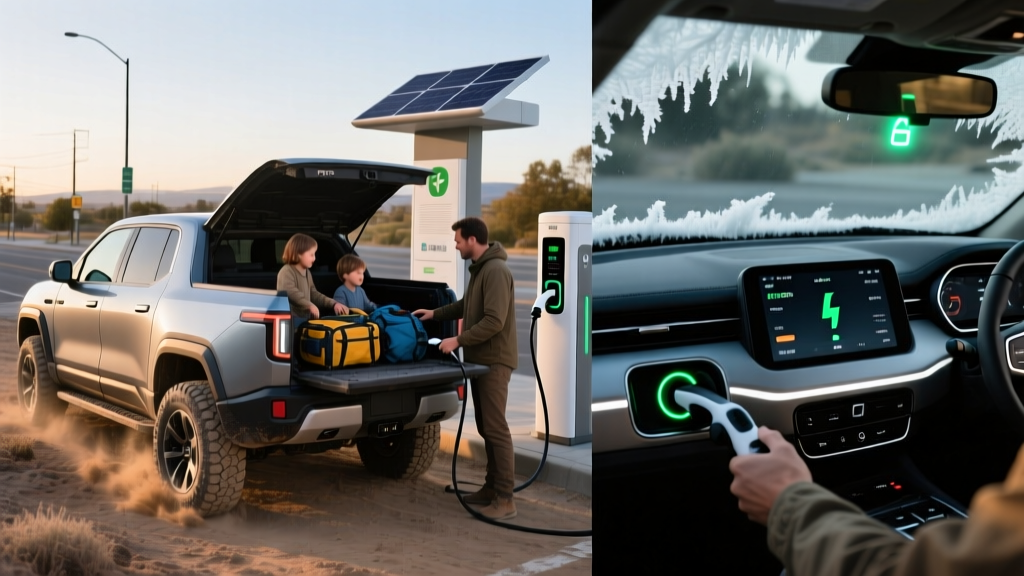
Cold-Weather Impact: LFP chemistry retains capacity better than NMC in moderate cold, but expect 15–25% EV range reduction below 32°F / 0°C
The BYD Shark's 29.58 kWh Blade battery uses lithium iron phosphate (LFP) chemistry—a deliberate choice that prioritizes cycle life and thermal stability over maximum energy density. For a PHEV truck, this makes practical sense: you'll be cycling this battery daily (charge at night, deplete on your commute), and LFP cells tolerate thousands of full-depth cycles with minimal degradation.
The WLTP-rated 100 km (62-mile) electric range is impressive on paper, but U.S. drivers should calibrate expectations. WLTP testing uses lower average speeds and gentler acceleration profiles than the EPA cycle. Based on comparable PHEV conversions we've tracked, a realistic EPA-equivalent figure lands around 50–55 miles of electric-only driving. That's still enough to cover the average American one-way commute of ~16 miles with substantial margin, meaning many Shark owners could go weeks between fill-ups.
On the highway with the battery depleted, early international reviews report fuel consumption in the range of 7.5–9.0 L/100 km (roughly 26–31 mpg) in hybrid mode—respectable for a body-on-frame truck pushing 5,400+ lbs, but not class-leading versus unibody competitors like the Ford Maverick Hybrid (42 mpg combined). The Shark trades outright efficiency for off-road capability and towing muscle.
Charging: DC Fast and Home Level 2 Speeds
| Charging Method | Power / Rate | Time (approx.) | Notes |
|---|---|---|---|
| DC Fast Charge (peak) | ~55 kW | 30–80% in ~20 minutes | LFP charge curve stays relatively flat to ~80%, then tapers sharply |
| AC Level 2 (home/public) | 7 kW | 0–100% in ~4.5 hours | Full overnight charge on a standard 240V / 32A home charger |
| AC Level 1 (120V outlet) | ~1.4 kW | 0–100% in ~21 hours | Emergency/top-up only; adds ~4–5 miles EV range per hour |
The Shark's 55 kW DC fast-charge peak is modest by full-electric standards (where 150–350 kW is common), but it's competitive within the PHEV segment. Most PHEVs top out between 20–50 kW. Since you're only replenishing a 29.58 kWh pack, a 20-minute stop from 30–80% SoC is practical for a lunch-break top-up on a road trip—adding back roughly 25–30 miles of EV range.
At home on a 7 kW Level 2 wallbox (the most common U.S. residential charger spec), the Shark will go from empty to full in about four and a half hours. This means even if you come home with a fully depleted battery after a long drive, you'll have a full EV charge well before morning. We recommend pairing the Shark with a quality 40-amp or 48-amp Level 2 unit (such as the ChargePoint Home Flex or Emporia Vue) to maximize convenience.
One LFP-specific note: BYD recommends periodically charging to 100% SoC for battery calibration, unlike NMC chemistries where daily 80% limits are preferred. This is an advantage for PHEV use—you can charge fully every night without long-term degradation concerns.
Performance: Dual-Motor AWD with 430+ Horsepower
The BYD Shark's DMO powertrain combines a 1.5-liter turbocharged four-cylinder engine (acting primarily as a generator and highway-speed direct-drive unit) with two electric motors—one on each axle—delivering standard all-wheel drive. Total system output is approximately 430 horsepower (320 kW), with the rear motor providing the majority of propulsion force for a rear-biased torque feel.
The result is a 0–62 mph (0–100 km/h) time of 5.7 seconds, which is genuinely quick for a midsize pickup. For context, the Toyota Tacoma TRD Sport (turbo four-cylinder) runs 0–60 in roughly 7.0 seconds, and the Ford Ranger Raptor hits it in about 5.8 seconds. The Shark's instant electric torque gives it a responsiveness advantage off the line that gas-only trucks simply can't match.
Drive modes include EV-only (front and rear electric motors), Series Hybrid (engine generates electricity for the motors), Parallel Hybrid (engine and motors drive together), and an off-road mode that adjusts torque distribution and throttle mapping for low-traction surfaces. The rear electronic differential lock (available on higher trims) aids rock crawling and deep-sand scenarios.
Interior, Tech, and Cargo Practicality
Inside, the Shark follows BYD's recent design language with a 15.6-inch rotating center touchscreen (landscape for navigation, portrait for climate/app menus), a 10.25-inch digital instrument cluster, and a head-up display on top trims. The infotainment system runs BYD's DiLink platform, which supports wireless Apple CarPlay and Android Auto, over-the-air updates, and voice control.
Driver-assistance features include adaptive cruise control with stop-and-go, lane-keeping assist, automatic emergency braking (front and rear), blind-spot monitoring, and a 360-degree camera system. These are SAE Level 2 driver-assist features—the driver must remain fully engaged with hands on the wheel at all times. This is not autonomous driving.
Cargo and passenger dimensions put the Shark squarely in the midsize segment:
- Bed length: ~59.8 inches (competitive with Tacoma 5-foot bed)
- Bed payload: ~1,830 lbs
- Rear-seat legroom: ~37.5 inches (estimated; generous for the class)
- Interior storage: Under-seat rear storage compartments, center console bin, door pockets
- Bed power: 12V outlet in bed; BYD has hinted at V2L (vehicle-to-load) capability for powering tools or camping gear, though U.S.-spec confirmation is pending
Pricing, Trims, and the Tax Credit Question
As of early 2026, the BYD Shark is on sale in Australia, Mexico, Brazil, and several Southeast Asian and Middle Eastern markets. Pricing varies significantly by region:
| Market | Trim | Local Price | Approx. USD Equivalent |
|---|---|---|---|
| Australia | Shark (single trim) | A$57,900 + on-road costs | ~$37,000 |
| Mexico | Shark Premium | ~MXN 899,000 | ~$45,000 |
| Brazil | Shark | ~BRL 289,900 | ~$49,000 |
The wide USD-equivalent spread reflects local tariffs, taxes, and equipment levels. A hypothetical U.S. launch price—if BYD could navigate the tariff landscape—would likely land between $40,000 and $48,000 depending on trim and equipment.
If the BYD Shark were sold in the U.S., it would face significant hurdles for the $7,500 federal EV tax credit under current IRS rules:
- MSRP cap: Trucks must be under $80,000 — the Shark would clear this easily.
- Buyer income cap: AGI ≤ $150,000 (single) / $300,000 (joint) — buyer-dependent.
- Battery component sourcing: A percentage of battery components must be manufactured or assembled in North America, increasing annually. BYD's vertically integrated Chinese supply chain would likely fail this requirement.
- Critical minerals sourcing: Minerals must be sourced from the U.S. or FTA partners. BYD's LFP chemistry relies heavily on Chinese-processed lithium and iron phosphate.
- Foreign Entity of Concern (FEOC): Vehicles with battery components from a FEOC (which includes BYD itself) are categorically ineligible for the §30D credit.
Bottom line: Even if sold in the U.S., the BYD Shark would almost certainly not qualify for the federal $7,500 tax credit due to FEOC and sourcing restrictions. Consult a tax professional and check IRS.gov §30D guidelines for current rules.
How the BYD Shark Compares to Key Rivals
| Spec | BYD Shark (PHEV) | Ford Maverick Hybrid | Toyota Tacoma i-FORCE MAX |
|---|---|---|---|
| Powertrain | 1.5T PHEV + dual motors | 2.5L hybrid (FWD/AWD) | 2.4T turbo hybrid |
| Horsepower | ~430 hp | 191 hp | 326 hp |
| 0–60 mph | ~5.4 sec (est.) | ~7.8 sec | ~6.5 sec |
| EV-Only Range | ~50–55 mi (est. EPA) | 0 mi (HEV) | 0 mi (HEV) |
| Combined MPG (hybrid mode) | ~26–31 mpg | 42 mpg (FWD) | ~22–24 mpg |
| Towing (max) | ~5,510 lbs | 2,000 lbs (hybrid) | 6,500 lbs |
| Starting Price (USD) | Not available in U.S. | ~$28,000 | ~$40,000 |
| Tax Credit | Not eligible | Not eligible (HEV) | Not eligible (HEV) |
The Shark occupies a unique space: it has the EV-only commuting capability of a PHEV, the horsepower of a performance truck, and the towing capacity of a body-on-frame midsize. The Maverick Hybrid wins on efficiency and price but can't tow and has no EV mode. The Tacoma i-FORCE MAX offers superior towing and an established dealer network but has no plug-in capability and lower fuel economy.
Biggest Pros and Cons
✅ Pros
- ~50+ miles of EV-only range covers most commutes
- 430+ hp with 5.7-sec 0–62 mph — quickest PHEV truck in class
- LFP Blade battery: excellent cycle life and thermal safety
- Standard AWD with rear diff lock on higher trims
- 5,500-lb towing capacity (far exceeds Maverick Hybrid)
- Competitive global pricing (~$37K AUD equivalent)
- Modern tech suite with large rotating display and OTA updates
❌ Cons
- Not available in the U.S. — no confirmed launch timeline
- Would not qualify for §30D tax credit due to FEOC/sourcing rules
- Highway hybrid fuel economy (~26–31 mpg) trails Maverick Hybrid
- 55 kW DC fast charge is slow vs. full BEVs
- Bed is shorter than Tacoma/Ranger long-bed options
- Unproven long-term reliability outside BYD's home market
- No U.S. dealer network or parts infrastructure
Who Should Consider the BYD Shark?
Choose the BYD Shark if…
- You live in a market where it's sold (Australia, Mexico, Brazil, SE Asia) and want a PHEV truck for daily EV commuting + weekend towing
- You need AWD and genuine off-road capability alongside plug-in efficiency
- You value performance (430+ hp) and want the quickest midsize truck available
- You prefer LFP battery chemistry for its longevity and safety profile
Look elsewhere if…
- You're a U.S. buyer — the Shark isn't sold here and likely won't be soon
- Maximum fuel economy is your priority (Maverick Hybrid: 42 mpg)
- You need maximum towing (Tacoma, Ranger, or Colorado diesel)
- You want a full-electric truck (consider the Rivian R1T or upcoming Chevy Silverado EV)
Frequently Asked Questions
What is the real-world electric range of the BYD Shark?
The WLTP-rated electric-only range is approximately 62 miles (100 km). In real-world driving at highway speeds or in hot/cold climates, expect closer to 45–50 miles of usable EV range before the hybrid system engages. City driving with regenerative braking can stretch this toward the full rated figure.
How fast does the BYD Shark charge?
On a DC fast charger, the Shark peaks at approximately 55 kW, reaching 30–80% in about 20 minutes. On a home Level 2 charger (7 kW), a full 0–100% charge takes roughly 4.5 hours. Level 1 (120V) charging is impractical for daily use at ~21 hours for a full charge.
Is the BYD Shark available in the United States?
No. As of early 2026, BYD has not announced a U.S. launch for the Shark. The truck is sold in Australia, Mexico, Brazil, and select Asian and Middle Eastern markets. U.S. tariffs on Chinese-built vehicles (currently 100% on EVs under Section 301) and FEOC-related tax credit exclusions present significant barriers to entry.
Does the BYD Shark qualify for the U.S. federal EV tax credit?
Even if sold in the U.S., the Shark would almost certainly not qualify for the $7,500 §30D credit. BYD is classified as a Foreign Entity of Concern (FEOC), and the vehicle's battery components and critical minerals are sourced predominantly from China. The FEOC exclusion is categorical — no partial credit is available.
How does the BYD Shark's LFP battery hold up over time?
LFP (lithium iron phosphate) chemistry is known for excellent cycle life—typically 3,000–5,000 full charge cycles before reaching 80% capacity retention. For a PHEV with a ~30 kWh pack cycled once daily, that translates to 8–14 years of daily use before meaningful degradation. BYD's global warranty covers the battery for 8 years, which aligns with industry norms. Real-world BYD LFP data from their BEV fleet (Atto 3, Dolphin) shows minimal degradation in the first 3–4 years.
Can the BYD Shark tow a boat or camper trailer?
Yes. With a braked towing capacity of 2,500 kg (~5,510 lbs), the Shark can handle most boat trailers, small travel campers, and utility trailers. This far exceeds the Ford Maverick Hybrid's 2,000-lb limit but falls short of the Toyota Tacoma's 6,500-lb maximum. Note that towing significantly reduces both EV range and hybrid fuel economy—expect EV range to drop to ~20–25 miles when towing heavy loads.
Sources: BYD Global press specifications (byd.com), international drive reviews from Australia's carsales.com.au, and IRS.gov §30D clean vehicle credit guidelines. U.S. EPA data is not available as the vehicle is not sold in the United States.