BYD Shark Interior and Cabin Overview
The BYD Shark 6 PHEV has drawn global attention as one of the first plug-in hybrid pickups from a Chinese automaker to target export markets. While BYD has not officially launched the Shark in the United States as of early 2026, the truck is on sale in Australia, Mexico, Brazil, and several other markets, prompting significant curiosity from American truck buyers. This review covers the interior layout, materials, and technology, alongside full powertrain, range, and charging specifications based on confirmed global-market data.
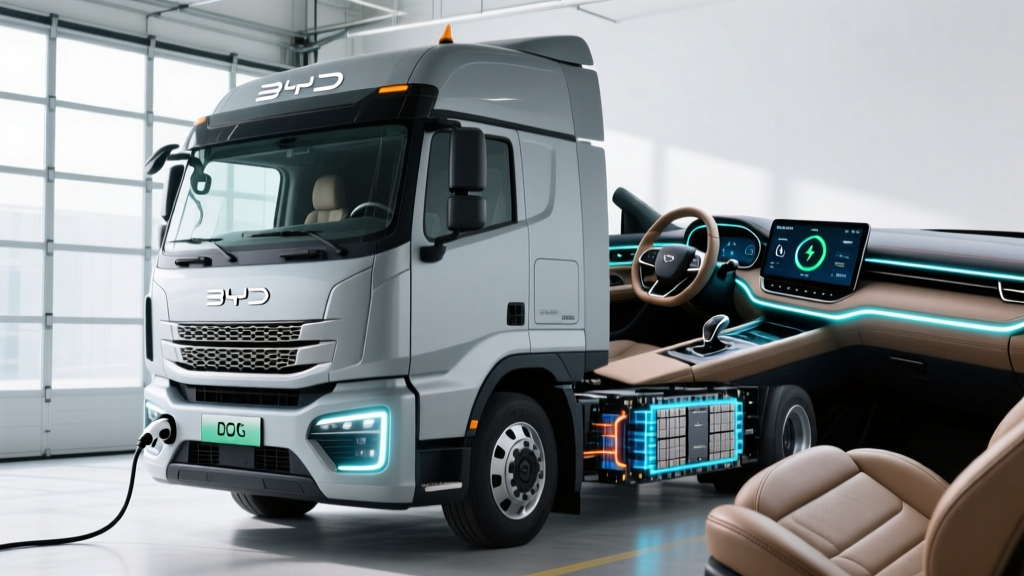
The Shark's cabin is built around a 12.8-inch rotating center touchscreen — a BYD signature — running the company's DiLink infotainment system. The dashboard uses a mix of soft-touch plastics on the upper surfaces with harder, more utilitarian materials on the lower door panels and center console, reflecting the truck's work-oriented positioning. A 10.25-inch digital instrument cluster sits behind a flat-bottom steering wheel, and a wireless phone charging pad occupies the center console.
Front seats in the top-spec trim are heated and ventilated, upholstered in synthetic leather. Rear-seat legroom measures approximately 37.4 inches, competitive with midsize trucks like the Ford Ranger and Toyota Tacoma. The rear bench folds in a 60/40 split, though the seat cushion sits relatively flat without significant contouring. Headroom is generous at 40.1 inches front and 38.8 inches rear, aided by the Shark's tall roofline.
Storage solutions include a deep center console bin, door pockets sized for 1-liter bottles, and a modestly sized glovebox. The bed measures approximately 59.8 inches long, 59.1 inches wide (between the wheel wells: ~44.3 inches), with a payload capacity rated at roughly 1,764 lbs (800 kg) in global markets. A spray-in bedliner and 12V power outlet in the bed are standard on higher trims.
Powertrain, Performance, and Drivetrain
The BYD Shark 6 uses a plug-in hybrid powertrain combining a 1.5-liter turbocharged inline-four engine with a rear-mounted electric motor. Total system output is rated at 430 horsepower (320 kW). The electric motor alone produces approximately 215 hp (160 kW), while the gasoline engine contributes around 188 hp (140 kW).
| Spec | Value |
|---|---|
| Powertrain | 1.5L Turbo I4 + Rear Electric Motor (PHEV) |
| Total System Output | 430 hp (320 kW) |
| Drivetrain | AWD (engine drives front, motor drives rear) |
| 0-100 km/h (0-62 mph) | 5.7 seconds (manufacturer claim) |
| Battery Capacity | 29.58 kWh (BYD Blade, LFP chemistry) |
| Electric-Only Range (WLTP) | 100 km (~62 miles) |
| Combined Range (WLTP) | ~840 km (~522 miles) |
| Max DC Fast Charge | ~70 kW (estimated) |
| AC Level 2 Charging | 7 kW onboard charger |
| Towing Capacity (braked) | 2,500 kg (~5,512 lbs) |
| Payload | ~800 kg (~1,764 lbs) |
| Ground Clearance | ~230 mm (9.1 inches) |
The AWD system is unconventional: the gasoline engine drives the front wheels through a dedicated hybrid transmission (BYD's DM-i / DM-p architecture), while the electric motor drives the rear axle. There is no mechanical connection between front and rear — torque distribution is managed electronically. This setup provides responsive electric-driven acceleration from a stop while the engine engages for sustained highway speeds or heavy loads.
The 0-62 mph time of 5.7 seconds places the Shark in performance territory similar to a Ford Ranger Raptor, though the Shark prioritizes efficiency over off-road hardware. Drive modes include EV (electric-only), HEV (hybrid), and a Sport mode that combines both power sources aggressively.
Battery Chemistry and Electric-Only Range
The Shark uses BYD's proprietary Blade Battery with lithium iron phosphate (LFP) chemistry. LFP cells trade some energy density for superior thermal stability, longer cycle life, and a lower risk of thermal runaway compared to NMC (nickel manganese cobalt) chemistries. For a truck that may see heavy loads, towing, and hot-climate use, LFP is a pragmatic choice.
Range Reality Check: WLTP vs. Real World
WLTP Electric-Only Range: 100 km (~62 miles)
EPA Equivalent Estimate: ~45–50 miles electric-only (EPA testing is more conservative than WLTP by roughly 15–20%)
Real-World Electric Range: Expect ~35–45 miles on electric power alone in mixed driving. Highway speeds above 65 mph and cold temperatures (below 40°F) can reduce electric-only range by 20–30%.
Total Combined Range: WLTP rates ~522 miles combined; real-world highway/towing scenarios may yield 350–420 miles before refueling.
The 29.58 kWh battery is liquid-cooled and liquid-heated, which is critical for maintaining charge acceptance in extreme temperatures. BYD rates the Blade Battery for over 3,000 charge cycles before reaching 80% state of health — a figure consistent with LFP's known longevity advantages.
For daily commutes under 40 miles, the Shark can operate almost entirely on electricity, with the gasoline engine serving as a range extender for longer trips. This PHEV approach eliminates range anxiety while still delivering meaningful fuel savings for drivers who charge regularly.
Charging Speed: DC Fast and Home Level 2
Charging a PHEV with a ~30 kWh battery is a different calculus than a full BEV. The smaller battery means faster full charges but also limits the benefit of ultra-fast DC infrastructure.
| Charging Level | Power | Time (0–100%) | Notes |
|---|---|---|---|
| Level 1 (120V household) | ~1.4 kW | ~21 hours | Emergency/trickle only |
| Level 2 (240V home/public) | 7 kW | ~4.5 hours | Full overnight charge |
| DC Fast Charge | ~70 kW peak | ~25–30 min (10–80%) | CCS2 in export markets |
The onboard AC charger tops out at 7 kW, meaning a full Level 2 charge from empty takes roughly 4.5 hours. This is adequate for overnight charging but slower than some PHEV competitors — the Toyota RAV4 Prime, for instance, offers an optional 6.6 kW charger with similar battery size.
DC fast charging peaks at approximately 70 kW. With a 29.58 kWh battery, this translates to a 10–80% charge in roughly 25–30 minutes. The charge curve tapers significantly above 80% state of charge, as is standard for LFP chemistry — LFP cells require careful top-end balancing, so the final 20% can take nearly as long as the first 80%.
One practical note: BYD uses CCS2 connectors in most export markets. If the Shark were to reach the US, it would likely need CCS1 (the North American standard) or, increasingly, NACS (Tesla's connector, now adopted by most major automakers for 2025+ models). Connector availability will be a key localization question.
Pricing, Tax Credits, and US Availability
As of early 2026, BYD has not announced US sales of the Shark. The truck is available in Australia (starting at approximately AUD $57,900, or ~USD $37,000), Mexico, and Brazil. US import tariffs on Chinese-manufactured vehicles — currently 100% for EVs under 2024 tariff increases — make direct import economically unviable without a US assembly plant or a significant trade agreement shift.
Estimated US Pricing (If Available)
| Item | Estimated Cost |
|---|---|
| Global Base MSRP (Australia) | ~AUD $57,900 (~$37,000 USD) |
| US MSRP (if imported, pre-tariff) | ~$42,000–$48,000 (estimated with localization) |
| 100% China EV Tariff Impact | +$42,000+ (renders import unviable) |
| Federal Tax Credit (§30D) | Up to $7,500 — but unlikely to qualify |
Tax Credit Reality: Even if the Shark were sold in the US, federal IRS §30D tax credit eligibility requires that the vehicle be assembled in North America (for new purchases after 2024, the point-of-sale transfer option also applies). A China-built BYD would not meet the North American assembly requirement. Additionally, battery component and critical mineral sourcing rules further restrict credits to vehicles with supply chains meeting specific thresholds. BYD's vertically integrated Chinese supply chain would almost certainly fail the sourcing requirements.
For US buyers interested in a PHEV truck, the current realistic options are limited. The Ford Maverick PHEV (if it reaches production) and plug-in hybrid SUVs like the Toyota RAV4 Prime or Jeep Wrangler 4xe remain the closest alternatives. The EPA's fueleconomy.gov database can be used to compare MPGe ratings across available PHEVs.
Technology, Safety, and Driver Assists
The Shark's DiLink infotainment system supports wireless Apple CarPlay and Android Auto, over-the-air software updates, and voice control. The rotating 12.8-inch screen can switch between landscape (for navigation/media) and portrait (for climate/vehicle settings) orientation. A 360-degree camera system with a transparent-chassis view aids parking and trail navigation.
Driver-assistance features include:
- Adaptive cruise control with stop-and-go
- Lane-keeping assist and lane-departure warning
- Automatic emergency braking (front and rear)
- Blind-spot monitoring
- Rear cross-traffic alert
These are SAE Level 2 driver-assistance features — they do not constitute autonomous or self-driving capability. The driver must maintain hands on the wheel and visual attention on the road at all times. BYD does not currently offer a hands-free highway driving system comparable to GM's Super Cruise or Ford's BlueCruise.
Safety ratings from ANCAP (Australia) or Euro NCAP have not been published for the Shark as of early 2026. US-market NHTSA or IIHS testing would not apply unless the vehicle enters the American market.
Interior Pros and Cons
Interior Strengths
- Large 12.8-inch rotating touchscreen with wireless CarPlay/Android Auto
- LFP Blade Battery offers superior thermal safety and longevity
- Competitive rear-seat legroom (~37.4 in) for a midsize truck
- Heated and ventilated front seats on higher trims
- 360-degree camera with transparent-chassis view
- Strong 430 hp system output with 5.7s 0-62 mph time
Interior Drawbacks
- Lower door and console plastics feel utilitarian vs. rivals like the Ranger
- No hands-free Level 2+ highway driving system
- DC fast-charge rate (~70 kW) is modest — not leveraging 350 kW infrastructure
- Rear seat cushion is flat with limited under-seat storage
- Not available in the US — 100% tariff on Chinese EVs blocks import
- No published NCAP/NHTSA crash-test ratings yet
Who Is the BYD Shark For?
The BYD Shark PHEV targets buyers who want a midsize truck with electric-driven daily commuting and gasoline backup for longer hauls — without the price premium of a full-electric truck like the Ford F-150 Lightning or Rivian R1T. In markets where it's sold, it undercuts those BEV trucks significantly on price while offering ~45 miles of electric range for typical commutes.
Best suited for: Drivers with home charging access, commutes under 45 miles, and occasional towing or road-trip needs. The PHEV powertrain eliminates range anxiety while still cutting fuel consumption substantially versus a gas-only truck.
Not ideal for: US buyers (unavailable due to tariffs), fleet operators needing established dealer/service networks, or buyers who want Level 2+ hands-free highway driving.
Frequently Asked Questions
What is the real-world electric-only range of the BYD Shark?
WLTP rates the Shark at 100 km (~62 miles) electric-only. Under more conservative EPA-equivalent testing, expect roughly 45–50 miles. In real-world mixed driving, plan for 35–45 miles on battery alone, with highway speeds and cold weather reducing that by 20–30%.
How fast does the BYD Shark charge?
On a 7 kW Level 2 home charger, a full charge takes about 4.5 hours. DC fast charging peaks at ~70 kW, achieving 10–80% in roughly 25–30 minutes. The LFP battery's charge curve tapers heavily above 80%, so plan extra time for a full DC charge.
Can I buy the BYD Shark in the United States?
No. As of 2026, BYD does not sell the Shark in the US, and the 100% tariff on Chinese-manufactured electric vehicles makes direct import economically unfeasible. BYD has not announced a US assembly plant.
Does the BYD Shark qualify for the $7,500 federal EV tax credit?
Even if it were sold in the US, the Shark would not qualify. The IRS §30D credit requires North American assembly and specific battery-sourcing thresholds that BYD's Chinese supply chain does not meet. See IRS guidance on clean vehicle credits for current eligibility rules.
Is the BYD Shark worth buying vs. the Ford Ranger or Toyota Tacoma?
In markets where it's available, the Shark offers more power (430 hp) and electric-only commuting at a competitive price. However, it lacks the established dealer networks, resale-value track record, and proven off-road hardware of the Ranger Raptor or Tacoma TRD. For US buyers, it's currently a moot point — the Ranger PHEV and Tacoma's hybrid powertrain are the relevant comparisons domestically.
What is the BYD Shark's towing capacity?
The Shark is rated to tow up to 2,500 kg (~5,512 lbs) braked. This is competitive with midsize trucks but below full-size offerings like the F-150. Note that towing significantly reduces both electric-only range and overall fuel efficiency — expect electric range to drop to 15–25 miles when towing at capacity.
Bottom Line
The BYD Shark 6 PHEV is a compelling midsize truck in the markets where it's sold — strong powertrain output, practical electric-only commuting range, and an interior that balances tech-forward features with work-truck durability. Its LFP Blade Battery is a standout for longevity and safety. But for US buyers, the Shark remains a "what if" — blocked by tariffs and absent from BYD's North American roadmap. Until that changes, American PHEV truck shoppers should watch the Ford Maverick lineup and consider PHEV SUVs as interim solutions.