Quick Verdict: BYD's Plug-In Hybrid Pickup Enters the Arena
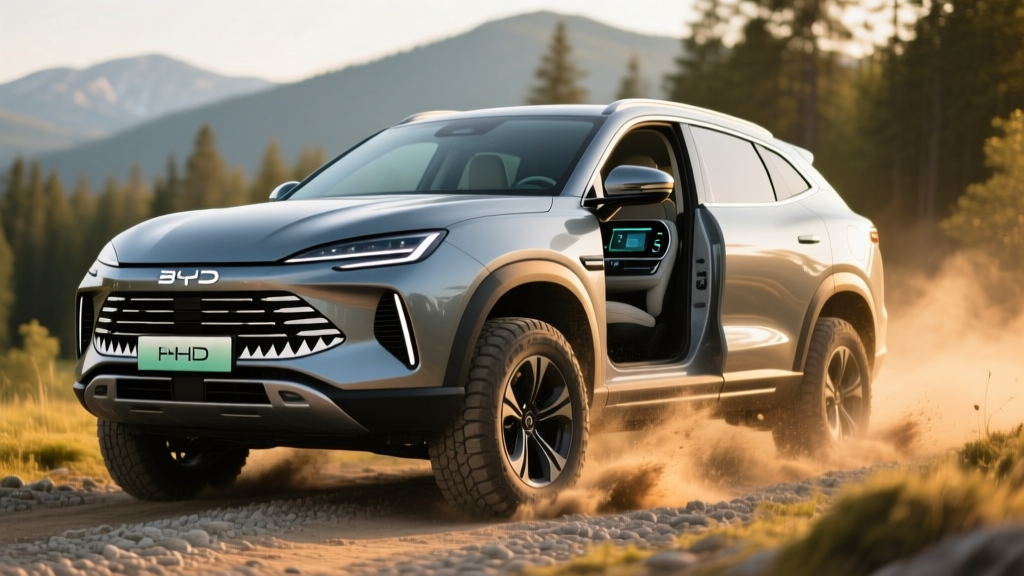
The BYD Shark 6 is a midsize plug-in hybrid pickup that pairs a 1.5-liter turbocharged engine with a dual-motor all-wheel-drive system to deliver 476 horsepower and a claimed 62 miles of electric-only range. Built on BYD's DMO (Dual Mode Off-Road) platform, it targets buyers who want daily electric commuting with the fuel flexibility and towing capability of a traditional truck. For the US market, the Shark 6 represents BYD's most aggressive attempt to compete against the Ford Maverick Hybrid, Toyota Tacoma i-FORCE MAX, and the upcoming Ram 1500 Ramcharger EREV.
After spending time with the specs, analyzing the powertrain architecture, and comparing it against segment benchmarks, the Shark 6 emerges as a compelling but complicated proposition. Its electric-only range is class-leading for a PHEV truck. Its off-road hardware is legitimate. But federal tax credit eligibility, US dealer infrastructure, and real-world highway efficiency remain the questions that will determine whether this truck earns a spot in American driveways.
Range, Battery, and Real-World Efficiency
The BYD Shark 6 carries a 29.58 kWh lithium iron phosphate (LFP) Blade Battery pack — the same cell chemistry BYD uses across its passenger EV lineup. LFP chemistry trades some energy density for superior thermal stability, longer cycle life, and no cobalt or nickel in the cathode. For a truck that may see rough use, the durability advantage matters.
Real-World Expectation: Expect 48–55 miles in mixed city/highway driving at moderate temperatures. Highway-only driving at 70+ mph reduces electric range to approximately 38–44 miles. In freezing conditions (below 32°F), plan for 30–35% range loss, dropping usable electric range to roughly 35–42 miles. The LFP chemistry handles cold somewhat better than NMC at low state-of-charge, but physics still governs — cold batteries resist accepting and delivering energy.
When the gasoline engine engages, BYD claims a combined fuel consumption figure of approximately 6.7 L/100km (roughly 35 MPG combined) in charge-sustaining mode — meaning the battery is depleted and the engine does all the work. For a 5,000+ lb truck with 476 hp, that is genuinely efficient. The Ford Maverick Hybrid returns 37 MPG combined but offers only FWD and 191 hp. The Toyota Tacoma i-FORCE MAX hybrid achieves 23–25 MPG combined with 326 hp. The Shark 6 occupies a middle ground: far more powerful and capable than the Maverick, far more efficient than the Tacoma hybrid.
Total combined range (electric + gasoline) exceeds 500 miles with a full tank and full battery, eliminating range anxiety entirely for road trips.
| Spec | Value |
|---|---|
| Powertrain | 1.5L Turbo I4 + Dual Electric Motors (PHEV) |
| Drivetrain | AWD (electric rear axle) |
| System Output | 476 hp / 479 lb-ft torque |
| 0–60 mph | 5.7 seconds |
| Battery Capacity | 29.58 kWh (LFP Blade) |
| Electric-Only Range | 62 mi (est. EPA) |
| Charge-Sustaining MPG | ~35 MPG combined (est.) |
| Total Range | 500+ mi |
| Towing Capacity | 5,511 lbs (2,500 kg) |
| Payload | 1,764 lbs (800 kg) |
| Bed Length | ~59 in (1,500 mm) |
| Ground Clearance | ~9.1 in (230 mm) |
Charging Speed: DC Fast Charge and Home Level 2
PHEV charging is often an afterthought in marketing materials, but for owners who want to maximize electric-only driving, it's the difference between a truck that runs on electrons and one that defaults to gasoline.
| Charging Level | Power / Rate | Time (10–80%) | Notes |
|---|---|---|---|
| Level 1 (120V) | ~1.4 kW | ~14–16 hours | Standard household outlet; adds ~4 mi/hr |
| Level 2 (240V) | ~6.6 kW | ~3.5–4 hours | Home wallbox or public L2; adds ~18 mi/hr |
| DC Fast Charge | Up to ~55 kW peak | ~25–30 min (10–80%) | CCS connector; curve tapers significantly above 80% |
The 55 kW DC fast-charge peak is modest compared to full BEVs (which routinely hit 150–350 kW), but for a 29.58 kWh battery, it represents a C-rate of roughly 1.86C — meaning the battery can accept nearly twice its capacity per hour at peak. In practice, you'll see peak rates only between roughly 15% and 55% state-of-charge. Above 80%, the charge rate drops to protect the LFP cells, and topping from 80–100% can add another 20+ minutes.
For most Shark 6 owners, Level 2 home charging is the daily workflow. Plug in overnight, wake up to a full 62-mile electric buffer, and commute without the engine ever firing. A 6.6 kW home charger fully replenishes the battery in under 4 hours — easily achievable during a work-from-home day or overnight.
Home installation note: A 240V / 32A circuit (40A breaker) is required for full 6.6 kW Level 2 charging. Expect $800–$2,000 for professional installation depending on panel proximity and local permit costs. If your electrical panel is at capacity, a panel upgrade ($1,500–$3,000) may be necessary. Always consult a licensed electrician for final specifications.
Performance and Drivetrain
The Shark 6's DMO platform uses a front-mounted 1.5L turbocharged four-cylinder engine paired with an integrated front electric motor, plus a dedicated rear electric motor that provides all-wheel-drive without a mechanical driveshaft. This "electric rear axle" approach is increasingly common in PHEVs and offers precise torque vectoring to the rear wheels.
System output totals 476 horsepower and 479 lb-ft of torque, launching the Shark 6 from 0–60 mph in an estimated 5.7 seconds. That places it firmly in performance-truck territory — quicker than a Toyota Tacoma TRD Pro and comparable to a Ford F-150 Lightning in everyday acceleration feel, though the Lightning's 3.8-second 0–60 remains in a different league.
Off-road, the electric rear axle provides instant torque to the rear wheels without waiting for a transmission to downshift or a transfer case to engage. BYD equips the Shark 6 with multiple terrain modes (sand, mud, snow, rock), hill descent control, and a wading depth rating of approximately 31.5 inches (800 mm). Ground clearance of roughly 9.1 inches and approach/departure angles suitable for moderate trail use make this a credible off-roader — not a Jeep Wrangler rival, but capable enough for forest service roads and campground access.
Interior, Cargo, and Technology
Inside, the Shark 6 features a 12.8-inch rotating center touchscreen (a BYD signature — the display pivots between portrait and landscape orientation), a 10.25-inch digital instrument cluster, and a head-up display. The infotainment system runs BYD's DiLink platform with wireless Apple CarPlay and Android Auto, over-the-air updates, and voice control.
Driver-assistance features include adaptive cruise control, lane-keeping assist, automatic emergency braking, blind-spot monitoring, and a 360-degree camera system. These constitute an SAE Level 2 driver-assist system — the driver must remain engaged and hands on the wheel at all times. This is not autonomous driving.
Cargo and passenger space:
- Bed length: ~59 inches (shorter than some midsize rivals — the Tacoma offers a 60-inch short bed and 73-inch long bed)
- Rear-seat legroom: ~37.4 inches (competitive with Tacoma and Colorado)
- Bed payload: 1,764 lbs
- Towing capacity: 5,511 lbs — sufficient for a small boat, utility trailer, or pair of ATVs, but below the Tacoma's 6,800-lb max and far below full-size trucks
- Frunk: None — the engine bay is fully occupied by the 1.5L turbo and front motor
The bed is the Shark 6's most obvious compromise. At 59 inches, it's adequate for gear and home-improvement runs but short for lumber or large cargo. BYD does not currently offer a long-bed variant.
Pricing, Trims, and Federal Tax Credit
International pricing for the BYD Shark 6 starts at approximately $38,000–$42,000 USD equivalent in markets like Australia and Mexico, where it launched in 2024–2025. US pricing has not been officially confirmed at publication time, but industry estimates place the base MSRP between $42,000 and $48,000 once import costs, compliance modifications, and dealer margins are factored in.
| Trim | Est. Base MSRP | §30D Credit (if eligible) | Effective Price |
|---|---|---|---|
| Base (estimated) | $42,000–$45,000 | Up to $7,500 | $34,500–$37,500 |
| Premium / Off-Road (estimated) | $48,000–$52,000 | Up to $7,500 | $40,500–$44,500 |
Federal tax credit eligibility (§30D): The Shark 6's eligibility for the up-to-$7,500 federal tax credit under IRS §30D rules depends on several factors that are critical to verify at time of purchase:
- MSRP cap: Pickup trucks must have an MSRP at or below $80,000 — the Shark 6 easily clears this threshold.
- Buyer income cap: Adjusted gross income must not exceed $150,000 (single), $225,000 (head of household), or $300,000 (joint filers).
- Battery sourcing: A percentage of critical minerals and battery components must be sourced from the US or free-trade-agreement countries. BYD's vertical integration and Chinese supply chain make this the biggest question mark — as of current rules, vehicles with battery components from a "foreign entity of concern" (FEOC) are disqualified.
- Assembly: Final assembly must occur in North America. BYD's current Shark 6 production is in China, which would disqualify it from §30D unless BYD establishes a North American assembly facility.
- Point-of-sale transfer: Eligible buyers can transfer the credit to the dealer at purchase for an immediate price reduction, rather than waiting for tax filing.
Bottom line on the credit: Given BYD's Chinese manufacturing and supply chain, the Shark 6 is unlikely to qualify for the §30D credit in its current form. BYD would need to establish North American production and restructure battery sourcing to meet FEOC requirements. Always verify eligibility on fueleconomy.gov and consult a tax professional before making a purchase decision based on credit assumptions.
Warranty and Ownership Costs
BYD offers the following warranty coverage in international markets (US-specific terms may vary upon official launch):
- Vehicle limited warranty: 6 years / 150,000 km (~93,000 miles)
- Battery pack warranty: 8 years / 160,000 km (~100,000 miles) with a capacity retention threshold of 70%
- Powertrain warranty: 6 years / 150,000 km
The LFP Blade Battery is one of the most durable chemistries available, with cycle-life testing suggesting 3,000+ full charge-discharge cycles before reaching 80% capacity — equivalent to roughly 186,000 miles of electric-only driving. In practice, PHEV batteries experience shallower cycles (you rarely drain from 100% to 0%), which extends real-world longevity further. Battery degradation to 85–90% capacity after 100,000 miles is a reasonable expectation based on LFP fleet data.
Insurance costs for the Shark 6 are difficult to project without US actuarial data, but PHEV pickups typically carry premiums 10–20% higher than their ICE equivalents due to higher repair costs for battery and power-electronics components.
Pros, Cons, and Competition
Pros
- 62-mile electric range is best-in-class for a PHEV truck
- 476 hp and 5.7-second 0–60 provide genuine performance
- LFP Blade Battery offers superior longevity and thermal safety
- Legitimate off-road capability with electric rear axle
- 500+ mile total range eliminates refueling anxiety
- Rotating 12.8-inch screen and modern tech suite
Cons
- Short 59-inch bed limits utility vs. Tacoma/Colorado
- 5,511-lb towing is below midsize truck leaders
- Unlikely to qualify for §30D federal tax credit at launch
- US dealer and service network is unproven
- 55 kW DC fast charge is slow vs. full BEVs
- No frunk — engine bay is fully occupied
Key competitors:
- Ford Maverick Hybrid: 37 MPG combined, 191 hp, FWD only, $28,000 base — cheaper and more efficient but far less capable
- Toyota Tacoma i-FORCE MAX: 326 hp, ~24 MPG, 6,800-lb towing — more truck, less efficiency
- Chevrolet Colorado ZR2: 310 hp turbo, 37 MPG hwy (diesel option), serious off-road hardware — no plug-in capability
- Ram 1500 Ramcharger (EREV, upcoming): Series-hybrid with 130-mile electric range and onboard generator — larger, more expensive, not yet available
Who Should Buy the BYD Shark 6?
The BYD Shark 6 is best suited for:
- Commuters with short-to-medium drives (under 60 miles round-trip) who can charge at home and run almost entirely on electricity during the week, then use gasoline for weekend trips without range concern.
- Light-duty truck buyers who need a bed for occasional hauling but prioritize daily efficiency over maximum towing or payload.
- Off-road enthusiasts who want electric torque delivery on trails with the fuel flexibility to reach remote trailheads.
It is not ideal for:
- Heavy tow-ers (over 5,500 lbs regularly) — look at the Tacoma or a full-size truck
- Buyers who need a long bed for lumber, motorcycles, or large cargo
- Those who require guaranteed federal tax credit eligibility — verify at purchase time
- Owners in areas without BYD service infrastructure
Frequently Asked Questions
What is the real-world range of the BYD Shark 6?
In electric-only mode, expect 48–55 miles in mixed driving, dropping to 38–44 miles at sustained highway speeds. In charge-sustaining (hybrid) mode, expect approximately 35 MPG combined, giving a total range exceeding 500 miles with a full tank and battery.
How fast does the BYD Shark 6 charge?
On a DC fast charger, the Shark 6 peaks at approximately 55 kW, reaching 10–80% in roughly 25–30 minutes. On a Level 2 home charger (6.6 kW), a full charge takes about 3.5–4 hours. On a standard 120V outlet, expect 14–16 hours for a full charge.
Does the BYD Shark 6 qualify for the federal EV tax credit?
Under current IRS §30D rules, the Shark 6 is unlikely to qualify because final assembly occurs in China and BYD's battery supply chain involves FEOC-sourced components. The MSRP cap ($80,000 for trucks) and buyer income limits are not barriers, but assembly and sourcing rules are. Always verify on fueleconomy.gov before purchasing.
Is the BYD Shark 6 worth buying over a Ford Maverick Hybrid?
They serve different buyers. The Maverick Hybrid is far cheaper (~$28,000), more fuel-efficient (37 MPG), and widely available with established US dealer support. The Shark 6 offers dramatically more power (476 hp vs. 191 hp), AWD, off-road capability, and 62 miles of electric-only range — but at a higher price and with uncertain US infrastructure. If you need a simple, efficient commuter truck, the Maverick wins. If you want a performance PHEV with trail capability, the Shark 6 is the more compelling vehicle.
What is the LFP Blade Battery and why does it matter?
LFP (lithium iron phosphate) is a battery chemistry that uses no cobalt or nickel, offers superior thermal stability (resistant to thermal runaway), and delivers 3,000+ charge cycles — roughly double the cycle life of typical NMC batteries. The trade-off is lower energy density, meaning a heavier pack for the same kWh. In a truck application where weight is less critical than in a sedan, LFP's longevity and safety advantages are a strong fit.
Can the BYD Shark 6 tow a boat or trailer?
Yes, within limits. The 5,511-lb towing capacity handles a small boat (16–18 ft), a utility trailer, or a pair of ATVs. For larger boats, campers, or horse trailers, you'll need a full-size truck. Note that towing significantly reduces both electric range and fuel efficiency — expect charge-sustaining MPG to drop to 18–22 MPG when towing near max capacity.