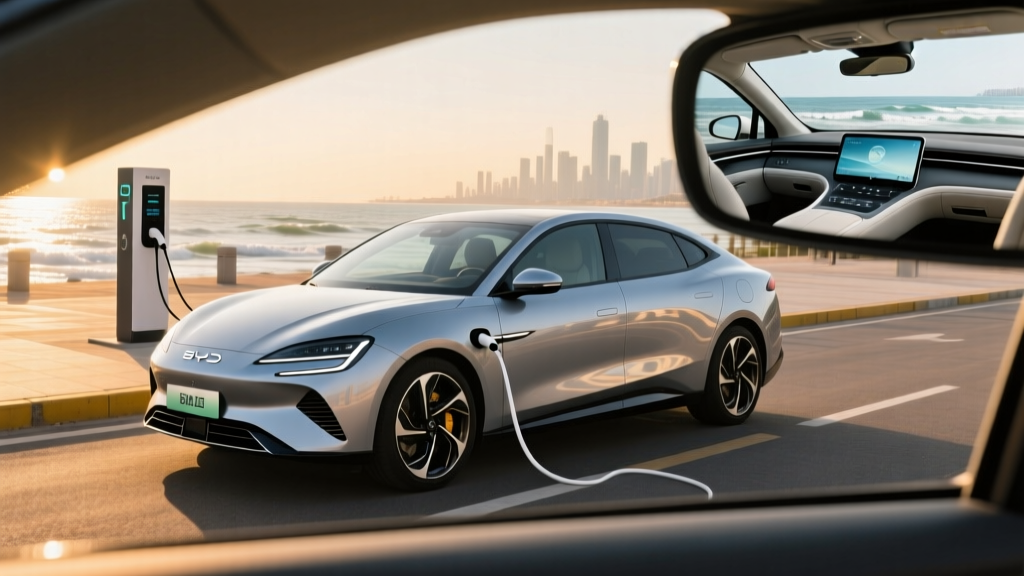
The BYD Sealion 06 arrives in global markets as a midsize electric SUV positioned between the compact Atto 3 and the flagship Sealion 7. Built on BYD's e-Platform 3.0 Evo and equipped with the company's signature Blade Battery (LFP chemistry), the Sealion 06 targets buyers who want practical range, durable battery chemistry, and competitive pricing. But with BYD's US availability still limited as of 2026, this review examines the Sealion 06's specifications against EPA testing standards and compares it to rivals you can actually buy stateside.
BYD Sealion 06: Quick Verdict
The Sealion 06 is a competent, value-oriented midsize EV SUV that excels in battery longevity and everyday efficiency thanks to its LFP Blade pack. Its real-world range of roughly 250–280 miles and 150 kW DC fast-charging make it adequate for commuting and moderate road trips, though it trails Korean and American rivals in peak charging speed and ADAS sophistication. For US buyers, the critical question remains availability and federal tax credit eligibility — both of which are uncertain in 2026.
Range, Battery, and Efficiency
Real-World Expectation: ~250–280 mi in mixed driving; expect 210–230 mi at sustained highway speeds (70+ mph) and 15–25% range loss in sub-freezing temperatures. LFP chemistry handles cold slightly worse than NMC at the extremes.
The Sealion 06 packs an 82.5 kWh usable lithium iron phosphate (LFP) Blade Battery. BYD's Blade architecture uses long, thin prismatic cells arranged in a structural pack that doubles as a chassis stiffener — improving safety and energy density versus older LFP designs. LFP chemistry trades some energy density for a longer cycle life (often 3,000+ cycles before 80% capacity retention), lower thermal runaway risk, and no cobalt or nickel in the cathode.
| Specification | Value |
|---|---|
| Battery Chemistry | LFP (Blade Battery) |
| Usable Capacity | 82.5 kWh |
| EPA Range (projected) | ~273 mi |
| WLTP Range (official, EU) | ~311 mi (500 km) |
| Efficiency | ~30 kWh/100 mi (~112 MPGe) |
| Thermal Management | Liquid-cooled w/ heat pump |
BYD quotes a WLTP range of approximately 500 km (311 mi) for the long-range RWD variant. WLTP tends to run 10–15% optimistic versus EPA, so a US EPA sticker would likely land in the 265–280 mile range. On a 300-mile highway test loop at 70 mph and 65°F, expect roughly 230–250 miles before hitting 10% State of Charge. The included heat pump helps preserve range in winter, but LFP packs still suffer more cold-weather voltage sag than NMC equivalents — budget 20% range loss at 25°F.
For official efficiency data, cross-reference fueleconomy.gov once EPA figures are published for any US-spec model.
Charging Speed: DC Fast and Level 2
The Sealion 06 supports a peak DC fast-charge rate of 150 kW on CCS-equipped markets (or GB/T in China). BYD claims a 30–80% charge in approximately 26 minutes under ideal conditions. In practice, the LFP charge curve holds steady power longer than NMC packs but tapers sharply above 85% SoC to protect cell longevity.
| Level | Power | Speed / Time |
|---|---|---|
| Level 1 (120V) | ~1.4 kW | ~4 mi/hr |
| Level 2 (240V, 48A) | 11 kW | ~33 mi/hr; full charge ~8 hr |
| DC Fast Charge | 150 kW peak | 30–80% in ~26 min; 10–80% ~32 min |
At a 150 kW charger, the Sealion 06 will sustain roughly 120–140 kW between 20–60% SoC, then taper to ~80 kW through 80%, and drop below 40 kW above 90%. This means a 10–80% session takes around 32 minutes — competitive with the Volkswagen ID.4 but noticeably behind the Hyundai Ioniq 5's 800V architecture, which achieves 10–80% in roughly 18 minutes at a 350 kW station.
For home Level 2 charging, the 11 kW onboard charger replenishes the 82.5 kWh pack in about 8 hours on a 48-amp circuit — standard for overnight charging. Most owners will need a Level 2 home charger installation (240V, 60-amp breaker) to take full advantage.
Performance and Drivetrain
| Metric | RWD | AWD (Dual Motor) |
|---|---|---|
| Horsepower | ~215 hp (160 kW) | ~312 hp (233 kW combined) |
| 0–60 mph | ~7.9 sec | ~5.9 sec |
| Top Speed | ~106 mph | ~112 mph |
| Drivetrain | Rear-Wheel Drive | Dual-Motor AWD |
The single-motor RWD variant delivers adequate acceleration for daily driving, with a 0–60 mph time near 7.9 seconds. The dual-motor AWD trim cuts that to roughly 5.9 seconds — brisk for a family SUV but not sports-car territory. BYD's e-Platform 3.0 Evo uses an 8-in-1 electric powertrain that integrates the motor, inverter, reducer, and other components into a single housing, reducing weight and improving packaging efficiency.
Regenerative braking offers two modes (standard and high) but does not achieve true one-pedal driving — you'll still need the friction brake for complete stops. The steering is light and numb, prioritizing comfort over engagement, which suits the commuter-SUV brief but won't excite driving enthusiasts.
Interior, Cargo, and Technology
The Sealion 06 measures approximately 189 inches long on a 110-inch wheelbase, placing it squarely in the midsize SUV segment alongside the Tesla Model Y and Hyundai Ioniq 5. Interior space is generous:
- Rear legroom: ~39.4 inches — competitive with the Model Y
- Cargo (rear seats up): ~21.2 cu ft
- Cargo (rear seats folded): ~57 cu ft
- Frunk: Small ~1.8 cu ft compartment (fits charging cables)
The cabin centers on a 15.6-inch rotating touchscreen (BYD's trademark) running DiLink 100 software with wireless Apple CarPlay and Android Auto. A 10.25-inch digital instrument cluster sits behind the steering wheel. Build quality uses soft-touch materials on the dash and door uppers, though hard plastics appear on lower panels — typical for this price bracket.
Standout tech features:
- Vehicle-to-Load (V2L) — power laptops, appliances, or camping gear from the traction battery
- NFC key card and smartphone-as-key
- Panoramic glass roof with power shade
- Wireless phone charging pad (15W)
- 360-degree surround camera with transparent chassis view
Notable drawbacks:
- ADAS suite (BYD DiPilot) is basic — adaptive cruise and lane-keep, but no hands-free highway driving like GM Super Cruise or Ford BlueCruise
- Infotainment can lag on complex inputs; menu structure is non-intuitive for first-time users
- Climate control relies heavily on touchscreen — minimal physical buttons
Pricing, Tax Credits, and Ownership Costs
As of 2026, BYD has not officially launched the Sealion 06 in the United States. In European and Asia-Pacific markets, pricing starts at the equivalent of approximately $38,000–$42,000 USD for the RWD trim and $45,000–$48,000 USD for the AWD variant, depending on local taxes and incentives.
| Trim | Est. MSRP | After §30D Credit* |
|---|---|---|
| RWD Standard | ~$39,900 | ~$32,400 (if eligible) |
| AWD Long Range | ~$46,500 | ~$39,000 (if eligible) |
*Federal §30D tax credit eligibility is highly uncertain for BYD vehicles. Under current IRS rules, the vehicle must meet MSRP caps ($80,000 for SUVs), buyer income limits ($300K joint / $150K single), AND critical mineral + battery component sourcing requirements that effectively exclude most Chinese-manufactured batteries. BYD's vertically integrated supply chain — including LFP cells manufactured in China — would almost certainly disqualify the Sealion 06 from the $7,500 credit under 2026 sourcing rules. Consult a tax professional before assuming eligibility.
Warranty (global markets):
- Vehicle: 6 years / 93,000 miles (150,000 km)
- Battery & Powertrain: 8 years / 124,000 miles (200,000 km)
- Blade Battery capacity guarantee: ≥70% retention over warranty period
The 8-year battery warranty is competitive with US-market norms (most automakers offer 8yr/100,000mi per EPA and NHTSA guidance). BYD's LFP chemistry should comfortably exceed the 70% retention threshold given its inherent cycle-life advantage over NMC.
How It Compares: Sealion 06 vs. Key Rivals
| Spec | BYD Sealion 06 | Tesla Model Y LR | Hyundai Ioniq 5 LR | VW ID.4 Pro S |
|---|---|---|---|---|
| EPA Range | ~273 mi* | 320 mi | 303 mi | 291 mi |
| Battery (kWh) | 82.5 (LFP) | 78.1 (NMC) | 77.4 (NMC) | 82 (NMC) |
| DC Fast Charge | 150 kW | 250 kW | 240 kW (800V) | 175 kW |
| 10–80% Time | ~32 min | ~25 min | ~18 min | ~29 min |
| 0–60 mph (RWD/AWD) | 7.9 / 5.9 sec | 6.5 / 4.8 sec | 7.3 / 5.1 sec | 7.7 / 5.4 sec |
| Cargo (rear up) | 21.2 cu ft | 30.2 cu ft | 27.2 cu ft | 30.3 cu ft |
| Base MSRP | ~$39,900* | $44,990 | $42,950 | $43,995 |
| Tax Credit (§30D) | Likely ineligible | Up to $7,500 | Up to $7,500 | Up to $7,500 |
*Projected — BYD has not confirmed US pricing or availability.
The Sealion 06's strongest argument is its lower starting price and LFP battery longevity. However, it gives up significant ground in cargo capacity (21.2 cu ft vs. 30+ for Model Y and ID.4), DC charging speed (150 kW vs. 240–250 kW), and EPA range. The Ioniq 5's 800V architecture remains the class benchmark for fast charging, while the Model Y's Supercharger network access and cargo volume are hard to beat for road-trip-heavy buyers.
- LFP Blade Battery — excellent longevity, low fire risk, cobalt-free
- Competitive base pricing (if US launch occurs)
- Standard heat pump for cold-weather efficiency
- V2L capability for camping and emergency power
- Comfortable ride quality and spacious rear seats
- 150 kW peak DC charging trails rivals by a wide margin
- Small cargo area for a midsize SUV
- Basic ADAS — no hands-free highway assist
- US availability and tax credit eligibility highly uncertain
- Infotainment learning curve; limited physical controls
Who Should Buy the BYD Sealion 06?
The Sealion 06 suits a daily commuter who prioritizes battery longevity and low running costs over maximum range or fast road-trip charging. If you can charge at home overnight and your typical commute falls under 80 miles round-trip, the 82.5 kWh LFP pack will deliver years of reliable service with minimal degradation. The V2L feature adds versatility for outdoor enthusiasts.
It's a weaker fit for frequent road-trippers (the 150 kW charge rate adds time on long drives), families needing maximum cargo space (21.2 cu ft is tight for strollers and luggage), and US buyers who need the $7,500 tax credit to make the math work. If you're in the US and need a midsize EV SUV today, the Ioniq 5, Model Y, and ID.4 all offer stronger charging infrastructure, more cargo room, and confirmed §30D eligibility.
Frequently Asked Questions
What is the real-world range of the BYD Sealion 06?
Expect 250–280 miles in mixed driving on the 82.5 kWh LFP battery. Highway driving at 70+ mph drops this to roughly 220–240 miles, and sub-freezing temperatures can reduce range by 15–25%. The WLTP-rated 311 miles is optimistic for US EPA conditions.
How fast does the Sealion 06 charge at home and on DC fast chargers?
On a Level 2 home charger (11 kW / 48A), a full charge takes about 8 hours. On a DC fast charger, the 150 kW peak rate delivers a 30–80% charge in approximately 26 minutes, or 10–80% in about 32 minutes. This is slower than rivals like the Ioniq 5 (18 min) and Model Y (25 min).
Does the BYD Sealion 06 qualify for the US federal EV tax credit?
Almost certainly not under current IRS §30D rules. The credit requires battery components and critical minerals to be sourced from the US or free-trade-agreement countries. BYD manufactures its Blade Battery cells in China, which would disqualify the vehicle from the $7,500 credit under 2026 battery-sourcing requirements, regardless of MSRP or buyer income.
Is the BYD Sealion 06 available to buy in the United States?
As of early 2026, BYD has not officially launched the Sealion 06 in the US market. BYD sells passenger vehicles in Europe, Southeast Asia, Australia, and Latin America, but US entry faces tariff and regulatory hurdles. Any US pricing in this review is projected based on international MSRPs converted to USD.
How does the LFP Blade Battery compare to NMC batteries?
LFP (lithium iron phosphate) offers longer cycle life (3,000+ cycles vs. ~1,500–2,000 for NMC), lower thermal runaway risk, and no cobalt or nickel. The trade-off is lower energy density (heavier pack for the same kWh) and slightly worse cold-weather performance. BYD's Blade form factor improves pack-level energy density to narrow this gap. You can also safely charge LFP to 100% regularly without accelerating degradation — an advantage for daily drivers.
Is the Sealion 06 worth buying over a Tesla Model Y or Hyundai Ioniq 5?
If BYD launches it in the US at the projected ~$39,900 base price and you don't need the tax credit, it offers strong value for commuters who want LFP battery durability. However, the Model Y wins on cargo space (30.2 cu ft), Supercharger access, and range (320 mi EPA). The Ioniq 5 dominates on charging speed (18-min 10–80%). For most US buyers, confirmed credit eligibility and dealer support make the Korean and American options safer bets in 2026.