Quick Verdict: A Premium Cabin With Caveats for US Buyers
BYD's Seal sedan has drawn global attention for blending European-style design with aggressive pricing, and the conversation often centers on one phrase: BYD luxury interior. The 2026 Seal delivers quilted Nappa leather, a rotating 15.6-inch infotainment display, crystal gear selector, and ambient lighting that punches well above its price class. But for US-based shoppers, the picture is complicated. As of early 2026, BYD has not officially launched the Seal in the United States, meaning no EPA certification, no US dealer network, and no confirmed federal tax credit pathway. This review evaluates the Seal's premium cabin, global-spec engineering, and what US buyers should know before considering a gray-market import or waiting for a potential stateside debut.
Spec Table: 2026 BYD Seal at a Glance
| Attribute | Seal Design (RWD) | Seal Excellence (AWD) |
|---|---|---|
| Battery Capacity | 82.5 kWh usable (LFP Blade) | 82.5 kWh usable (LFP Blade) |
| Est. EPA Range | ~320–340 mi (WLTP 354 mi) | ~295–310 mi (WLTP 323 mi) |
| Max DC Fast Charge | 150 kW peak | 150 kW peak |
| 10–80% DCFC Time | ~26 minutes | ~26 minutes |
| Level 2 AC Charge | 11 kW (~37 mi/hr) | 11 kW (~37 mi/hr) |
| 0–60 mph | 5.9 sec | 3.8 sec |
| Horsepower | 308 hp | 523 hp |
| Drivetrain | RWD (single motor) | AWD (dual motor) |
| MPGe (est.) | ~110 MPGe combined | ~98 MPGe combined |
| Cargo Volume | 14.1 cu ft trunk + 1.8 cu ft frunk | 14.1 cu ft trunk + 1.8 cu ft frunk |
| Rear Legroom | 36.6 inches | 36.6 inches |
| Battery Warranty (Global) | 8 yr / 100,000 mi (varies by market) | 8 yr / 100,000 mi |
| Global MSRP (EU equiv.) | ~€45,000 (~$48,500) | ~€50,000 (~$54,000) |
Sources: BYD Global Seal specs, fueleconomy.gov (EPA methodology reference). US pricing and EPA figures are estimates pending official certification.
The BYD Luxury Interior: What You Actually Get
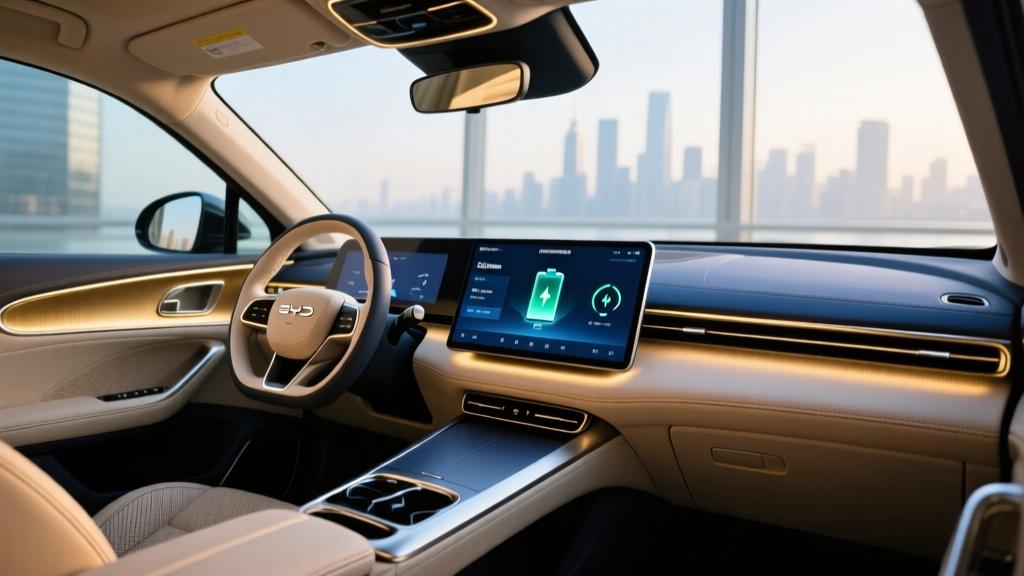
The cabin is where BYD makes its strongest case against established premium sedans like the Tesla Model 3, BMW i4, and Hyundai Ioniq 6. Step inside the 2026 Seal and the material quality is immediately apparent:
- Nappa leather upholstery with diamond-quilted stitching on seat bolsters and door panels
- Heated and ventilated front seats with 8-way power adjustment and memory settings
- 15.6-inch rotating touchscreen that toggles between portrait and landscape orientation — a BYD signature feature
- 10.25-inch digital instrument cluster behind a flat-bottom, leather-wrapped steering wheel
- Crystal gear selector with a minimalist center console layout
- 12-speaker Dynaudio sound system on Excellence trims
- 128-color ambient lighting integrated into door panels and dashboard trim
- Panoramic glass roof with UV and heat rejection coating
The fit and finish rival vehicles costing $15,000–$20,000 more. Soft-touch materials cover the upper dashboard, door uppers, and center console sides. The headliner is a suede-like Alcantara substitute that adds tactile warmth. However, the BYD luxury interior isn't flawless: the gloss-black center console attracts fingerprints aggressively, and the rotary drive selector takes adjustment if you're coming from a traditional shifter.
Infotainment and Driver Assistance
BYD's DiLink 100 infotainment system runs on a Qualcomm Snapdragon processor and supports wireless Apple CarPlay and Android Auto. The system is responsive, though the icon-heavy menu structure requires more taps than Tesla's minimalist approach or Hyundai's tile-based layout. Over-the-air updates are supported.
Driver assistance is provided by BYD's DiPilot suite, which includes adaptive cruise control, lane-keeping assist, automatic emergency braking, blind-spot monitoring, and rear cross-traffic alert. This is a SAE Level 2 system — the driver must remain fully engaged with hands on the wheel and eyes on the road. It is not autonomous driving, and BYD does not market it as such.
Range, Efficiency, and Real-World Expectations
The Seal's 82.5 kWh LFP (lithium iron phosphate) Blade battery pack is BYD's proprietary cell-to-body design, where cells are integrated directly into the chassis structure for improved rigidity and space efficiency. LFP chemistry offers excellent cycle life (3,000+ full cycles before significant degradation) and thermal stability, but it trades off energy density compared to NMC (nickel manganese cobalt) packs.
For the RWD Design trim, BYD's WLTP rating translates to an estimated EPA-equivalent range of 320–340 miles. Here's what to expect in practice:
- City driving (moderate speeds, regen-heavy): 330–350 miles achievable
- Highway driving (70–75 mph sustained): 260–290 miles
- Cold weather (below 32°F): 240–270 miles (LFP packs lose efficiency faster than NMC in freezing temps without preconditioning)
- Efficiency: Expect roughly 28–30 kWh/100 mi combined, translating to ~105–115 MPGe
The Seal does include a heat pump on all trims, which mitigates cold-weather range loss by roughly 10–15% compared to resistive cabin heating. Battery preconditioning for DC fast charging is available through the navigation system — route to a charger and the pack will warm to optimal temperature before you arrive.
Charging Speed: DC Fast and Home Level 2
The Seal's charging performance is adequate but not class-leading in 2026. Here's the breakdown:
| Charging Level | Power (kW) | Speed (mi/hr added) | Time |
|---|---|---|---|
| Level 1 (120V household) | 1.4 kW | ~4 mi/hr | ~60 hr (0–100%) |
| Level 2 (240V home/public) | 11 kW | ~37 mi/hr | ~9 hr (0–100%) |
| DC Fast Charge (CCS2/NACS) | 150 kW peak | ~250 mi/hr (peak) | ~26 min (10–80%) |
The 150 kW peak DC charge rate is the Seal's most notable limitation. Competitors like the Hyundai Ioniq 6 (peak 350 kW on 800V architecture) and Tesla Model 3 (peak 250 kW) charge significantly faster on capable stations. The Seal's charge curve peaks around 150 kW up to roughly 40% state of charge, then tapers to ~100 kW through 60%, and drops further to ~50 kW above 80%. This means a 10–80% session takes about 26 minutes on a 150+ kW charger — perfectly acceptable for a lunch stop, but you'll notice the gap on long road trips compared to 800V rivals.
For home charging, the 11 kW onboard charger is a bright spot. A fully installed Level 2 home charger on a 48-amp circuit will replenish the 82.5 kWh pack in roughly 9 hours, meaning a full overnight charge is easily achievable.
Pricing, Trims, and Federal Tax Credit Eligibility
Because BYD has not launched the Seal in the US market as of 2026, there is no official US MSRP. Global pricing provides a reference point:
| Trim | EU Price (approx.) | US Equivalent (est.) |
|---|---|---|
| Design (RWD) | €45,000 | ~$48,500 |
| Excellence (AWD) | €50,000 | ~$54,000 |
Does the BYD Seal Qualify for the Federal EV Tax Credit?
If BYD were to sell the Seal in the US, federal tax credit eligibility under IRS §30D would be highly unlikely for several reasons:
- Battery sourcing requirements: The §30D credit requires critical minerals and battery components to be sourced from the US or free-trade-agreement countries, with escalating percentages each year. BYD's vertically integrated Chinese supply chain would almost certainly fail the 2026 thresholds (80% critical minerals, 100% battery components from qualified sources).
- Foreign Entity of Concern (FEOC) exclusion: Vehicles with battery components manufactured or assembled by a FEOC (which includes many Chinese state-linked entities) are disqualified entirely from the credit as of 2024 onward.
- MSRP caps: Even if sourcing requirements were met, the Seal would need to fall under the $55,000 sedan cap — possible for the Design trim but tight for Excellence.
- Buyer income limits: AGI caps of $150K (single) / $300K (joint) would still apply.
Bottom line: US buyers should not expect a $7,500 credit on a BYD Seal. Consult IRS guidance on clean vehicle credits for current rules.
Pros and Cons
- Genuine luxury interior materials at a mid-price sedan cost
- LFP Blade battery with excellent cycle life and thermal safety
- Strong AWD performance (3.8 sec 0–60) on Excellence trim
- Generous rear legroom (36.6 in) and usable frunk
- Heat pump standard on all trims
- 11 kW Level 2 onboard charger for fast home replenishment
- Not available for US purchase as of 2026
- 150 kW DC fast-charge peak lags 800V competitors
- LFP range loss in cold weather exceeds NMC rivals
- No expected US federal tax credit eligibility
- DiLink infotainment menu structure is icon-heavy
- Gloss-black console trim is a fingerprint magnet
How It Compares: Seal vs. US-Market Rivals
Since the Seal isn't sold in the US, the practical question is what you'd be giving up by choosing an available alternative. Here's how the Seal's global specs stack up against sedans you can actually buy stateside:
| Spec | BYD Seal (RWD) | Tesla Model 3 LR | Hyundai Ioniq 6 SEL | BMW i4 eDrive40 |
|---|---|---|---|---|
| Est. EPA Range | ~330 mi | 341 mi | 361 mi | 307 mi |
| Battery | 82.5 kWh LFP | 75 kWh NMC | 77.4 kWh NMC | 81.5 kWh NMC |
| Peak DCFC | 150 kW | 250 kW | 350 kW | 205 kW |
| 0–60 mph | 5.9 sec | 4.9 sec | 6.2 sec | 5.5 sec |
| US MSRP | N/A | $47,740 | $42,715 | $57,900 |
| Tax Credit | Unlikely | Partial ($3,750) | Up to $7,500 | None (MSRP cap) |
The Seal's cabin materials arguably surpass the Model 3 and Ioniq 6, but both rivals offer faster charging, confirmed US availability, service networks, and tax credit potential. The BMW i4 matches the Seal on luxury but costs significantly more.
Who Should Consider the BYD Seal?
Wait for the Seal if: You prioritize interior luxury and material quality above charging speed, you live in a mild climate where LFP cold-weather loss is minimal, and you're willing to forgo the federal tax credit for a potentially lower base price (if BYD enters the US market).
Buy a US-market rival now if: You need reliable DC fast charging for road trips, you want federal or state incentive eligibility, you value an established dealer and service network, or you live in a cold-weather state where NMC chemistry performs better.
Frequently Asked Questions
Is the BYD Seal available for purchase in the United States?
No. As of early 2026, BYD has not launched the Seal or any passenger vehicle in the US market. BYD sells commercial vehicles and buses in the US, but consumer EVs are currently available only in Asia, Europe, Australia, and select other markets. Any US availability timeline remains speculative.
What is the real-world range of the BYD Seal?
Based on WLTP figures and typical EPA conversion factors, expect approximately 320–340 miles EPA-equivalent for the RWD Design trim. Real-world highway driving at sustained speeds yields roughly 260–290 miles, and cold-weather operation (below freezing) can reduce range to 240–270 miles due to LFP chemistry characteristics.
How fast does the BYD Seal charge?
The Seal peaks at 150 kW on DC fast chargers, achieving a 10–80% charge in approximately 26 minutes. On a Level 2 home charger (240V, 48A), the 11 kW onboard charger replenishes the pack in about 9 hours. This is slower than 800V competitors like the Ioniq 6 (350 kW peak, ~18 min 10–80%).
Does the BYD Seal qualify for the $7,500 federal EV tax credit?
Almost certainly not. Even if BYD launched the Seal in the US, the IRS §30D credit's battery-sourcing and FEOC (Foreign Entity of Concern) requirements would likely disqualify it due to BYD's Chinese-manufactured battery supply chain. The MSRP cap for sedans ($55,000) would also be a factor for higher trims.
Is the BYD Seal's interior really more luxurious than a Tesla Model 3?
On material quality — yes. The Seal uses Nappa leather, quilted stitching, suede-like headliner, and crystal trim elements that the Model 3's minimalist vegan-leather cabin doesn't match. However, Tesla's software integration, Supercharger network access, and over-the-air feature updates represent a different kind of premium experience that many buyers value equally.
What battery chemistry does the BYD Seal use?
The Seal uses BYD's proprietary LFP (lithium iron phosphate) Blade battery in a cell-to-body pack configuration. LFP offers superior cycle life (3,000+ cycles), excellent thermal stability (very low fire risk), and no cobalt. The trade-off is lower energy density than NMC and greater cold-weather range sensitivity.
Editorial note: This review is based on BYD's global specifications for the 2026 Seal as sold in European and Asian markets. US-specific EPA certification, pricing, and availability have not been confirmed by BYD. All US-equivalent estimates are approximations. For the latest information, consult BYD's global site and NHTSA.