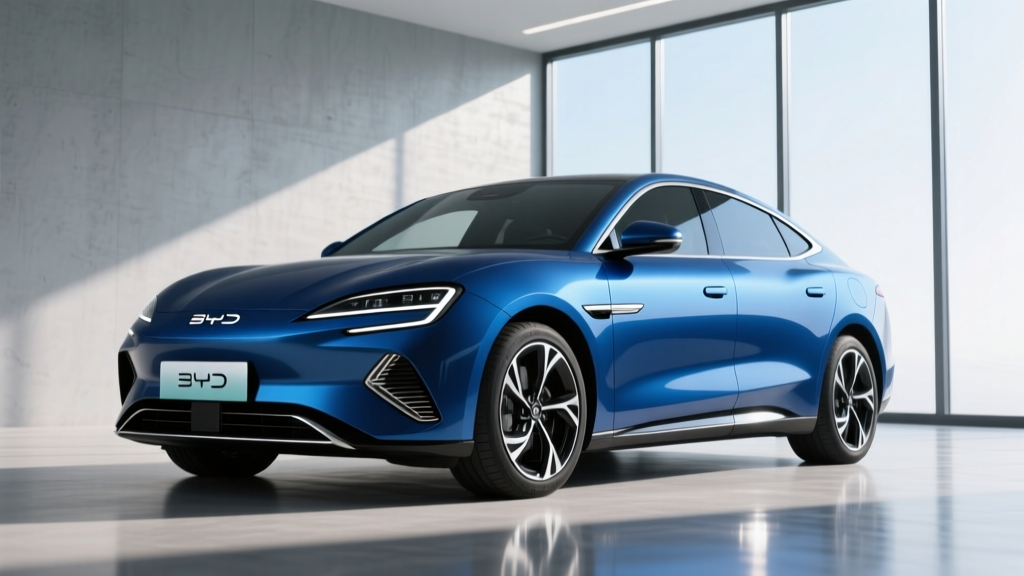
If you follow global EV sales, you have likely heard of the BYD Seal. Positioned as a direct rival to the Tesla Model 3, this midsize electric sedan has become one of the most talked-about vehicles in the global market. But for US-based shoppers searching for a Chinese Tesla competitor they can actually buy, the answer is more complicated than a simple spec sheet. In this review, we break down the 2026 BYD Seal's real-world range, charging performance, Blade Battery chemistry, pricing, and the critical question of whether you can drive one home in the United States.
Quick Verdict: A Legit Global Contender — With a US Catch
The BYD Seal is a genuinely competitive electric sedan on the world stage. It pairs a structural lithium iron phosphate (LFP) Blade Battery with strong efficiency, respectable DC fast-charging speeds, and a premium interior that challenges Tesla's minimalist approach. In markets like Europe, Australia, and Southeast Asia, it undercuts the Model 3 on price while matching or exceeding it in build quality and passenger space.
However, as of early 2026, BYD does not sell passenger vehicles in the United States. High US tariffs on Chinese-manufactured vehicles (currently 100% on EVs under Section 301 trade actions) make importing the Seal economically unviable. This review evaluates the Seal as it is sold globally and as it compares to US-available rivals, giving you the data to understand what you are missing — and what to buy instead.
BYD Seal 2026 Spec Overview
| Attribute | Specification |
|---|---|
| EPA-Est. Range (equivalent) | ~339 miles (WLTP); expect ~285-300 mi EPA if US-certified |
| Battery Capacity | 82.5 kWh usable |
| Battery Chemistry | LFP (BYD Blade Battery, cell-to-body structural pack) |
| Peak DC Fast Charge | 150 kW |
| 10-80% DC Charge Time | ~26 minutes |
| Level 2 AC Charge Rate | 11 kW (onboard charger) |
| Drivetrain | Dual-motor AWD |
| Horsepower | 523 hp (390 kW combined) |
| 0-60 mph | 3.8 seconds |
| Efficiency | ~110 MPGe (est.); ~30 kWh/100 mi |
| Cargo Volume | 14.1 cu ft (trunk) + 1.8 cu ft (frunk) |
| Rear Legroom | 36.6 inches |
| Battery Warranty (global) | 8 years / 100,000 miles (varies by market) |
| Base MSRP (Europe, approx.) | €48,000 (~$52,000 USD converted) |
Note: BYD does not publish EPA range figures because the Seal is not sold in the US. The WLTP range is 339 miles for the AWD Excellence trim and up to 374 miles for the RWD Design trim. EPA estimates are typically 10-15% lower than WLTP.
Real-World Range: What the Sticker Doesn't Tell You
WLTP Sticker: 339 miles (AWD) / 374 miles (RWD)
Estimated EPA Equivalent: ~285-300 miles (AWD) / ~320-340 miles (RWD)
Real-World Highway (70 mph): ~250-270 miles
Cold Weather (below 32°F): ~220-245 miles (est. 15-25% loss typical for LFP packs without heat pump optimization)
The BYD Seal's 82.5 kWh LFP Blade Battery is one of the largest in its class, and that capacity translates into genuinely usable range. In European road tests conducted by independent outlets, the AWD Excellence trim consistently delivered between 260 and 290 miles at highway speeds in moderate temperatures (60-75°F). That puts it in the same ballpark as a Tesla Model 3 Long Range AWD (EPA 341 miles) but slightly behind a Hyundai Ioniq 6 SE Long Range (EPA 361 miles).
The LFP chemistry matters here. LFP cells are less energy-dense than the NMC (nickel manganese cobalt) packs used in many long-range EVs, which is why BYD needed a physically larger battery to hit these numbers. But LFP offers significant advantages: longer cycle life (3,000+ charge cycles before meaningful degradation), better thermal stability, and no cobalt in the supply chain. BYD recommends you can charge the Blade Battery to 100% regularly without the accelerated degradation concerns that NMC owners face — a practical benefit for daily drivers who want full range every morning.
The Seal's cell-to-body (CTB) structural battery integration is also worth noting. By making the battery pack a load-bearing part of the chassis, BYD increases torsional rigidity to 40,500 N·m/deg — comparable to luxury sedans — while lowering the center of gravity. This contributes to the Seal's composed ride and handling, which multiple European reviewers have praised as more refined than the Model 3's firmer setup.
Charging Speed: 150 kW Peak, But the Curve Tells the Full Story
Charging speed is where the Seal reveals its most significant gap versus top competitors. The peak DC fast-charge rate is 150 kW, which is respectable but trails the Hyundai Ioniq 6 (up to 240 kW via its 800V architecture) and the Tesla Model 3 (up to 250 kW on V3 Superchargers).
| Charging Level | BYD Seal AWD | Tesla Model 3 LR AWD | Hyundai Ioniq 6 SE LR |
|---|---|---|---|
| DC Fast Charge (Peak kW) | 150 kW | 250 kW | 240 kW |
| 10-80% DC Time | ~26 min | ~15 min | ~18 min |
| Level 2 AC (kW) | 11 kW | 11.5 kW | 10.9 kW |
| Miles Added per Hour (L2) | ~38 mi/hr | ~44 mi/hr | ~42 mi/hr |
| Connector (Global) | CCS2 / GB/T | NACS (2025+) | CCS1 (NACS adapter avail.) |
Here is what 150 kW peak actually means in practice. The Seal sustains close to peak rate from roughly 10% to 40% State of Charge (SoC), then begins tapering. Between 40% and 60%, expect roughly 100-120 kW. Above 80%, the rate drops sharply to under 40 kW — standard behavior for LFP packs, which have a flatter voltage curve that makes the battery management system more conservative at high SoC. A typical 10-80% session takes about 26 minutes at a sufficiently powerful charger (180 kW+ stall).
For Level 2 home charging, the 11 kW onboard charger is competitive. On a 48-amp home charger (the most common Level 2 installation in the US), you would add roughly 38 miles of range per hour, or a full charge from empty in about 8.5 hours. That is perfectly adequate for overnight charging and matches what most buyers install.
The connector situation further complicates US availability. The Seal ships with CCS2 in Europe and GB/T in China. Neither is compatible with the US charging ecosystem, which has standardized on NACS (Tesla's connector) for 2025+ models, with CCS1 still available on older infrastructure. Adapting the Seal for the US would require a full charging-system redesign — another barrier to American sales.
Performance and Driving Dynamics
The AWD Excellence trim is the performance flagship, with dual motors producing 523 hp and a 3.8-second 0-60 mph time. That is quick by any measure — faster than a BMW 3 Series M340i and only a few tenths behind the Tesla Model 3 Performance (3.1 seconds). The RWD Design trim, with a single rear motor and 308 hp, does 0-60 in about 5.9 seconds, which is still brisk for daily driving.
Where the Seal distinguishes itself is ride quality. BYD has tuned the suspension for comfort over sportiness, with well-damped compliance over rough surfaces. The CTB battery structure contributes to a low, planted feel without the crashy ride quality that some Model 3 owners report on broken pavement. Steering is precise but light — this is a grand-touring sedan, not a track car, despite the horsepower figure.
Regenerative braking offers two modes (standard and high) rather than the aggressive one-pedal driving found in many competitors. You will still use the brake pedal regularly. Some drivers prefer this more natural feel; others expect the full one-pedal experience. BYD has not offered a true one-pedal mode as of the 2026 model year.
Interior, Tech, and Driver Assistance
Step inside the Seal and the contrast with Tesla is immediate. Where the Model 3 strips everything to a single 15.4-inch touchscreen, the Seal layers in materials and features: a 15.6-inch rotating center display (landscape or portrait), a 10.25-inch digital instrument cluster, a heads-up display, quilted leatherette seats, and ambient lighting with 128 colors. Build quality in European-market units has been consistently praised, with tight panel gaps and soft-touch materials throughout — an area where early Model 3s famously struggled.
The infotainment system runs BYD's DiLink software. It is feature-rich — wireless Apple CarPlay and Android Auto, built-in navigation, over-the-air updates, and a 12-speaker Dynaudio sound system on higher trims. However, the interface can feel cluttered compared to Tesla's streamlined UX, and some submenus require too many taps for simple adjustments like climate control.
Driver assistance is branded as DiPilot. It includes adaptive cruise control with stop-and-go, lane-centering assist, automatic emergency braking, blind-spot monitoring, and rear cross-traffic alert. Make no mistake: DiPilot is an SAE Level 2 driver-assist system, meaning the driver must remain fully engaged with hands on the wheel and eyes on the road at all times. It does not offer the hands-free capability of GM's Super Cruise or Ford's BlueCruise on mapped highways, and it is not comparable to Tesla's FSD (Supervised) in terms of route-planning automation. It is competent for highway cruising and traffic-jam assist, but nothing more.
Pricing, Tax Credits, and US Availability
This is where the Seal's story gets complicated for American buyers.
BYD does not sell passenger vehicles in the United States. The company has publicly stated it is evaluating US market entry but has made no firm commitments. Current US tariffs impose a 100% duty on Chinese-manufactured EVs under Section 301 trade actions, effectively doubling the vehicle's landed cost. Even if BYD began US sales, the Seal would likely price above $70,000 after tariffs — eliminating its core value proposition.
In markets where it is sold, the Seal's pricing is aggressive:
- Europe (Design RWD): €42,000 (~$45,500 USD)
- Europe (Excellence AWD): €48,000 (~$52,000 USD)
- Australia (Premium RWD): AUD $52,990 (~$34,500 USD)
- China (domestic): Starting at ¥189,800 (~$26,200 USD)
If the Seal were available in the US at its European-equivalent price (~$45,500-$52,000), it would fall under the IRS §30D clean vehicle credit MSRP cap of $55,000 for sedans. However, the credit's battery-sourcing requirements — which mandate that critical minerals and battery components come from the US or free-trade-agreement countries — would almost certainly disqualify a Chinese-manufactured BYD. The Seal's Blade Battery uses LFP cells manufactured in China with Chinese-sourced lithium and iron phosphate, failing both the critical-minerals and battery-component prongs of the §30D test.
Bottom line: even in a hypothetical US launch scenario, the Seal would almost certainly not qualify for the $7,500 federal tax credit, and buyer income caps ($150,000 single / $300,000 joint for modified AGI) would further limit eligibility. Always consult a tax professional and check the latest rules at irs.gov before making purchase decisions based on incentive estimates.
How It Compares to US-Available Alternatives
Since the Seal is not a realistic purchase for US buyers, here is how it stacks up against the sedans you can buy:
| Spec | BYD Seal AWD | Tesla Model 3 LR AWD | Hyundai Ioniq 6 SE LR AWD | BMW i4 xDrive40 |
|---|---|---|---|---|
| Est. EPA Range | ~290 mi | 341 mi | 316 mi | 282 mi |
| Battery (kWh / Chem.) | 82.5 / LFP | 75 / NMC | 77.4 / NMC | 81.5 / NMC |
| Peak DC Charge (kW) | 150 | 250 | 240 | 205 |
| 0-60 mph | 3.8 sec | 4.2 sec | 5.1 sec | 4.6 sec |
| Horsepower | 523 | 384 | 320 | 396 |
| US Base MSRP | N/A | $42,630 | $43,600 | $57,900 |
| Federal Tax Credit | Not eligible | Up to $7,500* | Up to $7,500* | Up to $7,500* |
| Battery Warranty | 8 yr / 100k mi | 8 yr / 120k mi | 10 yr / 100k mi | 8 yr / 80k mi |
*Federal tax credit eligibility depends on MSRP caps, buyer income limits, and battery-sourcing requirements. Verify current eligibility at fueleconomy.gov and consult a tax professional.
The Tesla Model 3 remains the benchmark for range, charging speed, and Supercharger-network access in the US. The Hyundai Ioniq 6 offers the best charging speed in the segment thanks to its 800V architecture and has the strongest warranty. The BMW i4 delivers luxury-badge prestige and driving dynamics at a significant price premium. The Seal would compete most directly with the Model 3 on interior quality and ride comfort, but its slower charging and LFP-related range trade-off would make it a tough sell at equivalent pricing.
Pros and Cons
- Excellent build quality and premium interior materials
- Structural Blade Battery (LFP) offers long cycle life and 100% SoC daily charging
- Strong performance: 523 hp, 3.8-sec 0-60 in AWD trim
- Comfortable, compliant ride quality superior to Model 3
- Generous rear-seat legroom (36.6 in) for the class
- Competitive pricing in international markets
- Rotating 15.6-inch center display with wireless CarPlay/Android Auto
- Not available in the United States
- 150 kW peak DC charging trails Model 3 (250 kW) and Ioniq 6 (240 kW)
- No true one-pedal driving mode
- Infotainment UI is feature-rich but cluttered
- DiPilot driver assist is basic Level 2 — no hands-free or advanced automation
- LFP battery is heavier, contributing to a ~4,564 lb curb weight
- No US service/parts network or warranty infrastructure
Who Should Consider the BYD Seal?
- Daily commuters who can charge at home and value ride comfort over maximum range
- Families who need generous rear-seat space and a large trunk for the class
- Tech-savvy buyers who want a premium interior with physical buttons and layered design rather than Tesla's minimalism
- LFP advocates who prioritize battery longevity and cobalt-free sourcing over energy density
- Road-trip warriors who need 300+ real-world highway miles and ultra-fast DC charging
- US buyers — the Seal simply is not available and likely will not be for years
- Hands-free driving enthusiasts — DiPilot does not match BlueCruise, Super Cruise, or FSD Supervised
Frequently Asked Questions
What is the real-world range of the BYD Seal?
The AWD Excellence trim delivers approximately 260-290 miles in real-world mixed driving at moderate temperatures, based on European road tests. Highway driving at sustained 70+ mph reduces this to roughly 250-270 miles. In cold weather (below freezing), expect 220-245 miles due to LFP chemistry characteristics and cabin-heating energy draw. The WLTP sticker figure is 339 miles, but real-world results consistently fall 15-25% below that.
How fast does the BYD Seal charge?
The Seal peaks at 150 kW on a DC fast charger, achieving a 10-80% charge in approximately 26 minutes. Charging tapers significantly above 80% SoC, so plan to unplug around 80% for the best time efficiency. On a Level 2 home charger (11 kW / 48 amps), you will add about 38 miles of range per hour, or fully recharge overnight in roughly 8.5 hours.
Can I buy the BYD Seal in the United States?
No. As of 2026, BYD does not sell passenger vehicles in the US market. A 100% tariff on Chinese-manufactured EVs makes importing economically impractical, and BYD has not announced any US launch timeline. If you want a comparable sedan, the Tesla Model 3, Hyundai Ioniq 6, and BMW i4 are the closest US-available alternatives.
Does the BYD Seal qualify for the US federal EV tax credit?
Even in a hypothetical US launch, the Seal would almost certainly not qualify for the §30D clean vehicle credit. The credit requires that battery components and critical minerals be sourced from the US or FTA partner countries. The Seal's Chinese-manufactured LFP Blade Battery does not meet these sourcing requirements. Additionally, buyer income caps ($150K single / $300K joint) and the $55,000 sedan MSRP cap would further limit eligibility.
How does the Blade Battery compare to NMC batteries?
BYD's Blade Battery uses lithium iron phosphate (LFP) chemistry arranged in long, thin blade-shaped cells. Compared to NMC (nickel manganese cobalt), LFP offers longer cycle life (3,000+ cycles vs. ~1,500-2,000 for NMC), superior thermal stability (much lower fire risk), no cobalt, and the ability to charge to 100% regularly without accelerated degradation. The trade-off is lower energy density — LFP packs are heavier for the same kWh capacity, which is why the Seal weighs roughly 4,564 lbs, about 200-300 lbs more than a Model 3 with a smaller NMC pack.
Is the BYD Seal worth buying over a Tesla Model 3?
In markets where both are sold, the Seal wins on interior quality, ride comfort, and rear-seat space. The Model 3 wins on range (341 EPA miles), charging speed (250 kW peak), Supercharger network access, and driver-assist sophistication (FSD Supervised). For US buyers, the question is moot — the Seal is not available, and the Model 3 remains the segment benchmark with full tax-credit eligibility on qualifying trims.