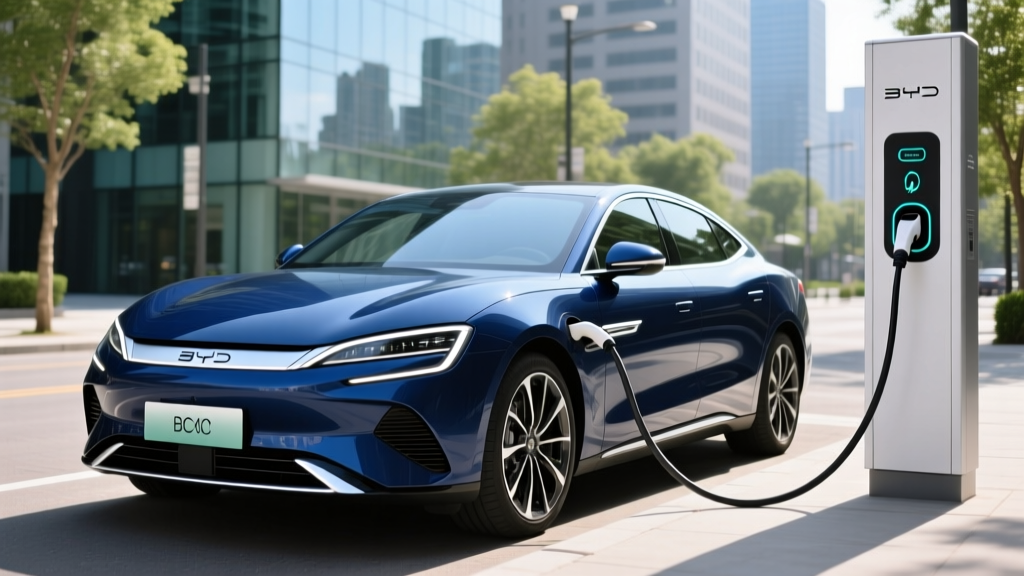
BYD's entry into the US passenger EV market remains one of the most anticipated—and most complicated—stories in the electric vehicle space. The BYD Seal, a sleek midsize sedan positioned squarely against the Tesla Model 3 and Hyundai IONIQ 6, has been on sale in Europe, Australia, and Southeast Asia since 2023, but its American arrival faces steep tariff barriers that fundamentally reshape the BYD Seal cost equation for US buyers. This review breaks down the 2026 global specs, what US pricing would look like under current trade policy, and whether the Seal's technology merits the wait.
BYD Seal Cost: Global Pricing and the US Tariff Problem
In markets where it's currently sold, the BYD Seal is priced aggressively. In Europe, the 2026 Seal Design (RWD) starts at approximately €44,900 (~$48,500 USD), while the dual-motor Excellence AWD variant lists at €47,900 (~$51,800 USD). In Australia, the Seal is even cheaper—starting at AUD $49,888 (~$32,000 USD) for the Premium trim before on-road costs.
However, US buyers cannot purchase the BYD Seal at these prices. The United States currently imposes a 100% tariff on Chinese-made electric vehicles, a policy enacted in 2024 and maintained through 2026. This effectively doubles the import cost, pushing a hypothetical US-spec Seal to an estimated $65,000–$75,000+ MSRP before any incentives—eliminating its core value proposition against domestically built competitors.
| Market | Trim | Local Price | USD Equivalent | After 100% US Tariff (Est.) |
|---|---|---|---|---|
| Europe | Design (RWD) | €44,900 | ~$48,500 | ~$73,000+ |
| Europe | Excellence (AWD) | €47,900 | ~$51,800 | ~$77,000+ |
| Australia | Premium (RWD) | AUD $49,888 | ~$32,000 | ~$64,000+ |
| China (Domestic) | Champion Edition | ¥189,800 | ~$26,200 | Not importable |
Bottom line on cost: Unless BYD establishes US or non-China manufacturing for the Seal (no such plant has been announced as of early 2026), the tariff wall makes this sedan uncompetitive on American soil. For comparison, the 2026 Tesla Model 3 Long Range starts at $42,490 and the Hyundai IONIQ 6 SE at $38,650—both built in plants that qualify for federal incentives.
Battery, Range, and Real-World Efficiency
The BYD Seal uses BYD's proprietary Blade Battery—a lithium iron phosphate (LFP) cell architecture renowned for thermal stability and long cycle life. The global-spec Seal carries an 82.5 kWh usable battery pack (gross capacity approximately 85 kWh).
The BYD Seal has not been EPA-rated for the US market. Based on its WLTP rating of 354 miles (570 km) for the RWD variant and applying the typical 15–20% WLTP-to-EPA reduction, we project an estimated EPA range of 285–300 miles for the RWD model and approximately 260–275 miles for the AWD Excellence.
Real-world caveat: Expect 240–265 miles on sustained highway driving at 70+ mph. In freezing temperatures (below 32°F), LFP chemistry experiences greater cold-weather range loss than NMC—plan for a 25–35% reduction, bringing effective winter range to roughly 190–220 miles for the RWD variant.
Efficiency-wise, the Seal RWD achieves approximately 3.8–4.0 miles per kWh in mixed driving, translating to an estimated 115–120 MPGe combined. That trails the Hyundai IONIQ 6 SE (140 MPGe) and Tesla Model 3 Long Range (132 MPGe) due to the Seal's heavier curb weight (~4,560 lbs) and less optimized aerodynamics compared to the IONIQ 6's teardrop shape.
Charging Speed: DC Fast Charge and Home Level 2
Charging performance is where the BYD Seal draws legitimate criticism from reviewers and owners in export markets.
| Charging Level | Power / Rate | Time / Speed | Notes |
|---|---|---|---|
| DC Fast Charge (Peak) | 150 kW max | 10–80% in ~26 minutes | Peak sustained only briefly; tapers to ~90 kW above 50% SoC |
| DC Fast Charge (Avg 10–80%) | ~95 kW average | ~26 min to 80% | Charge curve is flat but low-ceiling |
| Level 2 (Home/Public AC) | 11 kW onboard charger | 0–100% in ~8.5 hours | Adds ~28 miles of range per hour |
| Level 1 (120V household) | ~1.4 kW | ~60 hours 0–100% | Adds ~3–4 miles per hour; emergency use only |
The 150 kW DC fast-charge ceiling is the Seal's most significant competitive weakness. Rivals like the Hyundai IONIQ 6 (peak 240 kW, 10–80% in 18 minutes on 800V architecture) and even the Tesla Model 3 Long Range (peak 250 kW, 10–80% in ~15 minutes) significantly outpace it on road trips. On a 300-mile journey requiring one fast-charge stop, the Seal adds 10–12 minutes of downtime compared to an IONIQ 6 or Model 3.
The LFP Blade Battery does offer one charging advantage: BYD recommends regular charging to 100% without long-term degradation concerns, unlike NMC packs that benefit from an 80% daily ceiling. This means your full 82.5 kWh is practically usable every day.
Performance, Drivetrain, and Driving Dynamics
The BYD Seal is offered in two primary powertrain configurations:
- Design / Premium (RWD): Single rear motor producing 230 kW (308 hp) and 360 Nm (266 lb-ft) of torque. 0–60 mph in approximately 5.9 seconds.
- Excellence (AWD Dual-Motor): Combined output of 390 kW (523 hp) and 670 Nm (494 lb-ft). 0–60 mph in 3.8 seconds.
The AWD variant is genuinely quick, but the extra motor and associated weight (~4,850 lbs for AWD) reduce range by roughly 30–40 miles compared to RWD. For most buyers, the RWD model's 308 hp is more than adequate for highway merging and passing, and its efficiency advantage makes it the smarter daily-driver choice.
Ride quality benefits from the Seal's low center of gravity (battery pack mounted under the floor) and a multi-link rear suspension. European reviewers consistently note composed handling, though the steering lacks the precision feedback of a BMW i4 or Tesla Model 3.
Interior Space, Cargo, and Technology
The BYD Seal rides on BYD's e-Platform 3.0 with a 2,920 mm (115.0 in) wheelbase—comparable to the Tesla Model 3. Interior dimensions provide:
- Front legroom: ~41.3 inches
- Rear legroom: ~36.6 inches (adequate but tighter than the Hyundai IONIQ 6's 37.0 in)
- Cargo (trunk): ~14.1 cu ft (400 liters)
- Frunk: ~1.8 cu ft (52 liters) — small but useful for charging cables
The cabin is trimmed with vegan leather and features a rotating 15.6-inch central touchscreen (a BYD signature—it pivots between landscape and portrait orientation). The 10.25-inch digital instrument cluster is clear but basic. Wireless Apple CarPlay and Android Auto are standard. A 12-speaker Dynaudio sound system is available on higher trims.
Notable tech drawback: The Seal's ADAS suite (BYD's "DiPilot") provides adaptive cruise control, lane-keeping assist, and automated emergency braking, but it operates at SAE Level 2 and lacks the polish of Tesla's Autopilot or Hyundai's Highway Driving Assist 2. The driver monitoring system can be overly sensitive, and lane-centering accuracy on faded markings is inconsistent based on European owner reports.
Warranty Coverage
In export markets, BYD offers the following warranty structure for the Seal:
- Vehicle warranty: 6 years / 150,000 km (~93,000 miles)
- Battery pack warranty: 8 years / 160,000 km (~100,000 miles), with a capacity retention threshold of 70%
- Drive unit (motor/inverter): 8 years / 150,000 km
The LFP Blade Battery's chemistry provides additional peace of mind. Independent testing by IEEE-published studies and BYD's own nail-penetration tests demonstrate that LFP cells resist thermal runaway far better than NMC equivalents. Long-term degradation data from Chinese-market Seals (on sale since 2022) suggests approximately 8–10% capacity loss at 100,000 miles—well within warranty coverage.
Federal Tax Credit Eligibility (IRS §30D)
| §30D Requirement | BYD Seal Status | Result |
|---|---|---|
| Final assembly in North America | Assembled in China (Shenzhen/Xi'an) | ❌ Does NOT qualify |
| MSRP cap (sedans: $55,000) | Est. $65,000+ after tariffs | ❌ Exceeds cap |
| Battery component sourcing | BYD-manufactured cells (China) | ❌ Fails critical-mineral and component rules |
| Buyer income cap ($150K single / $300K joint) | Varies by buyer | N/A (other rules already disqualify) |
Verdict: The BYD Seal does not qualify for the IRS §30D federal EV tax credit of up to $7,500. It fails on final-assembly, MSRP cap, and battery-sourcing requirements. This is a decisive disadvantage against US-built competitors that do qualify—reducing the effective price gap between a Seal and a Tesla Model 3 or Hyundai IONIQ 6 by thousands of dollars. Source: IRS.gov Clean Vehicle Credits.
BYD Seal vs. Key Competitors: Is It Worth It?
| Spec | BYD Seal RWD (Est.) | Tesla Model 3 LR | Hyundai IONIQ 6 SE LR |
|---|---|---|---|
| US MSRP (base) | Not sold (est. $73K+) | $42,490 | $38,650 |
| EPA Range | ~290 mi (est.) | 341 mi | 361 mi |
| Battery (usable) | 82.5 kWh (LFP) | 75 kWh (NMC) | 77.4 kWh (NMC) |
| DC Fast Charge Peak | 150 kW | 250 kW | 240 kW |
| 10–80% DCFC Time | ~26 min | ~15 min | ~18 min |
| 0–60 mph | 5.9 sec | 4.2 sec | 5.1 sec |
| MPGe (combined est.) | ~118 | 132 | 140 |
| Federal Tax Credit | $0 | Up to $7,500 | Up to $7,500 |
Pros
- LFP Blade Battery offers excellent thermal safety and long cycle life
- 100% daily charging without degradation concerns
- Premium interior materials at a lower price point (in non-tariff markets)
- Rotating 15.6" infotainment screen is genuinely useful
- Strong 308 hp RWD powertrain for the price (globally)
Cons
- 150 kW DC fast-charge ceiling is class-worst for 2026
- Unavailable in the US due to 100% China EV tariff
- No federal tax credit eligibility
- Lower efficiency (MPGe) than IONIQ 6 or Model 3
- ADAS refinement lags behind Tesla and Hyundai systems
- No established US service/dealer network
Who Should Consider the BYD Seal?
Choose the BYD Seal if: You live in Europe, Australia, or Southeast Asia where it's sold at competitive prices, you prioritize battery safety and longevity (LFP chemistry) over fast-charging speed, and your daily commute fits within its ~280-mile real-world range.
Skip it (and buy a Model 3 or IONIQ 6) if: You're a US buyer—the tariff makes it unviable. Even in markets where it's available, choose a competitor if you road-trip frequently (the 150 kW charge ceiling adds significant stop time) or if you need best-in-class efficiency and range.
Frequently Asked Questions
What is the real-world range of the BYD Seal?
Based on its estimated EPA rating of ~290 miles (RWD), expect approximately 240–265 miles on highway trips at 70 mph in mild weather. In winter conditions below freezing, plan for 190–220 miles due to LFP chemistry's cold-weather sensitivity and cabin heating demands. City driving with regenerative braking can push range closer to the 290-mile estimate.
How fast does the BYD Seal charge?
DC fast charging peaks at 150 kW, reaching 10–80% in approximately 26 minutes. The charge curve is relatively flat but the low ceiling means sustained speeds hover around 95 kW average. At home on a Level 2 charger (11 kW), a full charge takes about 8.5 hours, adding roughly 28 miles of range per hour.
How much does the BYD Seal cost after tax credits?
In the US, the Seal is effectively unsaleable due to the 100% tariff on Chinese EVs, pushing estimated pricing above $65,000 with $0 in federal tax credits. In Europe, the Seal Design starts at €44,900 (~$48,500) before local incentives. In Australia, it starts at AUD $49,888 (~$32,000).
Does the BYD Seal qualify for the federal EV tax credit?
No. The Seal fails all three key §30D requirements: it is not assembled in North America, its tariff-inflated MSRP exceeds the $55,000 sedan cap, and its battery components and critical minerals are sourced from China, which is a restricted entity under current rules. Always verify current eligibility at IRS.gov.
Is the BYD Seal worth buying vs. the Tesla Model 3 or Hyundai IONIQ 6?
For US buyers, it is not an option in 2026. For international buyers, the Seal offers a compelling blend of LFP battery durability and interior quality at a lower price point. However, its 150 kW charging speed and lower efficiency make the IONIQ 6 and Model 3 better choices for frequent road-trippers, even at slightly higher prices.
What is BYD's Blade Battery and why does it matter?
The Blade Battery is BYD's proprietary LFP cell design that uses long, thin prismatic cells arranged in a structural array. It offers superior thermal runaway resistance (it passes nail-penetration tests without fire), longer cycle life (3,000+ charge cycles before 80% capacity), and lower cost than NMC. The trade-off is lower energy density and greater cold-weather range loss.