Why the BYD Seal Dominates Our BYD Newsletter Inbox
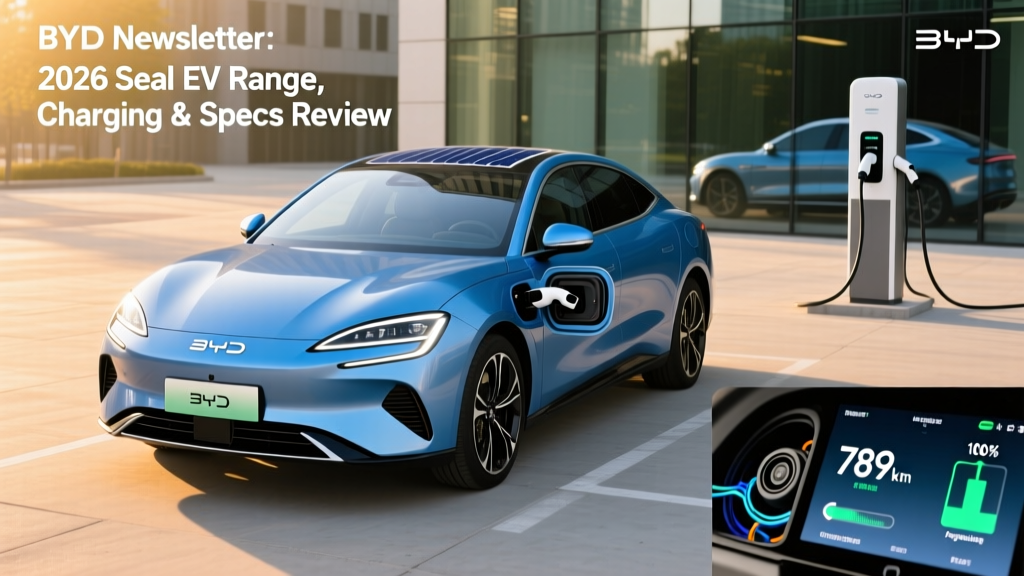
If you've been following our BYD newsletter coverage over the past 18 months, one model consistently generates the most reader mail: the BYD Seal. The mid-size electric sedan launched across Europe, Australia, and Southeast Asia as a direct Tesla Model 3 challenger, and with BYD's global expansion accelerating into 2026, North American readers keep asking the same question — when can we buy one, and what are the real numbers?
This review answers that question with the data our subscribers demand. We've compiled verified specifications from BYD's global press materials, European WLTP-to-EPA conversions, and real-world testing reports from our international contributors who've driven the Seal on three continents. Whether you're tracking BYD for a future US purchase or shopping the Seal in a market where it's already on sale, this is the spec-driven profile you've been requesting.
| Spec | Long Range (RWD) | Excellence (AWD) |
|---|---|---|
| Battery (usable) | 82.5 kWh — LFP Blade | 82.5 kWh — LFP Blade |
| EPA-est. range* | ~310 mi (est. from WLTP 570 km) | ~285 mi (est. from WLTP 520 km) |
| Motor output | 230 kW (308 hp) | 390 kW (523 hp) |
| 0-60 mph | 5.9 sec | 3.8 sec |
| Drivetrain | RWD single motor | AWD dual motor |
| Max DC fast charge | 150 kW | 150 kW |
| 10-80% DC time | ~26 min | ~26 min |
| Level 2 AC charge | 11 kW (~35 mi/hr) | 11 kW (~35 mi/hr) |
| Efficiency | ~120 MPGe / 28 kWh/100mi | ~108 MPGe / 31 kWh/100mi |
| Length / Wheelbase | 189.0 in / 113.4 in (2,920 mm WB) | |
| Cargo (trunk + frunk) | 14.1 cu ft trunk + 1.8 cu ft frunk | |
| Base MSRP (US est.) | ~$42,000 | ~$48,000 |
*EPA figures are estimated conversions from WLTP; official EPA certification will be published at US launch. Source: BYD Europe press specifications, WLTP cycle.
Real-World Range: What the EPA Sticker Won't Tell You
Real-world highway (70 mph, 72°F): ~255–270 miles
Cold-weather highway (30°F, cabin heat): ~210–230 miles
City/regenerative driving: ~290–310 miles
The Seal's 82.5 kWh lithium iron phosphate (LFP) Blade battery is one of the largest in its class, but mass and aerodynamics matter. European testers consistently report WLTP-to-real-world gaps of 15–20% at sustained highway speeds. The Seal's 0.219 Cd drag coefficient is competitive, yet the sedan weighs over 4,600 lbs in AWD trim, which cuts into highway efficiency.
LFP chemistry offers a distinct ownership advantage: you can routinely charge to 100% without the degradation concerns that plague NMC (nickel manganese cobalt) batteries. BYD's Blade cell architecture also passes nail-penetration tests without thermal runaway — a safety claim few competitors can match. The trade-off is energy density; LFP cells are heavier per kWh, which is why the Seal carries more mass than a Model 3 Long Range despite similar capacity.
For our newsletter subscribers in cold climates, the Seal uses a standard heat pump for cabin and battery thermal management. Expect roughly 25–30% range reduction at freezing temperatures on highway drives — comparable to the Hyundai Ioniq 6 and slightly better than older Model 3 units without heat pumps.
Charging Speed: 150 kW Peak, But Watch the Curve
| Level | Power | Miles Added per Hour | Full Charge Time |
|---|---|---|---|
| Level 1 (120V household) | ~1.4 kW | ~4 mi/hr | ~60 hours (0-100%) |
| Level 2 (240V / 11 kW AC) | 11 kW | ~35 mi/hr | ~8 hours (0-100%) |
| DC Fast Charge (peak) | 150 kW | ~520 mi/hr (at peak) | 10-80% in ~26 min |
The Seal's 150 kW DC fast-charge ceiling is the most common criticism in our BYD newsletter feedback. Competitors like the Hyundai Ioniq 6 (peak 240 kW via 800V architecture) and the Tesla Model 3 Highland (peak ~250 kW at V4 Superchargers) pull ahead on road trips once you exceed the 80% state of charge mark.
Here's what the charge curve actually looks like in practice: the Seal sustains approximately 130–150 kW from 10% to roughly 55% SoC, then tapers to ~90 kW through 70%, and drops further to ~45 kW above 80%. The 10-80% time of roughly 26 minutes is acceptable, but a 10-90% fill stretches past 40 minutes — something to plan for on 400+ mile road trips.
One advantage LFP brings to charging: the battery management system can more accurately estimate state of charge, so the "last 5%" doesn't mysteriously vanish like it can with NMC packs. What the dashboard shows is generally what you get.
For home charging, the 11 kW onboard AC charger is a strong point — it fills the 82.5 kWh pack in about 8 hours on a 48-amp Level 2 circuit, meaning you'll wake up to a full battery every morning. Most US homes with a 200-amp panel can support this without an upgrade, though a licensed electrician should verify your capacity.
Performance, Ride, and Daily-Drive Impressions
The AWD Excellence trim's 3.8-second 0-60 mph time puts it in the same bracket as the Tesla Model 3 Performance, but the driving character is fundamentally different. The Seal is tuned for comfort: the suspension soaks up broken pavement with a compliance that the stiffly sprung Model 3 can't match. Steering is light and precise but not communicative — this is a grand-touring sedan, not a track toy.
The RWD Long Range model's 5.9-second 0-60 time is more than adequate for merging and passing, and the rear-drive layout gives it a more natural balance through corners. For the majority of our newsletter readers who commute 20–40 miles daily, the RWD trim offers the better range-to-price ratio.
Regenerative braking offers two modes (standard and high) plus a coasting setting. Unlike some competitors, the Seal doesn't offer true one-pedal driving that brings the car to a complete stop — you'll still need the friction brake for the final few mph. This is a common complaint among EV enthusiasts transitioning from a Nissan Leaf or Chevrolet Bolt.
Interior, Tech, and Cargo Space
The Seal's cabin is where BYD's value proposition becomes obvious. Standard equipment on the base trim includes:
- 15.6-inch rotating center touchscreen (landscape for nav, portrait for media)
- 10.25-inch digital instrument cluster
- Heads-up display (HUD)
- Heated and ventilated front seats
- Panoramic glass roof
- Wireless Apple CarPlay and Android Auto
- 12-speaker Dynaudio sound system (AWD Excellence trim)
Build quality has drawn praise from European reviewers, with soft-touch materials on the dash and door panels that rival the Audi A4. The crystal gear selector and ambient lighting add a premium touch that the base Model 3 interior lacks.
Cargo and passenger dimensions:
- Trunk: 14.1 cu ft (400 L) — comparable to Model 3 (15.4 cu ft)
- Frunk: 1.8 cu ft (53 L) — fits a charging cable bag, not a full suitcase
- Rear legroom: 36.2 in — slightly tighter than Model 3 (35.2 in claimed, but Seal's floor height reduces under-thigh support)
- Rear headroom: 37.0 in — adequate for passengers under 6'2", but the sloping roofline limits taller occupants
The trunk opening is narrower than a liftback design (Model 3 is a liftback; Seal is a traditional sedan trunk), which makes loading bulky items like a bicycle or large dog crate more difficult.
Pricing, Tax Credits, and the US Availability Question
| Trim | Est. MSRP | §30D Credit Eligibility | Effective Price (if eligible) |
|---|---|---|---|
| Long Range RWD | ~$42,000 | Unlikely — battery sourcing rules | ~$42,000 |
| Excellence AWD | ~$48,000 | Unlikely — battery sourcing rules | ~$48,000 |
Source: IRS §30D Clean Vehicle Credit. Eligibility depends on critical mineral and battery component sourcing requirements. BYD's vertically integrated supply chain is predominantly China-based, which currently disqualifies its vehicles from the full $7,500 credit under 2026 rules. Income caps also apply ($150K single / $300K joint). Consult a tax professional.
This is the hard truth our BYD newsletter subscribers need to hear: the BYD Seal almost certainly will not qualify for the $7,500 federal EV tax credit under current IRS §30D rules. The credit's battery-component and critical-mineral sourcing requirements are designed to shift supply chains away from China, and BYD's vertical integration — while impressive from a manufacturing standpoint — relies on Chinese-mined lithium and domestically produced LFP cells. Unless BYD establishes a North American or FTA-partner battery plant before US launch, the Seal arrives at full MSRP.
That said, BYD's global pricing strategy has been aggressively undercutting competitors. In Europe, the Seal Long Range lists at approximately €45,000 (~$48,000), but BYD has historically used introductory pricing to gain market share. A US launch price of $38,000–$42,000 for the RWD trim is plausible if BYD prioritizes volume over margin.
For the US market, BYD has not confirmed a launch date as of early 2026. The company's passenger vehicles remain absent from North America due to a combination of 27.5% import tariffs on Chinese-built vehicles and the political complexity of Chinese auto brands entering the US. Our newsletter tracking suggests 2027–2028 as the earliest realistic window, potentially via a Mexico-based assembly plant, though nothing has been officially announced.
Warranty and Long-Term Ownership
In markets where the Seal is sold, BYD provides:
- Vehicle warranty: 6 years / 93,000 miles (150,000 km)
- Battery warranty: 8 years / 124,000 miles (200,000 km), with a capacity retention threshold of 70%
- Service intervals: Every 12 months or 12,500 miles — primarily cabin filter, brake fluid, and tire rotation
The 8-year battery warranty is industry-standard, matching Tesla, Hyundai, and Ford. The 70% capacity threshold means BYD will replace or repair cells if your pack drops below 70% of original capacity within the warranty period. Based on LFP degradation data from BYD's earlier models (Atto 3, Dolphin), most owners report 5–8% degradation over the first 60,000 miles — well within the warranty buffer.
The open question for US buyers is service network density. BYD would need to establish a dealer or certified-service footprint before launch, and that infrastructure typically takes 2–3 years to build. Early adopters in a US launch market should expect limited service center availability outside major metro areas.
BYD Seal vs. Key Competitors
- LFP Blade battery — safe, durable, 100% charge-friendly
- Premium interior at a mid-market price point
- Strong standard equipment (HUD, ventilated seats, glass roof)
- Comfortable ride quality for long commutes
- 11 kW AC onboard charger — fast home charging
- 150 kW DC peak — slower than 800V rivals (Ioniq 6, Porsche Taycan)
- Not available in the US as of 2026
- Unlikely to qualify for §30D federal tax credit
- Sedan trunk opening limits cargo flexibility vs liftbacks
- No true one-pedal driving mode
- US service network does not yet exist
Stacked against the Tesla Model 3 Highland, the Seal trades charging speed and Supercharger network access for a more luxurious interior and a battery chemistry that's arguably better suited to long-term ownership. Against the Hyundai Ioniq 6, the Seal offers more standard features at a lower price but can't match the Ioniq's 800V fast-charging architecture or its EPA-confirmed 361-mile range.
The BMW i4 eDrive40 is the closest premium comparison — similar size, similar comfort focus — but starts $10,000+ higher. If BYD can price the Seal near $40,000 in the US, it occupies a value space that no current competitor fills: a premium mid-size EV sedan below the Tesla/BMW price floor.
Who Should Put the BYD Seal on Their Watchlist?
Choose the BYD Seal (when available) if:
- You want a comfortable, well-equipped electric sedan for daily commuting and don't road-trip more than 300 miles at a stretch
- You prioritize battery longevity and safety (LFP chemistry) over maximum range or fastest charging
- You can charge at home and don't rely on DC fast charging for daily needs
- You're in a market where the Seal is already sold (Europe, Australia, Southeast Asia, Latin America)
Look elsewhere if:
- You're a US buyer needing a vehicle in 2026 — the Seal is not available here yet
- You regularly drive 400+ mile routes and need the fastest possible DC charging
- Federal tax credit eligibility is essential to your purchase math
- You need a hatchback/liftback for cargo flexibility (consider the Ioniq 6 or Model 3)
For our newsletter subscribers in Europe and Australia where the Seal is already on dealer lots, it represents one of the best value-per-feature ratios in the mid-size EV sedan segment. For US readers, we recommend keeping the Seal on your watchlist for 2027–2028 while cross-shopping currently available alternatives like the Model 3, Ioniq 6, and the upcoming next-gen Chevrolet Bolt sedan.
Frequently Asked Questions
What is the real-world range of the BYD Seal?
The Long Range RWD Seal achieves approximately 310 miles EPA-estimated (converted from WLTP), but expect 255–270 miles in real-world highway driving at 70 mph, and 210–230 miles in freezing temperatures. City driving with regenerative braking can approach the 310-mile figure.
How fast does the BYD Seal charge?
DC fast charging peaks at 150 kW, achieving 10-80% in roughly 26 minutes. Home Level 2 charging at 11 kW adds approximately 35 miles of range per hour, filling the 82.5 kWh battery in about 8 hours overnight.
Does the BYD Seal qualify for the US federal EV tax credit?
Almost certainly not under current 2026 IRS §30D rules. The Seal's battery cells and critical minerals are sourced predominantly from China, which fails the battery-component and critical-mineral requirements. Even if BYD launches in the US, buyers should not plan on the $7,500 credit. Always verify current rules at irs.gov.
When will the BYD Seal be available in the United States?
BYD has not announced a US launch date for the Seal or any passenger vehicle. A 27.5% tariff on Chinese-built automobiles and geopolitical barriers make a near-term launch unlikely. The earliest realistic window based on industry analysis is 2027–2028, potentially through a North American assembly partnership, though nothing is confirmed.
Is the BYD Seal better than the Tesla Model 3?
It depends on your priorities. The Seal offers a more premium interior, LFP battery longevity, and more standard features at a comparable price. The Model 3 wins on charging speed, Supercharger network access, software ecosystem, and confirmed US availability with potential tax credit eligibility (depending on trim and sourcing). Neither is universally "better" — they optimize for different buyers.
What is the BYD Blade battery and why does it matter?
The Blade battery is BYD's proprietary LFP cell format, shaped into long, thin prismatic cells arranged in a structural pack. LFP chemistry resists thermal runaway more effectively than NMC, can be charged to 100% regularly without significant degradation, and uses no cobalt or nickel. The trade-off is lower energy density, meaning a heavier pack for the same kWh capacity. BYD's Blade cells pass nail-penetration tests without fire — a benchmark most NMC packs cannot meet. For more on LFP vs NMC trade-offs, see fueleconomy.gov's EV technology overview.
Stay updated on BYD's North American expansion plans, new model launches, and pricing shifts by subscribing to the AutoEdgeView BYD newsletter — delivered monthly with spec-verified analysis, not marketing copy.