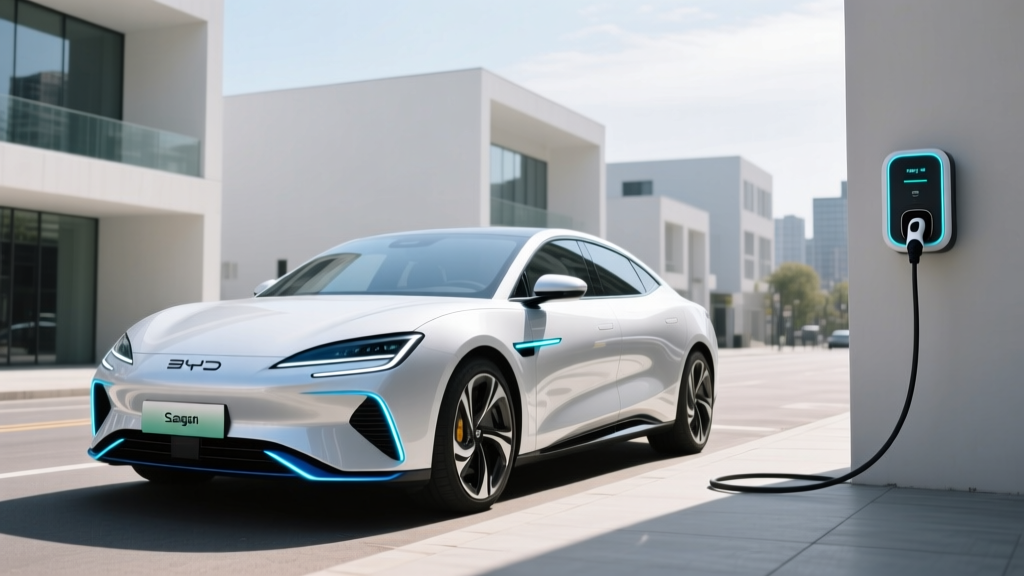
The BYD Seagull has become one of the most searched subcompact EVs globally — and for good reason. Priced under $12,000 in China with a usable range that outpaces many budget electric cars, it has generated enormous curiosity among US buyers wondering whether the cheapest credible EV on Earth will ever reach American shores. As of early 2026, the answer remains complicated. This profile covers the Seagull's confirmed specs, real-world range behavior, charging performance, and the tariff and regulatory barriers that define its US availability outlook.
BYD Seagull Quick Verdict: A Real EV, Not Available in the US
The BYD Seagull (also sold as the BYD Dolphin Mini in select Latin American and Southeast Asian markets) is a production battery-electric hatchback currently sold in China, Mexico, Brazil, Thailand, and parts of Europe. It is not sold in the United States as of the 2026 model year, and no US launch date has been announced. A 100% tariff on Chinese-built EVs, effective since 2024, makes direct import economically unviable. Any future US availability would require BYD to manufacture the vehicle in a non-China facility — a plan BYD has discussed for Mexico and Brazil but not confirmed for a US-market variant.
For the purposes of this review, we evaluate the highest-spec variant currently exported: the 2025-2026 BYD Seagull with the 38.88 kWh Blade Battery, which represents the version most likely to underpin any eventual North American offering.
Range, Battery, and Efficiency Specs
The Seagull uses BYD's proprietary Blade Battery, a lithium iron phosphate (LFP) cell arranged in a structural pack. LFP chemistry trades some energy density for superior thermal stability, longer cycle life, and zero cobalt or nickel content. It also tolerates regular 100% charging without the degradation concerns typical of NMC (nickel-manganese-cobalt) batteries.
| Specification | BYD Seagull (38.88 kWh Blade) |
|---|---|
| Battery Capacity (usable) | 38.88 kWh (LFP, Blade) |
| CLTC Range (China) | 405 km (~252 miles) |
| EPA-Estimated Range (projected) | ~220–235 miles (not EPA-certified for US) |
| Efficiency | ~27–29 kWh/100 mi (est. ~115–120 MPGe combined) |
| Motor Output | 75 kW (101 hp) / 135 Nm torque |
| 0–60 mph (est.) | ~11.0 seconds |
| Drivetrain | FWD, single-speed reduction gear |
| Top Speed | 130 km/h (81 mph) electronically limited |
Charging Speed: DC Fast Charge and Home Level 2
Charging is the Seagull's most visible compromise as a budget EV. Its DC fast-charging peak is modest by 2026 standards, and the onboard AC charger limits how quickly it recovers miles on a home Level 2 setup.
| Charging Level | Power | Time / Rate | Notes |
|---|---|---|---|
| DC Fast Charge (CCS2 / GB/T) | 40 kW peak | 30%–80% in ~30 minutes | Sustained rate ~30 kW; tapers sharply above 85% |
| Level 2 AC (home / public) | 6.6 kW onboard charger | 0–100% in ~6 hours | Adds ~22–25 miles of range per hour |
| Level 1 AC (120V household) | ~1.4 kW | 0–100% in ~28 hours | Emergency / trickle only |
A 40 kW DC peak means the Seagull is not a road-trip-friendly EV by modern standards. At a 150 kW Electrify America or Tesla Supercharger station, the Seagull will draw only a fraction of the stall's capacity. The charge curve is relatively flat from 30–80%, but the low absolute kW figure means highway stops take roughly twice as long as in a Hyundai Ioniq 5 or Chevrolet Equinox EV. For daily commuting with overnight Level 2 charging, however, the 6.6 kW onboard charger is adequate — most owners will wake to a full battery every morning.
US Pricing, Tariffs, and Tax Credit Reality
The Seagull's headline China price — starting around ¥69,800 (~$9,700 USD) for the base 30 kWh variant and ¥85,800 (~$11,900 USD) for the 38.88 kWh version — is what drives US search interest. But that price is unreachable for American buyers for structural reasons.
| Market / Scenario | Price (USD est.) | Notes |
|---|---|---|
| China domestic MSRP (38.88 kWh) | ~$11,900 | Includes VAT, local subsidies vary |
| Mexico retail (Dolphin Mini) | ~$21,000–$23,000 | Shipped from China, no US tariff exposure |
| Brazil retail (Dolphin Mini) | ~$22,500–$25,000 | Local CKD assembly starting 2025 |
| Hypothetical US import (pre-tariff) | ~$20,000–$24,000 | Freight, homologation, dealer margin added |
| Hypothetical US import (with 100% tariff) | ~$32,000–$40,000+ | Tariff eliminates price advantage entirely |
Federal Tax Credit (§30D): Even if the Seagull were sold in the US, it would almost certainly not qualify for the $7,500 federal EV tax credit under current IRS §30D rules. The credit requires battery components and critical minerals to be sourced from the US or free-trade-agreement partners, with escalating percentages each year. BYD's vertically integrated Chinese supply chain — including LFP cell production in Shenzhen — does not meet these sourcing thresholds. Additionally, the §30D credit has MSRP caps ($55,000 for sedans/hatchbacks) and buyer income limits ($150,000 single / $300,000 joint), though the Seagull would clear the MSRP cap easily. The binding disqualifier is battery sourcing. Always verify current-year rules at irs.gov or consult a tax professional.
Interior, Cargo, and Tech Features
For a sub-160-inch hatchback, the Seagull's packaging is surprisingly practical. BYD uses a dedicated EV platform (e-Platform 3.0) with a flat floor, which maximizes interior volume relative to the vehicle's footprint.
- Seating: 5 passengers (4 adults comfortably; 5th seat is tight for long trips)
- Rear legroom: ~33.5 inches (adequate for adults under 6 feet)
- Cargo behind rear seats: ~12.0 cu ft
- Cargo with rear seats folded: ~34.0 cu ft
- No front trunk (frunk): The motor and power electronics occupy the full front compartment
Infotainment: A 12.8-inch rotating touchscreen (landscape for navigation, portrait for climate/media) runs BYD's DiLink system. Wireless Apple CarPlay and Android Auto are included on export-spec models. A 5-inch digital instrument cluster sits behind the steering wheel. NFC key card and phone-as-key are standard.
Driver Assistance (ADAS): Export models offer adaptive cruise control, lane-keeping assist, automatic emergency braking, and a 360-degree camera. This is SAE Level 1–2 driver assistance — not autonomous driving — and requires full driver engagement at all times. It does not compare to Tesla Autopilot or GM Super Cruise in highway capability.
Notable drawbacks: No heat pump on base/export trims (range hit in cold weather), limited DC fast-charge speed, no frunk, rear drum brakes (adequate for the weight class but unusual to US buyers), and no confirmed over-the-air update schedule for export markets.
Who the BYD Seagull Is For — and Who Should Skip It
Choose the BYD Seagull (if available in your market) if:
- You need a second car for urban commuting under 40 miles round-trip
- Home Level 2 charging is available every night
- Budget is the primary purchase driver and you're outside the US
- You prefer LFP battery longevity over maximum range or fast-charge speed
Skip it (or wait for alternatives) if:
- You live in the US — it is not available and tariff barriers make near-term launch unlikely
- You need road-trip capability (40 kW DC charging is a significant limitation)
- You live in a cold climate where LFP winter range loss is a daily concern
- You want access to the US federal EV tax credit or established dealer service networks
US alternatives in the budget EV space (2026): The Chevrolet Equinox EV (~$33,000, 319 mi EPA), Hyundai Kona Electric (~$32,900, 261 mi EPA), and Nissan Leaf (~$28,140, 212 mi EPA) are all available with US warranty coverage, dealer service, and potential §30D credit eligibility. None match the Seagull's China price, but all are realistic purchases for American buyers.
Pros and Cons
- Lowest production cost of any credible 5-seat EV globally
- LFP Blade Battery: excellent cycle life, thermal safety, no cobalt
- Surprisingly roomy interior for a 155-inch hatchback
- Rotating 12.8" screen with wireless CarPlay/Android Auto
- Low running costs: ~$0.04–0.06 per mile on US-average electricity
- Not available in the US; 100% tariff blocks import viability
- 40 kW DC fast charge is slow for 2026; 30-min 30–80% stops
- No heat pump on many trims — cold-weather range suffers
- No federal tax credit eligibility due to Chinese battery sourcing
- Top speed limited to 81 mph — marginal for US interstate driving
- No US service/parts network
Frequently Asked Questions
What is the real-world range of the BYD Seagull?
The 38.88 kWh variant achieves approximately 252 miles on China's CLTC cycle, which translates to an estimated 220–235 miles on the more stringent EPA cycle. In real-world highway driving at 70 mph, expect 170–190 miles. In freezing weather, LFP chemistry causes a 20–30% reduction, yielding roughly 140–165 miles of practical range.
How fast does the BYD Seagull charge?
DC fast charging peaks at 40 kW, taking approximately 30 minutes from 30% to 80% state of charge. On a Level 2 home charger (240V), the 6.6 kW onboard charger delivers a full charge in about 6 hours, adding roughly 22–25 miles of range per hour. Level 1 (120V) is impractical for daily use at ~28 hours for a full charge.
Does the BYD Seagull qualify for the US federal EV tax credit?
No. Even if sold in the US, the Seagull's Chinese-manufactured LFP battery and supply chain do not meet the critical-mineral and battery-component sourcing requirements of IRS §30D. The 100% tariff on Chinese-built EVs also prevents competitive pricing. Always confirm current rules at irs.gov or with a tax professional.
Will BYD sell the Seagull in the United States?
As of 2026, BYD has announced no US launch plans for the Seagull or any passenger vehicle. BYD executives have stated publicly that the US market is not a near-term priority due to the tariff environment. BYD is building factories in Mexico, Brazil, Hungary, Thailand, and Indonesia, but none are confirmed to produce a US-bound Seagull variant.
Is the BYD Seagull worth buying vs. competitors?
In markets where it's available (China, Mexico, Brazil, Southeast Asia), the Seagull is arguably the best value in subcompact EVs — nothing else offers a 40 kWh LFP pack and 5-seat practicality near its price point. In the US, however, it is not purchasable, and tariff-adjusted pricing would erase its cost advantage over the Chevrolet Equinox EV, Hyundai Kona Electric, or Nissan Leaf, all of which offer faster charging, US warranty coverage, and potential tax credit access.
What is the BYD Seagull's battery warranty?
In China, BYD offers a 8-year/150,000 km (~93,000 mi) warranty on the Blade Battery with a capacity retention threshold of 70%. Export market warranties vary. No US warranty terms exist since the vehicle is not sold there. LFP chemistry generally degrades more slowly than NMC — real-world data from BYD's fleet vehicles suggests 90%+ capacity retention at 100,000 miles is achievable with regular charging habits.