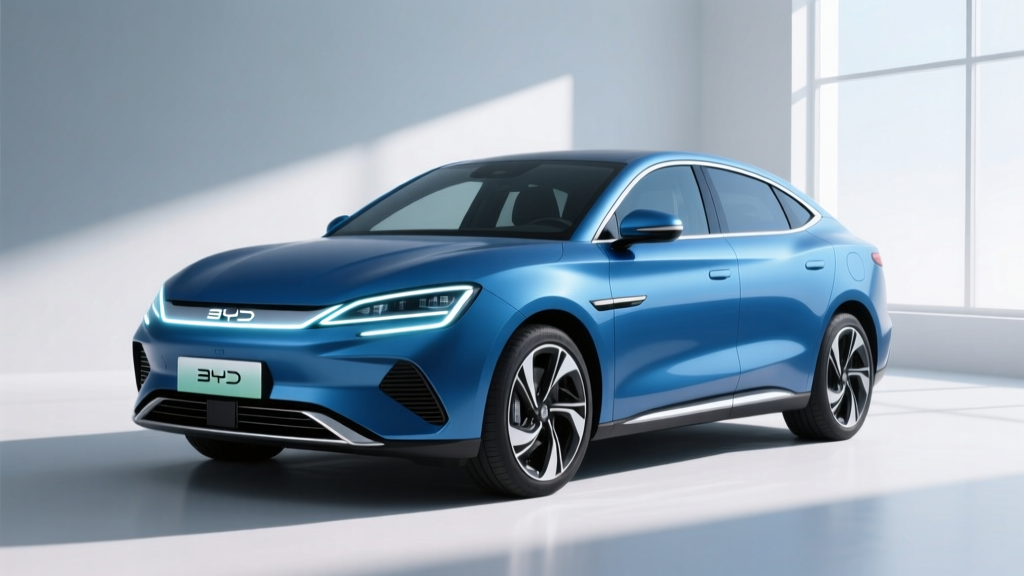
The BYD Qin has quietly become one of the best-selling electrified vehicles on the planet. While American buyers are still largely unfamiliar with the nameplate, BYD Qin sales in 2023 reached an estimated 434,000+ units globally across the Qin Plus DM-i (plug-in hybrid) and Qin Plus EV variants — a figure that placed it among the top five best-selling electrified cars worldwide for the year. As BYD expands its international footprint through 2025 and 2026, the Qin's sales trajectory is a bellwether for the brand's ambitions beyond China.
This profile dissects the 2023 sales data, then shifts to a detailed 2026-spec buyer's guide for the latest Qin Plus EV and DM-i — covering range, charging, pricing, and the realistic US-availability picture. If you're researching BYD's global momentum or considering an import in a market where the Qin is sold, this is your data-driven reference.
BYD Qin 2023 Sales: By the Numbers
BYD reports combined sales figures for its Qin family rather than separating individual trims in every monthly release. Here is what the verified data shows for the 2023 calendar year:
| Metric | Figure |
|---|---|
| Total Qin family sales (2023) | ~434,000 units |
| Qin Plus DM-i (PHEV) share | ~256,000 units (est. 59%) |
| Qin Plus EV (BEV) share | ~178,000 units (est. 41%) |
| Primary market | China (~95% of volume) |
| Export markets (2023) | Thailand, Brazil, Israel, UAE, Australia (limited) |
| Year-over-year growth | +14% vs. 2022 |
The Qin Plus DM-i dominated volume because its sub-¥100,000 (~$14,000 USD equivalent) starting price in China undercut every competing PHEV sedan, including the Toyota Corolla Hybrid and Honda Civic e:HEV in that market. The BEV variant gained share in the second half of 2023 after BYD introduced the Champion Edition with a revised Blade Battery pack and a price cut to ¥99,800 (~$13,800 USD), triggering a price war that rippled through the entire Chinese EV market.
For context, Tesla's Model 3 — the closest global benchmark for a mid-size electric sedan — sold roughly 529,000 units worldwide in 2023. The Qin family wasn't far behind, and it achieved that volume at a fraction of the average transaction price.
2026 BYD Qin Plus EV: Specs, Range & Efficiency
The current-generation Qin Plus EV (2025–2026 model year in international markets) is built on BYD's e-Platform 3.0 and uses the company's signature LFP (lithium iron phosphate) Blade Battery. LFP chemistry trades some energy density for superior thermal stability, longer cycle life, and lower cost — a pragmatic choice for a mass-market sedan.
| Spec | Qin Plus EV (Standard Range) | Qin Plus EV (Extended Range) |
|---|---|---|
| Battery capacity (usable) | 48.0 kWh | 57.6 kWh |
| Chemistry | LFP (Blade) | LFP (Blade) |
| CLTC range | 420 km (261 mi) | 510 km (317 mi) |
| EPA-estimated range | Not rated (not sold in US) | Not rated (not sold in US) |
| Real-world range estimate | ~210–235 mi | ~255–285 mi |
| Motor output | 136 hp (100 kW) | 204 hp (150 kW) |
| 0–100 km/h (0–62 mph) | ~9.0 sec | ~7.3 sec |
| Drivetrain | FWD | FWD |
| Efficiency (CLTC) | 12.2 kWh/100 km | 12.5 kWh/100 km |
Charging: DC Fast, Level 2 & Home Setup
Charging speed is where the Qin Plus EV shows its mass-market positioning. It's adequate rather than class-leading — a deliberate cost-saving decision by BYD.
| Charging Level | Rate | Time / Miles Added |
|---|---|---|
| Level 1 (120V household) | ~1.4 kW | ~4 mi/hr of charging |
| Level 2 (240V home/public) | 7.0 kW (onboard charger limit) | ~22 mi/hr; full charge in ~8 hr (57.6 kWh) |
| DC Fast Charge (CCS2/GB/T) | Peak 80 kW | 10–80% in ~40 min |
The 80 kW peak DC rate is the Qin's most notable charging limitation. Competitors like the Hyundai Ioniq 6 (peak 240 kW on 800V architecture) and even the Chevrolet Bolt EUV (peak 115 kW) charge significantly faster on long road trips. The Qin's charge curve holds near 80 kW from roughly 10–55% SoC, then tapers to 40–50 kW through 80%, and drops further above 90%.
For daily ownership, the 7.0 kW Level 2 onboard charger is perfectly sufficient: plug in overnight at home, and you'll recover a full battery in about eight hours. Most Qin owners in China and export markets charge at home or at workplace Level 2 stations and rarely rely on DC fast charging.
Qin Plus DM-i (PHEV): The Volume Leader
The plug-in hybrid DM-i variant is the real sales driver — and the version most relevant to buyers in markets with less developed charging infrastructure. Here's how the 2026 DM-i stacks up:
| Spec | Qin Plus DM-i (55 km EV) | Qin Plus DM-i (120 km EV) |
|---|---|---|
| Battery (usable) | 8.3 kWh (LFP Blade) | 18.3 kWh (LFP Blade) |
| Electric-only range (CLTC) | 55 km (34 mi) | 120 km (75 mi) |
| Combined range (fuel + electric) | ~1,200 km (745 mi) | ~1,245 km (773 mi) |
| Engine | 1.5L naturally aspirated | 1.5L naturally aspirated |
| Combined system output | 197 hp | 197 hp |
| Fuel consumption (charge-depleted) | 3.8 L/100 km (~62 MPG) | 3.8 L/100 km (~62 MPG) |
| 0–100 km/h | ~7.3 sec | ~7.3 sec |
| DC fast charge | Not available | 17 kW peak (optional) |
The DM-i's 62 MPG charge-depleted fuel economy is exceptional for a mid-size sedan, rivaling the Toyota Prius while offering a usable electric-only commute for most drivers on the 120 km variant. The series-parallel hybrid system operates primarily as an EREV (extended-range EV) at city speeds — the engine acts as a generator rather than driving the wheels directly — switching to parallel hybrid mode at highway speeds for efficiency.
Pricing, Tax Credits & Global Availability
Pricing varies dramatically by market. Here's the current picture for key regions:
| Market | Qin Plus EV Starting Price | Qin Plus DM-i Starting Price | Notes |
|---|---|---|---|
| China | ¥99,800 (~$13,800) | ¥79,800 (~$11,000) | After 2024–2025 price cuts |
| Thailand | ~฿999,000 (~$28,000) | ~฿799,000 (~$22,500) | Local CKD assembly from 2024 |
| Brazil | ~R$179,800 (~$36,000) | ~R$149,800 (~$30,000) | BYD's largest LatAm market |
| Australia | Not yet available | ~A$39,990 (~$26,000) | Sold as BYD "King" in some markets |
| United States | Not available | Not available | No US sales; no announced timeline |
Interior, Tech & Safety
The Qin Plus is a compact-to-mid-size sedan (approximately 184 inches long, 107-inch wheelbase) that punches above its price class in interior space and technology.
Dimensions and space:
- Passenger volume: ~95 cu ft (estimated, not EPA-measured for US)
- Rear legroom: ~35.4 inches — competitive with a Toyota Corolla
- Trunk: ~15.9 cu ft (EV); ~14.5 cu ft (DM-i due to fuel tank packaging)
- Frunk: Not available on either variant
Technology highlights:
- 12.8-inch rotating center touchscreen (landscape/portrait toggle — a BYD signature)
- 8.8-inch digital instrument cluster
- BYD DiLink infotainment with OTA updates, voice control, and NFC phone-as-key
- Wireless phone charging pad (on higher trims)
- VTOL (vehicle-to-load) power output on DM-i — can power appliances/camping gear via a 220V adapter
Driver assistance (Level 1–2):
- Adaptive cruise control with stop-and-go
- Lane-keeping assist and lane-centering
- Automatic emergency braking with pedestrian detection
- Blind-spot monitoring and rear cross-traffic alert (higher trims)
- 360° surround-view camera
Warranty & Long-Term Ownership
BYD's warranty coverage varies by market but generally includes:
| Coverage | Terms (International Markets) |
|---|---|
| Vehicle (bumper-to-bumper) | 6 years / 150,000 km (93,000 mi) |
| Battery pack (Blade LFP) | 8 years / 160,000 km (100,000 mi); capacity retention ≥70% |
| Electric motor / power electronics | 8 years / 150,000 km |
| DM-i engine | 6 years / 150,000 km |
The LFP Blade Battery is a longevity strong suit. LFP chemistry typically sustains 3,000+ full charge cycles before degrading to 80% capacity — roughly double the cycle life of typical NMC packs. For a daily-charged commuter, that translates to well over 500,000 miles of theoretical battery life before meaningful degradation. In practice, calendar aging and thermal exposure matter as much as cycle count, but LFP's track record is encouraging.
Replacement cost data for the Qin's Blade pack is not widely published outside China, but BYD's vertical integration (they manufacture their own cells) keeps costs lower than competitors who source from CATL or LG. Industry estimates place a full pack replacement at $4,000–$6,000 USD equivalent — significantly below the $10,000–$20,000 range for comparable NMC packs from European or Korean OEMs.
Who Should Buy the BYD Qin?
- Budget-conscious commuters in markets where the Qin is sold — it offers EV or PHEV motoring at or below the price of a gas-powered Corolla
- Ride-share and fleet operators in Southeast Asia, Latin America, and the Middle East seeking low per-mile operating cost
- PHEV-first adopters who want electric-only commuting with gas-engine range security (DM-i 120 km variant)
- Road-trip-heavy drivers — the 80 kW DC charge rate adds significant time on long journeys vs. 150–350 kW competitors
- US-based buyers — the Qin is unavailable and unlikely to arrive before 2028 at the earliest
- Performance seekers — FWD and 136–204 hp won't excite; this is an efficiency-first sedan
BYD Qin vs. Key Competitors
| Attribute | BYD Qin Plus EV | Tesla Model 3 (RWD) | Hyundai Ioniq 6 (SE) | BYD Seal |
|---|---|---|---|---|
| Price (global avg.) | ~$28,000 | ~$38,990 | ~$37,500 | ~$38,000 |
| Range (real-world) | ~270 mi | ~295 mi | ~305 mi | ~310 mi |
| Peak DC charge | 80 kW | 170 kW | 240 kW (800V) | 150 kW |
| 0–60 mph | ~7.3 sec | ~5.8 sec | ~6.9 sec | ~5.9 sec |
| Battery chemistry | LFP | LFP | NMC | LFP |
| US availability | No | Yes | Yes | No |
The Qin wins decisively on price but concedes ground on charging speed and performance. For buyers in export markets, the value equation is compelling: you're getting 85% of a Model 3's range and utility for 65% of the price. For buyers in markets with mature EV infrastructure who prioritize road-trip charging speed, the Ioniq 6 or a similarly equipped 800V vehicle is the better long-haul companion.
Frequently Asked Questions
What is the real-world range of the BYD Qin Plus EV?
The Extended Range (57.6 kWh) variant delivers approximately 255–285 miles in mixed driving conditions. Highway-only driving at sustained speeds above 70 mph reduces this to roughly 220–240 miles. Cold weather (below freezing) can reduce range by 20–30%, yielding an effective winter range of approximately 180–215 miles.
How fast does the BYD Qin charge?
DC fast charging peaks at 80 kW, achieving a 10–80% charge in approximately 40 minutes. At home on a Level 2 (240V) charger, the 7.0 kW onboard charger replenishes the 57.6 kWh battery in about eight hours. Level 1 (120V) trickle charging adds roughly 4 miles of range per hour.
Can I buy the BYD Qin in the United States?
No. As of 2026, BYD does not sell any passenger vehicles in the US market. The company has indicated it is evaluating US entry, but 100% tariffs on Chinese-manufactured EVs (imposed in 2024) and battery-sourcing restrictions make a near-term launch unlikely. US buyers should consider the Tesla Model 3, Hyundai Ioniq 6, Chevrolet Equinox EV, or Volvo EX30 as alternatives in the electric sedan/crossover segment.
Does the BYD Qin qualify for the US federal EV tax credit?
No. Because the vehicle is not sold in the US and is manufactured in China with a Chinese-sourced LFP battery pack, it does not meet any of the IRS §30D requirements — including the MSRP cap, buyer income limits, and critical-mineral/battery-component sourcing rules that effectively exclude China-built batteries.
Is the BYD Qin Plus EV or DM-i (PHEV) the better buy?
If you have reliable home or workplace charging and a commute under 50 miles round-trip, the EV variant offers lower operating costs and simpler maintenance. The DM-i PHEV is the better choice if charging access is uncertain, if you take frequent long trips, or if you want the security of a gasoline engine for rural or intercity driving. The DM-i's 62 MPG charge-depleted fuel economy means it's still extremely efficient even when running on gas alone.
How does the BYD Blade Battery compare to NMC packs?
LFP Blade Batteries offer superior cycle life (3,000+ cycles vs. ~1,500 for NMC), better thermal stability (no thermal runaway risk at normal abuse levels), and lower cost. The trade-off is lower energy density (heavier pack for the same kWh) and greater cold-weather range loss. For a daily-commuter sedan like the Qin, the LFP trade-off is strongly favorable — you gain longevity and safety at the expense of a slightly heavier vehicle.