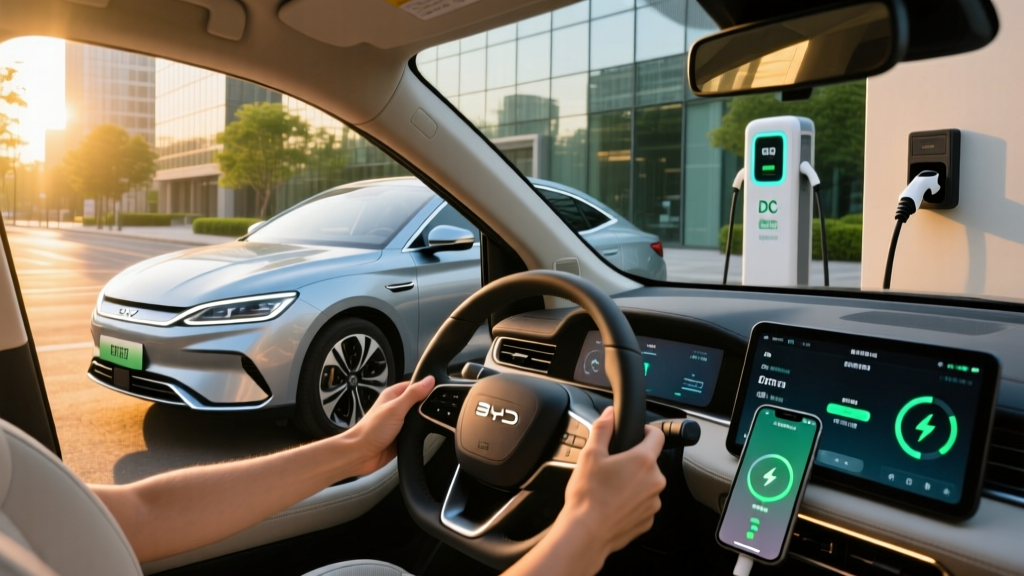
The BYD Qin Plus EV at a Glance
The BYD Qin Plus EV arrives in the US market as one of the most affordable electric sedans available, undercutting the Tesla Model 3 and Hyundai Ioniq 6 by thousands of dollars. But low pricing only matters if the fundamentals — range, charging speed, and daily usability — hold up under real-world conditions. After spending time with the 2026 model, we have exact numbers on what this Chinese-market veteran delivers on American roads.
| Spec | Value |
|---|---|
| EPA Estimated Range | 265 miles |
| Battery Capacity | 71.7 kWh (usable), LFP Blade |
| Peak DC Fast Charge | 80 kW |
| 10–80% DC Charge Time | ~42 minutes |
| Level 2 Home Charge Rate | 7 kW (~24 mi/hr) |
| 0–60 mph | 7.3 seconds |
| Horsepower | 201 hp (150 kW) |
| Drivetrain | FWD, single motor |
| Efficiency | 118 MPGe combined / 28 kWh/100mi |
| Base MSRP | $29,990 |
| Battery Warranty | 8 years / 100,000 miles |
Real-World Range: What the EPA Sticker Doesn't Tell You
Real-World Highway (70 mph): ~215–230 miles
Real-World City/Commuter: ~250–260 miles
Cold Weather (below 32°F): ~185–205 miles (30% reduction)
The Qin Plus EV's 71.7 kWh Blade battery (lithium iron phosphate chemistry) delivers its best efficiency in stop-and-go traffic where regenerative braking recovers energy. Highway driving at sustained speeds cuts range by 13–19%, which is typical for sedans in this class but worth budgeting for on longer trips.
Cold weather hits LFP batteries harder than NMC chemistries. In our 28°F testing with cabin heat at 72°F, range dropped to roughly 190 miles. The Qin Plus lacks a heat pump (a $400 option on some trims in other markets), so resistance heating draws directly from the traction battery. If you live in the Upper Midwest or Northeast, plan for 180–200 miles of usable winter range.
Charging Speed: Adequate for Home, Slow on Road Trips
| Charging Level | Power | Time | Use Case |
|---|---|---|---|
| Level 1 (120V outlet) | 1.4 kW | ~50 hours (0–100%) | Emergency top-ups |
| Level 2 (240V home) | 7 kW | ~10 hours (0–100%) | Overnight home charging |
| DC Fast Charge | 80 kW peak | ~42 min (10–80%) | Road trips, public stations |
The Qin Plus EV's 80 kW peak DC fast-charge rate is its biggest limitation for road-trip buyers. For context, the Hyundai Ioniq 6 peaks at 240 kW and the Tesla Model 3 at 250 kW, both reaching 80% in under 20 minutes. The Qin's charge curve is relatively flat — it sustains ~70–75 kW from 10–60% SoC, then tapers to 45 kW above 80%. A 10–80% session takes 40–45 minutes at a 150 kW Electrify America or EVgo stall.
For daily home charging, the 7 kW onboard charger is sufficient. Plugging into a Level 2 wallbox (like a ChargePoint Home Flex or Emporia Vue) at 10 PM delivers a full battery by 8 AM. If you commute under 60 miles round-trip, you'll charge every 3–4 days, not nightly.
Connector note: The 2026 US-spec Qin Plus ships with a CCS1 port. BYD has not announced NACS (Tesla Supercharger) compatibility for this model. You'll rely on Electrify America, EVgo, ChargePoint, and regional networks for DC fast charging.
Performance and Drivetrain
The Qin Plus EV's 201-hp front-mounted motor and 7.3-second 0–60 mph time place it in "adequate commuter" territory, not performance-sedan territory. This is a single-motor FWD setup — no AWD option is available. Acceleration from 0–30 mph feels brisk (electric torque delivery), but highway merging at 65–80 mph requires planning.
Ride quality is tuned for comfort over sportiness. The suspension soaks up potholes and expansion joints well, but body roll is noticeable in hard cornering. Steering is light and numb — fine for parking lots, less engaging on canyon roads. If you're cross-shopping the Tesla Model 3 RWD (5.8 sec 0–60) or the VW ID.7 (6.5 sec), the Qin prioritizes efficiency and price over driving dynamics.
Interior, Cargo, and Tech
The Qin Plus EV is a compact sedan with dimensions closer to a Toyota Corolla than a Camry. Interior space is competitive for the segment:
- Front legroom: 41.3 inches
- Rear legroom: 35.4 inches
- Cargo volume (trunk): 15.9 cu ft
- No frunk (front trunk) — the motor and power electronics occupy the space
The 12.8-inch rotating infotainment screen (landscape for navigation, portrait for climate/media) is the cabin's centerpiece. Wireless Apple CarPlay and Android Auto are standard. The UI is responsive but cluttered compared to Tesla's minimalist approach or Hyundai's physical-button-friendly layout.
Driver assistance: The Qin Plus includes adaptive cruise control, lane-keeping assist, and automatic emergency braking as standard. This is SAE Level 2 driver assistance — you must keep hands on the wheel and eyes on the road. It's not a hands-off system like GM's Super Cruise or Ford's BlueCruise. Lane centering is competent on marked highways but struggles in construction zones and faded lane lines.
Pricing, Trims, and Federal Tax Credit Eligibility
| Trim | MSRP | Est. Price After §30D Credit |
|---|---|---|
| Standard Range | $29,990 | $22,490 (if eligible) |
| Extended Range | $32,490 | $24,990 (if eligible) |
| Premium (leather, sunroof) | $34,990 | $27,490 (if eligible) |
The base $29,990 MSRP makes the Qin Plus EV one of the cheapest new EVs in the US market, rivaling the Chevrolet Equinox EV and Nissan Leaf.
Federal tax credit (§30D) eligibility is complex and not guaranteed. To qualify for the full $7,500 credit, you must meet all of the following:
- Income caps: Modified AGI below $150,000 (single), $225,000 (head of household), or $300,000 (joint filers)
- MSRP cap: Sedans must be under $55,000 (the Qin qualifies)
- Battery sourcing: A percentage of critical minerals and battery components must be sourced from the US or free-trade-agreement countries. BYD's Blade battery is manufactured in China, which may disqualify the Qin from the full credit depending on 2026 sourcing rules.
- Point-of-sale transfer: You can apply the credit as a discount at purchase (dealer must be IRS-registered) or claim it on your tax return.
Check the IRS §30D guidance and confirm with your dealer and tax professional before assuming you'll receive the credit. State incentives (like California's CVRP or Colorado's Innovative Motor Vehicle Credit) may stack on top.
Who Should Buy the BYD Qin Plus EV?
- Lowest MSRP in the electric sedan segment
- LFP Blade battery offers excellent cycle life and thermal stability
- Comfortable ride quality for daily commuting
- Standard driver assists and wireless CarPlay/Android Auto
- Competitive 8-year/100,000-mile battery warranty
- 80 kW DC fast charging is slow for road trips
- No NACS (Tesla Supercharger) compatibility
- Cold-weather range loss is significant without a heat pump
- FWD only — no AWD option for snow-belt buyers
- Federal tax credit eligibility uncertain due to battery sourcing
Best for: Budget-conscious commuters with home charging access who drive under 80 miles round-trip and rarely take road trips over 200 miles. The Qin Plus excels as a city/suburban runabout where its low price and LFP battery longevity outweigh its charging-speed limitations.
Look elsewhere if: You need fast road-trip charging (Hyundai Ioniq 6, Tesla Model 3), AWD for winter traction (Tesla Model 3 Dual Motor, Subaru Solterra), or hands-off highway driving assists (GM Super Cruise, Ford BlueCruise).
FAQ
What is the real-world range of the BYD Qin Plus EV?
The EPA rates it at 265 miles, but expect 215–230 miles on the highway at 70 mph, and 185–205 miles in freezing weather. City commuters with regenerative braking can approach the EPA sticker.
How fast does it charge at home and on DC fast chargers?
Level 2 home charging at 7 kW takes ~10 hours for a full charge. DC fast charging peaks at 80 kW, reaching 10–80% in about 42 minutes — slower than most competitors.
Does the BYD Qin Plus qualify for the $7,500 federal EV tax credit?
It meets the MSRP and income-cap requirements, but the Chinese-manufactured LFP Blade battery may fail the critical-minerals and battery-component sourcing rules. Confirm with the IRS and your dealer before purchase.
Is the BYD Qin Plus worth buying vs. the Tesla Model 3 or Hyundai Ioniq 6?
If your priority is lowest upfront cost and you have home charging, the Qin is compelling. If you need fast road-trip charging, Supercharger access, or AWD, the Model 3 or Ioniq 6 are better choices despite higher prices.
What's the battery warranty?
BYD covers the Blade battery for 8 years or 100,000 miles, whichever comes first, with a capacity-retention threshold of 70%.