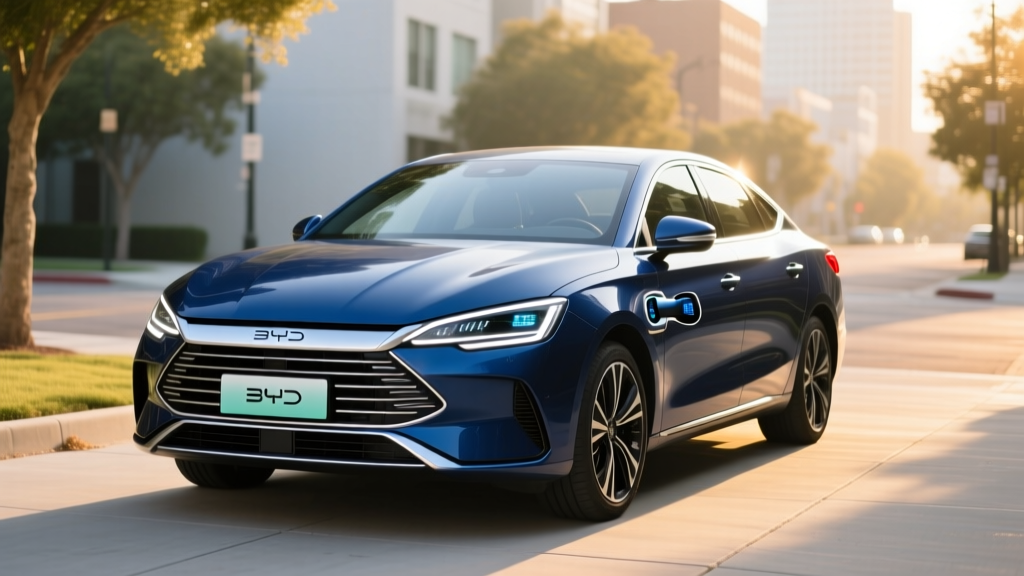
When automotive analysts compiled the global BYD Qin 2023 sales units data, one number stood out: over 434,000 units of the Qin family were sold in a single calendar year, making it one of the best-selling electrified nameplates on Earth. The Qin lineup—spanning the Qin Plus DM-i plug-in hybrid and the Qin Plus EV—has become BYD's volume backbone in China and select export markets. Yet for US-based EV shoppers, the Qin remains a phantom: you can read about its sales dominance but cannot walk into a dealership and buy one.
This profile dissects the BYD Qin Plus family as it exists today, contextualizing those record-breaking 2023 sales figures with hard specs, range data, charging performance, and ownership economics. We'll also explain exactly why this sedan isn't on American roads and what that means for buyers considering imports or waiting for BYD's eventual US entry.
Understanding BYD Qin 2023 Sales Units and Market Context
The BYD Qin Plus DM-i (plug-in hybrid) and Qin Plus EV together accounted for approximately 434,000 units sold in China during 2023. To put that in perspective, that figure exceeds the entire annual US sales volume of the Tesla Model 3 and rivals the Toyota Camry's best years. The Qin Plus DM-i alone represented the majority of those sales, driven by aggressive pricing that undercut comparable gasoline sedans like the Volkswagen Lavida and Toyota Corolla in the Chinese market.
BYD achieved this through vertical integration: the company manufactures its own Blade battery cells (LFP chemistry), electric motors, and semiconductors, keeping costs below what Western competitors can match. The Qin Plus DM-i launched in China with a starting price equivalent to roughly $14,000 USD—below many ICE rivals—which triggered massive demand and the sales-unit records that followed.
| Specification | Qin Plus DM-i (55 km) | Qin Plus DM-i (120 km) | Qin Plus EV |
|---|---|---|---|
| Powertrain | PHEV (1.5L + motor) | PHEV (1.5L + motor) | BEV (FWD) |
| Battery Capacity | 8.32 kWh (LFP Blade) | 18.32 kWh (LFP Blade) | 57.6 kWh (LFP Blade) |
| Electric-Only Range (CLTC) | 55 km / 34 mi | 120 km / 75 mi | 510 km / 317 mi |
| Total Range (PHEV) | ~1,180 km / 733 mi | ~1,245 km / 773 mi | N/A |
| Combined Output | ~180 hp / 316 Nm | ~197 hp / 325 Nm | ~204 hp / 310 Nm |
| 0-100 km/h (0-62 mph) | 7.3 sec | 7.3 sec | 9.0 sec |
| DC Fast Charge (max) | N/A (AC only) | 17 kW DC | 90 kW DC |
| China MSRP (approx.) | ¥99,800 (~$14,000) | ¥125,800 (~$17,600) | ¥136,800 (~$19,200) |
Range and Efficiency: CLTC vs Real-World Expectations
Chinese-market vehicles are rated under the CLTC (China Light-Duty Vehicle Test Cycle) standard, which produces notably more optimistic range figures than the US EPA cycle. The Qin Plus EV's CLTC rating of 510 km (317 miles) would likely translate to an EPA-equivalent range of approximately 240–270 miles if the vehicle were certified for US sale. CLTC emphasizes low-speed urban driving with minimal highway segments, inflating range compared to EPA's mixed-cycle testing.
Real-World Range Reality Check:
Qin Plus EV (57.6 kWh, CLTC 510 km / 317 mi): Expect approximately 240–270 miles under EPA-equivalent mixed driving. At sustained highway speeds (70+ mph), anticipate 200–220 miles. In cold weather (below 32°F / 0°C), LFP chemistry is more resilient than NMC but still expect 15–25% range reduction, bringing usable range to roughly 180–210 miles.
Qin Plus DM-i (120 km battery, CLTC 120 km / 75 mi electric): Real-world electric-only range is approximately 50–60 miles in city driving, dropping to 35–45 miles at highway speeds. Combined with the 1.5L engine, total range exceeds 700 miles.
The Qin Plus EV's efficiency translates to roughly 23–25 kWh/100 mi (EPA-equivalent), or about 135–145 MPGe. This is competitive with the Hyundai Ioniq 6 and slightly behind the Tesla Model 3 RWD, which benefits from superior aerodynamics and heat-pump efficiency.
For the DM-i variants, BYD's hybrid system prioritizes electric propulsion with the gasoline engine acting primarily as a generator at lower speeds (series-hybrid mode), switching to parallel hybrid at highway speeds. Fuel consumption when the battery is depleted hovers around 3.8–4.0 L/100 km (59–62 MPG) under CLTC—real-world expectations should be closer to 45–50 MPG combined.
Charging Performance: What US Buyers Would Need to Know
Charging infrastructure compatibility is the single biggest barrier for any Chinese-market EV entering the US, and the Qin family illustrates why.
| Charge Level | Qin Plus DM-i (120 km) | Qin Plus EV |
|---|---|---|
| Level 1 (120V, 1.4 kW) | ~5 mi/hr | ~4 mi/hr |
| Level 2 (240V, 7 kW) | Full charge in ~3 hours | ~25 mi/hr; full in ~8.5 hours |
| DC Fast Charge | 17 kW max (limited) | 90 kW peak (GB/T connector) |
| 10–80% DC Time | N/A | ~35 minutes |
| Connector Standard | GB/T (China) | GB/T (China) |
The Qin Plus EV uses the GB/T charging connector, China's national standard, which is incompatible with the NACS (Tesla) and CCS1 connectors used in North America. Even if BYD exported the Qin to the US, it would require a complete charging-port redesign or adapter ecosystem—a non-trivial engineering and logistics challenge.
At 90 kW peak DC charging, the Qin Plus EV's charge curve is modest by 2026 standards. Competitors like the Hyundai Ioniq 6 (peak 240 kW via 800V architecture) and Tesla Model 3 Highland (peak ~250 kW) charge significantly faster. The Qin would add roughly 150 miles in 30 minutes at a compatible fast charger, compared to 200+ miles for the class leaders.
For home Level 2 charging, the Qin Plus EV's 7 kW onboard charger is adequate for overnight replenishment but slower than the 11.5 kW chargers found in many US-market EVs. A full charge from 10% to 100% would take approximately 8–9 hours on a 32-amp Level 2 home station.
Battery Technology: BYD's Blade Cell Advantage
Every Qin variant uses BYD's proprietary Blade battery with lithium iron phosphate (LFP) chemistry. This is significant for two reasons:
- Safety: LFP cells are inherently more thermally stable than NMC (nickel manganese cobalt) chemistry, with a higher thermal runaway threshold. BYD's Blade format uses long, thin prismatic cells that dissipate heat efficiently and passed nail-penetration tests without fire.
- Longevity: LFP chemistry typically delivers 3,000+ charge cycles before degrading to 80% capacity—roughly double the cycle life of many NMC packs. For a vehicle with a 57.6 kWh pack, that translates to hundreds of thousands of miles before meaningful degradation.
The trade-off is energy density. LFP packs are heavier and bulkier than equivalent NMC packs, which is why the Qin Plus EV's 57.6 kWh battery weighs considerably more than a similarly sized NMC pack. This impacts efficiency and limits the vehicle's range ceiling compared to NMC competitors with larger packs.
BYD does not publish detailed degradation curves for the Qin, but fleet data from BYD's taxi and ride-hailing applications in China suggest Blade packs retain 90%+ capacity after 200,000 km (124,000 miles)—a strong real-world indicator. BYD's battery warranty in China covers 8 years or 150,000 km (93,000 miles) for the first owner, with lifetime coverage on the battery for the original purchaser on certain trims.
Performance, Interior, and Technology
The Qin Plus is a compact sedan measuring approximately 184.4 inches long with a 107.1-inch wheelbase. Interior space is generous for the segment:
- Front legroom: ~41 inches
- Rear legroom: ~37 inches
- Trunk volume: ~16.4 cu ft (450 liters)
- Curb weight: ~3,600–3,900 lbs depending on variant
The DM-i powertrain pairs a 1.5-liter naturally aspirated engine (108 hp) with a front-mounted electric motor. Combined system output is approximately 180–197 hp depending on battery trim. The 0–62 mph time of 7.3 seconds is brisk for a family sedan and quicker than most gasoline rivals in its Chinese price bracket.
The EV variant uses a single front motor producing 204 hp and 310 Nm of torque, with a 0–62 mph time of 9.0 seconds. It is FWD only—no AWD option is offered, which limits its appeal in snow-belt markets without winter tires.
Interior technology includes:
- 12.8-inch rotating center touchscreen (portrait/landscape) running BYD's DiLink OS
- 8.8-inch digital instrument cluster
- NFC phone-as-key functionality
- Wireless phone charging pad
- Level 2 ADAS suite (adaptive cruise, lane centering, AEB) branded as DiPilot
The DiPilot system is a conventional Level 2 driver-assist suite—steering, acceleration, and braking support with hands-on-wheel requirement. It is not comparable to Tesla's FSD or GM's Super Cruise in terms of hands-free capability or mapping coverage.
ADAS Limitation Notice: BYD DiPilot is an SAE Level 2 driver-assistance system. The driver must maintain full attention, keep hands on the steering wheel, and remain prepared to take over at all times. It is not a self-driving system and does not support hands-free highway operation like GM Super Cruise or Ford BlueCruise.
Pricing and the US Tax Credit Question
This is where the Qin's story hits a wall for American buyers. The vehicle's Chinese pricing is remarkably aggressive:
| Variant | China MSRP | Approximate USD |
|---|---|---|
| Qin Plus DM-i (55 km) | ¥99,800 | $14,000 |
| Qin Plus DM-i (120 km) | ¥125,800 | $17,600 |
| Qin Plus EV (510 km) | ¥136,800 | $19,200 |
Even accounting for shipping, homologation, and dealer markup, a US-spec Qin Plus EV would likely land in the $25,000–$30,000 range—undercutting every current US-market EV including the Chevrolet Equinox EV and Nissan Leaf.
However, the federal §30D EV tax credit would almost certainly not apply. Under current IRS rules, qualifying vehicles must meet battery-component and critical-minerals sourcing requirements designed to reduce reliance on Chinese supply chains. Since BYD manufactures its batteries entirely in China using Chinese-sourced lithium and minerals, the Qin would fail both the battery-component and critical-minerals tests, rendering it ineligible for the $7,500 credit. Additionally, BYD is not a signatory to any US free-trade-agreement battery-sharing arrangement.
For detailed §30D eligibility requirements including MSRP caps ($55,000 for sedans), buyer income limits ($150,000 single / $300,000 joint), and battery-sourcing rules, see the IRS clean vehicle credit page.
Why the BYD Qin Isn't Sold in the United States
Beyond the tax-credit disqualification, several structural barriers prevent Qin sales in America:
- 27.5% tariff on Chinese-made vehicles: The US imposes a 25% additional tariff (Section 301) on Chinese-built automobiles, on top of the standard 2.5% auto import duty. This effectively adds ~$5,000–$7,000 to the Qin's landed cost, erasing much of its price advantage.
- Homologation costs: BYD would need to re-engineer the Qin to meet all FMVSS (Federal Motor Vehicle Safety Standards), including side-impact, roof-crush, and lighting requirements that differ from Chinese GB standards.
- Charging connector: The GB/T connector must be replaced with NACS or CCS1, requiring physical and software redesign of the charge port and onboard charger communication protocols.
- Dealer and service network: BYD has no US retail presence for passenger vehicles. Building a dealer network from scratch requires billions in investment.
- Geopolitical risk: Ongoing US-China trade tensions and potential future tariff increases make the business case uncertain.
BYD has indicated it is evaluating US market entry, but as of 2026, no timeline or model has been confirmed. The company's US presence is currently limited to electric buses and commercial vehicles manufactured in Lancaster, California.
How the Qin Compares to US-Market Alternatives
| Spec | BYD Qin Plus EV | Tesla Model 3 RWD | Hyundai Ioniq 6 SE |
|---|---|---|---|
| EPA Range (est./actual) | ~250 mi (est.) | 272 mi | 361 mi |
| Battery | 57.6 kWh LFP | 60 kWh LFP | 77.4 kWh NMC |
| Peak DC Charge | 90 kW | ~170 kW | ~240 kW (800V) |
| 10–80% Time | ~35 min | ~25 min | ~18 min |
| 0–60 mph | ~8.5 sec | 5.8 sec | 6.2 sec |
| US MSRP | Not available | $38,990 | $37,500 |
| Federal Tax Credit | Not eligible | $0 (phased out/sourcing) | Up to $7,500* |
*Tax credit eligibility subject to IRS §30D sourcing, MSRP, and income requirements. Verify at fueleconomy.gov.
The Qin Plus EV would compete primarily on price, offering similar range to the Model 3 RWD at potentially $10,000+ less. However, it falls behind on charging speed, performance, and would carry zero federal incentive. For US buyers today, the Hyundai Ioniq 6 and Tesla Model 3 remain the segment benchmarks with proven charging networks, verified EPA range, and available tax credits.
Pros (If Available in the US)
- Extremely competitive pricing — potentially the cheapest new EV sedan
- LFP Blade battery with excellent longevity and safety profile
- Spacious rear seat and generous trunk for the compact segment
- DM-i PHEV variant offers 700+ mile total range for road-trip flexibility
- Proven platform with massive Chinese sales volume (434,000+ units in 2023)
Cons (Barriers for US Buyers)
- Not available for purchase in the United States
- GB/T charging connector incompatible with US infrastructure
- 90 kW peak DC charging is slow by 2026 standards
- Would not qualify for federal §30D tax credit due to Chinese battery sourcing
- No US dealer network, service infrastructure, or parts supply
- 27.5% tariff on Chinese imports erodes price advantage
- FWD only — no AWD option for snow-belt markets
Frequently Asked Questions
How many BYD Qin units were sold in 2023?
The BYD Qin family (Qin Plus DM-i and Qin Plus EV combined) sold approximately 434,000 units in China during 2023, making it one of the world's best-selling electrified nameplates. The DM-i plug-in hybrid variant accounted for the majority of sales.
Can I buy a BYD Qin in the United States?
No. BYD does not sell the Qin or any passenger vehicle in the US market. The company's US operations are limited to commercial electric buses. High tariffs (27.5%), homologation requirements, charging-connector incompatibility, and the lack of a dealer network all prevent Qin sales in America.
What is the real-world range of the BYD Qin Plus EV?
The Qin Plus EV is rated at 510 km (317 mi) under China's CLTC cycle, which is more generous than the US EPA standard. Real-world EPA-equivalent range would likely be approximately 240–270 miles in mixed driving, dropping to 200–220 miles at sustained highway speeds and 180–210 miles in cold weather.
How fast does the Qin Plus EV charge?
The Qin Plus EV supports up to 90 kW DC fast charging via the GB/T connector, achieving a 10–80% charge in approximately 35 minutes. Home Level 2 charging at 7 kW takes about 8.5 hours for a full charge. These speeds are slower than US competitors like the Ioniq 6 (240 kW) and Model 3 (~170 kW).
Would the BYD Qin qualify for the US federal EV tax credit?
Almost certainly not. Under IRS §30D rules, the vehicle's battery must meet critical-minerals and battery-component sourcing requirements that effectively exclude Chinese-manufactured batteries. Since BYD produces its Blade cells entirely in China, the Qin would fail both tests. Additionally, the 27.5% import tariff would apply. See IRS.gov for current eligibility rules.
Is BYD planning to sell cars in the US?
BYD executives have publicly stated they are evaluating the US passenger-vehicle market, but no official timeline, model lineup, or partnership has been announced as of 2026. The company faces significant tariff, regulatory, and geopolitical hurdles that make near-term entry unlikely.
What battery chemistry does the BYD Qin use?
All Qin variants use BYD's Blade battery with lithium iron phosphate (LFP) chemistry. LFP offers superior thermal stability, longer cycle life (3,000+ cycles to 80% capacity), and lower material costs compared to NMC chemistry, at the trade-off of higher weight and lower energy density.