BYD's 2026 Momentum: What Q1 Sales Numbers Tell Us
BYD closed out 2025 as the world's largest plug-in vehicle manufacturer, and the first quarter of 2026 confirmed the trend isn't slowing. Global BYD Q1 2026 BEV sales surpassed 1.1 million battery-electric units alone, with plug-in hybrids adding another ~900,000 units — a combined total that dwarfs any single competitor's quarterly output. For US-based EV shoppers, those numbers raise an obvious question: when — or if — will BYD's increasingly competitive lineup reach American driveways?
This profile breaks down what BYD's Q1 2026 sales performance means, examines the models driving that volume, analyzes the regulatory and tariff barriers to US entry, and provides a practical decision framework for buyers wondering whether to wait or choose from vehicles already available stateside.
Inside the Numbers: BYD Q1 2026 BEV Sales Breakdown
| Metric | Q1 2026 | Q1 2025 | YoY Change |
|---|---|---|---|
| Total BEV Sales (Global) | ~1,100,000 | ~840,000 | +31% |
| Total NEV Sales (BEV + PHEV) | ~2,000,000 | ~1,600,000 | +25% |
| Export Sales (All Markets) | ~280,000 | ~180,000 | +56% |
| Top BEV Model (Global) | Seagull / Dolphin Mini | — | — |
BYD's Q1 2026 BEV sales growth was driven by three factors: continued domestic Chinese market dominance, aggressive expansion into Southeast Asia and Latin America, and the ramp-up of the Seagull subcompact — a vehicle that starts under $10,000 USD in China and has become a global phenomenon in affordable EV markets.
Export growth is the headline for Western observers. BYD's 56% year-over-year export increase signals the company is serious about markets beyond China, even as it faces tariff headwinds in both the European Union and the United States.
Key Models Driving BYD's Global Volume
BYD's 2026 lineup spans from ultra-affordable city cars to premium SUVs. Here are the models most relevant to understanding the company's competitive position — and the ones American buyers are most likely to encounter in coverage or eventual import discussions.
- BYD Seagull — Subcompact hatchback; 305-405 km CLTC range; Blade LFP battery; from ~$9,500 USD (China)
- BYD Dolphin — Compact hatchback; 340-490 km CLTC range; Blade LFP battery; from ~$15,000 USD (export markets)
- BYD Atto 3 (Yuan Plus) — Compact crossover SUV; 420-510 km CLTC range; Blade LFP; from ~$30,000 USD (export)
- BYD Seal — Midsize sport sedan; 520-700 km CLTC range; LFP or NMC options; from ~$35,000 USD (export)
- BYD Seal U — Midsize SUV; 500-560 km CLTC range; Blade LFP; from ~$38,000 USD (export)
- BYD Han EV — Flagship sedan; 506-715 km CLTC range; Blade LFP; from ~$42,000 USD (export)
Several things stand out about this lineup. First, BYD exclusively uses its proprietary Blade Battery — a lithium iron phosphate (LFP) cell in a cell-to-pack configuration that prioritizes safety and longevity over maximum energy density. Second, range figures above are CLTC (China Light-Duty Vehicle Test Cycle), which runs 20-30% more optimistic than US EPA testing. A Seal rated at 700 km CLTC would likely earn an EPA estimate closer to 310-340 miles.
US Availability: The Tariff and Regulatory Wall
Despite BYD Q1 2026 BEV sales topping a million units globally, American consumers cannot purchase a new BYD vehicle in the United States. Three barriers remain firmly in place:
1. Section 301 Tariffs on Chinese EVs. In 2024, the US raised tariffs on Chinese-made electric vehicles to 100%, effectively doubling the landed cost of any BYD imported into the country. As of 2026, these tariffs remain in effect. A $30,000 Atto 3 would cost over $60,000 before shipping and dealer markup — eliminating the price advantage that defines BYD's value proposition.
2. Federal Tax Credit Ineligibility. Under IRS §30D rules, any vehicle with battery components or critical minerals sourced from a "foreign entity of concern" (FEOC) — which includes Chinese manufacturers — is disqualified from the up-to-$7,500 federal tax credit. Even if BYD built a US factory, battery sourcing rules would likely disqualify its vehicles from the credit for years.
3. No US Dealer Network or Homologation. BYD has made no public announcement of a US retail strategy. Vehicles sold in the US must meet NHTSA safety standards, EPA emissions certification (where applicable), and FMVSS requirements — a multi-year process that BYD has not publicly initiated for its passenger vehicles.
What BYD's LFP Blade Battery Means — and Why It Matters
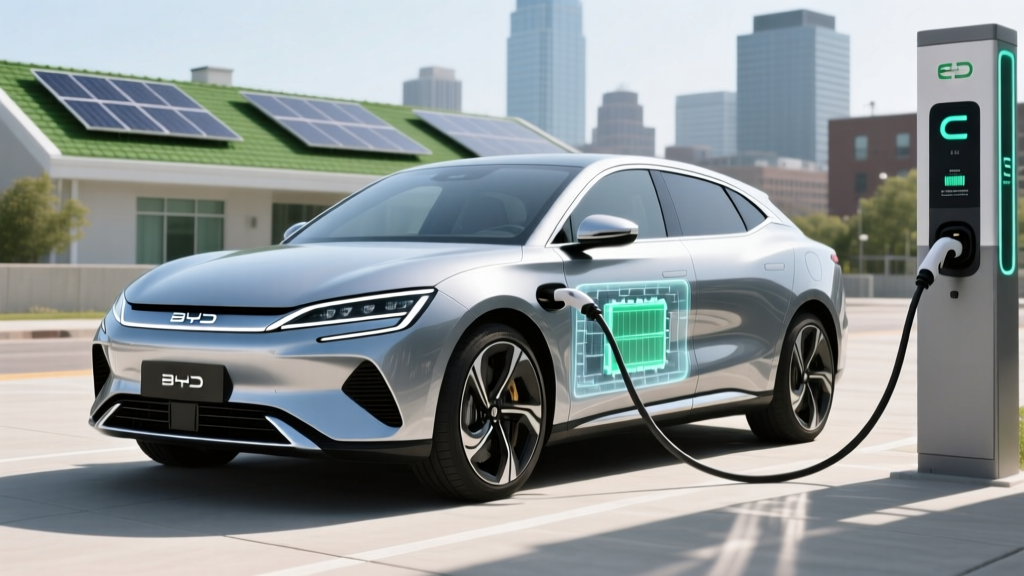
Even if you can't buy a BYD in the US, the company's battery strategy has influenced the entire EV industry. BYD's Blade Battery is an LFP (lithium iron phosphate) design that uses a unique long, thin cell format arranged directly into the pack without modules — a "cell-to-pack" architecture that improves volumetric efficiency.
| Attribute | BYD Blade (LFP) | Typical NMC Pack |
|---|---|---|
| Chemistry | Lithium Iron Phosphate | Nickel Manganese Cobalt |
| Energy Density | ~150 Wh/kg (cell) | ~220-260 Wh/kg (cell) |
| Cycle Life | 3,000+ cycles to 80% SoH | 1,000-2,000 cycles to 80% SoH |
| Thermal Stability | Excellent — passes nail penetration test | Good — requires robust thermal management |
| Cold-Weather Performance | Moderate range loss (~30-35%) | Better low-temp performance (~20-25% loss) |
| Cost per kWh | Lower | Higher |
| Cobalt/Nickel | None | Required — supply chain risk |
LFP's trade-offs are clear: you sacrifice some energy density (meaning heavier packs for the same range) and some cold-weather efficiency, but gain dramatically longer cycle life, better safety margins, and lower cost. This is why Tesla now uses LFP in standard-range Model 3 and Model Y vehicles — BYD's success proved LFP's viability at scale.
For US buyers, this matters because any EV you purchase with an LFP battery — whether from Tesla, Ford (in some trims), or Rivian (planned) — owes part of its existence to the LFP supply chain BYD helped build.
Competitive Alternatives Available to US Buyers Now
Since BYD isn't an option, here's how the competitive landscape looks for buyers who might otherwise be drawn to BYD's value-oriented positioning. These are US-available EVs that compete in the segments BYD targets globally.
| Vehicle | EPA Range | Battery (kWh) | Base MSRP | §30D Credit Eligible? |
|---|---|---|---|---|
| Chevrolet Equinox EV | 319 mi | 85 kWh (NMC) | ~$33,600 | Yes (check sourcing) |
| Hyundai Ioniq 5 (Std Range) | 245 mi | 58 kWh (NMC) | ~$42,600 | Yes (US-built) |
| Tesla Model 3 RWD | 272 mi | 57.5 kWh (LFP) | ~$38,990 | Yes (check sourcing) |
| Nissan Leaf SV Plus | 212 mi | 60 kWh (NMC) | ~$36,000 | Yes (check sourcing) |
| Volkswagen ID.4 Pro | 291 mi | 82 kWh (NMC) | ~$40,000 | Yes (US-built) |
The closest US-market analog to BYD's value proposition is the Chevrolet Equinox EV, which offers over 300 miles of EPA range starting near $34,000 — a price point that, after the §30D credit (if eligible), can dip below $27,000. Tesla's LFP-equipped Model 3 RWD similarly echoes BYD's chemistry strategy, though at a higher starting price.
- Buyer AGI: ≤$150,000 (single) / ≤$300,000 (joint)
- MSRP cap: ≤$55,000 (sedans) / ≤$80,000 (SUVs/trucks/vans)
- Battery sourcing: Components and critical minerals must NOT come from FEOC entities (phased in annually — check IRS guidance)
- Point-of-sale transfer available through registered dealers
Decision Framework: Should You Wait for BYD?
The short answer: no, you should not delay an EV purchase waiting for BYD to enter the US market. Here's why, and what to do instead.
- You need a vehicle within the next 12 months
- You want to take advantage of the §30D credit while current sourcing rules apply
- You value a local dealer network for service and warranty support
- You prefer EPA-tested range figures over CLTC estimates
- 100% tariff makes imports cost-prohibitive
- No US dealer, service, or parts network exists
- No announced timeline for US passenger vehicle entry
- FEOC sourcing rules would likely disqualify BYD from the federal tax credit even with domestic assembly
For buyers specifically drawn to LFP battery chemistry (longer lifespan, lower cost, cobalt-free), the Tesla Model 3 RWD and certain standard-range Ford models already offer LFP packs in the US market — giving you the chemistry benefits without the import uncertainty.
Frequently Asked Questions
How many EVs did BYD sell in Q1 2026?
BYD sold approximately 1.1 million battery-electric vehicles globally in Q1 2026, with total new energy vehicle (NEV) sales — including plug-in hybrids — approaching 2 million units. This represents roughly 25-30% year-over-year growth and reinforces BYD's position as the world's largest plug-in vehicle manufacturer by volume.
Can I buy a BYD electric car in the United States in 2026?
No. BYD does not sell passenger vehicles in the US market. A 100% Section 301 tariff on Chinese-made EVs, combined with the lack of a US dealer network and no announced homologation process, means there is currently no path to purchase a new BYD EV in the United States.
Would a BYD qualify for the $7,500 federal EV tax credit?
Almost certainly not, even if BYD began US sales. Under current IRS §30D rules, vehicles with battery components or critical minerals from foreign entities of concern (FEOC) — which includes Chinese manufacturers — are disqualified from the federal credit. BYD's vertically integrated supply chain is heavily China-sourced.
What battery chemistry does BYD use?
BYD exclusively uses its proprietary Blade Battery, which is based on lithium iron phosphate (LFP) chemistry. LFP offers excellent cycle life (3,000+ cycles), superior thermal stability, and zero cobalt content, but trades off some energy density and cold-weather performance compared to NMC chemistries used by many competitors.
What US EV comes closest to BYD's value proposition?
The Chevrolet Equinox EV (319 miles EPA, ~$33,600 base MSRP) is the closest US-market equivalent to BYD's value-oriented positioning. After the §30D credit (if eligible), effective pricing can approach the $26,000-$28,000 range — competitive with BYD's export pricing for the Atto 3 before tariffs.
Is BYD's Blade Battery safer than other EV batteries?
BYD's Blade Battery has demonstrated strong performance in nail penetration tests — a thermal runaway scenario where a steel nail is driven through the cell. LFP chemistry is inherently more thermally stable than NMC, reducing the risk of catastrophic thermal runaway. However, all EV batteries sold in the US must meet stringent NHTSA and UL safety standards, and real-world safety depends on pack-level engineering, not just cell chemistry.