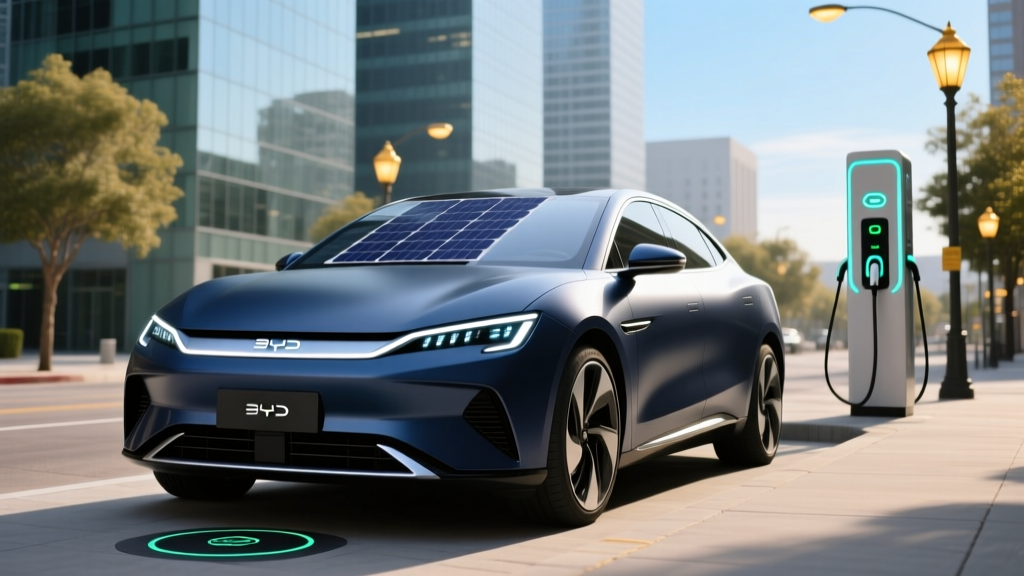
BYD continues to dominate global EV sales, but the question for American shoppers remains: when — and whether — these vehicles will arrive on US soil. Our analysis of the BYD light duty vehicle sales forecast 2026 examines the automaker's current lineup, projected growth, and what US buyers can realistically expect in terms of availability, pricing, and federal tax credit eligibility.
BYD's 2026 Sales Trajectory: Global Dominance, US Uncertainty
BYD (Build Your Dreams) has positioned itself as the world's largest EV manufacturer by unit volume, surpassing Tesla in total electrified vehicle sales when counting both BEVs and PHEVs. Industry analysts project BYD's global light duty vehicle sales to exceed 4.5 million units in 2026, with pure EVs (BEVs) accounting for roughly 55-60% of that total. However, the US market remains conspicuously absent from BYD's passenger vehicle strategy — at least for now.
The primary barriers to US market entry include:
- Tariff structure: A 100% tariff on Chinese-made EVs, implemented in 2024, effectively doubles the landed cost of any BYD passenger vehicle imported to the United States.
- Federal tax credit exclusion: Under IRS §30D rules, vehicles containing battery components from a "foreign entity of concern" (FEOC) — which includes Chinese manufacturers — are disqualified from the $7,500 federal credit. This applies to all 2026 model-year vehicles.
- Dealership and service infrastructure: BYD has no US passenger vehicle dealer network, service centers, or parts distribution for light duty cars and crossovers.
Despite these headwinds, BYD's global lineup offers a compelling preview of the price-to-spec ratios that may eventually pressure incumbent automakers — and understanding these vehicles helps US buyers benchmark value in the current market.
BYD's Core 2026 Light Duty Lineup: Specs That Matter
Below is a consolidated spec table covering BYD's most globally relevant light duty EVs for the 2026 model year. Note that these figures reflect international and Chinese domestic market specifications; EPA certification would be required for US sales and may yield different range results.
| Model | Battery (kWh) | Chemistry | WLTP Range | 0-60 mph | HP | Drivetrain | Global MSRP (USD equiv.) |
|---|---|---|---|---|---|---|---|
| Seal (sedan) | 82.5 kWh | LFP (Blade) | 354 mi | 5.9s (RWD) / 3.8s (AWD) | 215 (RWD) / 523 (AWD) | RWD or AWD | $34,000–$48,000 |
| Atto 3 (compact SUV) | 60.5 kWh | LFP (Blade) | 260 mi | 7.3s | 201 | FWD | $28,000–$36,000 |
| Dolphin (subcompact) | 60.4 kWh | LFP (Blade) | 265 mi | 7.0s | 201 | FWD | $22,000–$30,000 |
| Seal U (midsize SUV) | 87.0 kWh | LFP (Blade) | 311 mi | 6.7s | 308 | AWD | $38,000–$50,000 |
Charging Performance: DC Fast and Level 2 Rates
Charging speed is where BYD's LFP Blade battery architecture reveals both strengths and limitations. LFP cells are inherently more tolerant of high state-of-charge (SoC) stress, meaning owners can routinely charge to 100% without the degradation concerns associated with NMC batteries. However, peak DC fast-charge rates lag behind the 800V architectures now common in Hyundai/Kia and Porsche platforms.
| Model | Max DC Fast Charge | 10-80% Time | Level 2 Rate | Level 2 Miles/Hr | Connector |
|---|---|---|---|---|---|
| Seal | 150 kW | ~26 min | 11 kW (AC) | ~32 mi/hr | CCS2 (intl) / GB/T (China) |
| Atto 3 | 88 kW | ~36 min | 7.2 kW (AC) | ~22 mi/hr | CCS2 / GB/T |
| Dolphin | 88 kW | ~34 min | 7.2 kW (AC) | ~24 mi/hr | CCS2 / GB/T |
| Seal U | 140 kW | ~30 min | 11 kW (AC) | ~30 mi/hr | CCS2 / GB/T |
For context, the Hyundai Ioniq 5 peaks at 240 kW on a 350 kW charger, achieving 10-80% in approximately 18 minutes. The Tesla Model 3 Highland can sustain 250 kW at V3 Superchargers. BYD's 150 kW peak on the Seal is adequate for road trips but represents a generational gap in charge speed. On the practical side, BYD's LFP batteries tolerate frequent 100% top-offs, which partially offsets the slower DC charging by allowing owners to maximize usable range.
The charge curve taper is significant: BYD vehicles typically hold peak rate only between 10-40% SoC, then step down progressively. Expect the final 40-80% segment to take roughly as long as the initial 10-40% segment. This is standard LFP behavior and not unique to BYD, but it's important for road-trip planning.
Battery Technology: The Blade Cell Advantage
BYD's proprietary Blade Battery uses lithium iron phosphate (LFP) chemistry arranged in a cell-to-pack configuration that eliminates traditional module housings. The result is a structurally integrated battery that BYD claims passes nail penetration testing without thermal runaway — a safety benchmark that NMC cells typically cannot meet.
| Characteristic | BYD LFP Blade | Typical NMC Pack |
|---|---|---|
| Energy density | ~140 Wh/kg (lower) | ~220 Wh/kg (higher) |
| Cycle life | 3,000+ cycles to 80% SoH | 1,500-2,000 cycles to 80% SoH |
| Cold-weather range loss | ~30-35% at 20°F | ~20-25% at 20°F |
| Thermal runaway risk | Very low | Moderate (requires BMS mitigation) |
| Charge to 100% regularly? | Yes, recommended for calibration | No, 80% daily recommended |
| Cobalt content | None | Contains cobalt/nickel |
The trade-off is clear: BYD sacrifices energy density (meaning heavier packs for equivalent range) in exchange for longevity, safety, and cobalt-free sourcing. For a commuter vehicle charged at home nightly, the 3,000+ cycle life translates to roughly 500,000+ miles before reaching 80% state of health — effectively outlasting the vehicle itself.
Pricing, Tax Credits, and the US Availability Question
Even if BYD were to enter the US passenger vehicle market in 2026, the economic picture would be challenging. Here's the math:
| Model | Global MSRP | +100% Tariff | Estimated Landed Price | Federal §30D Credit | Effective Price |
|---|---|---|---|---|---|
| Dolphin | $26,000 | +$26,000 | ~$55,000* | $0 (FEOC exclusion) | ~$55,000 |
| Atto 3 | $32,000 | +$32,000 | ~$67,000* | $0 | ~$67,000 |
| Seal | $40,000 | +$40,000 | ~$84,000* | $0 | ~$84,000 |
*Includes estimated shipping, compliance, and dealer markup.
At these landed prices, BYD vehicles lose their primary competitive advantage — affordability. A $55,000 Dolphin competes against the Chevrolet Equinox EV (EPA 319 mi, ~$33,000 before credits) and the Tesla Model 3 (EPA 363 mi, ~$38,990 before credits). The economics simply don't work under current trade policy.
Where BYD IS Selling: The Global Sales Forecast
BYD's 2026 light duty vehicle sales growth is concentrated in markets where tariffs are lower, trade agreements are favorable, or local manufacturing is underway:
- China (domestic): ~2.8 million light duty units projected. BYD commands roughly 35% of China's NEV (new energy vehicle) market.
- Southeast Asia: Thailand, Indonesia, and Vietnam are growth markets. BYD opened a Thailand factory in 2024 and is expanding regional distribution.
- Europe: ~450,000-500,000 units projected. The EU imposed countervailing duties on Chinese EVs in 2024 (ranging 17-36% for BYD), but the brand remains price-competitive against European OEMs.
- Latin America: Brazil is a key growth market. BYD opened a production facility in Camaçari, Bahia, in 2025, targeting 150,000+ annual units for the region.
- Australia/New Zealand: ~60,000-80,000 units. No tariff barriers comparable to the US; BYD is a top-3 EV brand.
- Middle East & Africa: Emerging markets with growing EV adoption, minimal tariff friction.
According to industry analysis from MarkLines and EV-Volumes, BYD's total light duty vehicle sales forecast for 2026 sits between 4.2 and 4.8 million units globally — a roughly 15-20% year-over-year increase from 2025. This growth is driven by expanding PHEV sales (the DM-i hybrid platform) alongside BEV volume.
What This Means for US EV Shoppers in 2026
Even without direct BYD availability, the company's global pricing pressure affects US buyers indirectly:
- Competitive benchmarking: Automakers selling in the US must match BYD's spec-to-price ratio in global markets to remain viable. This pressure accelerates price cuts and feature additions on vehicles like the Tesla Model 3, Hyundai Ioniq 5, and Chevrolet Equinox EV.
- Battery supply chain: BYD's LFP Blade cell technology is licensed and supplied to other manufacturers. Expect to see Blade-derived cells in non-BYD vehicles over the next 2-3 years.
- Used market potential: If trade policy shifts, BYD's global fleet could eventually reach the US as used imports — though this is speculative and unlikely before 2028 at the earliest.
For US buyers evaluating current options, the practical takeaway is that BYD's global specs set a value ceiling. If a US-market EV doesn't offer competitive range, charging speed, and battery warranty relative to BYD's global pricing (adjusted for tariffs and credits), it may be overpriced. Use BYD's spec sheet as a benchmark, not a shopping list.
Frequently Asked Questions
Can I buy a BYD car in the United States in 2026?
No. BYD does not sell passenger vehicles in the US market as of 2026. The 100% tariff on Chinese-made EVs, combined with FEOC-based federal tax credit exclusion, makes US entry economically unviable under current trade policy. BYD does sell commercial vehicles (electric buses and trucks) in limited US fleet applications.
What is the BYD light duty vehicle sales forecast for 2026?
Industry analysts project BYD will sell between 4.2 and 4.8 million light duty vehicles globally in 2026, including both BEVs and PHEVs. This represents approximately 15-20% growth over 2025 and cements BYD's position as the world's largest electrified vehicle manufacturer by unit volume.
Would BYD vehicles qualify for the US federal EV tax credit?
No. Under 2026 IRS §30D rules, vehicles containing battery components from a foreign entity of concern (FEOC) are ineligible for the $7,500 new clean vehicle credit. Since BYD manufactures its own LFP Blade cells in China, all BYD vehicles are categorically excluded regardless of assembly location. See IRS.gov for current eligibility requirements.
How does BYD's Blade Battery compare to other EV batteries?
BYD's LFP Blade Battery offers superior cycle life (3,000+ cycles to 80% SoH vs ~1,500-2,000 for NMC), excellent thermal stability (passes nail penetration testing without thermal runaway), and cobalt-free sourcing. The trade-off is lower energy density (~140 Wh/kg vs ~220 Wh/kg for NMC), meaning heavier packs for equivalent range, and greater cold-weather range loss (~30-35% at 20°F vs ~20-25% for NMC).
Why are BYD cars so much cheaper than US-market EVs?
BYD's cost advantage stems from vertical integration (they manufacture their own batteries, semiconductors, and motors), lower Chinese labor costs, massive production scale (4M+ units annually), and LFP chemistry that avoids expensive cobalt and nickel. In markets without punitive tariffs, a BYD Seal undercuts a Tesla Model 3 by $10,000-$15,000 at comparable spec levels.
Is BYD planning to build cars in the US to avoid tariffs?
As of early 2026, BYD has not announced a US manufacturing facility for passenger vehicles. The company has explored factory locations in Mexico, Brazil, Thailand, Hungary, and Turkey. A US factory would theoretically bypass the import tariff but would not resolve the FEOC tax credit exclusion, since BYD's Chinese corporate structure and battery manufacturing would still trigger the §30D disqualification.