BYD in Lancaster CA: What the World's Largest EV Maker Actually Builds in America
If you've searched for "BYD in Lancaster CA," you've likely encountered a confusing reality: BYD (Build Your Dreams) operates a massive manufacturing facility in Lancaster, California, yet you cannot walk into a dealership and buy a BYD passenger car in the United States. The Lancaster factory produces heavy-duty electric transit buses, school buses, and commercial fleet vehicles — not the Seagull, Dolphin, or Atto 3 passenger EVs dominating headlines globally.
This guide clarifies exactly what BYD manufactures in Lancaster, reviews the specs of their flagship US-market electric bus, explains why BYD passenger vehicles remain absent from American roads, and explores what a potential US passenger-vehicle launch could look like based on global model data.
BYD Lancaster Factory: The Only Chinese-Owned Auto Plant in the US
BYD opened its Lancaster manufacturing campus in 2013, making it the first and only Chinese-owned automotive manufacturing facility in the United States. Located in Los Angeles County's Antelope Valley, the plant has expanded from an initial 100,000 square feet to over 500,000 square feet of production and R&D space.
The facility focuses exclusively on zero-emission commercial vehicles:
- K-Series Transit Buses: 30-foot, 35-foot, 40-foot, and 60-foot articulated electric buses used by municipal transit agencies including LA Metro, Long Beach Transit, and agencies across 30+ states.
- Type D School Buses: Full-size electric school buses meeting California Air Resources Board (CARB) and EPA standards for zero-emission school transportation.
- Class 8 Electric Trucks: Heavy-duty yard tractors and drayage trucks for port and logistics operations.
- Coaches: Intercity electric motorcoaches for private operators.
This distinction matters because many consumers encountering BYD's Lancaster presence assume they can purchase a BYD electric car locally. The reality is that federal tariffs, homologation requirements, and geopolitical trade barriers have kept BYD's globally popular passenger EVs — which sell for as little as $10,000 in China — out of the US consumer market entirely.
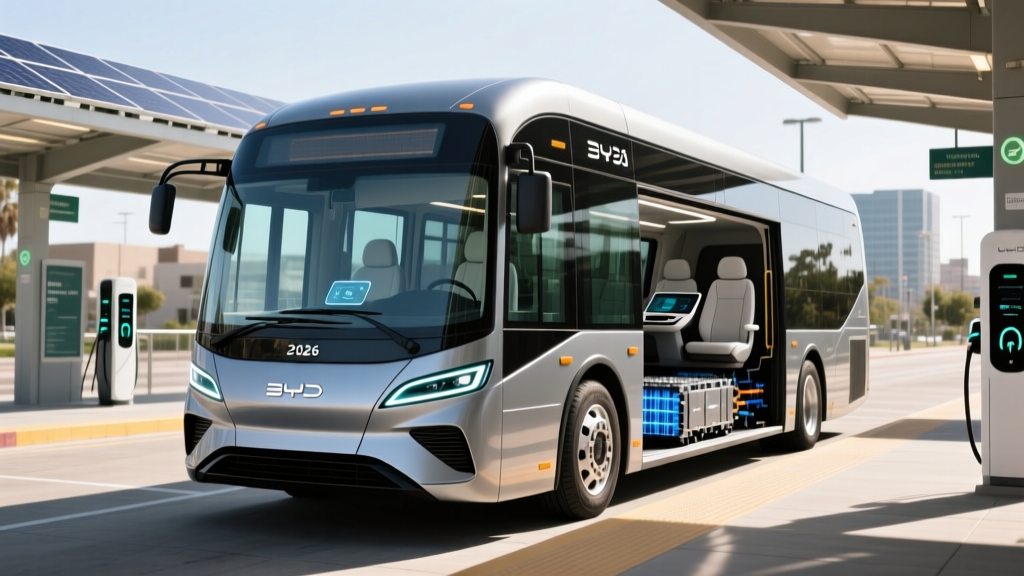
BYD K9M Electric Transit Bus: Specs, Range & Charging
The BYD K9M is the flagship product of the Lancaster facility and one of the most widely deployed electric transit buses in North America. Below are the verified specifications for the current-generation K9M 40-foot model based on BYD's published fleet data and transit agency procurement documents.
| Specification | Value |
|---|---|
| Battery Capacity | 446 kWh (LFP — Lithium Iron Phosphate) |
| EPA Estimated Range | ~246 miles (nominal, urban transit cycle) |
| Real-World Range | 170–220 miles depending on HVAC load, terrain, passenger count |
| Motor Output | 2 × 150 kW hub motors (300 kW total / ~402 HP) |
| Max Speed | 65 mph (governed) |
| DC Fast Charge (Peak) | Up to 150 kW via CCS1 |
| Charge Time (10–80%) | ~3.5–4 hours at 150 kW |
| Depot AC Charging | Level 2 at 19.2 kW; full charge in ~24 hours |
| GVWR | 42,000 lbs |
| Seating Capacity | Up to 40 seated / 60 total with standing room |
| Battery Warranty | 12 years / unlimited miles (fleet contract dependent) |
| Base Price (Fleet) | ~$1.0–$1.2 million per unit (varies by agency contract) |
LFP Battery Chemistry: Why BYD Chose It for Heavy-Duty Use
BYD exclusively uses LFP (Lithium Iron Phosphate) cells in its Lancaster-built vehicles — the same chemistry the company pioneered with its proprietary "Blade Battery" architecture for passenger cars. For commercial fleet applications, LFP offers critical advantages:
- Cycle Life: LFP cells tolerate 3,000–5,000+ full charge cycles before reaching 80% capacity retention — essential for buses charged daily for 12+ years of service.
- Thermal Stability: LFP chemistry is inherently more resistant to thermal runaway than NMC (Nickel Manganese Cobalt), a critical safety factor for vehicles carrying 40+ passengers.
- No Cobalt: Eliminates supply-chain and ethical concerns around cobalt mining, simplifying US procurement compliance.
- Trade-off: Lower energy density than NMC means heavier battery packs — acceptable in a 42,000-lb GVWR bus but a constraint in passenger cars where weight directly impacts range and handling.
Charging Infrastructure: What Fleet Operators Need
Charging a 446 kWh bus battery is fundamentally different from charging a passenger EV. BYD supports two primary charging strategies for Lancaster-built vehicles:
| Method | Power | Time (Empty to Full) | Use Case |
|---|---|---|---|
| Depot Level 2 (AC) | 19.2 kW per vehicle | ~24 hours | Overnight charging at bus depots |
| Depot DC Fast | 60–150 kW per vehicle | ~4–6 hours | Fleet depot with dedicated DC infrastructure |
| Opportunity Charging | 150–350 kW (pantograph) | 6–10 min (partial) | Mid-route top-up at transit hubs |
Most US transit agencies deploying BYD buses use overnight depot charging at 19.2 kW AC, supplemented by DC fast chargers for mid-day top-ups on longer routes. The capital cost of depot charging infrastructure — including utility upgrades, switchgear, and charger hardware — often exceeds the cost of the buses themselves, a factor that shapes total fleet electrification budgets.
Why BYD Passenger EVs Aren't Sold in the United States
BYD sold over 3 million new energy vehicles globally in 2023 and surpassed Tesla as the world's top BEV seller in Q4 2023. Models like the Seagull (a $10,000–$15,000 city car in China), Dolphin, Atto 3, and Seal are competitive with — and often cheaper than — equivalents from Tesla, Hyundai, and Volkswagen in global markets. So why can't US consumers buy them?
Tariff Barriers
Chinese-manufactured passenger vehicles face a 100% tariff under Section 301 trade actions updated in 2024, effectively doubling the landed cost of any BYD imported from China. Even if BYD shipped vehicles from its Lancaster plant, the facility is not configured for passenger-car assembly.
Homologation & Safety Certification
Every vehicle sold in the US must meet Federal Motor Vehicle Safety Standards (FMVSS), EPA emissions certifications (for range/efficiency labeling), and NHTSA crash-test requirements. BYD's global models are engineered to Chinese GB standards and European ECE/WVTA regulations, which differ meaningfully from US rules on lighting, bumper impact standards, airbag deployment, and cybersecurity requirements. Retooling for FMVSS compliance represents hundreds of millions in engineering and testing investment.
Dealer Network & Service Infrastructure
US consumers expect a dealership network for sales, financing, warranty service, and parts. BYD has no consumer-facing retail or service footprint in the US. Building one from scratch — or adopting a Tesla-style direct-to-consumer model — would require years and billions of dollars.
Geopolitical Risk
Ongoing US-China trade tensions, data-security concerns around connected vehicles, and potential future restrictions on Chinese automotive software make any large-scale US consumer launch a significant strategic gamble for BYD.
If BYD Came to the US: What the Seagull and Dolphin Would Offer
While BYD passenger EVs aren't available in the US, global specifications provide a compelling picture of what American buyers might see if trade barriers shifted. Based on published international specs for BYD's most export-ready models:
| Model | Battery (kWh) | WLTP Range | Est. EPA Range | 0–100 km/h | Global Price (USD equiv.) |
|---|---|---|---|---|---|
| BYD Seagull | 38 kWh (LFP Blade) | ~250 mi | ~200–220 mi | ~11.0 sec | $10,000–$15,000 |
| BYD Dolphin | 60.5 kWh (LFP Blade) | ~265 mi | ~225–245 mi | ~7.0 sec | $20,000–$28,000 |
| BYD Atto 3 | 60.5 kWh (LFP Blade) | ~260 mi | ~220–240 mi | ~7.3 sec | $28,000–$35,000 |
| BYD Seal | 82.5 kWh (LFP Blade) | ~355 mi | ~300–320 mi | ~5.9 sec (AWD) | $38,000–$50,000 |
Important: WLTP range figures (used in Europe and China) are typically 15–25% higher than EPA estimates. The "Est. EPA Range" column applies a conservative conversion. Actual US-spec EPA ratings would require formal certification. These models are not available for purchase in the United States as of 2026.
Federal Tax Credits & Fleet Incentives for BYD Commercial Vehicles
The IRS §30D Clean Vehicle Credit applies to consumer passenger vehicles and does not cover heavy-duty transit buses or school buses. However, BYD's Lancaster-built commercial vehicles qualify for separate federal and state incentive programs:
- IRA §13403 Commercial Clean Vehicle Credit (IRC 45W): Up to $40,000 per qualifying commercial vehicle (over 14,000 lbs GVWR) for fleet purchasers.
- EPA Clean School Bus Program: Up to $375,000 per zero-emission school bus plus $20,000 for charging infrastructure under the Bipartisan Infrastructure Law funding through 2026.
- CARB HVIP (California): California's Hybrid and Zero-Emission Truck and Bus Voucher Incentive Program provides point-of-sale vouchers of $120,000–$300,000+ for eligible zero-emission transit and school buses.
- FTA Low-No Program: Federal Transit Administration grants covering up to 80% of electric bus procurement and 90% of charging infrastructure costs for qualifying transit agencies.
For individual consumers hoping to apply the $7,500 federal EV tax credit to a BYD passenger car: this is not currently possible because no BYD passenger vehicle is sold in the US market. Even if one were imported, the 100% tariff and likely failure to meet §30D battery-sourcing and critical-mineral requirements would disqualify it from the credit.
Pros and Cons: BYD's US Presence
Pros
- US-based manufacturing in Lancaster creates 750+ American jobs
- LFP Blade Battery technology offers industry-leading cycle life and thermal safety
- 12-year battery warranty on commercial vehicles exceeds most competitors
- Proven deployment across 30+ US states with major transit agencies
- Strong incentive support (federal + California) reduces fleet acquisition cost
- Vertically integrated — BYD makes its own batteries, motors, and semiconductors
Cons
- No consumer passenger EVs available in the US — Lancaster only builds commercial vehicles
- 100% tariff on Chinese-made cars blocks affordable BYD models from US buyers
- No consumer dealer network, service centers, or parts distribution for individuals
- Heavy-duty bus pricing ($1M+) is irrelevant to individual car shoppers
- FMVSS homologation gap means years of re-engineering needed for any US passenger launch
- Geopolitical uncertainty could disrupt even commercial operations long-term
Who BYD in Lancaster Actually Serves
BYD's Lancaster operation is purpose-built for institutional fleet buyers, not individual consumers. The ideal "customer" for a Lancaster-built BYD is:
- Municipal transit agencies replacing aging diesel bus fleets with zero-emission alternatives to meet state and federal clean-air mandates.
- School districts leveraging EPA Clean School Bus funding to electrify student transportation, particularly in environmental-justice communities prioritized by federal grant scoring.
- Port and logistics operators needing Class 8 electric yard tractors and drayage trucks to comply with CARB's Advanced Clean Fleets regulation.
- Private coach companies exploring electric intercity routes where depot charging and predictable schedules align with battery-electric capabilities.
If you're an individual consumer in Lancaster, CA looking for an electric car, your local options remain Tesla (Fremont-built), Hyundai/Kia, Ford, Chevrolet, Volkswagen, and the growing roster of EVs from established automakers — none of which include a BYD badge.
Frequently Asked Questions
Can I buy a BYD electric car in Lancaster, California?
No. BYD's Lancaster facility manufactures electric transit buses, school buses, and commercial trucks for fleet buyers. No BYD passenger vehicles (cars, SUVs, or pickups) are sold to consumers anywhere in the United States. There is no BYD consumer dealership in Lancaster or any other US city.
Why doesn't BYD sell cars in the US when they're the world's largest EV maker?
Three primary barriers: a 100% tariff on Chinese-made passenger vehicles, the cost and complexity of re-engineering vehicles to meet US FMVSS safety standards, and the absence of a consumer dealer and service network. Geopolitical tensions and data-security scrutiny of connected Chinese vehicles add further risk.
What is the range of BYD's Lancaster-built electric bus?
The BYD K9M 40-foot transit bus has a nominal range of approximately 246 miles on a standard transit duty cycle. In real-world fleet operations, agencies typically plan around 170–220 usable miles depending on climate, terrain, passenger load, and HVAC usage. Cold weather and extreme heat can reduce range by 20–35%.
How fast does the BYD K9M bus charge?
At a DC fast charger rated for 150 kW, the K9M's 446 kWh battery charges from 10% to 80% in approximately 3.5–4 hours. Overnight depot charging at 19.2 kW Level 2 takes roughly 24 hours for a full charge. Some transit agencies use high-power pantograph opportunity chargers (up to 350 kW) for 6–10 minute mid-route top-ups.
Does BYD use LFP or NMC batteries in its Lancaster vehicles?
BYD exclusively uses LFP (Lithium Iron Phosphate) battery chemistry in all Lancaster-built vehicles. LFP offers superior cycle life (3,000–5,000+ cycles), better thermal safety, and no cobalt dependency — all critical for heavy-duty commercial use. The trade-off is lower energy density compared to NMC, which adds weight but is acceptable in buses with high GVWR limits.
Will BYD ever sell passenger cars in the United States?
BYD has not announced any plans for a US passenger-vehicle launch. Industry analysts estimate that even under optimistic trade-policy scenarios, a consumer launch is at minimum 3–5 years away. BYD is expanding manufacturing in Thailand, Brazil, Hungary, and potentially Mexico, which could theoretically serve as export hubs, but US tariff and homologation barriers remain formidable.
What federal incentives exist for BYD's electric buses?
Fleet buyers of BYD Lancaster-built buses can access the IRC 45W Commercial Clean Vehicle Credit (up to $40,000), the EPA Clean School Bus Program (up to $375,000 per bus), California's HVIP vouchers ($120,000–$300,000+), and FTA Low-No grants (up to 80% of bus cost). These incentives are designed for institutional purchasers, not individual consumers.
Sources: BYD North America fleet specifications, EPA Clean School Bus Program, IRS Clean Vehicle Credits, Los Angeles County transit procurement records.