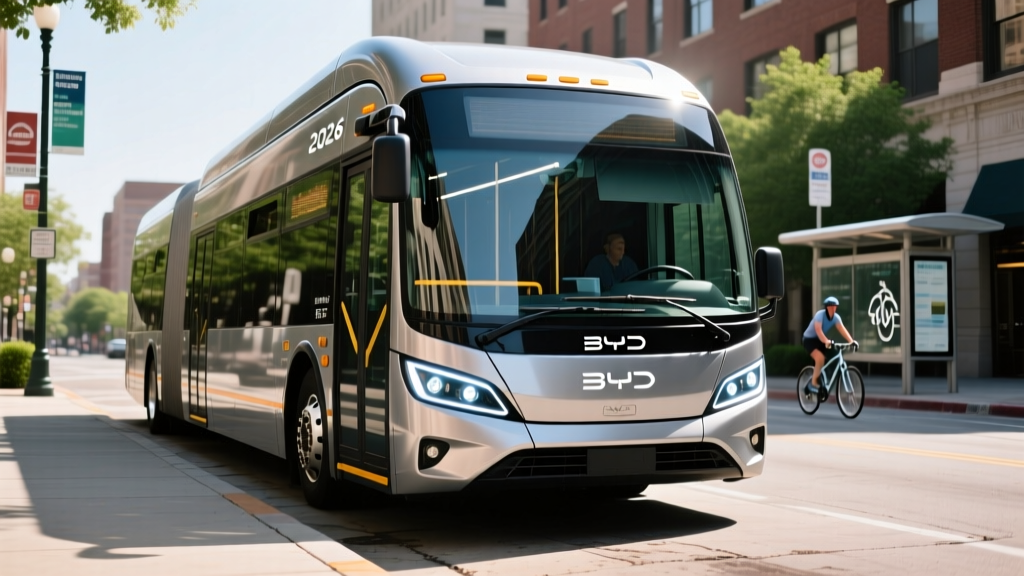
When fleet operators search for BYD buses in the USA, they are almost always looking at one vehicle: the BYD K9M, a 40-foot battery-electric transit bus that has become the most widely deployed heavy-duty electric bus in North America. BYD (Build Your Dreams) entered the U.S. commercial vehicle market in 2013 with a Lancaster, California factory and has since delivered hundreds of K-series buses to transit agencies from Los Angeles Metro to IndyGo. This is not a consumer vehicle review — the K9M is a Class 8 commercial transit bus purchased by municipalities and private operators — but for fleet managers, procurement officers, and transit planners evaluating electrification, this profile covers the K9M's range, charging infrastructure needs, battery chemistry, total cost of ownership, and how it stacks up against competitors like New Flyer's Xcelsior CHARGE NG and Proterra's ZX5.
Quick Verdict: Who BYD Buses in the USA Serve Best
The BYD K9M fits transit agencies running fixed routes under 200 miles per day with depot-based overnight charging. Its lithium iron phosphate (LFP) battery chemistry offers a longer cycle life than the NMC packs used by some competitors, and BYD vertically integrates battery, motor, and chassis manufacturing — a supply-chain advantage that has historically translated to faster delivery times. The trade-off is a heavier curb weight, slightly lower energy density, and a charging architecture that, while adequate for depot charging, does not match the peak DC fast-charge rates of newer competitors. If your agency needs 300+ mile routes or opportunity charging (mid-route pantograph top-ups), the K9M requires careful route-matching or a look at extended-range alternatives.
BYD K9M Specification Table
| Specification | BYD K9M (2025–2026 Model Year) |
|---|---|
| Vehicle Class | Class 8 Heavy-Duty Transit Bus |
| Length / Width / Height | 40.0 ft / 102 in / 132 in |
| Curb Weight (approx.) | ~38,000 lbs |
| GVWR | 44,000 lbs |
| Battery Capacity (usable) | 440 kWh (LFP — Lithium Iron Phosphate) |
| EPA Estimated Range | ~220 miles (laden, mixed route cycle) |
| Motor Power | 2 × 150 kW hub motors (300 kW combined / ~402 HP) |
| Peak Torque | ~3,100 lb-ft combined at wheels |
| Drivetrain | Rear-axle dual hub motors (RWD) |
| 0–30 mph (laden) | ~12 seconds |
| Top Speed (governor-limited) | 65 mph |
| Passenger Capacity | Up to 78 (39 seated + 39 standing, config-dependent) |
| Max DC Fast Charge Rate | ~150 kW (CCS1) |
| 10–80% DC Charge Time | ~3.0–3.5 hours (at 150 kW sustained) |
| Depot AC Charging | Up to 60 kW (J1772/CCS AC); ~8–9 hours for full charge |
| Efficiency | ~2.0 kWh/mile (route-dependent) |
| Battery Warranty | 12 years / unlimited miles (to 70% capacity retention) |
| Base Price (estimated, before incentives) | ~$850,000–$950,000 per unit (fleet contract pricing varies) |
Note: Transit bus pricing is negotiated per fleet contract and varies with options, battery sizing, delivery volume, and federal/state grant offsets. The figures above represent typical single-unit or small-fleet pricing as of 2025–2026 procurement cycles.
Range, Efficiency, and Real-World Expectations
The K9M's energy consumption averages around 2.0 kWh per mile in moderate conditions, which translates to roughly 50 miles per 100 kWh of battery energy. This is competitive with the New Flyer Xcelsior CHARGE NG (which runs slightly more efficient at ~1.8 kWh/mile in some agency reports) but reflects the K9M's heavier LFP pack. LFP batteries are denser in weight than NMC, and that extra mass — roughly 2,000–3,000 lbs more than an equivalent NMC-equipped competitor — shows up in energy consumption on hilly routes.
For context on how transit agencies evaluate range, the Federal Transit Administration's Low-No program funds bus electrification and requires agencies to submit realistic route analyses. BYD's 220-mile EPA-style figure is useful for comparison shopping, but your agency's route-matching exercise should use the 160–190 mile planning number and model worst-case winter scenarios.
Charging Infrastructure: Depot and DC Fast Charging
| Charging Method | Connector | Max Power | Approximate Time (10–80%) | Use Case |
|---|---|---|---|---|
| Depot AC (Level 2 equivalent) | CCS1 / J1772 Combo | Up to 60 kW | ~8–9 hours (full 0–100%) | Overnight depot charging |
| DC Fast Charge | CCS1 | ~150 kW peak | ~3.0–3.5 hours | Mid-day top-up or faster depot turnover |
| Pantograph (overhead) | SAE J3105 (optional) | Up to 300 kW (agency-spec) | ~15–25 min for 30–50 mi add | Opportunity charging at route terminals |
The K9M's standard charging setup is depot-based: plug in overnight at 60 kW AC and wake up to a full 440 kWh pack in roughly 8–9 hours. This works perfectly for agencies running single-shift routes under 180 miles. The DC fast-charge capability at ~150 kW (via CCS1) is adequate but not class-leading — New Flyer's latest Xcelsior CHARGE NG supports DC rates up to 350 kW on its highest-capacity pack, enabling faster mid-day turnaround.
One important charging-curve reality: the K9M's LFP battery sustains near-peak charge rates longer than NMC packs (LFP chemistry tolerates high-current charging with less thermal stress), but the 150 kW ceiling means the charge curve is relatively flat rather than peaky. You will not see the dramatic 50 kW → 250 kW spikes that passenger EVs like the Hyundai Ioniq 5 deliver. Instead, expect a steady ~120–150 kW from 10% to about 75% SoC, tapering to ~60–80 kW through the final 20%. This is normal for heavy-duty LFP applications and actually beneficial for battery longevity.
Agencies considering opportunity charging (mid-route top-ups via overhead pantograph) should note that BYD offers J3105-compatible pantograph charging as a factory option on the K9M, but it requires significant infrastructure investment — typically $250,000–$500,000 per pantograph station including electrical upgrades and civil work. BYD's pantograph option tops out around 300 kW, which can add 30–50 miles of range in a 15–25 minute layover.
Battery Chemistry: Why BYD's LFP Matters for Fleet Buyers
BYD is one of the world's largest LFP battery manufacturers, and the K9M uses the company's proprietary Blade Battery architecture — a cell-to-pack design that arranges long, thin prismatic LFP cells directly into the pack structure, eliminating intermediate modules. The result is a structurally rigid pack with improved thermal stability.
| Factor | LFP (BYD K9M) | NMC (Many Competitors) |
|---|---|---|
| Energy Density (Wh/kg) | ~140–160 | ~200–250 |
| Cycle Life (to 80% SoH) | 3,000–5,000+ cycles | 1,500–2,500 cycles |
| Thermal Runaway Risk | Very low | Moderate (requires more BMS cooling) |
| Cold-Weather Performance | Moderate (heating required) | Slightly better at low temps |
| Weight (for equivalent kWh) | Heavier | Lighter |
| Cost per kWh (pack level) | Lower | Higher |
| Cobalt / Nickel Content | None (iron + phosphate) | Contains cobalt and nickel |
For transit agencies, the LFP trade-off is straightforward: you accept a heavier, slightly less energy-dense pack in exchange for dramatically longer cycle life (critical for buses running 365 days/year), lower thermal runaway risk (important for depot safety and insurance), and zero cobalt exposure in the supply chain. BYD's 12-year battery warranty — covering capacity retention down to 70% — reflects confidence in LFP's longevity. Most agencies will retire or repower a bus before the LFP pack reaches end-of-life.
Pricing, Federal Incentives, and Total Cost of Ownership
A new BYD K9M typically costs between $850,000 and $950,000 per unit before incentives, depending on configuration, battery options, and fleet volume. For comparison, a standard 40-foot diesel transit bus costs roughly $550,000–$650,000, and the New Flyer Xcelsior CHARGE NG (40-foot, battery-electric) typically lands in the $900,000–$1.1 million range depending on battery sizing.
Unlike consumer EVs, transit buses purchased by government entities or tax-exempt organizations do not qualify for the IRS §30D Clean Vehicle Credit (which is designed for individual taxpayers). However, fleet buyers access substantial federal funding through other mechanisms:
- FTA Low-No Program: Grants covering up to 80% of capital costs for zero-emission buses and 90% for charging infrastructure. The 2021 Infrastructure Investment and Jobs Act allocated $5.5 billion through 2026 for this program. See FTA Low-No program details.
- IRA §30C Alternative Fuel Vehicle Refueling Property Credit: Up to $100,000 per charging station for qualifying depot installations in eligible census tracts (low-income or non-urban areas). Available to tax-exempt entities as a direct payment starting 2023.
- IRA §45W Clean Vehicle Credit (Commercial): Up to $40,000 for qualifying commercial clean vehicles — available to tax-exempt organizations as a direct payment. Applies to buses meeting weight and sourcing requirements under IRS rules.
- State/Local Incentives: Programs like California's Hybrid and Zero-Emission Truck and Bus Voucher Incentive Project (HVIP) can offset $200,000–$350,000 per bus. Eligibility varies by jurisdiction — check your state air quality board.
On the operating-cost side, electric buses deliver significant fuel and maintenance savings. Electricity for transit charging averages $0.08–$0.15 per kWh depending on utility rate structures and time-of-use schedules. At 2.0 kWh/mile and $0.12/kWh, the K9M costs roughly $0.24 per mile in energy — compared to $0.80–$1.10 per mile for a diesel bus at 4.5 mpg and $3.80/gallon. Over a 12-year bus lifespan at 40,000 miles/year, that is approximately $270,000–$410,000 in fuel savings per bus. Maintenance savings (no engine oil, no DPF filters, no transmission fluid, reduced brake wear from regenerative braking) add an estimated $50,000–$100,000 over the vehicle's life.
Technology, Driver Assists, and Interior
The K9M's driver environment is purpose-built for transit: a digital instrument cluster showing SoC, energy consumption, and regen levels; a 10-inch infotainment touchscreen with route navigation and fleet telematics integration; and electrically adjustable, air-suspended driver seating. BYD integrates its own fleet management telematics platform, which provides real-time SoC monitoring, geofencing, energy-use analytics, and predictive maintenance alerts to dispatchers.
Driver-assistance features include:
- Forward collision warning with automatic emergency braking (SAE Level 1)
- Lane departure warning
- Blind-spot monitoring with pedestrian detection (critical for urban transit)
- 360-degree surround-view camera system
- Electronic stability control tuned for high-center-of-gravity vehicle dynamics
These are SAE Level 1 driver-assist features — the driver remains fully responsible for vehicle operation at all times. There is no Level 2 or higher automation available on the K9M, which is appropriate for transit operations where the driver must manage passenger boarding, fare collection, and traffic interactions.
Passenger-facing features include low-floor entry (ADA-compliant ramp), USB charging ports at select seats, LED interior lighting, and HVAC with electric heat pump heating (which improves cold-weather range by ~10–15% compared to resistive electric heating). Seated capacity is typically 39 passengers with room for 39 additional standing riders, though interior configurations vary by agency specification.
BYD K9M vs. Key Competitors
| Spec | BYD K9M | New Flyer Xcelsior CHARGE NG (XDE40) | Proterra ZX5 (40-ft) |
|---|---|---|---|
| Battery Chemistry | LFP (Blade Battery) | NMC (Siemens/other) | NMC (Proterra proprietary) |
| Battery Capacity | 440 kWh | Up to 550 kWh | Up to 660 kWh |
| Claimed Range | ~220 mi | ~240 mi | ~260+ mi |
| Max DC Charge Rate | ~150 kW | Up to 350 kW | Up to 350 kW |
| Battery Warranty | 12 yr / unlimited mi | 12 yr / 500,000 mi | 12 yr / 500,000 mi |
| U.S. Manufacturing | Lancaster, CA | Multiple U.S. plants | Greenville, SC / Joliet, IL |
| Estimated Base Price | $850K–$950K | $900K–$1.1M | $950K–$1.2M |
The K9M's primary advantage is cost and LFP longevity. Its primary disadvantage is lower peak charging speed and heavier weight. Agencies running high-frequency routes with short layover windows may prefer the Xcelsior CHARGE NG's 350 kW DC capability. Agencies prioritizing 12-year total cost of ownership and fire-safety margins may prefer the K9M's LFP pack.
- LFP battery offers 3,000–5,000+ cycle life — outlasts most bus service lives
- Competitive base pricing ($850K–$950K)
- 12-year battery warranty, no mileage cap
- Vertically integrated supply chain (BYD makes cells, motors, and chassis)
- U.S. assembly in Lancaster, CA (Buy America compliant for FTA funding)
- Heat pump HVAC improves winter efficiency
- Zero cobalt in battery supply chain
- 150 kW max DC charge rate is below newer competitors (350 kW)
- LFP pack is heavier, increasing energy consumption on hilly routes
- 220-mile range limits deployment on longer routes without opportunity charging
- Cold-weather range loss (20–35%) requires conservative winter route planning
- BYD's U.S. political headwinds (some state/local restrictions on Chinese-manufactured vehicles, though Lancaster assembly mitigates Buy America concerns)
- Pantograph opportunity charging is optional and infrastructure-intensive
Frequently Asked Questions
What is the real-world range of the BYD K9M electric bus?
BYD quotes approximately 220 miles under a standard transit duty cycle. In real-world fleet operations with full passenger loads, HVAC running, and hilly terrain, plan for 160–190 usable miles. In cold weather (below 32°F), that drops to roughly 110–150 miles. Route-matching should always use worst-case seasonal numbers.
How fast does the BYD K9M charge at the depot and on DC fast charging?
At the depot on AC power (up to 60 kW), a full charge takes approximately 8–9 hours — ideal for overnight scheduling. On DC fast charging at the K9M's ~150 kW peak rate, a 10–80% charge takes roughly 3.0–3.5 hours. The LFP charge curve is relatively flat, sustaining near-peak rates through ~75% SoC before tapering.
Does the BYD K9M qualify for the federal EV tax credit?
Not the consumer §30D credit — transit agencies and government entities are typically tax-exempt. However, the IRA's §45W Commercial Clean Vehicle Credit (up to $40,000, available as a direct payment to tax-exempt entities) and the FTA Low-No grant program (covering up to 80% of bus capital costs) are the primary federal funding mechanisms. The §30C credit can offset up to $100,000 per depot charging station. Always verify current-year rules with the IRS and FTA.
How does the BYD K9M compare to the New Flyer Xcelsior CHARGE NG?
The K9M is typically $50,000–$150,000 less expensive per unit and offers a longer-life LFP battery. The Xcelsior CHARGE NG offers higher battery capacity (up to 550 kWh), faster DC charging (up to 350 kW), and slightly longer range (~240 miles). Agencies prioritizing lowest acquisition cost and longest battery cycle life lean BYD; agencies needing faster mid-day charging and longer routes lean New Flyer.
Where are BYD buses manufactured for the U.S. market?
BYD assembles K-series buses at its factory in Lancaster, California. This U.S. final assembly allows the K9M to meet FTA Buy America requirements for federal grant-funded procurement, though some components (battery cells, certain electronics) are sourced from BYD's global supply chain. Some states and municipalities have enacted additional restrictions on Chinese-headquartered manufacturers — fleet buyers should verify local procurement rules.
What is the total cost of ownership advantage over a diesel bus?
Over a 12-year, 480,000-mile lifespan, a BYD K9M can save $270,000–$410,000 in fuel costs and $50,000–$100,000 in maintenance compared to a diesel equivalent. Combined savings of $320,000–$510,000 help offset the higher upfront purchase price, particularly when federal grants cover 80%+ of capital costs. Break-even typically occurs within 5–7 years of operation depending on route mileage and electricity rates.