Why BYD in Mexico Matters for North American EV Shoppers
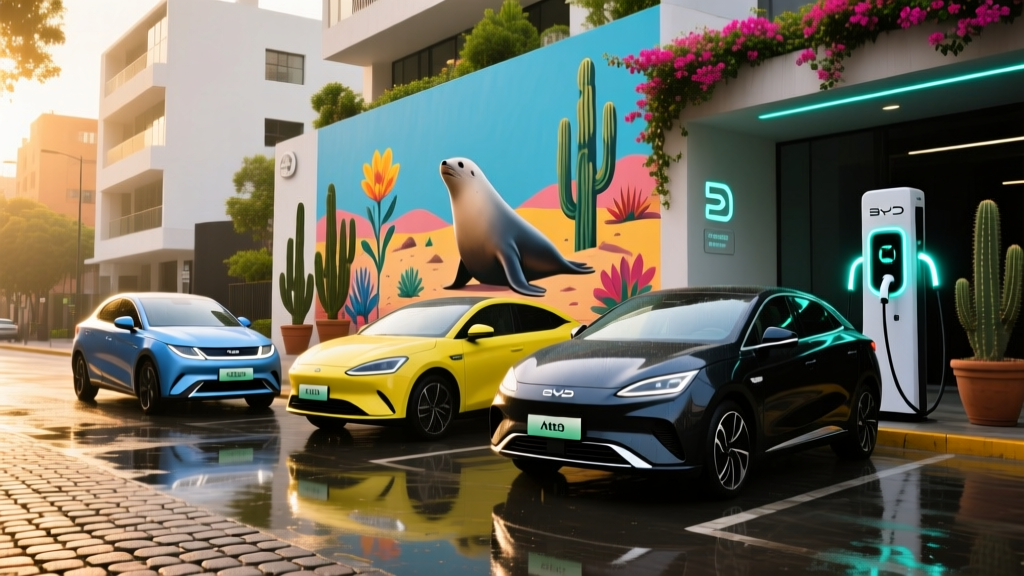
BYD's rapid expansion across Latin America has made it one of the most visible EV brands south of the US border. If you've been searching for information on BYD in Mexico, you're likely weighing whether these aggressively priced electric vehicles represent a genuine alternative to Tesla, Hyundai, and Chevrolet — or whether cross-border purchasing is even viable. This profile examines the three core BYD models sold in Mexican dealerships as of early 2026, breaks down their real-world range and charging behavior, and addresses the critical question US buyers always ask: Can I import one, and does it qualify for the federal EV tax credit?
BYD entered the Mexican market in mid-2023 and by 2026 operates over 50 dealerships across major metro areas including Mexico City, Guadalajara, Monterrey, and Puebla. The brand's Blade Battery (LFP chemistry) and vertically integrated supply chain allow pricing that undercuts most competitors by 15-30%. But spec sheets only tell part of the story — charging infrastructure compatibility, real-world efficiency, and long-term serviceability matter just as much.
2026 BYD Lineup in Mexico: Model-by-Model Breakdown
BYD's Mexican portfolio centers on three models positioned across distinct segments. Here's how they stack up on the numbers that matter most.
| Spec | Dolphin (Standard) | Atto 3 (Yuan Plus) | Seal (Premium) |
|---|---|---|---|
| Body Style | Subcompact Hatchback | Compact Crossover SUV | Mid-Size Sedan |
| Battery (usable) | 44.9 kWh (LFP Blade) | 58.56 kWh (LFP Blade) | 82.5 kWh (LFP Blade) |
| Drivetrain | FWD, Single Motor | FWD, Single Motor | RWD / AWD (dual-motor) |
| Horsepower | 94 hp (70 kW) | 201 hp (150 kW) | 313 hp RWD / 530 hp AWD |
| 0-60 mph | ~12.3 sec | ~7.3 sec | 5.9 sec RWD / 3.8 sec AWD |
| WLTP Range | 340 km (~211 mi) | 420 km (~261 mi) | 570 km (~354 mi) RWD |
| EPA-Est. Range* | ~190 mi (est.) | ~235 mi (est.) | ~310 mi RWD (est.) |
| Max DC Charge | 60 kW | 80 kW | 150 kW |
| 10-80% DC Time | ~41 min | ~35 min | ~26 min |
| Level 2 Rate | 6.6 kW (~22 mi/hr) | 7 kW (~25 mi/hr) | 11 kW (~37 mi/hr) |
| MPGe (est. combined) | ~115 MPGe | ~108 MPGe | ~112 MPGe (RWD) |
| Cargo Volume | 12.0 cu ft (rear seats up) | 15.7 cu ft / 47.3 cu ft (seats folded) | 14.1 cu ft (trunk) |
| Base MSRP (Mexico) | ~$359,800 MXN (~$19,800 USD) | ~$599,800 MXN (~$33,100 USD) | ~$849,900 MXN (~$46,900 USD) |
| Battery Warranty | 8 yr / 160,000 km | 8 yr / 160,000 km | 8 yr / 160,000 km |
*EPA range figures are estimates based on typical WLTP-to-EPA conversion ratios (~15-18% reduction). BYD does not sell vehicles in the US and these models lack official EPA certification. Sources: BYD Mexico official site, fueleconomy.gov for EPA methodology.
Real-World Range: What to Actually Expect
Dolphin: WLTP 211 mi → Expect ~170-185 mi in mixed city/highway driving at moderate temperatures. Highway-only at 75 mph drops to ~145-155 mi. Cold weather (below 40°F) can reduce range by 20-30%, yielding as low as ~120 mi.
Atto 3: WLTP 261 mi → Expect ~210-230 mi mixed use. Sustained highway driving at Mexican toll-road speeds (110 km/h / 68 mph) yields ~190-205 mi. Cold-weather reduction brings this to ~155-170 mi.
Seal RWD: WLTP 354 mi → Expect ~280-310 mi mixed use. Highway cruising at 70 mph delivers ~255-275 mi. In winter conditions, plan for ~210-235 mi.
Note: LFP batteries (used in all three models) tolerate 100% daily charging better than NMC chemistries, so you can regularly use the full pack capacity without accelerated degradation concerns. However, LFP cells lose more capacity in extreme cold than NMC, making range loss steeper in sub-freezing climates.
Charging Speed and Infrastructure Compatibility
Charging is where BYD's Mexico-market vehicles reveal a notable limitation for North American use. All three models use the GB/T charging standard (China's national connector) for DC fast charging, with some Mexican-market units adapted to CCS1 via dealer-supplied adapters. This is not the same plug-and-play experience as Tesla's NACS or the CCS1 standard used by most non-Tesla EVs in the US and Canada.
| Charging Level | Dolphin | Atto 3 | Seal |
|---|---|---|---|
| Level 1 (120V, 12A) | ~1.4 kW / ~5 mi/hr | ~1.4 kW / ~5 mi/hr | ~1.4 kW / ~5 mi/hr |
| Level 2 (240V home) | 6.6 kW / ~22 mi/hr | 7 kW / ~25 mi/hr | 11 kW / ~37 mi/hr |
| DC Fast Charge (peak) | 60 kW | 80 kW | 150 kW |
| 10-80% DC Time | ~41 min | ~35 min | ~26 min |
| Connector (DC) | GB/T (CCS1 adapter avail.) | GB/T (CCS1 adapter avail.) | GB/T (CCS1 adapter avail.) |
Charging curve reality: The Seal's 150 kW peak rate is not sustained across the entire 10-80% window. Expect peak rates between 10-40% State of Charge (SoC), tapering to ~90 kW by 60% SoC and ~45 kW approaching 80%. This taper behavior is typical of LFP chemistry, which has a flatter voltage curve than NMC and requires more careful current management in the upper SoC range. The Atto 3 peaks at 80 kW but sustains ~60 kW through about 55% SoC before tapering — a relatively flat curve that makes its 35-minute 10-80% time competitive with vehicles boasting higher peak numbers but steeper taper.
For home Level 2 charging, all three models accept standard 240V J1772 connections (the North American Level 2 standard), which means any quality home wall connector will work. A full home charge from 10% takes approximately 6.5 hours (Dolphin), 8 hours (Atto 3), or 7.5 hours (Seal).
Performance, Efficiency, and Daily Drivability
The three BYD models span a wide performance envelope. The Dolphin is unapologetically a city car: 94 hp and a 12.3-second 0-60 time mean highway merging requires planning, but its tight 33.5-foot turning circle and low curb weight (~3,400 lbs) make it nimble in Mexico City traffic. Efficiency is its strong suit, with estimated consumption around 29 kWh/100 mi in city driving.
The Atto 3 hits a sweet spot for most buyers: 201 hp delivers confident highway passing, and the 7.3-second 0-60 time is respectable for a compact crossover. Ride quality is firm but controlled, with a multi-link rear suspension that handles Mexican speed bumps (topes) competently. At ~108 MPGe combined, it consumes roughly 31 kWh/100 mi — slightly thirstier than a Hyundai Kona Electric but competitive for its weight class.
The Seal is the performance flagship. The AWD variant's 530 hp and 3.8-second 0-60 time put it in Tesla Model 3 Performance territory, while the RWD model's 313 hp and 5.9-second sprint still outpace most gas-powered sedans in its price bracket. Cell-to-body (CTB) battery integration lowers the center of gravity and contributes to composed handling. Efficiency for the RWD model is estimated at ~30 kWh/100 mi (~112 MPGe), aided by a standard heat pump that preserves range in cold conditions.
Pricing, Tax Credits, and the US Import Question
BYD's Mexican pricing is undeniably aggressive. But US-based buyers researching BYD in Mexico often have a specific question: Can I buy one in Mexico and drive it home?
BYD Mexico Pricing & US Tax Credit Reality
| Model | Mexico MSRP | Approx. USD | US §30D Credit Eligible? | Why / Why Not |
|---|---|---|---|---|
| Dolphin Standard | $359,800 MXN | ~$19,800 | No | Not sold in US; no EPA cert; not NHTSA/FMVSS compliant |
| Atto 3 (Yuan Plus) | $599,800 MXN | ~$33,100 | No | Not sold in US; assembled in China; battery sourcing fails §30D critical-mineral rules |
| Seal Premium RWD | $849,900 MXN | ~$46,900 | No | Not sold in US; no US dealer network or homologation |
The IRS §30D clean vehicle credit requires that the vehicle be purchased from a US-licensed dealer, be EPA-certified, meet FMVSS safety standards, and satisfy battery-component and critical-mineral sourcing requirements. BYD does not sell vehicles through US dealerships, and none of its Mexico-market models carry EPA range certification or NHTSA compliance. Additionally, BYD's vertically integrated supply chain — which sources battery cells and critical minerals primarily from China — would not meet the §30D foreign-entity-of-concern (FEOC) restrictions that took full effect in 2025.
Bottom line: Even if you physically purchased a BYD in Mexico and imported it (a process requiring DOT/EPA import approval, bumper and lighting modifications, and potentially crash-test equivalence documentation), the vehicle would not qualify for the $7,500 federal tax credit, and you would face significant insurance, service, and parts challenges in the US.
§30D Federal Tax Credit Requirements (2026 Rules)
- Vehicle must be purchased new from a US-licensed dealer
- Must have EPA fuel-economy certification and meet FMVSS safety standards
- MSRP cap: $55,000 for sedans; $80,000 for SUVs, vans, and trucks
- Buyer income cap: $150,000 single / $225,000 head of household / $300,000 joint (modified AGI)
- Battery components must not be manufactured by a Foreign Entity of Concern (FEOC) — effectively excluding Chinese-sourced components from 2024+
- Critical minerals must be sourced from the US or FTA-partner nations (phased percentages increase annually)
- Credit amount: up to $7,500, split between $3,750 for battery components + $3,750 for critical minerals
- Point-of-sale transfer available — buyer can apply credit as a down-payment reduction at purchase
Source: IRS.gov — Clean Vehicle Credits. Eligibility rules change frequently; consult a tax professional before making purchase decisions.
Tech, Interior, and Standout Features
BYD equips its Mexico-market vehicles generously, often matching or exceeding feature content from competitors at higher price points.
Infotainment: All three models feature a 12.8-inch rotating center touchscreen (landscape for navigation, portrait for social media/apps). The system runs BYD's DiLink OS with wireless Apple CarPlay and Android Auto, built-in navigation, and over-the-air updates. Response times are adequate but not class-leading — the UI can lag slightly when switching between heavy apps.
Driver Assistance (SAE Level 2): The Atto 3 and Seal include BYD's DiPilot suite: adaptive cruise control with stop-and-go, lane-keeping assist, automatic emergency braking, blind-spot monitoring, and rear cross-traffic alert. The Dolphin Standard omits adaptive cruise, offering only basic AEB and lane-departure warning. Important: DiPilot is an SAE Level 2 driver-assistance system — it does not enable autonomous or "self-driving" operation. The driver must remain attentive with hands on the wheel at all times.
SAE Automation Level: BYD DiPilot = Level 2 (partial automation). The system can control steering and speed simultaneously under driver supervision. It is not Level 4 (driverless) like Waymo. You are the driver; the car is assisting.
Standout features:
- Blade Battery (LFP): BYD's proprietary cell design passes nail-penetration tests without thermal runaway — a meaningful safety advantage. LFP chemistry also offers longer cycle life (~3,000+ full cycles to 80% capacity vs ~1,500-2,000 for NMC) and tolerates routine 100% charging.
- V2L (Vehicle-to-Load): The Atto 3 and Seal support 2.2 kW V2L output via a standard adapter, allowing you to power laptops, small appliances, or tools from the traction battery.
- Panoramic glass roof: Standard on Seal and Atto 3 top trims, with UV-blocking coating that reduces cabin heat gain — useful in Mexican and southwestern US climates.
- Heat pump: Standard on all Seal trims and Atto 3, improving cold-weather range retention by 10-15% compared to resistive heating.
Notable drawbacks:
- GB/T DC charging connector limits compatibility with North American public fast-charging networks (Electrify America, EVgo, Tesla Superchargers) without adapters that may not be rated for sustained high-power sessions.
- No US dealer network means zero warranty service, limited parts availability, and potential insurance difficulties if the vehicle is imported.
- Rear visibility in the Seal is compromised by the sloping roofline; a digital rearview mirror is not offered.
- Infotainment UI polish lags behind Hyundai, Kia, and Tesla — functional but occasionally sluggish.
BYD Mexico vs Key Competitors
For buyers physically located in Mexico, BYD competes against several established alternatives. Here's how the value proposition compares:
| Attribute | BYD Atto 3 | Hyundai Kona Electric | MG4 EV | JAC E-Sei 4 |
|---|---|---|---|---|
| Price (MXN) | ~$599,800 | ~$749,000 | ~$549,000 | ~$489,900 |
| Battery | 58.56 kWh LFP | 65.4 kWh NMC | 64 kWh LFP | 52 kWh LFP |
| WLTP Range | 420 km | 484 km | 450 km | 380 km |
| DC Fast Charge | 80 kW | 100 kW | 88 kW | 60 kW |
| Dealer Network (MX) | 50+ locations | 120+ locations | 30+ locations | 20+ locations |
| CCS1 Native? | No (adapter) | Yes | No (adapter) | Yes |
The Hyundai Kona Electric offers superior range, faster DC charging, and native CCS1 compatibility — but at a ~25% price premium. The MG4 undercuts the Atto 3 on price with comparable range, though its dealer network is thinner. The BYD Atto 3's advantage lies in its LFP Blade Battery longevity, V2L capability, and BYD's rapidly expanding Mexican service footprint.
Who Should Buy a BYD in Mexico — And Who Shouldn't
Choose BYD in Mexico if:
- You live in Mexico and want an affordable EV with strong battery longevity (LFP's 3,000+ cycle life translates to 300,000+ miles of usable capacity)
- You primarily drive in urban or suburban settings where the Dolphin or Atto 3's range is more than sufficient
- You value V2L capability for camping, job sites, or backup power
- You have access to home Level 2 charging and don't rely heavily on public DC fast-charging networks
Look elsewhere if:
- You plan to import the vehicle to the United States (legal, service, and charging-compatibility hurdles are severe)
- You regularly take 400+ km highway road trips where the Seal's real-world ~275 mi range requires mid-trip charging stops
- You need native CCS1/NACS charging for compatibility with Mexico's growing Electrify America and Ionity-equivalent networks
- You want the longest possible warranty coverage with established North American service infrastructure
Warranty and Long-Term Ownership
BYD provides an 8-year / 160,000 km (~100,000 mi) battery warranty across all three models, with a guaranteed minimum 70% capacity retention over that period. The vehicle bumper-to-bumper warranty is 6 years / 150,000 km. These terms are competitive with Hyundai's 10-year/100,000-mi battery warranty and exceed Tesla's 8-year/120,000-mi coverage for Model 3 (though Tesla guarantees slightly higher 70% retention).
For Mexican owners, BYD's expanding dealership network means warranty service is increasingly accessible in major metro areas. However, owners in smaller cities may face 2-3 hour drives to the nearest authorized service center. Parts availability has improved significantly since 2024 but still lags behind established brands like Nissan (Leaf) and Volkswagen for routine consumables.
Frequently Asked Questions
What is the real-world range of BYD EVs sold in Mexico?
The Dolphin delivers approximately 170-185 miles in mixed driving, the Atto 3 achieves 210-230 miles, and the Seal RWD manages 280-310 miles. Highway-only driving at sustained speeds reduces these figures by 15-20%, and cold weather (below 40°F) can cut range by an additional 20-30%. LFP batteries are more susceptible to cold-weather range loss than NMC chemistries.
How fast do BYD vehicles charge on DC fast chargers and at home?
DC fast charging ranges from 60 kW (Dolphin, ~41 min 10-80%) to 150 kW (Seal, ~26 min 10-80%). Home Level 2 charging at 240V adds approximately 22-37 miles of range per hour depending on the model. Note that GB/T connectors require an adapter for use with CCS1-based public chargers common in North America.
Can I buy a BYD in Mexico and import it to the United States?
While technically possible through DOT/EPA import procedures, it is impractical for most buyers. The vehicle lacks EPA certification, NHTSA safety compliance, and US-spec lighting/bumper standards. You will not qualify for the $7,500 federal §30D tax credit, insurance will be difficult to obtain, and BYD has no US service network for warranty work or parts.
Does a BYD purchased in Mexico qualify for the US federal EV tax credit?
No. The IRS §30D credit requires purchase through a US-licensed dealer, EPA certification, and compliance with battery-component and critical-mineral sourcing rules. BYD's China-sourced battery supply chain triggers FEOC (Foreign Entity of Concern) restrictions that disqualify the vehicle regardless of purchase location.
What are the biggest pros and cons of BYD EVs in Mexico?
Pros: Aggressive pricing, excellent LFP Blade Battery safety and longevity, generous standard features, V2L capability, expanding Mexican dealer network. Cons: GB/T charging connector limits public fast-charger compatibility, no US sales or service presence, infotainment polish lags competitors, real-world range falls below WLTP sticker figures (as with all EVs), limited availability outside major Mexican metro areas.
Is the BYD Blade Battery safer than other EV batteries?
BYD's Blade Battery uses LFP (lithium iron phosphate) chemistry in a cell-to-pack structural design that passes nail-penetration testing without thermal runaway — a significant safety benchmark. LFP chemistry is inherently more thermally stable than NMC. However, "safer" is relative: all modern EV batteries from reputable manufacturers include extensive thermal management and are statistically very safe. The Blade Battery's advantage is an additional margin of abuse tolerance.
How does BYD's warranty compare to competitors in Mexico?
BYD's 8-year/160,000 km battery warranty (70% minimum retention) is competitive. Hyundai offers 10-year/160,000 km on the Kona Electric battery. MG provides 8-year/160,000 km on the MG4. The key differentiator is service accessibility: BYD's ~50 Mexican dealerships are growing but still trail Hyundai's established network of 120+ locations.
Sources consulted: BYD Mexico official specifications, IRS §30D Clean Vehicle Credit rules, fueleconomy.gov for EPA range methodology. Pricing reflects early 2026 Mexican MSRP and approximate USD conversion at ~18.2 MXN/USD. Tax credit rules are subject to change; consult a qualified tax professional for personal eligibility.