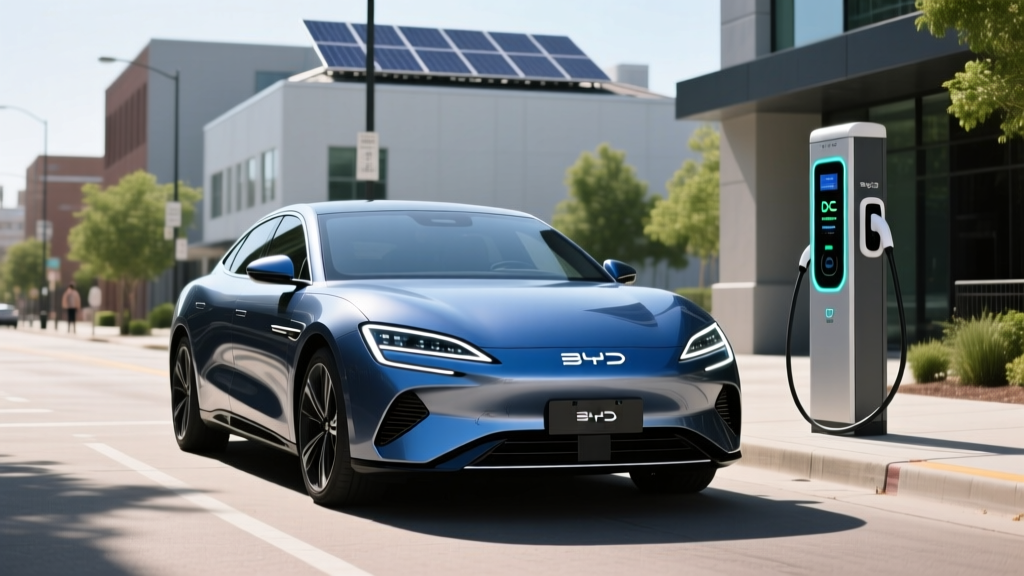
If you have spent any time reading global EV news, you have seen the headlines: BYD has surpassed Tesla in global battery-electric sales, is expanding aggressively into Europe, Southeast Asia, and Latin America, and is building factories at a staggering pace. Naturally, American shoppers are asking: What is the deal with BYD in America? Can you buy one? Should you wait?
The short answer for 2026 is no — BYD does not sell passenger vehicles in the United States, and there is no announced timeline for a US launch. The barriers are not about product quality; they are about tariffs, trade policy, and battery-sourcing regulations that make importing Chinese-built EVs economically unviable under current rules.
But BYD's global lineup is worth studying. It tells you what the rest of the world is driving, what technology is coming, and what American buyers are missing. Below, we break down the models you would want, the exact specs, the tariff math, and what a hypothetical US launch would need to look like.
The Tariff Wall: Why BYD Can't Sell Cars in the US Right Now
As of 2026, Chinese-built electric vehicles face a compounding tariff structure that effectively prices them out of the American market:
- Base auto import tariff: 2.5%
- Section 301 tariff on Chinese EVs (raised August 2024): 100%
- Battery and critical-mineral tariffs: Additional duties on Chinese-sourced battery cells and processed minerals
A BYD Seal that sells for roughly $38,000 equivalent in China would land in the US at well over $75,000 before dealer markup — obliterating the value proposition that makes BYD competitive globally. There is currently no free-trade agreement, no tariff exemption pathway, and no announced BYD US factory that would bypass these duties.
BYD has stated publicly that it is "studying" the US market but has committed to no timeline. The company's current expansion focus is on markets with lower trade barriers: Mexico, Brazil, Thailand, Indonesia, and the European Union (which has imposed its own, albeit lower, countervailing duties on Chinese EVs).
The BYD Models Americans Would Actually Want
BYD's global passenger-car lineup spans compacts, crossovers, sedans, and performance models. Here are the three most relevant for US buyers, with full specifications based on current global-market configurations.
BYD Seal (Midsize Sport Sedan — Tesla Model 3 Competitor)
| Spec | BYD Seal (RWD Extended Range) | BYD Seal (AWD Performance) |
|---|---|---|
| Battery | 82.5 kWh (LFP Blade) | 82.5 kWh (LFP Blade) |
| Range (WLTP) | ~354 miles (570 km) | ~323 miles (520 km) |
| Est. EPA Range | ~300–315 miles (estimated) | ~275–290 miles (estimated) |
| Power | 313 hp (230 kW) | 530 hp (390 kW) |
| 0–100 km/h (0–62 mph) | 5.9 seconds | 3.8 seconds |
| Drivetrain | RWD single motor | AWD dual motor |
| DC Fast Charge (peak) | 150 kW | 150 kW |
| 10–80% DC Time | ~26 minutes | ~26 minutes |
| AC Level 2 Charge | 11 kW (3-phase, where available) | 11 kW |
| Length / Width | 189.0 in / 72.8 in | 189.0 in / 72.8 in |
| Cargo (trunk + frunk) | ~14.1 cu ft trunk + 1.8 cu ft frunk | Same |
| Global Price (approx.) | ~$38,000–$42,000 equiv. | ~$46,000–$50,000 equiv. |
BYD Atto 3 / Yuan Plus (Compact Crossover — Hyundai Kona Electric / Chevrolet Equinox EV Competitor)
| Spec | BYD Atto 3 (Standard Range) | BYD Atto 3 (Extended Range) |
|---|---|---|
| Battery | 49.9 kWh (LFP Blade) | 60.5 kWh (LFP Blade) |
| Range (WLTP) | ~211 miles (340 km) | ~261 miles (420 km) |
| Est. EPA Range | ~180–190 miles (estimated) | ~225–240 miles (estimated) |
| Power | 204 hp (150 kW) | 204 hp (150 kW) |
| 0–100 km/h | 7.3 seconds | 7.3 seconds |
| Drivetrain | FWD single motor | FWD single motor |
| DC Fast Charge (peak) | 80 kW | 88 kW |
| 10–80% DC Time | ~29 minutes | ~29 minutes |
| AC Level 2 Charge | 7 kW (single-phase markets) | 7 kW |
| Cargo Volume | ~15.6 cu ft (rear seats up) | Same |
| Global Price (approx.) | ~$28,000–$32,000 equiv. | ~$33,000–$37,000 equiv. |
BYD Dolphin (Subcompact Hatchback — Chevrolet Bolt EV Spiritual Successor)
| Spec | BYD Dolphin (Standard Range) | BYD Dolphin (Extended Range) |
|---|---|---|
| Battery | 44.9 kWh (LFP Blade) | 60.5 kWh (LFP Blade) |
| Range (WLTP) | ~199 miles (320 km) | ~261 miles (420 km) |
| Est. EPA Range | ~170–180 miles (estimated) | ~225–235 miles (estimated) |
| Power | 95 hp (70 kW) | 204 hp (150 kW) |
| 0–100 km/h | 12.3 seconds | 7.0 seconds |
| DC Fast Charge (peak) | 60 kW | 88 kW |
| 10–80% DC Time | ~29 minutes | ~29 minutes |
| Global Price (approx.) | ~$20,000–$24,000 equiv. | ~$26,000–$30,000 equiv. |
BYD's Blade Battery: What LFP Chemistry Means for Buyers
Every BYD passenger vehicle uses the company's proprietary Blade Battery, a cell-to-pack design using lithium iron phosphate (LFP) chemistry. This is a deliberate choice with real ownership implications.
| Factor | LFP (BYD Blade) | NMC / NCA (Most US EVs) |
|---|---|---|
| Energy Density | Lower (~140–160 Wh/kg cell) | Higher (~250–300 Wh/kg cell) |
| Cycle Life | 3,000+ full cycles to 80% SoH | 1,500–2,000 cycles to 80% SoH |
| Thermal Stability | Excellent — no thermal runaway in nail-penetration tests | Good, but requires more active cooling |
| Cold-Weather Performance | More range loss in freezing temps (~25–35% drop) | Better cold retention (~15–25% drop) |
| Charging to 100% | Recommended periodically for BMS calibration | Generally capped at 80–90% for longevity |
| Cobalt / Nickel | None — lower supply-chain ethics risk | Contains cobalt and/or nickel |
| Cost | ~20–30% cheaper per kWh | Higher raw-material cost |
The Blade Battery's cell-to-pack architecture eliminates module-level structure, improving volume utilization by roughly 50% over conventional pack designs. The result: BYD fits competitive kWh capacity into smaller physical packages, though the packs are heavier than equivalent NMC packs.
For a US buyer, the LFP trade-off is straightforward — you gain longevity and safety, but you sacrifice some cold-weather range and energy density. In northern US climates, a BYD with a WLTP-stated 420 km range might deliver only 175–190 real miles on a 20°F January highway drive.
Charging: How BYD Stacks Up Against US Standards
| Level | BYD Typical Spec | US Market Equivalent | Connector |
|---|---|---|---|
| Level 1 (120V) | ~1.8 kW (not commonly included) | ~1.4–1.9 kW, 3–5 mi/hr | Varies by market |
| Level 2 (240V) | 7–11 kW AC onboard | 7.7–11.5 kW, 25–44 mi/hr | Would need J1772/NACS for US |
| DC Fast Charge | 60–150 kW peak (CCS2 or GB/T) | 150–350 kW peak (CCS1/NACS) | Would need CCS1 or NACS adapter |
BYD's DC fast-charging speeds are the lineup's weakest competitive point for the US market. The Seal peaks at 150 kW — respectable, but the Tesla Model 3 Highland hits 250 kW on V3 Superchargers, and the Hyundai Ioniq 6 peaks at 240+ kW on 800V architecture. A 26-minute 10–80% session on the Seal is adequate for road trips but noticeably slower than the 18-minute sessions American buyers are starting to expect from 800V platforms.
Connector compatibility is another barrier. BYD uses CCS2 in Europe and GB/T in China. A US launch would require either CCS1 (the legacy US standard) or NACS (the Tesla standard now adopted by Ford, GM, Hyundai, and others). Retooling for NACS would be the logical choice given the 2026 Supercharger network opening, but it represents a non-trivial engineering and certification cost.
What a BYD Would Cost in America (If It Could Be Sold)
Let's run the tariff math on the BYD Seal Extended Range, the model most likely to compete with the Tesla Model 3 and Hyundai Ioniq 6 in the US:
| Cost Factor | Amount |
|---|---|
| Factory-gate price (China) | ~$28,000 |
| Shipping & logistics | ~$2,500 |
| Base import duty (2.5%) | ~$763 |
| Section 301 tariff (100%) | ~$30,500 |
| Landed cost before dealer | ~$61,763 |
| Dealer margin & destination | ~$5,000–$8,000 |
| Estimated US MSRP | ~$67,000–$70,000 |
| Federal §30D tax credit | $0 (China-built battery disqualifies) |
| Effective buyer cost | ~$67,000–$70,000 |
At $67,000+, a BYD Seal would compete with the BMW i4 and Mercedes EQB — not the $38,000–$45,000 Model 3 and Ioniq 6 it targets in other markets. The 100% Section 301 tariff, enacted in August 2024 and still in effect in 2026, is the single largest barrier.
- Battery components must NOT be manufactured by a "foreign entity of concern" (FEOC) — Chinese companies are FEOCs as of 2024 for battery components, 2025 for critical minerals
- Critical minerals must be sourced from the US or FTA partners — BYD's supply chain is overwhelmingly China-domestic
- Vehicle MSRP must be under $55,000 (sedans) or $80,000 (SUVs/trucks)
- Buyer AGI must be under $150,000 (single) / $300,000 (joint)
- Vehicle must be assembled in North America (final assembly requirement)
Source: IRS §30D Clean Vehicle Credit
BYD vs. What You Can Actually Buy in the US Right Now
Since you cannot buy a BYD in America in 2026, here is how the closest US-market equivalents compare on the specs that matter:
| Spec | BYD Seal AWD (Not Available in US) | Tesla Model 3 Long Range AWD | Hyundai Ioniq 6 SEL AWD |
|---|---|---|---|
| EPA Range | ~285 mi (est.) | 341 mi | 316 mi |
| Battery | 82.5 kWh LFP | ~75 kWh NMC | 77.4 kWh NMC |
| Peak DC Charge | 150 kW | 250 kW | ~240 kW (800V) |
| 10–80% Time | ~26 min | ~25 min | ~18 min |
| 0–60 mph | 3.8 sec | 4.2 sec | 5.1 sec |
| Horsepower | 530 hp | ~346 hp | 320 hp |
| Base MSRP (2026 est.) | N/A | ~$47,740 | ~$46,700 |
| Tax Credit Eligible? | No | Partial / varies | Partial / varies |
| NACS Connector? | No | Yes (native) | Yes (adapter or native by MY) |
The comparison reveals BYD's core challenge: even without tariffs, the Seal trails the Model 3 and Ioniq 6 on range and charging speed — the two metrics US buyers scrutinize most. Where BYD wins is raw power (530 hp for the price) and LFP battery longevity. But in the American market, charging speed and Supercharger network access carry outsized weight.
The BYD Commercial Exception: Electric Buses in America
There is one BYD product already operating in the United States: BYD electric buses. BYD has operated a factory in Lancaster, California, since 2013, building battery-electric transit buses for US municipalities. However, even this operation has faced headwinds — the 2020 National Defense Authorization Act prohibited federal transit funds from being used to purchase buses from Chinese-owned manufacturers, effectively cutting BYD off from new federal-funded contracts.
This commercial-vehicle experience is relevant because it demonstrates BYD can manufacture in the US. A passenger-vehicle factory — potentially in Mexico, which has an FTA with the US — would be the most plausible path to American market entry, though no such plan has been announced.
What Would Need to Change for BYD to Enter the US Market
For BYD passenger vehicles to become available in America, at least one of the following would need to occur:
- Section 301 tariff reduction or exemption: Politically unlikely in the current trade environment. Both major US political parties have taken hawkish stances on Chinese EV imports.
- BYD builds a North American factory outside China: A Mexican assembly plant could theoretically qualify under USMCA rules, but battery sourcing and FEOC restrictions would still likely disqualify vehicles from the §30D tax credit. Mexico is also under increasing US political pressure regarding Chinese auto investment.
- BYD partners with an established US-market automaker: No such partnership has been announced or rumored.
- US trade policy shift: A future administration could renegotiate tariff schedules, but there is no indication this is forthcoming.
The most realistic near-term scenario: BYD continues to dominate in markets with lower trade barriers and occasionally surfaces in US policy discussions as the example of what American tariffs are designed to block.
Frequently Asked Questions
Can I buy a BYD car in the United States in 2026?
No. BYD does not sell passenger vehicles in the US. A 100% Section 301 tariff on Chinese-built EVs, combined with battery-sourcing restrictions, makes importing BYD vehicles economically unfeasible. BYD has not announced any US factory or launch timeline.
Why are BYD cars so much cheaper than US EVs?
BYD's cost advantage comes from vertical integration — the company manufactures its own batteries (the LFP Blade Battery), semiconductors, and many components. Combined with China's lower labor costs and massive production scale (over 3 million NEVs sold in 2024), BYD achieves per-unit costs that Western automakers cannot currently match. In China, a BYD Dolphin starts around $15,000 equivalent.
Is the BYD Blade Battery safe?
Yes — LFP chemistry is inherently more thermally stable than NMC. BYD's Blade Battery passed nail-penetration tests without thermal runaway (fire), a benchmark that many NMC cells fail. The cell-to-pack design also distributes heat more effectively. This is a genuine safety advantage, and it is why Tesla uses LFP in standard-range Model 3 and Model Y vehicles built in Shanghai.
Would a BYD qualify for the $7,500 federal EV tax credit?
Almost certainly not, even if one could be imported. The IRS §30D rules require that battery components not be manufactured by a foreign entity of concern (FEOC). Chinese companies are classified as FEOCs. Additionally, the vehicle must undergo final assembly in North America, which no current BYD model does.
What is BYD's warranty like on global-market vehicles?
BYD's standard warranty in most export markets covers the vehicle for 6 years/150,000 km (~93,000 miles) and the battery for 8 years/160,000 km (~100,000 miles), with a capacity retention threshold of 70%. This is broadly comparable to the 8-year/100,000-mile battery warranties offered by Hyundai, Kia, and Tesla in the US. Specific terms would depend on any future US-market configuration.
Is BYD planning to sell cars in the US eventually?
BYD executives have said the company is "evaluating" the US market, but no timeline, factory plan, or partnership has been announced as of early 2026. The company's current expansion priority is building factories in Thailand, Brazil, Hungary, Indonesia, and Turkey — all markets with lower trade barriers than the US. A US entry before 2028–2030 appears unlikely under current trade policy.
What should I buy instead of a BYD in the US?
If you were drawn to the BYD Seal's value proposition (sporty sedan, competitive range, mid-$30Ks), the closest US-market alternatives are the Tesla Model 3 (from ~$38,990, 341-mile LR range, 250 kW charging, Supercharger access), the Hyundai Ioniq 6 (from ~$38,650, 316-mile range, 800V fast charging), or the upcoming refreshed Chevrolet Bolt for budget buyers. None match BYD's China-market pricing, but all are available, tax-credit-eligible (check current fueleconomy.gov listings), and compatible with the US charging network.
- LFP Blade Battery offers exceptional cycle life and thermal safety
- AWD Seal delivers 530 hp and sub-4-second 0–60 at a budget price point
- Vertical integration keeps per-unit costs well below Western competitors
- Cobalt-free battery supply chain
- Competitive interior quality and rotating-center-stack tech in higher trims
- DC fast charging (60–150 kW) lags behind 800V competitors (240–350 kW)
- LFP chemistry means greater cold-weather range loss in northern US climates
- No NACS connector — would need adapter or redesign for Supercharger access
- Zero US dealer or service network
- Would not qualify for federal or most state EV incentives
- Brand recognition and resale value completely unproven in the US