The BYD Han is the Chinese automaker's flagship electric sedan — a vehicle that has sold in the hundreds of thousands globally and positions itself as a premium alternative to the Tesla Model S, Mercedes EQE, and BMW i5. For US-based shoppers searching for details on the BYD Han interior, range, and charging specs, the picture in 2026 remains complicated: BYD has not officially launched passenger vehicles in the United States, and a 100% tariff on Chinese-built EVs effectively blocks direct import. Still, the Han is widely available in Europe, Latin America, Southeast Asia, and the Middle East, and understanding its specs matters for anyone tracking the global EV landscape or considering a gray-market import.
This review covers the latest BYD Han EV (the 2024–2026 refresh sold in international markets), with a focus on the interior quality and technology that buyers search for most, alongside the hard numbers on range, charging, and performance that define real-world ownership.
BYD Han Interior: Materials, Layout, and Technology
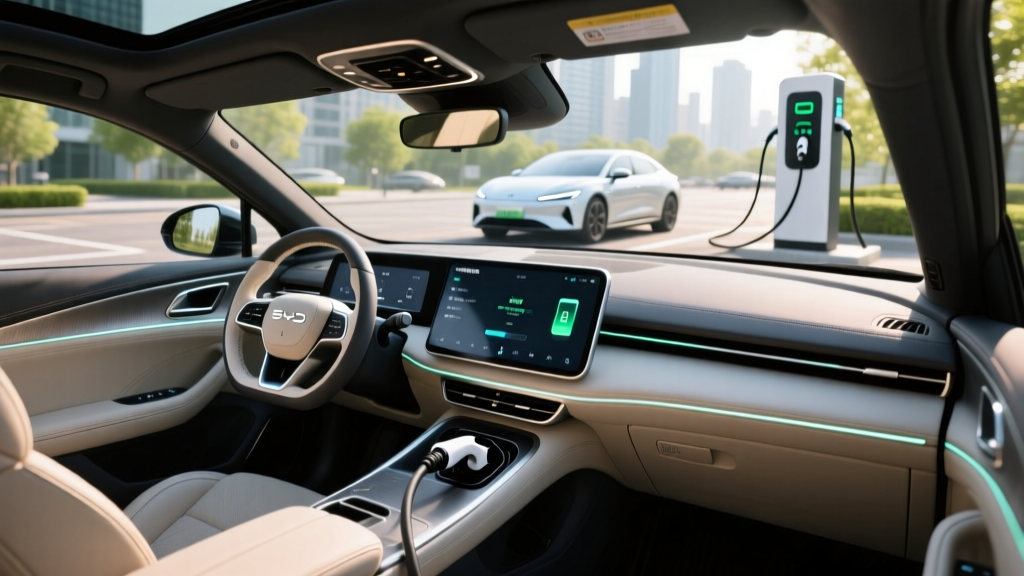
The BYD Han interior is where this sedan makes its strongest case against European and American rivals. Stepping inside, the cabin presents a blend of quilted Nappa leather seats (standard on higher trims), open-pore wood or aluminum trim on the dashboard and door panels, and a flat floor thanks to the skateboard-style Blade Battery pack underneath.
The centerpiece is a 15.6-inch rotating center touchscreen — a BYD signature. The display physically rotates between landscape (for navigation and media) and portrait (for climate and vehicle settings) with a button press or voice command. It runs BYD's DiLink 4.0 infotainment system, which supports wireless Apple CarPlay, Android Auto, and a native app ecosystem. The interface is responsive, though some English-market reviewers have noted inconsistent translation quality in non-Chinese menus.
Behind the steering wheel sits a 12.3-inch digital instrument cluster, and on higher trims (Flagship and above), a heads-up display projects speed and navigation onto the windshield. The center console houses a wireless phone charging pad (up to 15W), two USB-C ports, and a traditional gear selector — not a stalk or button-based system.
Interior dimensions are generous for the segment:
- Front legroom: 41.3 inches
- Rear legroom: 37.8 inches
- Front headroom: 39.4 inches
- Rear headroom: 37.2 inches (slightly compromised by the sloping roofline)
- Trunk volume: 14.5 cubic feet (no frunk)
- Rear seats: 60/40 split-folding on most trims
The rear seat is where the Han differentiates from sportier sedans. It's designed for chauffeured comfort: available heated and ventilated rear outboard seats, a rear center armrest with climate and media controls, and ambient lighting that extends across all four doors. The trunk is deep but narrow, and the lack of a front trunk (frunk) means total cargo capacity trails the Tesla Model S (26 cu ft combined) significantly.
Battery, Range, and Efficiency
The BYD Han EV is powered by BYD's proprietary Blade Battery, a lithium iron phosphate (LFP) cell arranged in a long, thin blade form factor that improves pack-level structural rigidity and thermal stability. The current-generation Han uses an 85.4 kWh usable battery pack.
| Spec | Value |
|---|---|
| Battery (usable) | 85.4 kWh, LFP (Blade) |
| WLTP Range | 427 mi (605 km) |
| Est. EPA-Equivalent Range | ~320–340 mi |
| Efficiency | ~28 kWh/100 mi (est. ~113 MPGe) |
| Max DC Fast Charge | 120 kW |
| 10–80% DC Charge Time | ~35 minutes |
| Level 2 AC Charge Rate | 7 kW (single-phase) / ~22 mi/hr |
| Powertrain | Single-motor FWD (241 hp) or Dual-motor AWD (516 hp) |
| 0–60 mph (AWD) | 3.9 seconds |
| 0–60 mph (FWD) | 7.9 seconds |
| Top Speed | 115 mph (electronically limited) |
| International MSRP | ~$42,000–$58,000 (varies by market) |
| Battery Warranty | 8 years / 150,000 km (~93,000 mi) |
The LFP chemistry is a double-edged sword. On the positive side, LFP cells are more thermally stable (less prone to thermal runaway), tolerate regular 100% charging without accelerated degradation, and are cheaper to produce — which keeps the Han's price competitive. On the downside, LFP has lower energy density than NMC, meaning a heavier pack for the same range, and it performs worse in extreme cold without active preconditioning.
Charging Speed: DC Fast and Home Level 2
The BYD Han's 120 kW peak DC fast-charging rate is its most notable weakness in 2026. Competitors like the Hyundai Ioniq 6 (peak 240 kW), Tesla Model 3 (peak 250 kW), and Porsche Taycan (peak 270 kW) charge substantially faster. At 120 kW, the Han's charge curve holds relatively steady from 10% to about 60% SoC, then tapers progressively. The 10–80% session takes approximately 35 minutes on a capable 150 kW+ station.
| Level | Power | Miles Added per Hour | 10–80% Time |
|---|---|---|---|
| Level 1 (120V household) | 1.4 kW | ~4 mi/hr | ~45+ hours |
| Level 2 (240V home) | 7 kW | ~22 mi/hr | ~12 hours |
| DC Fast Charge | 120 kW (peak) | ~230 mi/hr (peak) | ~35 min |
For home charging, the 7 kW onboard charger means a full 0–100% session takes roughly 12 hours. Most owners charging overnight from a typical 20–30% state of charge will wake to a full battery. The Han uses a CCS2 connector in European markets and GB/T in China. There is no NACS (Tesla-style) port available, which would be a barrier to Supercharger access if the car were sold in the US.
A practical note on the charge curve: BYD's LFP pack holds close to 100–110 kW from 10% to about 55% SoC, then drops to 80 kW through 70%, and falls below 40 kW above 85%. If you're road-tripping, plan to charge to 80% and move on — the last 20% adds 25+ minutes for roughly 60 miles of range.
Performance and Driving Dynamics
The BYD Han is offered in two powertrain configurations:
- FWD (single motor): 241 horsepower, 258 lb-ft torque, 0–60 mph in 7.9 seconds. This is the volume seller and prioritizes efficiency.
- AWD (dual motor): 516 horsepower, 516 lb-ft torque, 0–60 mph in 3.9 seconds. Genuinely quick, though the Han's 4,700+ lb curb weight is felt in corners.
The driving experience is tuned for comfort, not sportiness. The suspension soaks up bumps well, cabin noise isolation is impressive at highway speeds, and the steering is light and predictable. Regenerative braking offers two levels (standard and high), but the Han does not offer true one-pedal driving — you'll still need the brake pedal for full stops. The AWD model's straight-line speed is thrilling, but body roll in corners and a numb steering feel remind you this is a grand tourer, not a sports sedan.
The Han comes equipped with BYD's DiPilot driver-assistance suite, which includes adaptive cruise control, lane-keeping assist, automatic emergency braking, blind-spot monitoring, and a 360-degree camera system. This is SAE Level 2 driver assistance — it requires hands-on-wheel engagement and full driver attention at all times. It is not a self-driving system.
Pricing, Tax Credits, and US Availability
Here's the critical context for US readers: BYD does not sell passenger vehicles in the United States as of 2026. The company has publicly stated it is evaluating a US entry, but the current 100% tariff on Chinese-built electric vehicles (imposed under Section 301 and expanded in 2024) makes direct import economically unviable. BYD is building factories in Hungary, Brazil, Thailand, and Indonesia, but none of these facilities would bypass US tariff rules for the American market under current trade policy.
For reference, here is what the Han costs in international markets, converted to USD:
| Market | Trim | Local Price | USD Equivalent |
|---|---|---|---|
| China | Premium (FWD) | ¥209,800 | ~$29,000 |
| China | Flagship (AWD) | ¥279,800 | ~$38,500 |
| Europe (Germany) | Design (FWD) | €50,990 | ~$55,000 |
| Brazil | EV (FWD) | R$299,800 | ~$53,000 |
Because BYD is not sold in the US, the Han does not qualify for the IRS §30D federal EV tax credit. The credit requires the vehicle to be assembled in North America (with narrow exceptions for commercial leases under §45W), and it must meet battery-component and critical-mineral sourcing requirements. Even if BYD entered the US market, the Chinese origin of its Blade Battery cells and supply chain would likely disqualify the Han from the credit under current IRS rules.
How the BYD Han Compares to US-Available Rivals
Since the Han isn't buyable in the US, here's how it stacks up on paper against sedans you can actually purchase, to provide context for its positioning:
- Tesla Model 3 Long Range AWD — EPA 363 mi, 250 kW charging, 4.2s 0–60, ~$47,740 MSRP. Better charging, better software, Supercharger access. Less luxurious interior.
- Hyundai Ioniq 6 SE Long Range — EPA 361 mi, 240 kW charging (800V), 5.1s 0–60, ~$42,715 MSRP. Dramatically faster charging, eligible for §30D credit. Less rear-seat space.
- BMW i5 eDrive40 — EPA 295 mi, 205 kW charging, 5.7s 0–60, ~$71,195 MSRP. Superior build quality and brand prestige, but nearly double the Han's China price.
- Mercedes-Benz EQE 350+ — EPA 308 mi, 170 kW charging, 6.2s 0–60, ~$76,050 MSRP. The most comparable in luxury feel, but far more expensive.
The Han's value proposition is clear in markets where it's sold: it delivers near-Mercedes interior quality at a fraction of the price. But in the US, tariff barriers and the lack of a dealer/service network make it a non-starter for now.
Pros
- Premium interior materials rivaling European luxury sedans
- LFP Blade Battery: excellent thermal safety, 100% charge-friendly
- Spacious rear seat with available heated/ventilated outboard positions
- Strong AWD performance (3.9s 0–60) in a comfortable package
- Competitive pricing in international markets
- Rotating 15.6" screen is genuinely useful, not gimmicky
Cons
- Not available in the United States (100% tariff barrier)
- 120 kW peak DC charging is slow for 2026 standards
- No front trunk (frunk) — cargo space trails rivals
- LFP battery loses significant range in cold weather
- DiPilot ADAS is functional but unrefined vs. Tesla/Ford/GM systems
- No NACS connector; limited public charging network in many markets
- Infotainment translation quality inconsistent in English
Who the BYD Han Is Built For
The BYD Han targets a specific buyer: someone who values rear-seat comfort and interior luxury over outright sportiness or cutting-edge charging speed. In markets where it's available, it appeals to:
- Executive commuters who want a quiet, comfortable daily driver with a premium cabin
- Ride-hail and fleet operators (particularly in China and Southeast Asia) who benefit from the LFP battery's longevity and low operating cost
- Families who need generous rear legroom for child seats or adult passengers
It does not suit road-trippers who need fast charging, towing-capable buyers (the Han is not rated for towing), or anyone in the US who needs a local service network and warranty support.
Frequently Asked Questions
What is the real-world range of the BYD Han?
The BYD Han is rated at 427 miles on the WLTP cycle, which translates to roughly 320–340 miles on an EPA-equivalent basis. In real-world highway driving at 70 mph, expect 270–295 miles. In cold weather below freezing, the LFP battery's range drops by 25–35%, yielding approximately 200–240 miles of usable range. The car does offer battery preconditioning, but its effectiveness is moderate compared to heat-pump-equipped rivals like the Tesla Model 3 or Hyundai Ioniq 6.
How fast does the BYD Han charge?
The BYD Han peaks at 120 kW on DC fast chargers, achieving a 10–80% charge in approximately 35 minutes. This is notably slower than 2026 competitors: the Hyundai Ioniq 6 charges 10–80% in ~18 minutes at 240 kW, and the Tesla Model 3 does it in ~20 minutes at 250 kW. At home on a Level 2 (240V, 7 kW) charger, the Han adds about 22 miles of range per hour, or a full charge in roughly 12 hours.
Can I buy the BYD Han in the United States?
No. As of 2026, BYD does not sell passenger vehicles in the US. A 100% tariff on Chinese-built EVs makes import economically unfeasible. BYD has not announced a US-market timeline, and even vehicles built in BYD's overseas plants (Hungary, Brazil, Thailand) would face tariff and trade-origin scrutiny under current US policy.
Does the BYD Han qualify for the federal EV tax credit?
No. The IRS §30D clean vehicle credit requires final assembly in North America and compliance with battery-component and critical-mineral sourcing rules (source: IRS). The BYD Han is assembled in China and uses Chinese-sourced LFP cells, making it ineligible. Even if BYD entered the US market, the battery sourcing requirements would likely prevent credit eligibility under current rules.
Is the BYD Han worth buying over a Tesla Model S or BMW i5?
On value alone, the Han is compelling — it offers a comparably luxurious interior and strong performance at roughly half the price of a BMW i5 or Mercedes EQE. However, it falls short on DC charging speed (120 kW vs. 200+ kW for rivals), software refinement, and brand support infrastructure outside China. If you're in a market where the Han is sold with full dealer support, it's a strong choice for comfort-focused buyers. If you need fast road-trip charging, the latest ADAS features, or an established service network, rivals are better picks.
How long will the BYD Han's Blade Battery last?
BYD warranties the Blade Battery for 8 years or 150,000 km (~93,000 miles) against capacity loss below 70% of original capacity. LFP chemistry is known for excellent cycle life — laboratory data shows LFP cells retaining 80%+ capacity after 3,000+ full charge cycles, which translates to well over 500,000 miles in theory. Real-world degradation depends on charging habits and climate, but LFP packs generally outlast NMC packs in total cycle life. BYD recommends regular 100% charges for LFP (unlike NMC, where 80% daily is preferred) to help the battery management system calibrate cell balance.
Note: This review is based on BYD Han specifications available in international markets (China, Europe, Latin America) as of early 2026. US pricing, availability, and tax-credit information are not applicable as the vehicle is not sold in the United States. Specifications may vary by market and model year. For authoritative data, consult fueleconomy.gov for EPA-rated US vehicles or BYD's regional press sites for international specs.