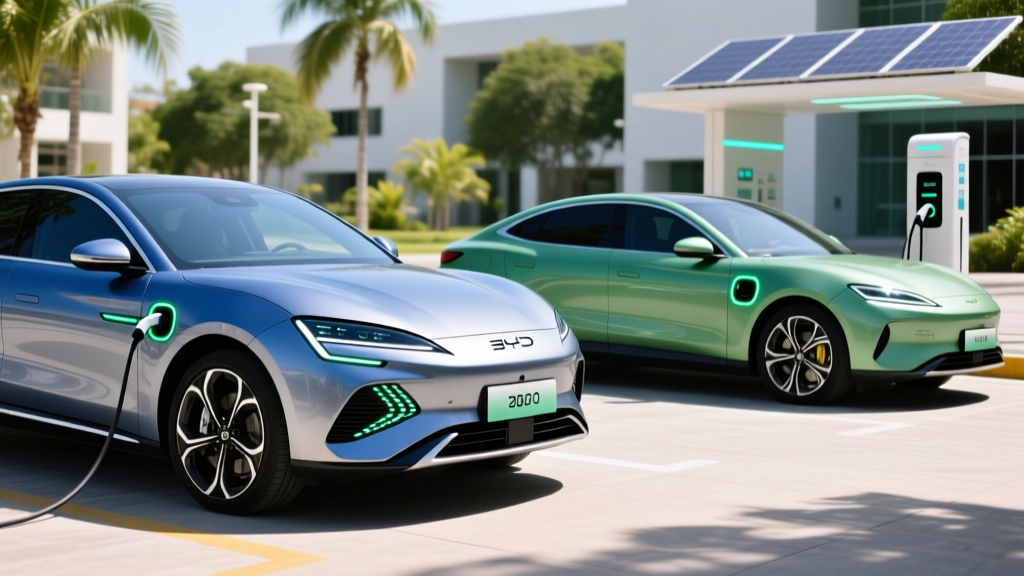
BYD has rapidly expanded across Latin America, and Guatemala has become one of its key Central American markets. Unlike the United States — where BYD passenger vehicles remain unavailable due to tariff barriers — Guatemalan buyers can walk into dealerships and drive home a BYD electric vehicle today. But how do these models stack up in real-world range, charging practicality, and value when you factor in local infrastructure and ownership costs?
This review covers the three BYD models most widely available in Guatemala as of early 2026: the Atto 3 (compact SUV), the Dolphin (compact hatchback), and the Seal (sport sedan). We break down exact specs, real-world range expectations on Guatemalan roads, charging logistics, and how these vehicles compare to the limited EV alternatives in the region.
BYD's Guatemala Lineup at a Glance
BYD entered Guatemala through local dealership partnerships, offering vehicles adapted for Latin American markets. These are largely the same global-spec models sold in Europe, Australia, and Southeast Asia, though trim availability and pricing differ. Below is a side-by-side look at the three core models.
| Spec | Atto 3 (Extended Range) | Dolphin (Extended Range) | Seal (Design RWD) |
|---|---|---|---|
| Battery Capacity | 60.48 kWh usable (LFP Blade) | 60.48 kWh usable (LFP Blade) | 82.56 kWh usable (LFP Blade) |
| WLTP Range | 420 km (261 mi) | 427 km (265 mi) | 570 km (354 mi) |
| Estimated Real-World Range | ~340 km (211 mi) | ~350 km (217 mi) | ~460 km (286 mi) |
| Motor Output | 150 kW (201 hp), FWD | 150 kW (201 hp), FWD | 230 kW (308 hp), RWD |
| 0-100 km/h (0-62 mph) | 7.3 sec | 7.0 sec | 5.9 sec |
| Max DC Fast Charge | 88 kW | 88 kW | 150 kW |
| 10-80% DC Charge Time | ~29 min | ~29 min | ~26 min |
| Level 2 AC Charge Rate | 7 kW (~25 mi/hr) | 7 kW (~25 mi/hr) | 11 kW (~40 mi/hr) |
| Approx. Guatemala Price (USD) | $34,000-$38,000 | $29,000-$33,000 | $48,000-$55,000 |
| Drivetrain | FWD single motor | FWD single motor | RWD single motor |
Note: BYD publishes WLTP range figures, which are generally 10-20% more optimistic than U.S. EPA estimates. We provide WLTP numbers here because these are the official figures for the Latin American market. Real-world estimates reflect mixed driving including highway, elevation changes, and tropical heat.
Real-World Range on Guatemalan Roads
WLTP sticker: Atto 3 — 420 km (261 mi) | Dolphin — 427 km (265 mi) | Seal — 570 km (354 mi)
Expect in practice: Atto 3 — ~340 km | Dolphin — ~350 km | Seal — ~460 km
Highway at 120 km/h: subtract another 15-20%. Mountain routes (e.g., Guatemala City to Quetzaltenango): subtract 10-15% for sustained climbing, partially recovered on descent via regen.
Guatemala's driving environment is uniquely demanding for EVs. Guatemala City sits at roughly 1,500 meters elevation, and routes to surrounding highlands involve sustained climbs that draw heavily on the battery. The good news: altitude doesn't degrade battery chemistry the way extreme cold does, and regenerative braking on descents can recover meaningful energy.
The Atto 3 and Dolphin, both with 60.48 kWh LFP Blade batteries, deliver similar real-world results. In mixed city and suburban driving around Guatemala City — where traffic congestion actually favors EVs thanks to zero idle consumption and aggressive regen — expect roughly 340-360 km. On the CA-1 highway at sustained 100-110 km/h, that drops to around 280-300 km.
The Seal, with its larger 82.56 kWh pack and more aerodynamic sedan profile, stretches comfortably past 450 km in mixed driving. On a Guatemala City to Escuintla run (roughly 55 km each way), the Seal can manage multiple round trips without charging.
LFP chemistry matters here: these batteries tolerate regular 100% charges without the degradation concerns of NMC packs. BYD recommends charging to 100% at least once weekly for LFP battery calibration — an advantage for Guatemalan owners who may charge nightly at home.
Charging Speed and Infrastructure in Guatemala
Charging infrastructure remains the single biggest consideration for EV ownership in Guatemala. As of early 2026, public DC fast-charging stations are concentrated in Guatemala City, with sparse coverage along intercity corridors.
| Charging Level | Atto 3 / Dolphin | Seal | Miles Added per Hour (approx.) |
|---|---|---|---|
| Level 1 (120V household) | ~1.4 kW | ~1.4 kW | ~4-5 mi/hr |
| Level 2 (240V, 7-11 kW) | 7 kW | 11 kW | 25-40 mi/hr |
| DC Fast Charge (peak) | 88 kW | 150 kW | ~250-400 mi/hr at peak |
| 10-80% DC Time | ~29 minutes | ~26 minutes | N/A |
The Atto 3 and Dolphin share an 88 kW peak DC charge rate, which is modest by 2026 standards. The Hyundai Ioniq 5, for comparison, peaks at 240 kW on an 800V architecture. In practice, BYD's LFP batteries maintain a relatively flat charge curve through the middle of the session — you won't see the dramatic taper that NMC packs exhibit above 80%, but the lower peak rate means the 10-80% session still takes close to 30 minutes at a capable charger.
The Seal's 150 kW peak is more competitive, though still below the class-leading 350 kW capability of vehicles like the Porsche Taycan or the 250 kW of the Tesla Model 3 Highland.
Home charging is where Guatemalan BYD owners will do most of their charging. A 7 kW Level 2 wallbox (the standard BYD-recommended home unit) requires a dedicated 240V circuit. In Guatemala City, installation typically costs $500-$1,200 depending on panel capacity and wiring distance. Most urban homes with modern electrical panels can accommodate this without a full service upgrade. A full overnight charge from 20% to 100% takes roughly 8-9 hours for the Atto 3 and Dolphin, and about 10-11 hours for the Seal.
Public charging networks in Guatemala are still developing. Operators like EverCharge and hotel/retail-located chargers provide Level 2 and limited DC fast-charging in the capital. For intercity travel — say, Guatemala City to Antigua (45 km) or Lake Atitlán (140 km) — planning around destination charging is essential. The Atto 3's 211-mile real-world range handles the Antigua trip trivially, but Lake Atitlán requires either a mid-trip top-up or a full charge before departure with a comfortable buffer.
Performance and Driving Dynamics
The Atto 3 and Dolphin share BYD's 150 kW (201 hp) front-mounted permanent magnet motor. Both deliver brisk city acceleration — the 0-100 km/h time of roughly 7 seconds means confident highway merging and passing. The instant torque characteristic of electric motors makes these feel quicker than their numbers suggest in stop-and-go Guatemala City traffic.
The Seal is the performance standout. Its 230 kW (308 hp) rear motor pushes it to 100 km/h in 5.9 seconds, and the RWD layout gives it more engaging handling dynamics than the front-drive Atto 3 and Dolphin. The dual-motor AWD Seal Performance variant (3.8-second 0-100 km/h) is available in some Latin American markets but has limited availability in Guatemala as of 2026.
All three models feature BYD's standard regenerative braking with adjustable intensity. The strongest regen setting enables near one-pedal driving in city conditions, though it doesn't bring the vehicle to a complete stop — you'll still need the friction brakes at very low speeds.
Interior, Cargo, and Technology
The Atto 3 is BYD's most practical offering for Guatemalan families. Cargo volume is 440 liters (15.5 cu ft) behind the rear seats, expanding to roughly 1,340 liters (47.3 cu ft) with the 60/40 split rear seats folded. Rear legroom is generous at approximately 980 mm (38.6 in), and the flat floor (no transmission tunnel) makes the middle seat usable for a third passenger.
The Dolphin sacrifices some cargo space — 345 liters (12.2 cu ft) trunk — but its hatchback design keeps it practical for daily errands. Rear legroom is slightly tighter at roughly 930 mm (36.6 in). For a single professional or a couple without children, it's adequate; for a family of four on a road trip, packing light is mandatory.
The Seal offers 400 liters (14.1 cu ft) of trunk space in a traditional sedan configuration, with a rear seat pass-through for longer items. Its cabin materials and fit-and-finish are noticeably above the Atto 3 and Dolphin, approaching entry-level luxury territory.
All three models come with BYD's rotating 12.8-inch infotainment touchscreen (15.6 inches on the Seal), wireless Apple CarPlay and Android Auto, and a digital instrument cluster. The infotainment system is functional but not class-leading — the interface can feel cluttered, and voice recognition in Spanish remains inconsistent. Driver-assistance features include adaptive cruise control, lane-keeping assist, automatic emergency braking, and a 360-degree camera system. Note: these are SAE Level 2 driver-assistance features — the driver must remain fully engaged at all times. This is not autonomous driving.
Pricing, Tax Considerations, and Ownership Costs
BYD's Guatemala pricing positions these vehicles as value-oriented EVs, undercutting the few competitors in the market (notably the Hyundai Kona Electric and imported Tesla Model 3).
| Model | Base Trim (approx.) | Top Trim (approx.) | U.S. Federal §30D Credit Eligible? |
|---|---|---|---|
| Dolphin | $29,000 | $33,000 | No — not sold in U.S. |
| Atto 3 | $34,000 | $38,000 | No — not sold in U.S. |
| Seal | $48,000 | $55,000 | No — not sold in U.S. |
U.S. buyers: BYD vehicles are not available for sale in the United States and therefore do not qualify for the IRS §30D federal tax credit. The credit applies only to new clean vehicles purchased from a licensed U.S. dealer. This review targets the Guatemala and Central American market, where different incentive structures apply.
Guatemala does not currently offer a direct purchase subsidy comparable to the U.S. §30D credit. However, EVs benefit from exemption from the annual circulation tax (Impuesto de Circulación) for a period established at registration, and some municipalities offer reduced registration fees. Consult Guatemalan SAT (tax authority) guidelines for current-year specifics, as these policies have evolved year over year.
Electricity costs in Guatemala average roughly $0.18-$0.24 per kWh for residential service. Charging the Atto 3 from 20% to 100% at home costs approximately $8.70-$11.60 — translating to a per-kilometer energy cost of roughly $0.025-$0.034. Compare this to gasoline at approximately $4.50-$5.00 per gallon and a comparable ICE SUV achieving 25 mpg, yielding a per-kilometer fuel cost of roughly $0.11-$0.13. The per-kilometer savings are substantial: roughly 70-75% less to "fuel" the BYD.
Warranty and Battery Longevity
BYD's warranty coverage in Guatemala mirrors its global standard for most markets:
- Vehicle warranty: 6 years / 150,000 km (93,000 mi)
- Battery warranty: 8 years / 160,000 km (99,000 mi), with a capacity retention threshold of 70%
- Drive unit (motor/inverter): 8 years / 150,000 km
The LFP Blade Battery is one of BYD's strongest selling points for longevity. LFP chemistry inherently offers more charge cycles than NMC — typically 3,000+ full cycles before reaching 80% capacity, compared to 1,000-2,000 for NMC. In practical terms, 3,000 cycles of a 60 kWh pack equals roughly 1.8 million kilometers of driving — far beyond the vehicle's mechanical lifespan.
Guatemala's tropical climate is actually favorable for LFP batteries. Unlike extreme cold, which temporarily reduces range and slows charging, warm ambient temperatures keep LFP cells in their optimal operating range. Thermal management is still important — all three models feature active liquid cooling/heating — but the demands on the system are lighter than in northern climates.
How Do BYD's Guatemala EVs Compare to Competitors?
- LFP Blade Battery: exceptional cycle life, safe chemistry, 100% charge-friendly
- Strong value: Atto 3 undercuts Kona Electric by $5,000+ in-market
- Practical range for daily Guatemalan commutes (340-460 km real-world)
- Low running costs: ~$0.03/km vs ~$0.12/km for gasoline
- Generous standard equipment: 360° camera, adaptive cruise, large touchscreen
- Warm-climate LFP performance avoids cold-weather range loss
- DC fast-charge rate (88 kW on Atto 3/Dolphin) is below 2026 class average
- Public charging infrastructure in Guatemala remains limited outside the capital
- Infotainment UI feels cluttered; Spanish voice control is inconsistent
- No Apple/Google native integration beyond screen mirroring
- Aftermarket parts and independent service options are still developing
- Resale value data is thin — BYD is new to the Guatemalan market
The most direct competitor in Guatemala is the Hyundai Kona Electric (64 kWh, WLTP 484 km, ~$42,000). The Kona offers more WLTP range and a faster 100 kW DC charge rate, but costs significantly more. The MG4 EV, also entering Central American markets, offers similar pricing to the Dolphin but with a less proven dealer network in Guatemala.
For Guatemalan buyers who can charge at home and whose daily driving stays within 200-300 km, the BYD Atto 3 and Dolphin represent the most accessible entry point into EV ownership in the country. The Seal is a credible alternative for buyers who would otherwise consider a Tesla Model 3 — at a lower price, though without access to the Supercharger network.
Who Should Buy a BYD in Guatemala?
- Choose the BYD Dolphin if: you're a solo commuter or couple in Guatemala City with home charging access, daily driving under 150 km, and a budget under $33,000.
- Choose the BYD Atto 3 if: you need a family SUV with rear-seat space for children, cargo room for weekly shopping, and the ground clearance for Guatemala's uneven roads. Budget: $34,000-$38,000.
- Choose the BYD Seal if: you want a premium sedan experience, regularly drive 300+ km per day, and value performance (5.9s 0-100 km/h). Budget: $48,000-$55,000.
- Look elsewhere if: you regularly drive intercity routes exceeding 350 km one-way without reliable destination charging, or if you need AWD for highland roads in the rainy season.
Frequently Asked Questions
What is the real-world range of BYD EVs in Guatemala?
Expect roughly 340 km (211 mi) from the Atto 3, 350 km (217 mi) from the Dolphin, and 460 km (286 mi) from the Seal in mixed driving. Highway driving at sustained speeds reduces this by 15-20%. Mountain routes with sustained climbs draw more energy but benefit from regenerative braking on descents.
How fast do BYD models charge in Guatemala?
At a DC fast charger, the Atto 3 and Dolphin peak at 88 kW (10-80% in ~29 minutes), while the Seal peaks at 150 kW (10-80% in ~26 minutes). At home on a 7-11 kW Level 2 charger, a full charge takes 8-11 hours depending on the model. Standard 120V household outlets add roughly 4-5 miles per hour — adequate only for emergency trickle charging.
Does a BYD purchased in Guatemala qualify for the U.S. federal EV tax credit?
No. The IRS §30D credit applies only to vehicles purchased new from a licensed U.S. dealer. BYD does not sell passenger vehicles in the United States. Guatemalan tax benefits for EVs follow local SAT regulations, which currently include circulation tax exemptions.
Is the BYD Atto 3 better than the Hyundai Kona Electric for Guatemala?
The Kona Electric offers more WLTP range (484 km vs. 420 km) and a slightly faster DC charge rate. But the Atto 3 costs roughly $4,000-$8,000 less in the Guatemalan market and provides a more spacious interior. For city-based drivers who charge at home, the Atto 3's range is sufficient and the value proposition is stronger.
How long will the BYD Blade Battery last in Guatemala's climate?
BYD's LFP Blade Battery is rated for 3,000+ full charge cycles before dropping to 80% capacity — equivalent to well over 1 million kilometers. Guatemala's warm climate is favorable for LFP chemistry, and the battery warranty covers 8 years / 160,000 km with a 70% capacity retention guarantee.
Can I road-trip a BYD from Guatemala City to Tikal?
Guatemala City to Tikal is roughly 500 km one-way. With real-world range of 211-286 miles, you will need at least one mid-route DC fast charge. As of 2026, public charging along this corridor is extremely limited. This trip is feasible only with careful planning and confirmed charging stops. For now, BYD EVs in Guatemala are best suited for daily commuting and shorter regional trips with home charging as the primary strategy.