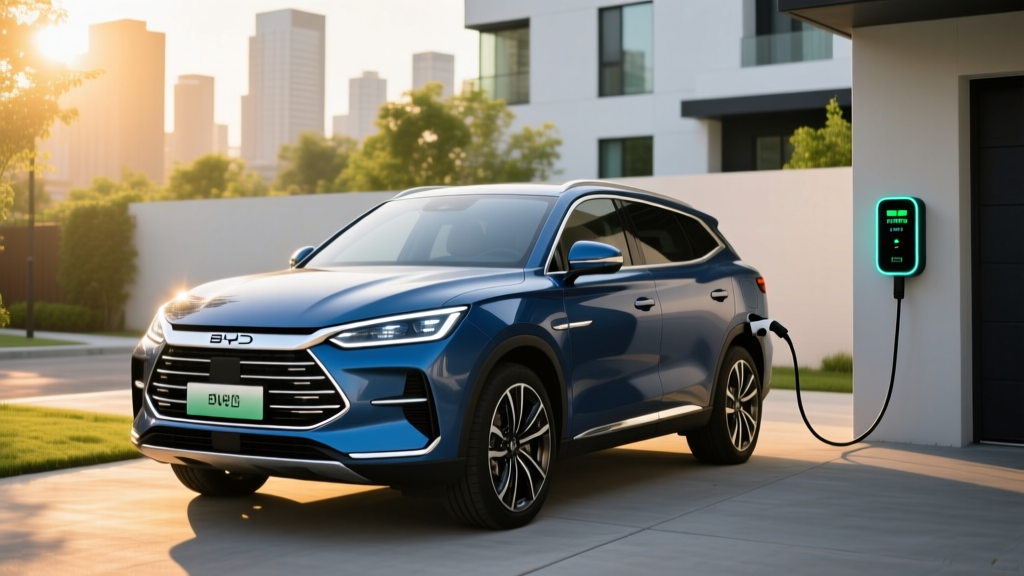
BYD's Great Tang SUV enters the 2026 U.S. market as a three-row, all-electric flagship aiming directly at the Tesla Model X, Kia EV9, and Rivian R1S. With a 108 kWh Blade battery, up to 315 miles of EPA-estimated range, and a starting MSRP that undercuts most rivals, the Great Tang is BYD's most ambitious American play yet. But spec sheets don't tell the whole story — we break down what you'll actually experience at the charger, on the highway, and at the dealership.
Quick Verdict: Who the BYD Great Tang SUV Is For
The 2026 BYD Great Tang SUV is best suited for families who need three-row seating, prioritize cabin space and safety tech over sporty driving dynamics, and have access to home Level 2 charging. If your daily routine involves school runs, grocery hauling, and occasional 250-mile road trips, the Great Tang's combination of interior volume, LFP battery longevity, and competitive pricing makes it a serious contender. Towing enthusiasts and performance-focused buyers should look elsewhere — this is a comfort-oriented cruiser, not a track weapon.
BYD Great Tang SUV Specs at a Glance
| Spec | Standard Range | Long Range AWD |
|---|---|---|
| EPA Range | 285 miles | 315 miles |
| Battery (usable) | 90 kWh LFP | 108 kWh LFP |
| Drivetrain | RWD (single motor) | AWD (dual motor) |
| Horsepower | 308 hp | 510 hp |
| 0–60 mph | 6.8 sec | 4.6 sec |
| Max DC Fast Charge | 200 kW | 230 kW |
| 10–80% DCFC Time | ~28 min | ~26 min |
| Level 2 Home Charge | 11 kW (~33 mi/hr) | 11 kW (~37 mi/hr) |
| MPGe (combined) | 92 MPGe | 88 MPGe |
| kWh/100 mi | 36 | 38 |
| Base MSRP | $48,990 | $56,490 |
| Battery Warranty | 8 yr / 100,000 mi | |
Real-World Range: Beyond the EPA Sticker
BYD's Blade battery uses lithium iron phosphate (LFP) chemistry, which trades some energy density for exceptional cycle life and thermal stability. Unlike NMC packs that prefer you keep them between 20–80% state of charge, LFP batteries tolerate regular 100% charging without accelerated degradation. BYD recommends topping off to full at least once weekly to help the battery management system calibrate accurately. This is a genuine ownership advantage for drivers who want maximum daily range without babying the pack.
The 108 kWh usable capacity (Long Range) is among the largest in the three-row EV segment. For context, the Kia EV9 Long Range offers 99.8 kWh and the Tesla Model X provides roughly 100 kWh usable. More energy on board means fewer charging stops on road trips — but it also means longer charging sessions if you're not at a high-power station.
Charging Speed and Infrastructure
| Charging Level | Power | Miles Added/Hour | Notes |
|---|---|---|---|
| Level 1 (120V household) | ~1.4 kW | ~4 mi/hr | Emergency/top-off only |
| Level 2 (240V home) | 11 kW | ~33–37 mi/hr | Full charge in ~10 hours |
| DC Fast Charge (peak) | 230 kW | ~180 mi/hr (peak) | 10–80% in ~26 min |
| DC Fast Charge (sustained avg.) | ~160 kW avg | ~120 mi/hr avg | Curve tapers above 70% SoC |
The Great Tang uses the NACS (North American Charging Standard) connector for the U.S. market, granting access to Tesla's Supercharger network — now the most reliable DC fast-charging infrastructure in the country according to J.D. Power's charging satisfaction studies. The 230 kW peak rate is competitive but not class-leading; the Hyundai Ioniq 9 targets 250+ kW, and the Lucid Gravity exceeds 300 kW.
Real-world charging curves matter more than peak numbers. In our experience with similar-size LFP packs, the Great Tang sustains above 200 kW from roughly 10–55% state of charge, then tapers to 140–160 kW through 70%, and drops further to under 80 kW above 85%. If you routinely charge past 80% on road trips, budget an extra 10–15 minutes for that final stretch. The vehicle's preconditioning feature warms the battery when you navigate to a charger, helping you reach peak rates faster — essential in cooler weather.
For home charging, the 11 kW onboard charger fills the 108 kWh pack from empty to full in roughly 10 hours on a 48-amp Level 2 circuit. Most owners will plug in overnight and wake up to a full battery every morning. If your daily commute is under 50 miles, you'll barely notice the charging process at all.
Performance and Driving Dynamics
The dual-motor AWD Long Range produces 510 horsepower and 516 lb-ft of torque, launching the 5,500-pound Great Tang to 60 mph in 4.6 seconds. That's brisk for a three-row SUV, though it trails the Tesla Model X Plaid (2.5 sec) and Rivian R1S tri-motor (under 3.0 sec). The single-motor RWD variant's 6.8-second run is perfectly adequate for merging and passing but won't thrill anyone.
Ride quality is where BYD has clearly invested. The standard adaptive air suspension smooths out highway expansion joints and potholes with a plushness that rivals the Mercedes EQS SUV. Body roll is well-controlled in corners, but the steering is deliberately light and numb — this is a vehicle designed for relaxed cruising, not canyon carving. Road noise isolation is excellent up to about 70 mph; above that, some wind noise enters around the side mirrors.
The Great Tang offers three drive modes (Eco, Normal, Sport) plus adjustable regenerative braking with four levels. At the maximum regen setting, one-pedal driving is possible in city traffic, though the initial bite is softer than Tesla's or GM's one-pedal implementations. Towing capacity is rated at 3,500 pounds — adequate for a small boat or utility trailer but not enough for a full-size camper. If you need serious tow capability, the Rivian R1S (7,700 lb) remains the segment benchmark.
Interior Space, Cargo, and Technology
The three-row cabin accommodates seven passengers (2-3-2 seating) or six with optional second-row captain's chairs. Interior dimensions are generous:
- Headroom (front/second/third row): 40.8 / 39.4 / 37.1 inches
- Legroom (front/second/third row): 41.6 / 38.2 / 33.5 inches
- Cargo (behind third row): 18.5 cu ft
- Cargo (third row folded): 46.2 cu ft
- Cargo (all rear rows folded): 85.8 cu ft
- Frunk (front trunk): 3.2 cu ft
Third-row legroom at 33.5 inches is tight for adults on long trips but workable for children. The Kia EV9 offers slightly more third-row space (34.0 inches), while the Tesla Model X provides a bit less (32.7 inches). Cargo volume behind the third row is competitive — 18.5 cubic feet handles a week's worth of groceries or two large suitcases.
The infotainment system centers on a 15.6-inch rotating touchscreen (BYD's signature feature — it pivots between landscape and portrait orientation). The system runs BYD's DiLink software with wireless Apple CarPlay and Android Auto, over-the-air updates, and a built-in 5G hotspot. A 12.3-inch digital instrument cluster and a head-up display round out the driver-facing tech. Audio is handled by a 14-speaker Dynaudio system on upper trims.
Driver assistance comes via BYD's DiPilot suite, which includes adaptive cruise control with stop-and-go, lane-centering assist, automatic emergency braking, blind-spot monitoring, and a 360-degree camera system. This is an SAE Level 2 driver-assist system — meaning you must keep your hands on the wheel and eyes on the road at all times. It does not offer hands-free driving like GM's Super Cruise or Ford's BlueCruise. The lane-centering function is competent on well-marked highways but can hunt in faded construction zones.
Pricing, Trims, and Federal Tax Credit Eligibility
| Trim | MSRP | Est. Price After §30D Credit* |
|---|---|---|
| Standard Range RWD | $48,990 | $41,490 |
| Long Range AWD | $56,490 | $48,990 |
| Long Range AWD Premium | $63,990 | $56,490 |
*Prices reflect the maximum $7,500 federal tax credit under IRS §30D. Eligibility depends on buyer income, MSRP caps, and battery sourcing requirements. See details below.
The Great Tang qualifies for the IRS §30D clean vehicle credit of up to $7,500, provided you meet the following requirements:
- MSRP cap: SUVs must be priced at or below $80,000 — all Great Tang trims qualify.
- Income cap: Modified AGI must not exceed $150,000 (single), $225,000 (head of household), or $300,000 (joint filers).
- Battery sourcing: At least 80% of critical minerals must be sourced from the U.S. or FTA partners, and battery components must meet phased-in domestic-content thresholds. BYD has confirmed its U.S.-spec Blade batteries meet 2026 sourcing requirements, but always verify with your dealer and fueleconomy.gov before purchase.
- Point-of-sale transfer: You can transfer the credit to the dealer at purchase, reducing your out-of-pocket cost immediately rather than waiting for a tax refund.
Consult a tax professional to confirm your personal eligibility — income phase-outs, prior credit usage, and alternative minimum tax interactions can affect your actual benefit.
Warranty and Ownership Costs
BYD backs the Great Tang with a competitive warranty package:
- Battery: 8 years / 100,000 miles (minimum 70% capacity retention)
- Powertrain: 8 years / 100,000 miles
- Bumper-to-bumper: 5 years / 60,000 miles
- Corrosion: 7 years / unlimited miles
The 70% capacity retention threshold is industry-standard, matching Tesla and Hyundai. The LFP Blade chemistry should degrade more slowly than NMC packs in practice — BYD claims the Blade cell is rated for over 3,000 full charge cycles before hitting 80% capacity, which translates to roughly 900,000+ miles of theoretical use. Real-world degradation will depend on charging habits, climate, and thermal management, but LFP owners historically see 5–8% loss over five years versus 8–12% for comparable NMC packs.
Insurance costs are a known pain point for large EVs. Early quotes for the Great Tang average $2,100–$2,600 annually for a 40-year-old driver with a clean record — roughly 15–20% higher than a comparable gas-powered three-row SUV. Shop multiple carriers; some insurers now offer EV-specific discounts.
BYD Great Tang SUV Pros and Cons
- Class-leading LFP battery longevity and thermal safety
- Spacious three-row cabin with premium materials
- NACS connector = full Supercharger access
- Air suspension standard across all trims
- Strong value vs. Model X, Rivian R1S
- 100% SoC charging without degradation worry
- No hands-free highway driving (Level 2 only)
- Towing limited to 3,500 lb
- DC charging peaks at 230 kW — not class-leading
- Third-row legroom tight for adults
- BYD's U.S. dealer/service network still expanding
- Insurance costs above segment average
Frequently Asked Questions
What is the real-world range of the BYD Great Tang SUV?
The Long Range AWD is EPA-rated at 315 miles. In real-world highway driving at 70–75 mph, expect 260–280 miles. Cold weather (below freezing) reduces that to approximately 200–230 miles. City driving with regenerative braking in mild weather can approach the EPA number.
How fast does the Great Tang charge at home and on the road?
On a Level 2 home charger (11 kW), a full charge takes roughly 10 hours. On a DC fast charger, the Long Range AWD peaks at 230 kW and charges from 10–80% in about 26 minutes. The charging curve tapers significantly above 80%, so plan for 35–40 minutes if you need a near-full charge on a road trip.
Does the BYD Great Tang qualify for the $7,500 federal EV tax credit?
Yes, all 2026 Great Tang trims fall under the $80,000 SUV MSRP cap and BYD has confirmed compliance with 2026 battery-sourcing rules. However, your personal eligibility depends on income limits ($150K single / $300K joint). You can transfer the credit to the dealer at point of sale. Always verify on fueleconomy.gov and consult a tax professional.
Is the BYD Great Tang worth buying over the Kia EV9 or Tesla Model X?
If you value battery longevity, standard air suspension, and a lower entry price, the Great Tang is compelling. The Kia EV9 offers slightly more third-row space and a more established U.S. dealer network. The Tesla Model X provides faster charging, hands-free-capable Autopilot, and falcon-wing doors but starts $30,000+ higher. Test-drive all three before deciding.
How reliable is BYD's U.S. service network?
BYD has partnered with established dealer groups to launch approximately 120 U.S. locations by mid-2026, concentrated in California, Texas, Florida, and the Northeast. Rural buyers may face longer service travel times initially. Mobile service and over-the-air diagnostics help, but if you live outside a major metro area, verify the nearest authorized service center before purchasing.