Quick Verdict: BYD's Ambitious Driver-Assist Play
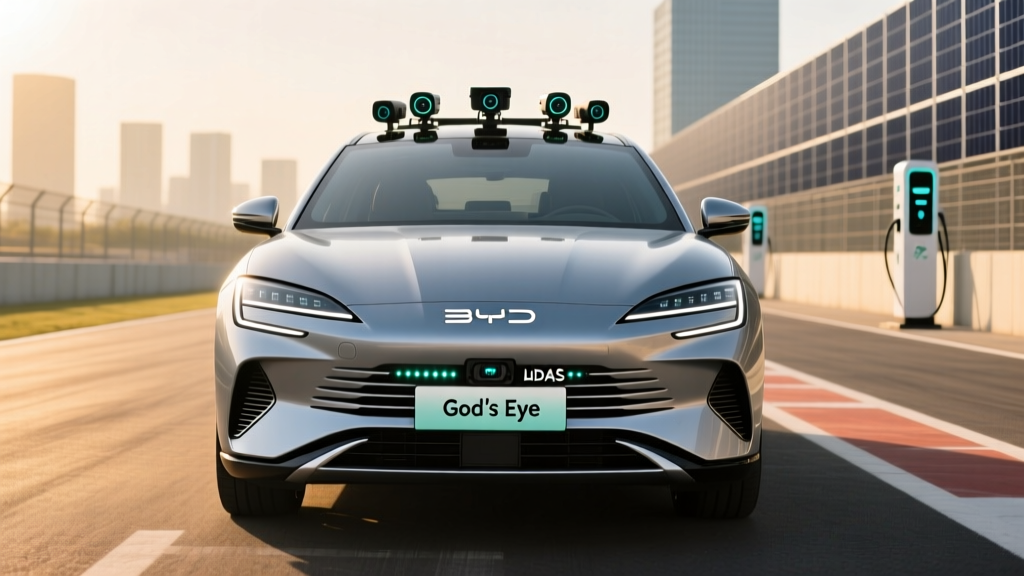
BYD's "God's Eye" (天神之眼, Tiānshén zhī Yǎn) is the Chinese automaker's proprietary advanced driver-assistance system (ADAS), branded under the DiPilot umbrella. Introduced across BYD's premium and mainstream lineups starting in 2024 and expanded through the 2025–2026 model years, God's Eye represents one of the most sensor-dense Level 2 systems on the global market. For US-based EV shoppers, the critical question is twofold: how does the technology stack up against Tesla Autopilot, Ford BlueCruise, and GM Super Cruise — and will you actually be able to buy it stateside?
This review breaks down the hardware, software capabilities, real-world limitations, and market availability of BYD God's Eye as of early 2026. We'll also address the tax-credit and regulatory realities that affect any BYD purchase in the United States.
BYD God's Eye / DiPilot is a Level 2 driver-assistance system per SAE International's J3016 taxonomy. This means the system can control steering, acceleration, and braking simultaneously — but the driver must remain fully engaged, monitor the road at all times, and be prepared to take over instantly. This is not self-driving. Only Level 4 services like Waymo operate without a human driver in the loop.
God's Eye Hardware: Sensors, Cameras, and Compute
BYD offers God's Eye in multiple tiers depending on the vehicle model and trim. The highest-spec variant, found on the Seal, Han, and Tang EVs (2025–2026 models sold in international markets), includes:
| Component | Quantity / Spec |
|---|---|
| Cameras | 11 (including forward-facing 8MP, surround-view, cabin monitoring) |
| Millimeter-wave radars | 5 (1 long-range front, 4 corner) |
| LiDAR | 1 roof-mounted unit (on select trims; not all models) |
| Ultrasonic sensors | 12 (parking assist) |
| Compute platform | NVIDIA DRIVE Orin (254 TOPS) on premium trims; lower-spec Horizon Robotics chip on base DiPilot |
The inclusion of LiDAR on higher trims is a notable differentiator. Most competing Level 2 systems — Tesla Autopilot, Subaru EyeSight — rely exclusively on cameras (Tesla) or cameras plus radar. LiDAR gives God's Eye an additional depth-perception layer that improves object detection in low-light and adverse weather conditions, though it adds cost and is not standard across all BYD models.
Lower-spec DiPilot variants (DiPilot 100, found on the Dolphin and Atto 3) omit the LiDAR and use fewer cameras (typically 5–7) with a less powerful compute chip. These systems still offer adaptive cruise control, lane-centering, and automated emergency braking, but lack the higher-tier features like automated lane changes and intersection assist.
What God's Eye Actually Does: Feature Breakdown
Here's what the top-tier God's Eye / DiPilot 300 system offers in real-world driving as of the 2026 model year in international markets:
- Adaptive Cruise Control (ACC) with stop-and-go: Maintains set speed and following distance in highway traffic, including full stops and resumptions.
- Lane Centering Assist (LCA): Actively keeps the vehicle centered in marked lanes; performs adequately on well-marked highways but can hunt on faded or construction-zone markings.
- Automated Lane Change: When the driver activates the turn signal, the system checks adjacent lanes and executes the lane change if clear. Driver confirmation via steering-wheel touch is required.
- Navigation-Guided Driving: On supported mapped highways, the system can suggest lane changes and adjust speed for upcoming exits and interchanges. This is similar in concept to Tesla's "Navigate on Autopilot" or Ford's BlueCruise with Lane Change Assist.
- Intersection Assist: Using LiDAR and cameras, the system can detect cross-traffic and pedestrians at intersections and apply braking if the driver proceeds unsafely. This is a Level 2 safety feature, not autonomous intersection navigation.
- Automated Parking: Ultrasonic sensors and cameras enable hands-free parallel and perpendicular parking in detected spaces.
- Driver Monitoring: An infrared cabin camera tracks eye gaze and head position. If the driver looks away or closes their eyes, escalating alerts sound, and the system can bring the vehicle to a controlled stop.
- It does not drive the car autonomously. You are the driver at all times.
- It does not handle unmapped rural roads, construction zones, or severe weather reliably.
- It does not replace attentive driving. NHTSA data shows that overreliance on Level 2 systems contributes to preventable crashes.
- Navigation-guided driving requires pre-mapped highway segments and may not be available outside Greater China and select international markets.
Real-World Performance: How It Drives
Based on international press evaluations and owner reports from Chinese and European-market BYD Seal and Han owners (2025 model year), God's Eye performs competently but not class-leading compared to established systems:
Highway cruising: Lane centering is stable on well-marked divided highways, with smooth steering inputs. On par with Toyota Safety Sense 3.0 and slightly behind GM Super Cruise, which offers hands-off driving on pre-mapped roads (over 750,000 miles of compatible roads in North America, per GM's Super Cruise page).
Lane changes: The automated lane-change feature is conservative — it waits for large gaps and occasionally aborts maneuvers if a vehicle approaches quickly in the target lane. This is safer than aggressive but can feel hesitant in dense traffic.
City driving: God's Eye is less confident in urban environments. The system can struggle with unprotected left turns, complex multi-lane intersections, and unpredictable pedestrian behavior. BYD does not market this as a city-capable autonomous system, which is appropriate given its Level 2 classification.
Adverse conditions: The LiDAR-equipped variant handles rain and dusk better than camera-only systems, but heavy rain, fog, and snow still degrade performance significantly. The system will issue a takeover request when sensor confidence drops — a correct and safe behavior.
Compared to Tesla Autopilot / FSD (Supervised): Tesla's vision-only system offers broader geographic coverage and more aggressive lane-change behavior, but its lack of LiDAR and radar means it can occasionally phantom-brake or misjudge stationary objects. God's Eye is more conservative and sensor-redundant but less feature-rich in terms of navigation-guided coverage outside China.
US Availability: The Elephant in the Room
As of early 2026, BYD does not sell passenger vehicles in the United States. The company has publicly stated ambitions to enter the US market, but faces significant headwinds:
- 100% tariff on Chinese-made EVs: Under Section 301 trade provisions, Chinese-manufactured electric vehicles face a 100% import tariff as of 2025, effectively doubling the sticker price of any BYD model brought to the US. This makes models like the Seal (priced around ¥180,000–250,000 in China, roughly $25,000–$35,000 USD equivalent) economically unviable once tariffed.
- Federal tax credit ineligibility: Even if BYD established US sales, its vehicles would almost certainly not qualify for the IRS §30D clean vehicle credit. The credit requires battery components and critical minerals to be sourced from the US or free-trade-agreement partners — and explicitly excludes vehicles with battery components from a "foreign entity of concern" (FEOC), which includes Chinese manufacturers.
- Homologation and safety testing: BYD vehicles would need to meet all NHTSA Federal Motor Vehicle Safety Standards (FMVSS) and undergo IIHS crash testing before US sale. As of 2026, no BYD passenger vehicle has been crash-tested by either US body.
BYD has explored building vehicles in Mexico or other FTA-partner nations to circumvent tariffs, but US policy responses (including potential secondary tariffs) have made this path uncertain. For American buyers, God's Eye technology is observable but not purchasable in a BYD vehicle at this time.
BYD God's Eye vs. Competing ADAS Systems
| Feature | BYD God's Eye (DiPilot 300) | Tesla Autopilot / FSD (Supervised) | GM Super Cruise | Ford BlueCruise 1.4 |
|---|---|---|---|---|
| SAE Level | Level 2 | Level 2 | Level 2 (hands-off on mapped roads) | Level 2 (hands-off on mapped roads) |
| LiDAR | Yes (select trims) | No | No | No |
| Hands-off driving | No | No | Yes (mapped highways) | Yes (mapped highways) |
| Auto lane change | Yes (signal-initiated) | Yes (FSD) | Yes (on compatible roads) | Yes (signal-initiated) |
| US availability | ❌ Not available | ✅ All Tesla models | ✅ Select GM models | ✅ Select Ford/Lincoln |
| Subscription cost | Included (China); TBD international | $8,000 one-time or $99/mo (FSD) | $2,100/3yr or $25/mo after trial | $2,100 one-time or $75/mo |
What This Means for US EV Buyers
If you're a US-based EV shopper researching BYD God's Eye, here's the practical takeaway:
- If you want the most advanced ADAS available in the US today: GM Super Cruise and Ford BlueCruise offer hands-off highway driving on hundreds of thousands of mapped miles. Tesla FSD (Supervised) offers the broadest geographic coverage but requires constant supervision and has drawn NHTSA scrutiny for driver engagement concerns.
- If you're interested in BYD's technology for future reference: God's Eye's sensor-dense approach (especially LiDAR integration at a mass-market price point) signals where the global ADAS market is heading. If BYD eventually enters the US through a joint venture or local manufacturing, this tech could become relevant.
- If you're buying now and want strong Level 2 ADAS: Look at the Hyundai Ioniq 5/6 (Highway Driving Assist 2), Toyota bZ4X (Safety Sense 3.0), or BMW i4/iX (Driving Assistant Professional). All offer capable adaptive cruise + lane centering with proven US-market support, NHTSA/IIHS crash-test data, and potential §30D tax-credit eligibility.
The Bottom Line
BYD God's Eye is a genuinely impressive Level 2 ADAS suite for international markets, offering LiDAR redundancy and a broad feature set at a price point that undercuts most Western competitors. However, its US relevance in 2026 is effectively zero due to trade barriers, tariff structures, and the absence of any BYD passenger-vehicle distribution network in America. For US buyers, the competitive ADAS landscape is well-served by Tesla, GM, Ford, Hyundai, and BMW — all of which offer systems that are purchasable, serviceable, and eligible for US safety ratings and (in some cases) federal tax incentives.
Watch this space: if trade policy shifts or BYD establishes non-China manufacturing for export to North America, God's Eye technology could become a factor. Until then, it remains a compelling benchmark rather than a buying option.
Is BYD God's Eye a self-driving system?
No. God's Eye (DiPilot) is an SAE Level 2 driver-assistance system. It can control steering, acceleration, and braking simultaneously, but the driver must remain fully engaged and monitor the road at all times. It is not autonomous and cannot drive without human supervision.
Can I buy a BYD with God's Eye in the United States?
Not as of 2026. BYD does not sell passenger vehicles in the US market. Chinese-made EVs face a 100% import tariff under Section 301, and BYD vehicles would not qualify for the IRS §30D federal clean vehicle credit due to battery-sourcing and FEOC (foreign entity of concern) restrictions.
How does God's Eye compare to Tesla Autopilot?
God's Eye uses a more diverse sensor suite (cameras + radar + LiDAR on premium trims) compared to Tesla's camera-only approach. In practice, God's Eye is more conservative in its driving behavior, while Tesla FSD (Supervised) offers broader geographic coverage for navigation-guided features. Neither system is self-driving; both are SAE Level 2.
Does God's Eye include LiDAR on all BYD models?
No. LiDAR is available only on higher-spec DiPilot 300 variants found in premium BYD models (Seal, Han, Tang) on select trims. Entry-level DiPilot systems (Dolphin, Atto 3) use cameras and radar only.
What ADAS systems are best for US buyers in 2026?
For hands-off highway driving, GM Super Cruise and Ford BlueCruise lead. For the broadest feature set and geographic coverage (with required driver supervision), Tesla FSD (Supervised) is the most widely deployed. For reliable, no-subscription Level 2 assist, Hyundai's Highway Driving Assist 2 and Toyota Safety Sense 3.0 are strong choices included in the vehicle price.