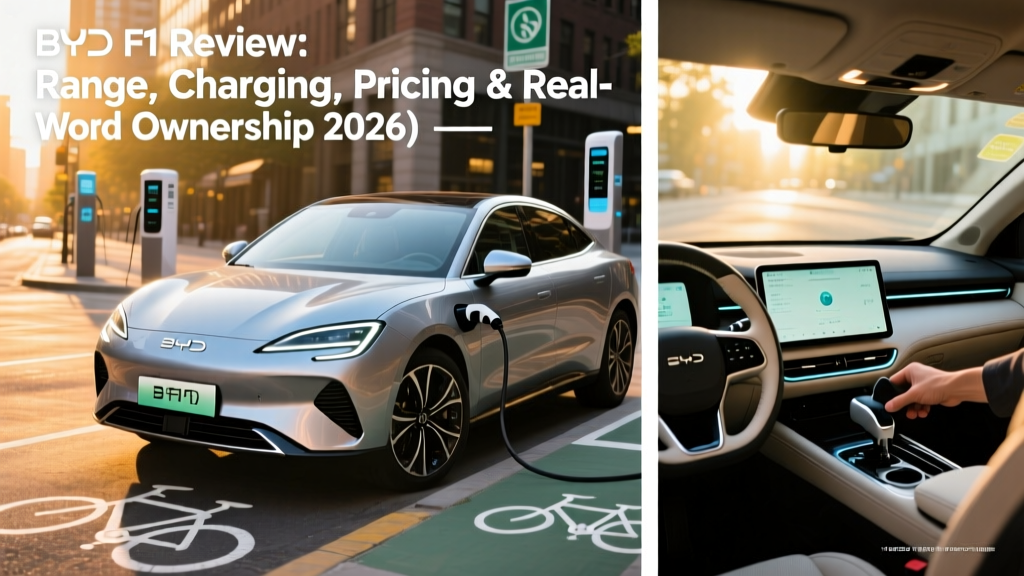
The BYD F1 is a compact electric hatchback that has drawn attention globally for its aggressive pricing and practical urban footprint. As one of BYD's entry-level EVs aimed at international markets, the F1 targets budget-conscious commuters who want a modern BEV without the premium price tag. But affordability only matters if the fundamentals — range, charging speed, battery longevity, and real-world usability — hold up under scrutiny. This review breaks down every spec that matters to an EV buyer in 2026.
Note on availability: The BYD F1 has been announced for select international markets as of early 2026. It is not currently sold in the United States due to existing tariffs on Chinese-manufactured vehicles and BYD's absence from the U.S. passenger-car market. This review covers global-market specifications and provides context for U.S. buyers watching BYD's expansion. All specs are based on BYD's published data and independent reporting; U.S.-specific figures (EPA certification, federal tax credit eligibility) remain unconfirmed pending any future U.S. launch.
BYD F1 Specifications at a Glance
| Specification | BYD F1 (Global Market) |
|---|---|
| Battery Capacity | ~58.5 kWh usable (LFP — Blade Battery) |
| Range (WLTP) | ~249 miles (400 km) |
| Range (Est. EPA-equivalent) | ~210–225 miles (unconfirmed) |
| Motor Output | ~150 kW (201 hp) front-mounted single motor |
| Drivetrain | Front-wheel drive (FWD) |
| 0–100 km/h (0–62 mph) | ~7.9 seconds |
| DC Fast Charging (Peak) | ~150 kW (CCS2/NACS TBD by market) |
| 10–80% DC Fast Charge | ~28 minutes (estimated) |
| Level 2 AC Charging | 11 kW onboard charger (~30 mi/hr) |
| Efficiency (WLTP) | ~14.5 kWh/100 km (~23.3 kWh/100 mi) |
| Cargo Volume | ~14.5 cu ft (rear seats up), ~42 cu ft (folded) |
| Length / Width / Height | ~169.3 in / 71.3 in / 60.6 in |
| Curb Weight | ~3,750 lbs |
| Base Price (Global) | ~$20,000–$24,000 USD equivalent (varies by market) |
| Battery Warranty | 8 years / 100,000 miles (global standard) |
Range: WLTP Numbers vs Real-World Expectations
The F1's LFP Blade Battery is a hallmark of BYD's lineup. Lithium iron phosphate (LFP) chemistry trades energy density for superior thermal stability, longer cycle life, and lower cost. That makes the F1 well-suited to daily commuting and frequent charge cycles — LFP cells tolerate regular 100% charges better than NMC, and BYD actually recommends periodic full charges to maintain cell balancing accuracy.
Where LFP falls short is cold-weather performance. Without an active heat pump (the F1 uses resistive cabin heating in most trims, though a heat pump option has been mentioned for higher-spec markets), winter range degradation can be significant. Budget 20–30% range loss in sub-freezing temperatures unless the battery is preconditioned before driving.
For urban commuters covering 30–50 miles per day, the F1's real-world range is more than adequate — you'll charge every 3–4 days on a typical commute cycle. Road trippers should plan charging stops every 160–180 miles to stay comfortable, factoring in the 10–80% fast-charge window.
Charging Speed: DC Fast and Home Level 2
| Charging Level | Power | Time / Rate |
|---|---|---|
| Level 1 (120V household) | ~1.4 kW | ~3–4 miles per hour; full charge in 40+ hours |
| Level 2 (240V home/public AC) | Up to 11 kW | ~28–30 miles per hour; 10–100% in ~6 hours |
| DC Fast Charging | Peak ~150 kW | 10–80% in ~28 minutes |
The F1's ~150 kW peak DC fast-charge rate is competitive for its class but not segment-leading. For context, the Hyundai Kona Electric peaks at around 100 kW, while the Chevrolet Bolt EUV tops out near 115 kW. The F1's advantage is its LFP battery's tolerance for sustained charge rates — LFP cells tend to hold higher kW deeper into the charge curve compared to NMC cells, which taper aggressively past 80% State of Charge (SoC).
That said, 150 kW is a peak number, not a sustained rate. Expect the F1 to charge at its maximum rate roughly between 10–50% SoC, then taper progressively. The 10–80% time of approximately 28 minutes is respectable for a compact EV in this price range, but it won't match the 18-minute 10–80% sprints of 800V-architecture vehicles like the Hyundai Ioniq 5 or Kia EV6.
At home on a Level 2 charger (240V, 48A circuit), the F1's 11 kW onboard charger replenishes the battery at roughly 28–30 miles of range per hour. A full charge from 10% takes about 5.5–6 hours — easily achievable overnight. For most owners, plugging in each evening and charging to 80–90% (or 100% periodically for LFP cell balancing) will be the standard routine.
Connector compatibility depends on market: European models use CCS2, while any future North American variant would likely adopt NACS (Tesla's connector, now the North American standard). BYD has not confirmed a NACS-equipped F1 for the U.S. market.
Performance and Driving Dynamics
The F1's front-mounted electric motor produces approximately 150 kW (201 hp) and routes power to the front wheels. The 0–62 mph (0–100 km/h) time of roughly 7.9 seconds places it squarely in the "adequately quick" category — not thrilling, but responsive enough for highway merging and city driving. Instant electric torque gives the F1 a punchy feel off the line that belies its modest power figure.
Ride quality in BYD's compact platform is tuned for comfort over sportiness. The suspension absorbs urban road imperfections well, and the low center of gravity from the underfloor Blade Battery pack keeps body roll reasonable through corners. Steering is light and direct — ideal for parking and city maneuvering, though it lacks the feedback enthusiasts might want on winding roads.
Regenerative braking offers multiple levels, including a strong regen mode that approximates one-pedal driving. BYD's implementation is smooth, with a gradual ramp-up rather than the abrupt deceleration some competitors deliver. The friction brakes blend in naturally when additional stopping power is needed.
No dual-motor or all-wheel-drive variant has been announced for the F1. If you need AWD capability for snow or rough terrain, you'll need to look at other models in BYD's lineup (like the Atto 3 / Yuan Plus) or competitors.
Interior, Cargo, and Technology
The F1's interior follows BYD's current design language: a large central touchscreen (12.8-inch rotating display on higher trims, fixed 10.1-inch on base), digital instrument cluster, and a relatively minimal physical button layout. Material quality is acceptable for the price point — soft-touch surfaces on the dashboard upper, harder plastics on the door panels and lower dash. It doesn't feel premium, but it doesn't feel cheap either.
Passenger space is adequate for four adults. Front legroom is generous at approximately 41 inches, while rear legroom sits around 35 inches — tight for tall passengers on longer trips but fine for city use. Headroom is good front and rear thanks to the hatchback roofline.
Cargo capacity is approximately 14.5 cubic feet behind the rear seats, expanding to roughly 42 cubic feet with the 60/40 split rear seats folded. That's competitive with the Nissan Leaf and slightly less than the Chevrolet Bolt EUV's 16.3 cu ft. The load floor is relatively flat, though there's no front trunk (frunk) — the space under the hood houses the motor and power electronics.
Standout tech features:
- BYD's DiLink infotainment system with over-the-air (OTA) updates
- Rotating center display (12.8-inch) that pivots between landscape and portrait orientation
- Wireless Apple CarPlay and Android Auto (on mid and upper trims)
- Vehicle-to-load (V2L) capability — power external devices from the traction battery
- 360-degree surround-view camera (upper trims)
- Wireless phone charging pad
Notable drawbacks:
- Driver-assistance suite is basic compared to U.S. competitors — adaptive cruise control and lane-centering are available but not as refined as GM's Super Cruise or Ford's BlueCruise
- No hands-free driving capability; this is a conventional SAE Level 1–2 assist system requiring full driver engagement
- Infotainment responsiveness can lag on the base 10.1-inch screen
- Rear visibility is compromised by thick C-pillars; the surround camera helps mitigate this
- No heat pump on base trims (resistive heating reduces winter efficiency)
Pricing, Trims, and Tax Credit Outlook
| Trim (Global Market) | Est. Price (USD Equivalent) | Key Features |
|---|---|---|
| Base / Comfort | ~$20,000 | 10.1" screen, basic ADAS, 150 kW motor, 58.5 kWh battery |
| Mid / Premium | ~$22,000 | 12.8" rotating screen, wireless CarPlay/AA, 360° camera, heat pump |
| Top / Flagship | ~$24,000 | All Premium features + panoramic roof, leatherette seats, V2L, premium audio |
In markets where the F1 is available (Southeast Asia, Latin America, parts of Europe and the Middle East), pricing starts at roughly $20,000 USD equivalent — positioning it as one of the most affordable new EVs globally. This is BYD's core competitive advantage: leveraging vertical integration (BYD manufactures its own batteries, semiconductors, and motors) to undercut competitors on price while maintaining acceptable quality.
U.S. Tax Credit (IRS §30D) Status: The BYD F1 does not currently qualify for the U.S. federal EV tax credit because BYD does not sell passenger vehicles in the United States. Even if the F1 were available in the U.S., it would face significant hurdles under §30D rules:
- Battery sourcing requirements: The F1's Blade Battery is manufactured by BYD in China. Under current §30D rules, vehicles with battery components from a "foreign entity of concern" (FEOC) — which includes Chinese manufacturers — are disqualified from the credit.
- Critical minerals: Similar FEOC restrictions apply to critical mineral sourcing for battery cathodes and anodes.
- MSRP caps: The F1's price would fall well under the $55,000 sedan cap, so MSRP is not the limiting factor.
- Income caps: Buyer AGI limits ($150K single / $300K joint) would apply if the vehicle were eligible.
For U.S. buyers, the F1 is a vehicle to watch rather than purchase. BYD has not announced plans to enter the U.S. passenger-car market, and current trade policy (including 100%+ tariffs on Chinese EVs) makes near-term entry unlikely. For more on federal EV tax credit rules, see the IRS Clean Vehicle Credits page.
Who Should Consider the BYD F1?
Competitive context: In global markets, the F1 competes against the MG4, Hyundai Kona Electric, and locally produced compact EVs. Its price advantage is substantial — undercutting most competitors by $5,000–$10,000 — but its charging speed, driver-assistance refinement, and cold-weather performance trail more established offerings. For buyers prioritizing lowest total cost of ownership in mild climates, the F1 is compelling. For those wanting the latest in fast-charging tech or advanced ADAS, competitors have an edge.
Warranty and Battery Longevity
BYD backs the F1's Blade Battery with an 8-year / 100,000-mile warranty (global standard; specific terms vary by market). The warranty covers battery capacity degradation below a specified threshold — typically 70% of original capacity, which is industry standard.
The LFP chemistry in the Blade Battery is one of its strongest ownership arguments. LFP cells are rated for 3,000+ full charge cycles before reaching 80% capacity retention — significantly more than typical NMC cells (1,000–2,000 cycles). In practical terms, that translates to well over 500,000 miles of equivalent driving before significant degradation, far exceeding the vehicle's likely service life. The F1's battery should easily outlast the car itself under normal use.
BYD's vehicle warranty varies by market but generally includes 6 years / 100,000 miles for the powertrain and 3–4 years / 60,000 miles for the bumper-to-bumper coverage. These terms are competitive but not class-leading — Hyundai's 10-year / 100,000-mile powertrain warranty in the U.S. remains the benchmark.
Frequently Asked Questions
What is the real-world range of the BYD F1?
The BYD F1 is rated at approximately 249 miles (400 km) under the WLTP cycle. Under EPA-equivalent testing, expect roughly 210–225 miles. In real-world highway driving, plan for 175–195 miles, and 150–170 miles in cold weather without battery preconditioning.
How fast does the BYD F1 charge?
On DC fast charging, the F1 peaks at approximately 150 kW, achieving a 10–80% charge in roughly 28 minutes. On a Level 2 home charger (240V), the 11 kW onboard charger adds about 28–30 miles of range per hour, with a full charge taking about 6 hours.
Does the BYD F1 qualify for the U.S. federal EV tax credit?
No. The BYD F1 is not currently sold in the United States, and even if it were, its Chinese-manufactured Blade Battery would likely disqualify it under §30D's foreign entity of concern (FEOC) battery-sourcing restrictions. See IRS §30D guidelines for current eligibility rules.
Is the BYD F1 worth buying over competitors?
In markets where it's available, the F1 offers the lowest entry price in the compact EV segment. If your priority is minimizing purchase cost and you drive primarily in mild climates with home charging access, it's a strong value pick. If you need faster charging, more range, advanced driver assists, or cold-weather capability, competitors like the Hyundai Kona Electric or MG4 may serve you better despite higher prices.
What are the biggest pros and cons of the BYD F1?
- Aggressive pricing — one of the cheapest new EVs globally
- LFP Blade Battery: exceptional cycle life and thermal safety
- Adequate range for daily commuting (210–225 mi est. EPA)
- V2L capability for powering external devices
- Comfortable ride quality for urban driving
- Not available in the U.S.; no federal tax credit eligibility
- DC fast charging at 150 kW trails segment leaders
- No heat pump on base trims — poor cold-weather efficiency
- Driver-assist tech is basic; no hands-free driving
- No AWD option
Will BYD sell the F1 in the United States?
As of 2026, BYD has not announced plans to sell passenger vehicles in the U.S. market. Current U.S. tariffs on Chinese-manufactured EVs (100%+) make importing vehicles like the F1 economically unviable. BYD is expanding manufacturing in other regions (Southeast Asia, Latin America, Europe) and has stated it is monitoring the U.S. market, but no timeline has been provided. For now, U.S. buyers should consider the F1 a benchmark for global EV pricing rather than a near-term purchase option.